answer.
Ask question
Login Signup
Ask question
All categories
  • English
  • Mathematics
  • Social Studies
  • Business
  • History
  • Health
  • Geography
  • Biology
  • Physics
  • Chemistry
  • Computers and Technology
  • Arts
  • World Languages
  • Spanish
  • French
  • German
  • Advanced Placement (AP)
  • SAT
  • Medicine
  • Law
  • Engineering
stiv31 [10]
2 years ago
10

Determine the number of valence electrons in POCl₃ and then draw the corresponding Lewis structure (by following the octet rule

on all atoms)

Chemistry
1 answer:
Aleks [24]2 years ago
3 0

Answer:

Valence electrons: P = 5, O =6, Cl = 7

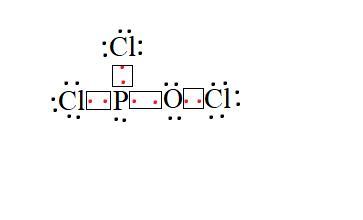
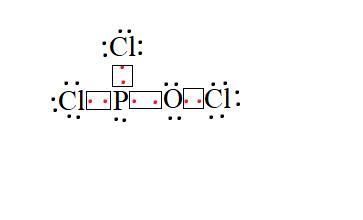
The Lewis structure is shown below.

Explanation:

To determine the number of valence electrons, we need to find the atom at the periodic table, because the group determines this. P is at group 15 (or 5A), so it has 5 valence electrons, O is at group 16 (or 6A) so it has 6 valence electrons, and Cl is at group 17 (or 7A) so it has 7 valence electrons.

To follow the octet rule, all the atoms must have 8 electrons in the valence shell, so, P must do 3 bonds, O two, and Cl one. So, the most likely formula is P with a single bond with O, and with two Cl, and the other Cl with a single bond with O.

There'll be 1 lone pair in P, 2 lone pairs in O, and 3 lone pairs in each Cl atom, as shown below.

The Lewis structure is done by placing the atoms with their valence electrons represented and then making the bonds, as shown below.
You might be interested in
A 100 mL reaction vessel initially contains 2.60×10^-2 moles of NO and 1.30×10^-2 moles of H2. At equilibrium the concentration
Sliva [168]

Answer:

<h2>The equilibrium constant Kc for this reaction is 19.4760</h2>

Explanation:

The volume of vessel used= 100 ml

Initial moles of NO= \frac{2.60}{10^2} moles

Initial moles of H2= \frac{1.30}{10^2} moles

Concentration of NO at equilibrium= 0.161M

Concentration(in M)=\frac{moles}{volume(in litre)}

Moles of NO at equilibrium= 0.161(\frac{100}{1000})

                                            =\frac{1.61}{10^2} moles


                    2H2 (g)        +    2NO(g) <—>    2H2O (g) +    N2 (g)

<u>Initial</u>          :1.3*10^-2          2.6*10^-2                0                   0        moles

<u>Equilibrium</u>:1.3*10^-2 - x     2.6*10^-2-x              x                   x/2     moles

∴\frac{2.60}{10^2}-x=\frac{1.61}{10^2}

⇒x=\frac{0.99}{10^2}

Kc=\frac{[H2O]^2[N2]}{[H2]^2[NO]^2} (volume of vesselin litre)

<u>Equilibrium</u>:0.31*10^-2      1.61*10^-2          0.99*10^-2        0.495*10^-2  moles

⇒Kc=\frac{(0.0099)^2(0.00495)}{(0.0031)^2(0.0161)^2}  (0.1)

⇒Kc=19.4760

3 0
2 years ago
Write the empirical formula of at least four binary ionic compounds that could be formed from the following ions: Ca2+, V5+, Br-
Jet001 [13]

Answer:

CaS, CaBr₂, VBr₅, and V₂S₅.

Explanation:

  • The ionic compound should be neutral; the overall charge of it is equal to zero.
  • Binary ionic compound is composed of two different ions.

<u>Ca²⁺ can combined with either Br⁻ or S²⁻ to form binary ionic compounds.</u>

  • CaS can be formed via combining Ca²⁺ with S²⁻ to form the neutral binary ionic compound CaS.
  • CaBr₂ can be formed via combining 1 mole of Ca²⁺ with 2 moles of Br⁻ to form the neutral binary ionic compound CaBr₂.

<u>V⁵⁺ can combined with either Br⁻ or S²⁻ to form binary ionic compounds.</u>

  • V₂S₅ can be formed via combining 2 moles of V⁵⁺ with 5 moles of S²⁻ to form the neutral binary ionic compound V₂S₅.
  • VBr₅ can be formed via combining 1 mole of V⁵⁺ with 5 moles of Br⁻ to form the neutral binary ionic compound VBr₅.

<em>So, the empirical formula of four binary ionic compounds that could be formed is: CaS, CaBr₂, VBr₅, and V₂S₅.</em>

<em></em>

5 0
2 years ago
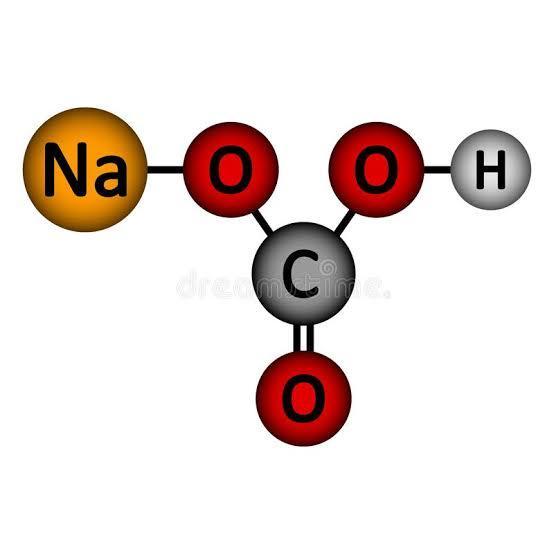
Two students are working together to build two models. Both models will represent the molecular structure of sodium bicarbonate,
otez555 [7]

Answer:

Each student will need;

1 red jelly bean, 1 white jelly bean, 1 black jelly bean and 3 red jelly beans.

Explanation:

Sodium bicarbonate molecule, NaHCO3, or baking soda is composed of the following:

1 atom of sodium, Na;

1 atom of hydrogen, H;

1 atom of carbon, C, and

3 atoms of oxygen.

For each of the models to be built by the two students, these atoms are to be represented accordingly.

Since Red jelly beans represent sodium atoms (Na), white jelly beans represent hydrogen atoms (H), black jelly beans represent carbon atoms (C), and blue jelly beans represent oxygen atoms (O), each student will need;

1 red jelly bean, 1 white jelly bean, 1 black jelly bean and 3 red jelly beans.

A sample model is found in the attachment below:

4 0
2 years ago
Which diatomic molecule is formed when the two atoms share six electrons
Leviafan [203]

The diatomic molecule that is formed when two atoms share six electrons is N2.

The atomic number of nitrogen is 7 and its electronic configuration is 2,5. This implies that, nitrogen has 5 electrons in its outermost shell. To attain the octet structure, it needs 3 electrons more. To form a diatomic molecule, two nitrogen atoms come together and each donate three electrons, which are equally shared between the two, thus, each ends up having 8 electrons in its outermost shell.

3 0
2 years ago
Read 2 more answers
The equilibrium constant, Kc, for the reaction H2 (g) + I2 (g) ⇄ 2HI (g) at 425°C is 54.8. A reaction vessel contains 0.0890 M H
Mars2501 [29]

Answer: The reaction is not at equilibrium and will proceed to make more products to reach equilibrium.

Explanation:  

Equilibrium constant is defined as the ratio of concentration of products to the concentration of reactants each raised to the power their stoichiometric ratios. It is expressed as K_{eq}

K is the constant of a certain reaction when it is in equilibrium, while Q is the reaction  quotient of activities of products and reactants at any stage other than equilibrium of a reaction.

For the given chemical reaction:

H_2(g)+I_2(g)\rightarrow 2HI(g)

The expression for Q is written as:

Q=\frac{[HI]^2}{[H_2]^1[I_2]^1}

Q=\frac{[0.0890]^2}{[0.215]^1[0.498]^1}

Q=0.074

Given : K_{eq} = 54.8

Thus as Q, the reaction will shift towards the right i.e. towards the product side.

4 0
2 years ago
Other questions:
  • In a blast furnace, elemental iron is produced from a mixture of coke (c), iron ore (fe3o4), and other reactants. an important r
    15·1 answer
  • In an experiment, 16.8 g of k2so4 was dissolved in 1.00 kg of water to make a solution. the freezing point of the solution was m
    11·1 answer
  • Give an example of each of the following: (a) a monatomic cation, (b) a monatomic anion, (c) a polyatomic cation,(d) a polyatomi
    6·1 answer
  • The sun shines with equal intensity on a farm field, an asphalt road, and the ocean. Which material will heat up most during the
    5·1 answer
  • To save time you can approximate the initial volume of water to ±1 mL and the initial mass of the solid to ±1 g. For example, if
    14·1 answer
  • A student adds 10.00 mL of a 2.0 M nitric acid solution to a 100.00 mL volumetric flask. Next, 50.00 mL of a 0.00500 M solution
    15·1 answer
  • Police often monitor traffic with "K-band" radar guns, which operate in the microwave region at 22.235 GHz (1 GHz = 109 Hz). Fin
    7·1 answer
  • In a lab, 33 g of potassium chloride is formed from 60.0 g of potassium chlorate decomposing. Calculate the theoretical yield an
    10·1 answer
  • How many moles are present in 2.126 g of H2O2 ?
    5·2 answers
  • Give an example of a rule of the natural world that a scientist can assume is always true.
    6·1 answer
Add answer
Login
Not registered? Fast signup
Signup
Login Signup
Ask question!