answer.
Ask question
Login Signup
Ask question
All categories
  • English
  • Mathematics
  • Social Studies
  • Business
  • History
  • Health
  • Geography
  • Biology
  • Physics
  • Chemistry
  • Computers and Technology
  • Arts
  • World Languages
  • Spanish
  • French
  • German
  • Advanced Placement (AP)
  • SAT
  • Medicine
  • Law
  • Engineering
Blababa [14]
2 years ago
12

A solar radiation flux of 700 W/m2 is absorbed in a metal plate that is perfectly insulated on the back surface. The convection

heat transfer coefficient may vary from 10 W/m2K up to 100
Calculate the temperature of the plate under equilibrium conditions.
Engineering
1 answer:
skad [1K]2 years ago
4 0

Answer:

The main solution to this problem is to note that under equilibrium conditions, the rate at which heat is transferred into the metal plate from the sun by radiation must be equal to the rate at which heat is lost from the plate to the surrounding air by convection.

Explanation:

Therefore, qᵃ = qᵇΔT

where

a = Radiation energy source

b = Convection energy source

ΔT = Tp - Ta = Temperature change between the plate and the air under equilibrium condition

Given,

qᵃ = 700 W/m2

qᵇ = 10 W/m2K - 100 W/m2K

Hence, for qᵇ = 10 W/m2K,

        ΔT = qᵃ / qᵇ

        ΔT = 700/10 = 70K

Similarly, for qᵇ = 100 W/m2K

              ΔT = 700/100 = 7K

The temperature change of the plate under equilibrium conditions range from 7K to 70K.

You might be interested in
How does Accenture generate value for clients through Agile and DevOps?
Nana76 [90]
By permanently locking in stakeholder requirements during a project's planning phase. -through highly detailed process documentation that is updated following every work cycle.
7 0
1 year ago
Read 2 more answers
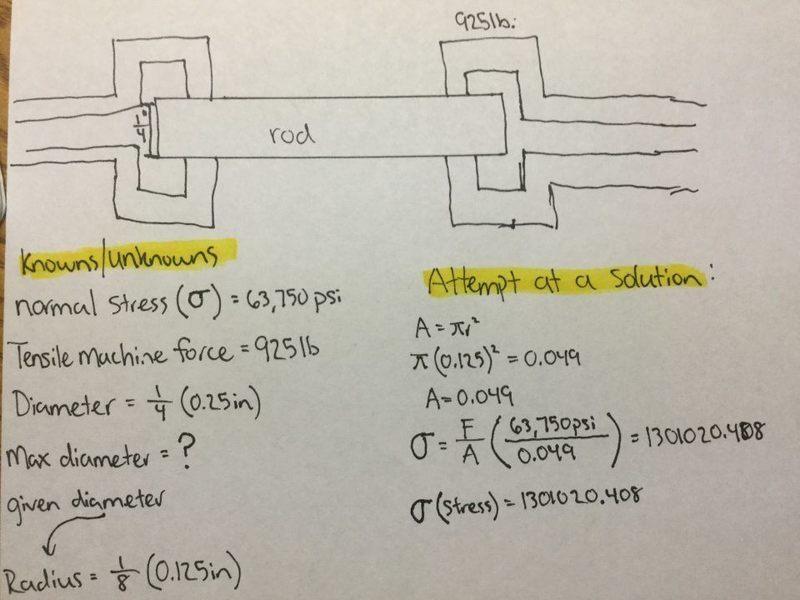
2. A ¼ in. diameter rod must be machined on a lathe to a smaller diameter for use as a specimen in a tension test. The rod mater
gladu [14]

Answer:

we use

sigma=force /area\\A=\pi r^2\\D=2*r

5 0
2 years ago
Determine F12 and F21 for the following configurations: (a) A long semicircular duct with diameter of 0.1 meters: (b) A hemisphe
uysha [10]

Answer:

long duct: 1.0 and 0.424

Hemisphere 1.0 ; 0.125; 0.5

Explanation:

For a long duct:

By inspection, F_{12} = 1.0

Calculating by reciprocity, F_{21} = \frac{A_{1} }{A_{2}F_{12}  }  = \frac{2RL}{\frac{3}{4}*2\pi RL  }* 1.0\\                                                         = 0.424

Hemisphere:

By reciprocity gives = 0.125

using the summation rule: F_{21} + F_{22} + F_{23} = 1

However, because this is a hemisphere, the value will be= 0.5 * 1

                                                                                               = 0.5

6 0
2 years ago
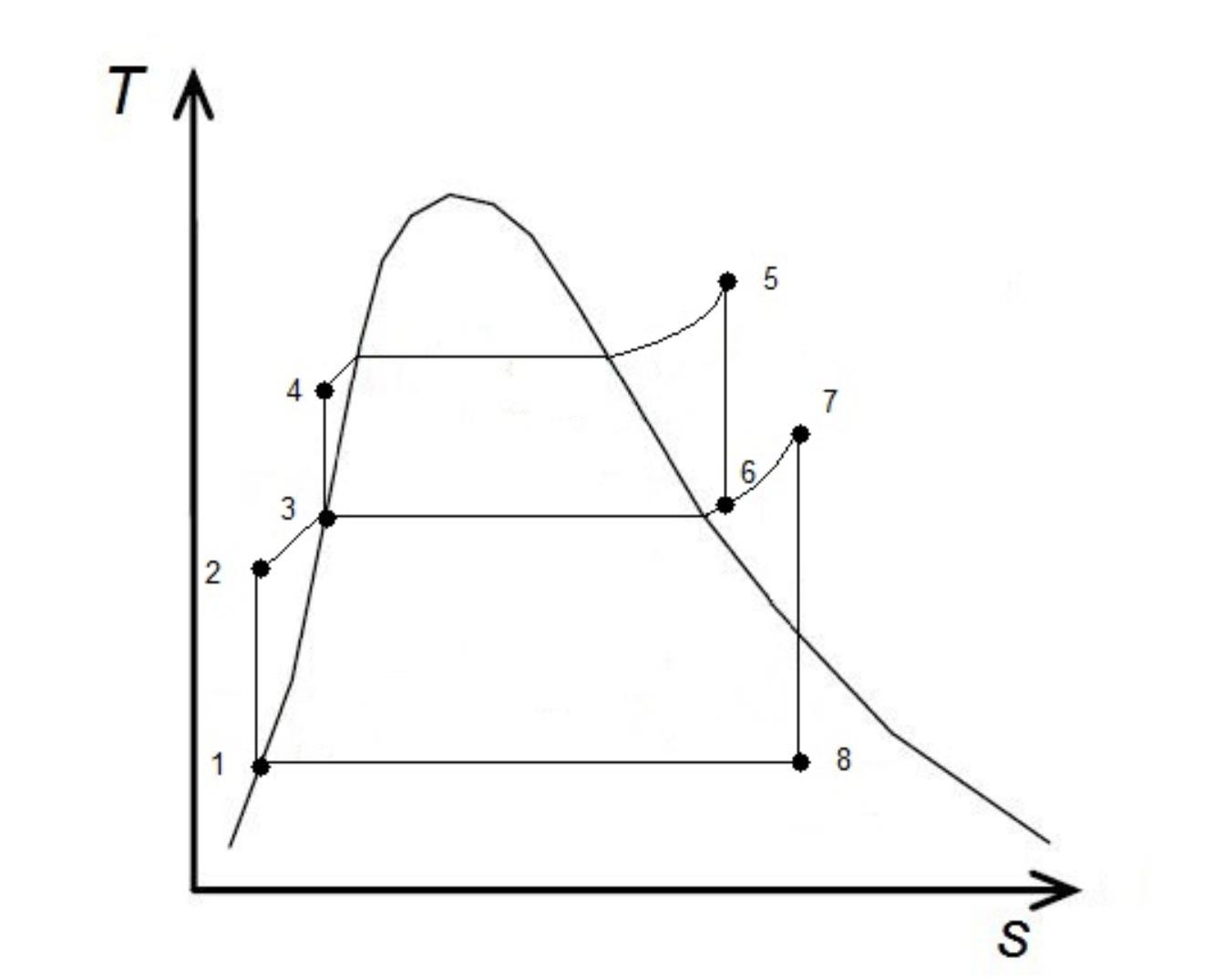
A steam power plant operates on an ideal reheat- regenerative Rankine cycle and has a net power output of 80 MW. Steam enters th
trasher [3.6K]

Answer:

flow(m) = 54.45 kg/s

thermal efficiency u = 44.48%

Explanation:

Given:

- P_1 = P_8 = 10 KPa

- P_2 = P_3 = P_6 = P_7 = 800 KPa

- P_4 = P_5 = 10,000 KPa

- T_5 = 550 C

- T_7 = 500 C

- Power Output P = 80 MW

Find:

-  The mass flow rate of steam through the boiler

-  The thermal efficiency of the cycle.

Solution:

State 1:

P_1 = 10 KPa , saturated liquid

h_1 = 192 KJ/kg

v_1 = 0.00101 m^3 / kg

State 2:

P_2 = 800 KPa , constant volume process work done:

h_2 = h_1 + v_1 * ( P_2 - P_1)

h_2 = 192 + 0.00101*(790) = 192.80 KJ/kg

State 3:

P_3 = 800 KPa , saturated liquid

h_3 = 721 KJ/kg

v_3 = 0.00111 m^3 / kg

State 4:

P_4 = 10,000 KPa , constant volume process work done:

h_4 = h_3 + v_3 * ( P_4 - P_3)

h_4 = 721 + 0.00111*(9200) = 731.21 KJ/kg

State 5:

P_5 = 10,000 KPa , T_5 = 550 C

h_5 = 3500 KJ/kg

s_5 = 6.760 KJ/kgK

State 6:

P_6 = 800 KPa , s_5 = s_6 = 6.760 KJ/kgK

h_6 = 2810 KJ/kg

State 7:

P_7 = 800 KPa , T_7 = 500 C

h_7 = 3480 KJ/kg

s_7 = 7.870 KJ/kgK

State 8:

P_8 = 10 KPa , s_8 = s_7 = 7.870 KJ/kgK

h_8 = 2490 KJ/kg

- Fraction of steam y = flow(m_6 / m_3).

- Use energy balance of steam bleed and cold feed-water:

                                        E_6 + E_2 = E_3

               flow(m_6)*h_6 + flow(m_2)*h_3 = flow(m_3)*h_3

                                    y*h_6 + (1-y)*h_3 = h_3

                                  y*2810 + (1-y)*192.8 = 721

Compute y:                          y = 0.2018

- Heat produced by the boiler q_b:

                             q_b = h_5 - h_4 +(1-y)*(h_7 - h_8)

                    q_b = 3500 -731.21 + ( 1 - 0.2018)*(3480 - 2810)

Compute q_b:               q_b = 3303.58 KJ/ kg

-Heat dissipated by the condenser q_c:

                                       q_c = (1-y)*(h_8 - h_1)

                                 q_c= ( 1 + 0.2018)*(2810 - 192)

Compute q_c:               q_c = 1834.26 KJ/ kg

- Net power output w_net:

                                     w_net = q_b - q_c

                                w_net = 3303.58 - 1834.26

                                    w_net = 1469.32 KJ/kg

- Given out put P = 80,000 KW

                                     flow(m) = P / w_net

compute flow(m)          flow(m) = 80,000 /1469.32 = 54.45 kg/s

- Thermal efficiency u:

                                     u = 1 - (q_c / q_b)

                                     u = 1 - (1834.26/3303.58)

                                     u = 44.48 %

5 0
2 years ago
1. A glass window of width W = 1 m and height H = 2 m is 5 mm thick and has a thermal conductivity of kg = 1.4 W/m*K. If the inn
emmasim [6.3K]

Answer:

1. \dot Q=19600\ W

2. \dot Q=120\ W

Explanation:

1.

Given:

  • height of the window pane, h=2\ m
  • width of the window pane, w=1\ m
  • thickness of the pane, t=5\ mm= 0.005\ m
  • thermal conductivity of the glass pane, k_g=1.4\ W.m^{-1}.K^{-1}
  • temperature of the inner surface, T_i=15^{\circ}C
  • temperature of the outer surface, T_o=-20^{\circ}C

<u>According to the Fourier's law the rate of heat transfer is given as:</u>

\dot Q=k_g.A.\frac{dT}{dx}

here:

A = area through which the heat transfer occurs = 2\times 1=2\ m^2

dT = temperature difference across the thickness of the surface = 35^{\circ}C

dx = t = thickness normal to the surface = 0.005\ m

\dot Q=1.4\times 2\times \frac{35}{0.005}

\dot Q=19600\ W

2.

  • air spacing between two glass panes, dx=0.01\ m
  • area of each glass pane, A=2\times 1=2\ m^2
  • thermal conductivity of air, k_a=0.024\ W.m^{-1}.K^{-1}
  • temperature difference between the surfaces, dT=25^{\circ}C

<u>Assuming layered transfer of heat through the air and the air between the glasses is always still:</u>

\dot Q=k_a.A.\frac{dT}{dx}

\dot Q=0.024\times 2\times \frac{25}{0.01}

\dot Q=120\ W

5 0
2 years ago
Other questions:
  • 3. (20 points) Suppose we wish to search a linked list of length n, where each element contains a key k along with a hash value
    7·1 answer
  • When a man returns to his well-sealed house on a summer day, he finds that the house is at 35°C. He turns on the air conditioner
    13·1 answer
  • A flexural member is fabricated from two flange plates 7-1/2 x ½ and a web plate 17 x 3/8. The yield stress of steel is 50 ksi.
    8·1 answer
  • "It is necessary to select a metal alloy for an application that requires a yield strength of at least 345 MPa (50,000 psi) whil
    10·1 answer
  • A dc shunt generator rated at 85 kW produces a voltage of 280 V. The brush voltage drop is 2.5 V, and the armature and field res
    6·1 answer
  • An airplane in level flight at an altitude h and a uniform speed v passes directly over a radar tracking station A. Calculate th
    5·1 answer
  • Complete the following sentence.
    5·1 answer
  • 11 Notează, în caiet, trăsăturile personajelor ce se pot
    13·1 answer
  • Who play 1v1 lol unblocked games 76
    8·2 answers
  • Why is data driven analytics of interest to companies?
    9·1 answer
Add answer
Login
Not registered? Fast signup
Signup
Login Signup
Ask question!