answer.
Ask question
Login Signup
Ask question
All categories
  • English
  • Mathematics
  • Social Studies
  • Business
  • History
  • Health
  • Geography
  • Biology
  • Physics
  • Chemistry
  • Computers and Technology
  • Arts
  • World Languages
  • Spanish
  • French
  • German
  • Advanced Placement (AP)
  • SAT
  • Medicine
  • Law
  • Engineering
saw5 [17]
2 years ago
14

A pipe in a district heating network is transporting over-pressurized hot water (10 atm) at a mass flow of 0.5 kg/s. The pipe is

5 m long, has an inner radius of 50 cm and pipe wall thickness of 50 mm. The pipe has a thermal conductivity of 20 W/m-K, and the inner pipe surface is at a uniform temperature of 110 ºC. The convection heat transfer coefficient of the air surrounding the pipe is 100W/m2 -K. The temperature of the water at inlet of pipe is 130 ºC and the constant pressure specific heat of hot water is 4000 J/kg-ºC. If the temperature of the air surrounding the pipe is 20 ºC, determine the exit temperature of the water at the end of the pipe.
Engineering
1 answer:
aivan3 [116]2 years ago
6 0

Answer:3.6 kg/s 14 w/m-k

Explanation:

You might be interested in
A 150-lbm astronaut took his bathroom scale (a spring scale) and a beam scale (compares masses) to the moon where the local grav
kozerog [31]

Answer:

a)Wt =25.68 lbf

b)Wt = 150 lbf

F= 899.59 N

Explanation:

Given that

g = 5.48 ft/s^2.

m= 150 lbm

a)

Weight on the spring scale(Wt) = m g

We know that

1\ lbf=32.17 \ lmb.ft/s^2

Wt = 150 x 5.48/32 lbf

Wt =25.68 lbf

b)

On the beam scale

This is scale which does not affects by gravitational acceleration.So the wight on the beam scale will be 150 lbf.

Wt = 150 lbf

If the plane is moving upward with acceleration 6 g's then the for F

F = m a

We know that

1\ ft/s^2= 0.304\ m/s^2

5.48\ ft/s^2= 1.66\ m/s^2

a=6 g's

a=9.99\ m/s^2

So

F = 90 x 9.99 N

F= 899.59 N

3 0
2 years ago
Given an array of words representing your dictionary, you test words to see if it can be made into another word in dictionary. T
katen-ka-za [31]

Answer:

Detailed solution is given below:

8 0
2 years ago
An adiabatic gas turbine expands air at 1300 kPa and 500◦C to 100 kPa and 127◦C. Air enters the turbine through a 0.2-m2 opening
Viktor [21]

Given:

Pressure, P_{1} = 1300 kPa

Temperature,  T_{1} = 500^{\circ}

P_{2} = 100 kPa

T_{2} = 127^{\circ}  

velocity, v = 40 m/s

A = 1m^{2}

Solution:

For air propertiess at

P_{1} = 1300 kPa

T_{1} = 500^{\circ}

h_{1} = 793kJ/K

v_{1} = 0.172\frac{m^{3}}{kg}

and also at

P_{2} = 100 kPa

T_{2} = 127^{\circ}  

h_{2} = 401 KJ/K

v_{2} =  1.15\frac{m^{3}}{kg}

a) Mass flow rate is given by:

m' = \frac{Av}{v_{1}}

Now,

m = \frac{0.2\times 40}{0.172} = 46.51 kg/s

b) for the power produced by turbine, P = m'(h_{1} - h_{2})

P = 46.51\times(793 - 401) = 18.231 MW

5 0
2 years ago
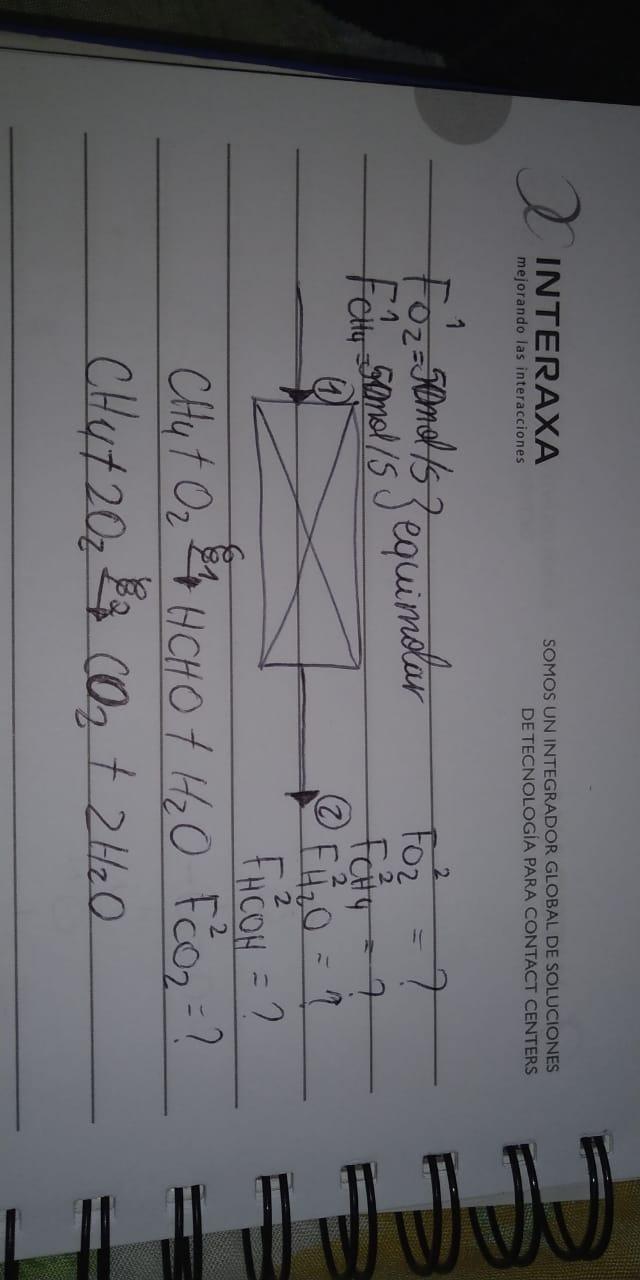
Methane and oxygen react in the presence of a catalyst to form formaldehyde. In a parallel reaction, methane is oxidized to carb
Nezavi [6.7K]

Answer:

y_{CH_4}^2=\frac{5mol/s}{100mol/s}=0.05\\y_{O_2}^2=\frac{3mol/s}{100mol/s}=0.03\\y_{H_2O}^2=\frac{47mol/s}{100mol/s}=0.47\\y_{HCHO}^2=\frac{43mol/s}{100mol/s}=0.43\\y_{CO_2}^2=\frac{2mol/s}{100mol/s}=0.02

Explanation:

Hello,

a. On the attached document, you can see a brief scheme of the process. Thus, to know the degrees of freedom, we state the following unknowns:

- \xi_1 and \xi_2: extent of the reactions (2).

- F_{O_2}^2, F_{CH_4}^2, F_{H_2O}^2, F_{HCHO}^2 and F_{CO_2}^2: Molar flows at the second stream (5).

On the other hand, we've got the following equations:

- F_{O_2}^2=50mol/s-\xi_1-2\xi_2: oxygen mole balance.

- F_{CH_4}^2=50mol/s-\xi_1-\xi_2: methane mole balance.

- F_{H_2O}^2=\xi_1+2\xi_2: water mole balance.

- F_{HCHO}^2=\xi_1: formaldehyde mole balance.

- F_{CO_2}^2=\xi_2: carbon dioxide mole balance.

Thus, the degrees of freedom are:

DF=7unknowns-5equations=2

It means that we need two additional equations or data to solve the problem.

b. Here, the two missing data are given. For the fractional conversion of methane, we define:

0.900=\frac{\xi_1+\xi_2}{50mol/s}

And for the fractional yield of formaldehyde we can set it in terms of methane as the reagents are equimolar:

0.860=\frac{F_{HCHO}^2}{50mol/s}

In such a way, one realizes that the output formaldehyde's molar flow is:

F_{HCHO}^2=0.860*50mol/s=43mol/s

Which is equal to the first reaction extent \xi_1, therefore, one computes the second one from the fractional conversion of methane as:

\xi_2=0.900*50mol/s-\xi_1\\\xi_2=0.900*50mol/s-43mol/s\\\xi_2=2mol/s

Now, one computes the rest of the output flows via:

- F_{O_2}^2=50mol/s-43mol/s-2*2mol/s=3mol/s

- F_{CH_4}^2=50mol/s-43mol/s-2mol/s=5mol/s

- F_{H_2O}^2=43mol/s+2*2mol/s=47mol/s

- F_{HCHO}^2=43mol/s

- F_{CO_2}^2=2mol/s

The total output molar flow is:

F_{O_2}+F_{CH_4}+F_{H_2O}+F_{HCHO}+F_{CO_2}=100mol/s

Therefore the output stream composition turns out into:

y_{CH_4}^2=\frac{5mol/s}{100mol/s}=0.05\\y_{O_2}^2=\frac{3mol/s}{100mol/s}=0.03\\y_{H_2O}^2=\frac{47mol/s}{100mol/s}=0.47\\y_{HCHO}^2=\frac{43mol/s}{100mol/s}=0.43\\y_{CO_2}^2=\frac{2mol/s}{100mol/s}=0.02

Best regards.

7 0
2 years ago
Superheated steam at an average temperature 200 C is transported through a steel pipe (k=50 W/mK, D_0=8.0 cm,D_i=6.0 cm,and L=20
Zarrin [17]

The total amount of daily heat transfer is 1382.38 M w.

The temperature on the outside surface of the gypsum plaster insulation is 17.96 ° C.

<u>Explanation:</u>

Given data,

T_{\infty} = 10° C

h_{0} = 250 w/ m^{2} k

Pipe length = 20 m

Inner diameter d_{1} = 6 cm, r_{1} = 3 cm

Outer diameter d_{2} = 8 cm, r_{2} = 4 cm

The thickness of insulation is 4 cm.

r_{3} = r_{2} + 4

= 4+4

r_{3} = 8 cm

h_{0} is the heat transfer coefficient of  convection inside, h_{i} is the heat transfer coefficient of  convection outside.

The heat transfer rate between ambient and steam is

q=\frac{T_{S}-T_{\infty}}{\frac{1}{h_{i}\left(2 \pi r_{1} L\right)}+\frac{\ln \left(r_{2} / r_{1}\right)}{2 \pi K_{1} L}+\frac{\ln \left(r_{3}/ r_{2}\right)}{2 \pi K_{2} L}+\frac{1}{h_{0}\left(2 \pi r_{3} L\right)}} watt

=  \begin{aligned}&\frac{1}{800(2 \pi x \cdot 03 \times 20)}\++\frac{\ln (4 / 3)}{2 \pi \times 50 \times 20}+\frac{\ln (8 / 4)}{2 \pi \times 0.5 \times 20}+\frac{1}{200(2 \pi x \cdot 08 \times 20)}\end{aligned} watt

= \frac{190}{0.0003317+0.0000458+0.0110+0.0004976} watt

q = 15999.86 watt

The total amount of daily heat transfer = 15999.86 × 86400

= 1382.387904 watt

= 1382.38 M w

The total amount of daily heat transfer is 1382.38 M w.

b) The temperature on the outside surface of the gypsum plaster insulation.

q = \frac{T_{3}-T_{\infty}}{\frac{1}{\ln \left(2 \pi \ r_{3} L\right)}}

15999.86   =\frac{\frac{1}{T_3}-10}{\frac{1}{200(2 \pi . 08 \times 20)}}

T_{3} - 10 = 7.96

T_{3} = 17.96 ° C.

4 0
2 years ago
Other questions:
  • Radioactive wastes are temporarily stored in a spherical container, the center of which is buried a distance of 10 m below the e
    13·1 answer
  • A 60-kg woman holds a 9-kg package as she stands within an elevator which briefly accelerates upward at a rate of g/4. Determine
    14·1 answer
  • Water at 400 kPa with a quality of 75% has its pressure raised 200 kPa (to 600 kPa) in a constant volume process. What is the ne
    15·1 answer
  • PDAs with two stacks are strictly more powerful than PDAs with one stack. Prove that 2-stack PDAs are not a valid model for CFLs
    12·1 answer
  • A circular ceramic plate that can be modeled as a blackbody is being heated by an electrical heater. The plate is 30 cm in diame
    15·1 answer
  • The basic barometer can be used to measure the height of a building. If the barometric readings at the top and the bottom of a b
    15·1 answer
  • The velocity of a particle which moves along the s-axis is given by v = 2-4t+5t^(3/2), where t is in seconds and v is in meters
    11·2 answers
  • Vehicles arrive at a single toll booth beginning at 8:00 A.M. They arrive and depart according to a uniform deterministic distri
    9·1 answer
  • The procedure for determining the presence of Non-Condensable Gasses in refrigerant contained in an external recovery tank utili
    5·2 answers
  • The velocity distribution for laminar flow between parallel plates is given by u umax = 1 − ( 2y h ) 2 Where h is the distance s
    15·1 answer
Add answer
Login
Not registered? Fast signup
Signup
Login Signup
Ask question!