answer.
Ask question
Login Signup
Ask question
All categories
  • English
  • Mathematics
  • Social Studies
  • Business
  • History
  • Health
  • Geography
  • Biology
  • Physics
  • Chemistry
  • Computers and Technology
  • Arts
  • World Languages
  • Spanish
  • French
  • German
  • Advanced Placement (AP)
  • SAT
  • Medicine
  • Law
  • Engineering
dmitriy555 [2]
2 years ago
3

what mass of aluminum hydroxide is needed to decompose in order to produce aluminum oxide and 35 L of water at STP

Chemistry
1 answer:
miss Akunina [59]2 years ago
4 0

The mass of aluminium hydroxide is 81.12 g.

<u>Explanation:</u>

The chemical equation for the decomposition of Aluminium hydroxide follows:

                    2 Al(OH)3 ------> Al2O3 + 3H2O

At STP:

22.4 L of volume is occupied by 1 mole of a gas.

So, 35 L of the  volume will be occupied by = (1 / 22.4) \times 35 = 1.56 mol

By Stoichiometry of the reaction:

3 moles of water is produced by 2 moles of Aluminium hydroxide

So, 1.56 moles of water is produced by = (2 /3) \times 1.56 = 1.04 mol.

To calculate the mass of Aluminium hydroxide, we use the equation:

         Number of moles = given mass / molar mass

Number of moles of Aluminium hydroxide = 1.04 mol

The Molar mass of Aluminium hydroxide = 78 g/mol

Putting values in above equation, we get:

           1.04 mol = mass of Aluminium hydroxide / 78

The mass of Aluminium hydroxide needed is 81.12 grams.

You might be interested in
A 0.050 M solution of AlCl3 had an observed osmotic pressure of 3.85 atmatm at 20°C.Calculate the van't Hoff factor iii for AlCl
Alja [10]

Answer:

The actual Van't Hoff factor for AlCl3 is 3.20

Explanation:

Step 1: Data given

Molarity of AlCl3 = 0.050 M

osmotic pressure = 3.85 atm

Temperature = 20 °C

Step 2: Calculate the Van't Hoff factor

AlCl3(aq) → Al^3+(aq) + 3Cl^-(aq)

The theoretical value is 4 ( because 1 Al^3+ ion + 3 Cl- ions) BUT due to the interionic atractions the actual value will be less

Osmotic pressure depends on the molar concentration of the solute but not on its identity., and is calculated by:

π = i.M.R.T

 ⇒ with π = the osmotic pressure = 3.85 atm

⇒ with i = the van't Hoff factor

⇒ with M = the molar concentration of the solution = 0.050 M

⇒ with R = the gas constant = 0.08206 L*atm/K*mol

⇒ with T = the temperature = 20 °C = 293.15 Kelvin

i = π /(M*R*T )

i = (3.85) / (0.050*0.08206*293.15)

i = 3.20

The actual Van't Hoff factor is 3.20

6 0
2 years ago
When an aldose reacts with Barfoed's reagent, what type of organic compound forms? What type of chemical is this?
Fudgin [204]
Barfoed's test is a concoction test utilized for identifying the nearness of monosaccharides. It depends on the diminishment of copper(II) acetic acid derivation to copper(I) oxide (Cu2O), which frames a block red hasten. 
Barfoed's reagent comprises of a 0.33 molar arrangement of unbiased copper acetic acid derivation in 1% acidic corrosive arrangement. The reagent does not keep well and it is, thusly, fitting to make it up when it is really required. May store uncertainly as per a few MSDS's.
7 0
2 years ago
Read 2 more answers
Which of the following reactions are possible if sodium is more reactive than aluminum, 3 iron, and lead?
Deffense [45]

Answer:

Reaction I: Sodium + Aluminum chloride →Sodium chloride + Aluminum

Explanation:

Sodium being more reactive means that it will take the place of aluminium in whats called a displacement reaction and form.

Sodium chloride + Aluminum

8 0
2 years ago
Read 2 more answers
If the mass percentage composition of a compound is 72.1% Mn and 27.9% O, its empirical formula is
mojhsa [17]

Answer:

MnO- Manganese Oxide

Explanation:

Empirical formula: This is the formula that shows the ratio of elements

present in a  

compound.


How to determine Empirical formula

1. First arrange the symbols of the elements present in the compound

alphabetically to  determine the real empirical formula. Although, there

are exceptions to this rule, E.g H2So4

2. Divide the percentage composition by the mass number.

3. Then divide through by the smallest number.

4. The resulting answer is the ratio attached to the elements present in

a compound.


                                                                              Mn                         O    


% composition                                                      72.1                      27.9    


Divide by mass number                                       54.94                     16  


                                                                               1.31                      1.74    


Divide by the smallest number                         1.31                      1.31                          

                                                                               1                    1.3


The resulting ratio is 1:1


Hence the Empirical formula is MnO, Manganese oxide

8 0
2 years ago
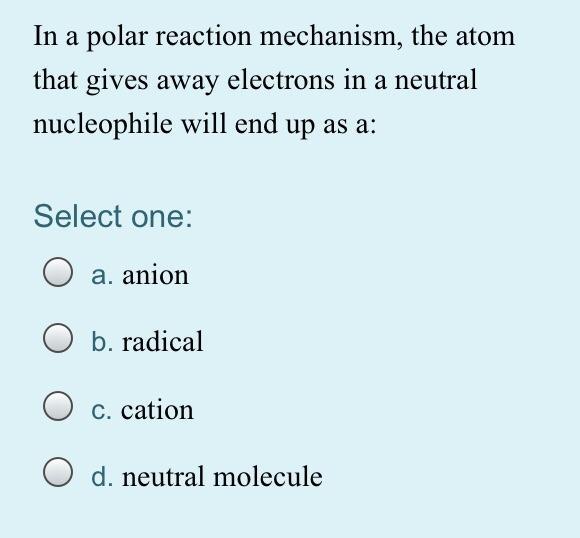
In a polar reaction mechanism, the atom that gives away electrons in a neutral nucleophile will end up as a(n):
Ray Of Light [21]

The question is incomplete, the complete question is shown in the image attached.

Answer:

Cation

Explanation:

In a polar reaction mechanism, a specie must give out electrons and another specie must accept those electrons.

The specie that gives out electrons becomes electron deficient and positively charged so we refer to such a specie as a cation.

Hence, the specie that looses electrons becomes a cation.

5 0
2 years ago
Other questions:
  • Which changes occur when Pt2+ is reduced?
    10·2 answers
  • When you open a bottle of a soft drink and leave it open, the drink eventually goes flat. this happens because the equilibrium b
    6·1 answer
  • Which indicator would be the best to use for a titration between 0.20 m hi with 0.10 m ba(oh)2? you will probably need to consul
    5·2 answers
  • Write a balanced half-reaction describing the reduction of aqueous chromium(IV) cations to solid chromium.
    13·1 answer
  • Why is liquid mercury a good electrical conductor in terms of atomic structure?
    8·2 answers
  • Aluminum–lithium (Al–Li) alloys have been developed by the aircraft industry to reduce the weight and improve the performance of
    8·1 answer
  • What we call "tin cans" are really iron cans coated with a thin layer of tin. The anode is a bar of tin and the cathode is the i
    13·1 answer
  • A sample of helium gas has a volume of 0.180L, a pressure of 0.800a and a temperature of 29 C. What is the new temp or gas of vo
    12·1 answer
  • Calculate the amount, in moles, of PO43- present at equilibrium when excess Sr3(PO4)2 is added to 750. mL 1.2 M Sr(NO3)2(aq). As
    13·1 answer
  • 1-chloro-4-methyl-2-pentene undergoes hydrolysis in warm water to give a mixture of 4-methyl-2-penten-1-ol and 4-methyl-1-penten
    11·1 answer
Add answer
Login
Not registered? Fast signup
Signup
Login Signup
Ask question!