answer.
Ask question
Login Signup
Ask question
All categories
  • English
  • Mathematics
  • Social Studies
  • Business
  • History
  • Health
  • Geography
  • Biology
  • Physics
  • Chemistry
  • Computers and Technology
  • Arts
  • World Languages
  • Spanish
  • French
  • German
  • Advanced Placement (AP)
  • SAT
  • Medicine
  • Law
  • Engineering
White raven [17]
2 years ago
10

For flow over a plate, the variation of velocity with vertical distance y from the plate is given as u(y) = ay − by2 where a and

b are constants. Choose the correct relation for the wall shear stress in terms of a, b, and μ.
Engineering
1 answer:
lesantik [10]2 years ago
8 0
Bruh bruh bruh bruh bruh bruh
You might be interested in
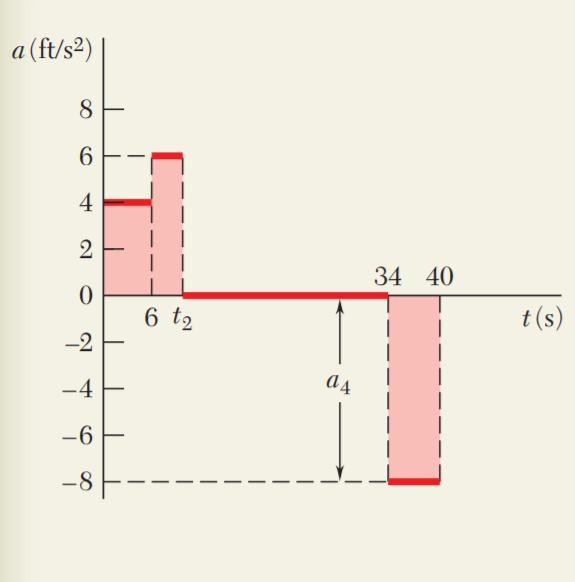
A subway car leaves station A; it gains speed at the rate of 4 ft/s^2 for of until it has reached and then at the rate 6 then th
salantis [7]

Answer:

See attachment

1512 ft

Explanation:

Since the acceleration is either constant or zero,  the a−t curve is made of horizontal straight-line segments. The values of t2  and a4 are determined as follows:

Acceleration - Time

0 < t < 6: Change in v = area under a–t curve

V_6 - 0 =  (6 s)(4 ft/s2 ) = 24 ft/s

6 < t < t2: Since the velocity increases from 24 to 48 ft/s,

Change in v = area under a–t curve

48 - 24 = (t2 - 6) * 6

t2 = 10 s

t2 < t < 34: Since the velocity is constant, the acceleration is zero.

34 < t < 40: Change in v = area under a–t curve

0 - 42 = 6*a4

a4 = - 8 ft / s^2

The acceleration being negative, the corresponding area is below the t axis;  this area represents a decrease in velocity.

Velocity - Time

Since the acceleration is either constant or zero, the  v−t curve is made of straight-line segments connecting the points determined above.

Change in x = area under v−t curve

0 < t < 6:     x6 - 0 = 0.5*6*24 = 72 ft

6 < t < 10:    x10 - x6 = 0.5*4*(24 + 48) = 144 ft

10 < t < 34:     x34 - x10 = 48*24 = 1152 ft

34 < t < 40:     x40 - x34 = 0.5*6*48 = 144 ft

Adding the changes in x, we obtain the distance from A to B:

d = x40 - 0 = 1512 ft

8 0
2 years ago
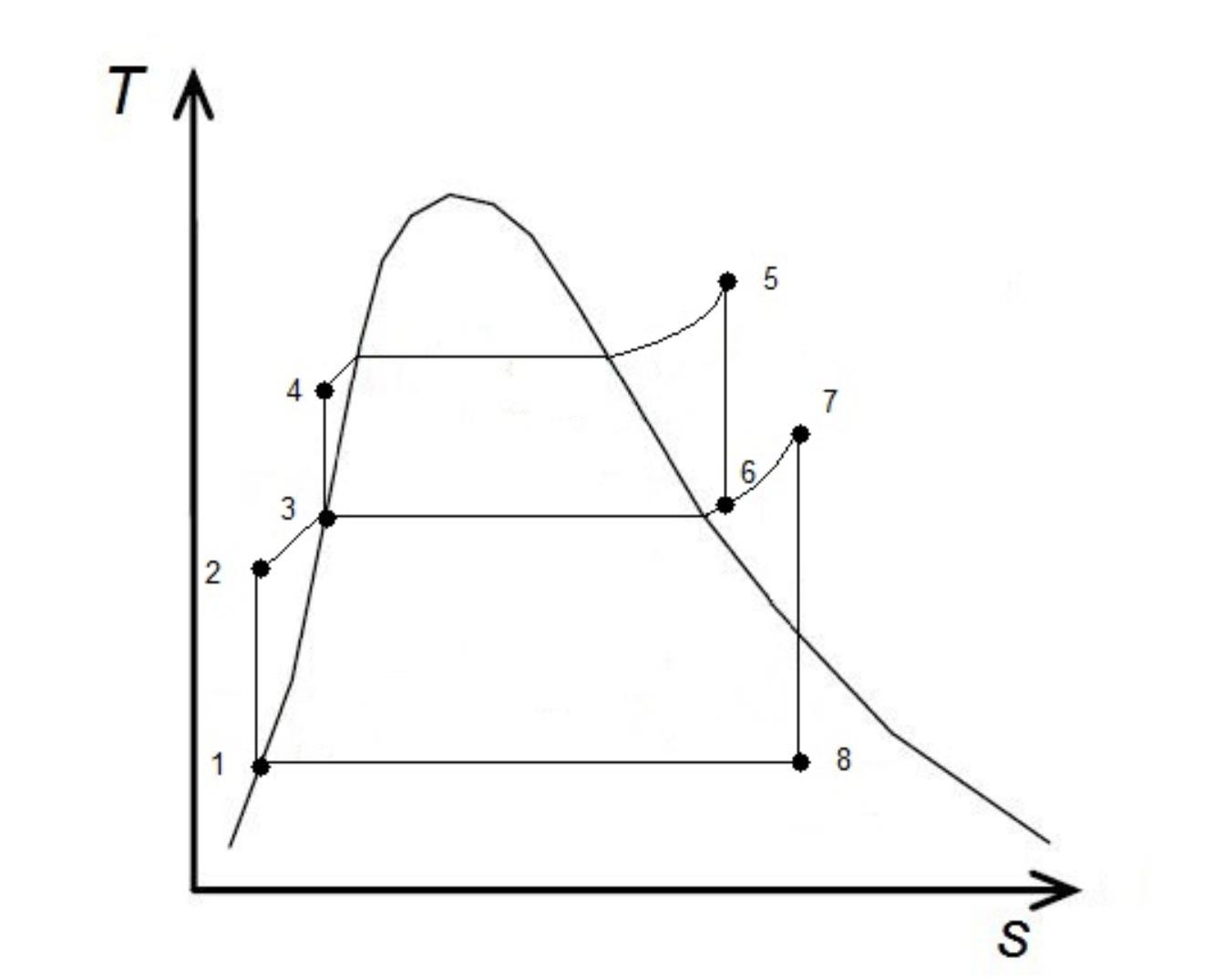
A steam power plant operates on an ideal reheat- regenerative Rankine cycle and has a net power output of 80 MW. Steam enters th
trasher [3.6K]

Answer:

flow(m) = 54.45 kg/s

thermal efficiency u = 44.48%

Explanation:

Given:

- P_1 = P_8 = 10 KPa

- P_2 = P_3 = P_6 = P_7 = 800 KPa

- P_4 = P_5 = 10,000 KPa

- T_5 = 550 C

- T_7 = 500 C

- Power Output P = 80 MW

Find:

-  The mass flow rate of steam through the boiler

-  The thermal efficiency of the cycle.

Solution:

State 1:

P_1 = 10 KPa , saturated liquid

h_1 = 192 KJ/kg

v_1 = 0.00101 m^3 / kg

State 2:

P_2 = 800 KPa , constant volume process work done:

h_2 = h_1 + v_1 * ( P_2 - P_1)

h_2 = 192 + 0.00101*(790) = 192.80 KJ/kg

State 3:

P_3 = 800 KPa , saturated liquid

h_3 = 721 KJ/kg

v_3 = 0.00111 m^3 / kg

State 4:

P_4 = 10,000 KPa , constant volume process work done:

h_4 = h_3 + v_3 * ( P_4 - P_3)

h_4 = 721 + 0.00111*(9200) = 731.21 KJ/kg

State 5:

P_5 = 10,000 KPa , T_5 = 550 C

h_5 = 3500 KJ/kg

s_5 = 6.760 KJ/kgK

State 6:

P_6 = 800 KPa , s_5 = s_6 = 6.760 KJ/kgK

h_6 = 2810 KJ/kg

State 7:

P_7 = 800 KPa , T_7 = 500 C

h_7 = 3480 KJ/kg

s_7 = 7.870 KJ/kgK

State 8:

P_8 = 10 KPa , s_8 = s_7 = 7.870 KJ/kgK

h_8 = 2490 KJ/kg

- Fraction of steam y = flow(m_6 / m_3).

- Use energy balance of steam bleed and cold feed-water:

                                        E_6 + E_2 = E_3

               flow(m_6)*h_6 + flow(m_2)*h_3 = flow(m_3)*h_3

                                    y*h_6 + (1-y)*h_3 = h_3

                                  y*2810 + (1-y)*192.8 = 721

Compute y:                          y = 0.2018

- Heat produced by the boiler q_b:

                             q_b = h_5 - h_4 +(1-y)*(h_7 - h_8)

                    q_b = 3500 -731.21 + ( 1 - 0.2018)*(3480 - 2810)

Compute q_b:               q_b = 3303.58 KJ/ kg

-Heat dissipated by the condenser q_c:

                                       q_c = (1-y)*(h_8 - h_1)

                                 q_c= ( 1 + 0.2018)*(2810 - 192)

Compute q_c:               q_c = 1834.26 KJ/ kg

- Net power output w_net:

                                     w_net = q_b - q_c

                                w_net = 3303.58 - 1834.26

                                    w_net = 1469.32 KJ/kg

- Given out put P = 80,000 KW

                                     flow(m) = P / w_net

compute flow(m)          flow(m) = 80,000 /1469.32 = 54.45 kg/s

- Thermal efficiency u:

                                     u = 1 - (q_c / q_b)

                                     u = 1 - (1834.26/3303.58)

                                     u = 44.48 %

5 0
2 years ago
A curve in a speed track has a radius of 1000 ft and a rated speed of 120 mi/h. (From Sample Prob. 12.7 is the definition of rat
forsale [732]

Answer:

tan \theta = \frac{(176ft/s)^2}{1000 ft 32.2 ft/s^2}= 0.962

\theta = tan^{-1} (0.962) = 43.89

Explanation:

If the question is: Determine the banking angle θ

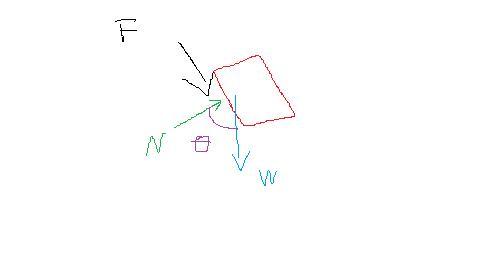
We have the forces involved on the figure attached.

For this case we know that the weight is given by:

W = mg

And for this case the centripetal acceleration would be given by:

a=\frac{v^2}{r}

If we analyze the sum of forces on x and y we have:

\sum F_x = m a_x

F + W sin \theta = ma cos theta

And if we solve for the force we got:

F = ma cos \theta - mg sin \theta = \frac{mv^2}{r} cos \theta - mg sin \theta

\sum F_y = m a_y

N - W cos \theta = ma sin \theta

If we solve for the normal force we got:

N =W cos \theta + ma sin \theta = \frac{mv^2}{r} sin \theta + mg cos \theta

In order to find the banking angle we use the fact that F =0

0 = \frac{mv^2}{r} cos \theta - mg sin \theta

tan \theta= \frac{v^2}{rg}

The velocity on this case is 120 mi/h if we convert this into ft/ s we got:

120 mi/h * \frac{5280 ft}{1mi} *\frac{1hr}{3600 s}= 176 ft/s

And then we have this:

tan \theta = \frac{(176ft/s)^2}{1000 ft 32.2 ft/s^2}= 0.962

\theta = tan^{-1} (0.962) = 43.89

5 0
2 years ago
Determine the angular acceleration of the uniform disk if (a) the rotational inertia of the disk is ignored and (b) the inertia
lukranit [14]

Answer:

α = 7.848 rad/s^2  ... Without disk inertia

α = 6.278 rad/s^2  .... With disk inertia

Explanation:

Given:-

- The mass of the disk, M = 5 kg

- The right hanging mass, mb = 4 kg

- The left hanging mass, ma = 6 kg

- The radius of the disk, r = 0.25 m

Find:-

Determine the angular acceleration of the uniform disk without and with considering the inertia of disk

Solution:-

- Assuming the inertia of the disk is negligible. The two masses ( A & B )  are hung over the disk in a pulley system. The disk is supported by a fixed support with hinge at the center of the disk.

- We will make a Free body diagram for each end of the rope/string ties to the masses A and B.

- The tension in the left and right string is considered to be ( T ).

- Apply newton's second law of motion for mass A and mass B.

                      ma*g - T = ma*a

                      T - mb*g = mb*a

Where,

* The tangential linear acceleration ( a ) with which the system of two masses assumed to be particles move with combined constant acceleration.

- g: The gravitational acceleration constant = 9.81 m/s^2

- Sum the two equations for both masses A and B:

                      g* ( ma - mb ) = ( ma + mb )*a

                      a =  g* ( ma - mb ) / ( ma + mb )

                      a = 9.81* ( 6 - 4 ) / ( 6 + 4 ) = 9.81 * ( 2 / 10 )

                      a = 1.962 m/s^2  

- The rope/string moves with linear acceleration of ( a ) which rotates the disk counter-clockwise in the direction of massive object A.

- The linear acceleration always acts tangent to the disk at a distance radius ( r ).

- For no slip conditions, the linear acceleration can be equated to tangential acceleration ( at ). The correlation between linear-rotational kinematics is given below :

                     a = at = 1.962 m/s^2

                     at = r*α      

Where,

           α: The angular acceleration of the object ( disk )

                    α = at / r

                    α = 1.962 / 0.25

                    α = 7.848 rad/s^2                                

- Take moments about the pivot O of the disk. Apply rotational dynamics conditions:


                Sum of moments ∑M = Iα

                 ( Ta - Tb )*r = Iα

- The moment about the pivots are due to masses A and B.


               Ta: The force in string due to mass A

               Tb: The force in string due to mass B

                I: The moment of inertia of disk = 0.5*M*r^2

                   ( ma*a - mb*a )*r = 0.5*M*r^2*α

                   α = ( ma*a - mb*a ) / ( 0.5*M*r )

                   α = ( 6*1.962 - 4*1.962 ) / ( 0.5*5*0.25 )

                   α = ( 3.924 ) / ( 0.625 )

                   α = 6.278 rad/s^2

6 0
2 years ago
4. Water vapor enters a turbine operating at steady state at 1000oF, 220 lbf/in2 , with a volumetric flow rate of 25 ft3/s, and
hodyreva [135]
Yes i is the time of the day you get to frost the moon and back and then you can come over and then go to hang out with me me and then go to hang out
6 0
2 years ago
Other questions:
  • Determine the amount of gamma and alpha phases in a 10-kg, 1060 steel casting as it is being cooled to the following temperature
    6·1 answer
  • Pam Jones worked for 41 years at the same company and had positive performance ratings and personnel records. She needed a calcu
    9·1 answer
  • A pitfall cited in Section 1.10 is expecting to improve the overall performance of a computer by improving only one aspect of th
    6·1 answer
  • A mass of 12 kg saturated refrigerant-134a vapor is contained in a piston-cylinder device at 240 kPa. Now 300 kJ of heat is tran
    8·1 answer
  • A three-story school has interior column bays that are spaced 25 ft apart in both directions. If the loading on the flat roof is
    7·1 answer
  • The velocity of a particle which moves along the s-axis is given by v = 2-4t+5t^(3/2), where t is in seconds and v is in meters
    11·2 answers
  • You are an electrician on the job. The electrical blueprint shows that eight 500-W lamps are to be installed on the same circuit
    11·1 answer
  • Two resistors of values 7.0 and 15.0 Ω are connected in parallel. This combination in turn is hooked in series with a 3.8- Ω res
    7·1 answer
  • The velocity distribution for laminar flow between parallel plates is given by u umax = 1 − ( 2y h ) 2 Where h is the distance s
    15·1 answer
  • NEEDS TO BE IN PYTHON:ISBN-13 is a new standard for indentifying books. It uses 13 digits d1d2d3d4d5d6d7d8d910d11d12d13 . The la
    15·1 answer
Add answer
Login
Not registered? Fast signup
Signup
Login Signup
Ask question!