answer.
Ask question
Login Signup
Ask question
All categories
  • English
  • Mathematics
  • Social Studies
  • Business
  • History
  • Health
  • Geography
  • Biology
  • Physics
  • Chemistry
  • Computers and Technology
  • Arts
  • World Languages
  • Spanish
  • French
  • German
  • Advanced Placement (AP)
  • SAT
  • Medicine
  • Law
  • Engineering
Svetlanka [38]
2 years ago
12

At a ski resort, water at 40 F is pumped through a 3-in diameter, 2000ft long, steel pipe from a pond at an elevation of 4286ft

to a snow-making machine at an elevation of 4623ft at a rate of 0.26ft^3/s. It is necessary to maintain a pressure of 180 psi at the snow making machine. Determine the horsepower added to the water by the pump. Neglect minor loses.
Engineering
1 answer:
larisa86 [58]2 years ago
5 0

Answer:

Total power supplied to the water by the pump shaft in the absence of losses = 22.2 hp

Explanation:

Neglecting the losses, it means the pump operates at a 100% efficiency and total power supplied by shaft = power gained by the fluid

Power gained by the fluid is converted to the power to overcome pressure difference, Power in kinetic energy form and Power in potential energy form

Power to overcome pressure difference = Q(ΔP)

Q = volumetric flow rate = 0.26 ft³/s = 0.00736 m³/s

ΔP = 180 psi = 1.241 × 10⁶ Pa

Power to overcome pressure difference = 0.00736 × 1.241 × 10⁶ = 9134.2 W

Power in kinetic energy form = ṁ(v₂² - v₁²)/2

ṁ = mass flow rate = Density × volumetric flow rate = 1000 × 0.00736 = 7.36 kg/s (Density of water = 1000 kg/m³

since the water was initially at rest, v₁ = 0m/s

v₂ = volumetric flowrate/cross sectional area

Cross sectional Area of pipe = 2πrl

r = 3/2 in = 0.0381 m, l = 2000 ft = 609.6m

v₂ = 0.00736/(2π× 0.0381 × 609.6) = 0.000504 m/s

Power in kinetic energy form = ṁ(v₂² - v₁²)/2 = 7.36(0.0000504²)/2 = (9.4 × 10⁻⁸) W

Power in potential energy = ṁg(z₂ - z₁)

z₂ - z₁ = change in elevation = (4623 - 4286) = 337 ft = 102.72 m

Power in potential energy = ṁg(z₂ - z₁) = 7.36 × 9.8 × 102.72 = 7408.99 = 7409 W

Total power gained by fluid = 9134.2 + (9.4 × 10⁻⁸) + 7409 = 16543.2 W

Total power supplied by shaft = Total power gained by fluid = 16543.2 W

In horsepower,

746 W = 1 Horsepower

16543.2 W = 22.185 hp = 22.2 hp

Hope this Helps!!!!

You might be interested in
A cylindrical drum (2 ft. dia ,3 ft height) is filled with a fluid whose density is 40 lb/ft^3. Determine (a. the total volume o
Ksivusya [100]

Answer:

a)V=9.42\ ft^3

b)Mass in lb = 376.8 lb

Mass in slug = 11.71 slug

c)v=0.025\ ft^3/lb

d)w=1276 \ lb/ft.s^2

Explanation:

Given that

d= 2 ft

r= 1 ft

h= 3 ft

Density

\rho = 40\ lb/ft^3

a)

We know that volume V given as

V=\pi r^2 h

V=\pi \times 1^2\times 3

V=9.42\ ft^3

b)

Mass = Density x volume

mass =40\times 9.42\ lb

mass= 376.8 lb

We know that

1 lb = 0.031 slug

So 376.8 lb= 11.71 slug

Mass in lb = 376.8 lb

Mass in slug = 11.71 slug

c)

we know that specific volume(v) is the inverse of density.

v=\dfrac{1}{\rho}\ ft^3/lb

v=\dfrac{1}{40}\ ft^3/lb

v=0.025\ ft^3/lb

d)

Specific weight(w) is the product of density and the gravity(g).

w= ρ X g

w = 40 x 31.9

w=1276 \ lb/ft.s^2

8 0
2 years ago
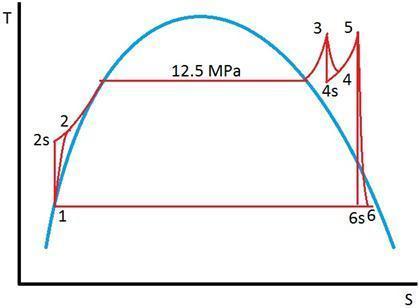
A steam power plant operates on the reheat Rankine cycle. Steam enters the highpressure turbine at 12.5 MPa and 550°C at a rate
gayaneshka [121]

Answer:

A) condenser pressure = 9.73 kPa,

B) 10242 kw

C) 36.9%

Explanation:

given data

entrance pressure of steam = 12.5 MPa

temperature of steam = 550⁰c

flow rate of steam = 7.7 kg/s

outer pressure = 2 MPa

reheated steam temperature = 450⁰c

isentropic efficiency of turbine( nt ) = 85% = 0.85

isentropic efficiency of pump = 90% = 0.90

From steam tables

at 12.5 MPa and 550⁰c ; h3 = 3476.5 kJ/kg,  S3 = 6.6317 kJ/kgK

also for an Isentropic expansion

S4s = S3 .

therefore when S4s = 6.6317 kJ/kg and P4 = 2 MPa

h4s = 2948.1 kJ/kg

nt = 0.85

nt (0.85) = \frac{h3-h4}{h3-h4s} = \frac{3476.5 - h4}{3476.5 - 2948.1}

making h4 subject of the equation

h4 = 3476.5 - 0.85 (3476.5 - 2948.1)

h4 = 3027.3 kj/kg

at P5 = 2 MPa and T5 = 450⁰c

h5 = 3358.2 kj/kg,  s5 = 7.2815 kj/kgk

at P6 , x6 = 0.95  and s5 = s6

using nt = 0.85 we can calculate for h6 and h6s

from the chart attached below we can see that

p6 = 9.73 kPa, h6 = 2463.3 kj/kg

B) the net power output

solution is attached below

c) thermal efficiency

thermal efficiency = 1 - \frac{qout}{qin} = 1 - ( 2273.7/ 3603.8) = 36.9% ≈ 37%

8 0
2 years ago
The air contained in a room loses heat to the surroundings at a rate of 50 kJ/min while work is supplied to the room by computer
Artemon [7]

Answer:

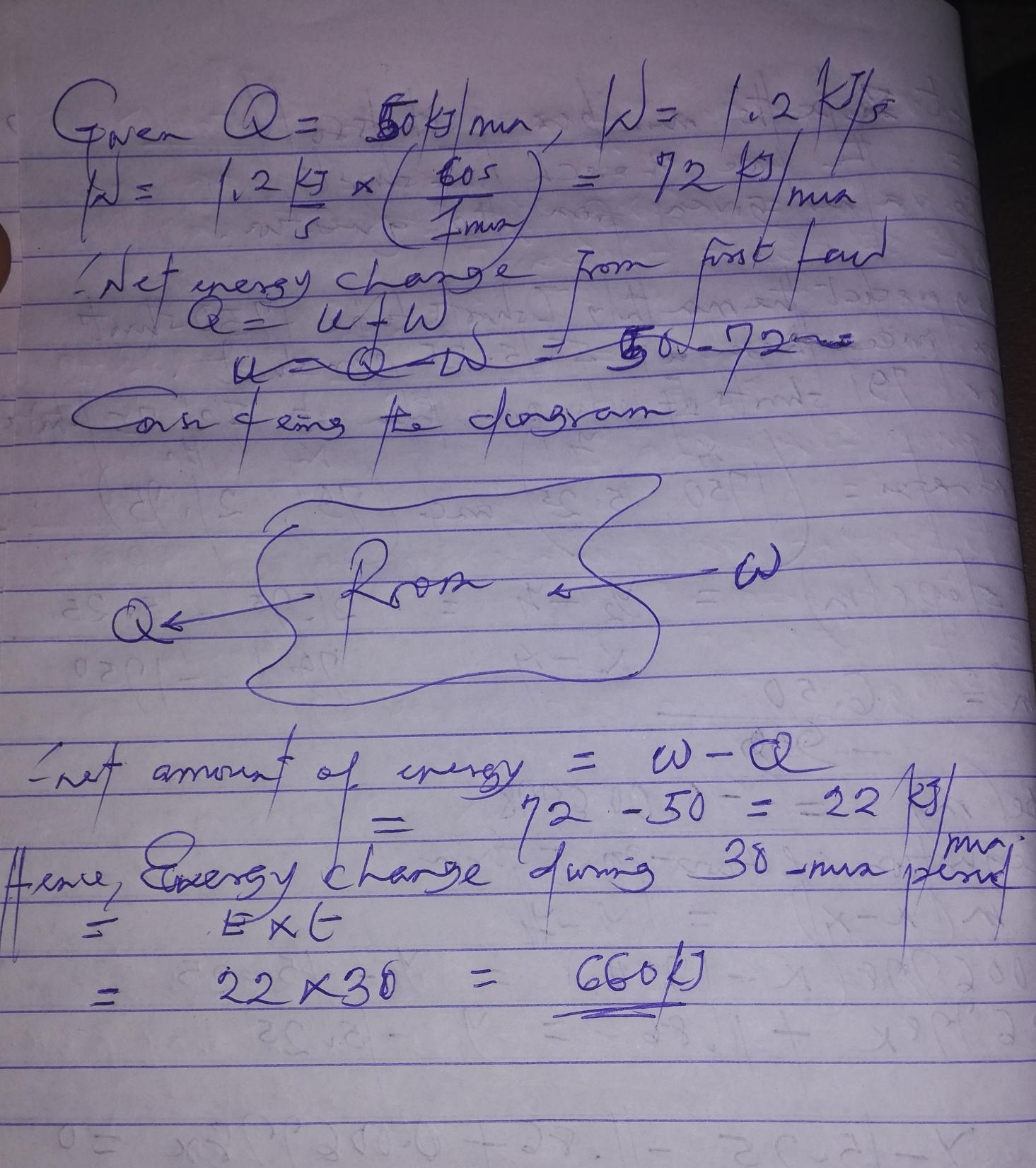
net amount of energy change of the air in the room during a 30-min period = 660KJ

Explanation:

The detailed calculation is as shown in the attached file.

4 0
2 years ago
Read 2 more answers
As the porosity of a refractory ceramic brick increases:
ivolga24 [154]

Answer:

A) strength decreases, chemical resistance decreases, and thermal insulation increases

Explanation:

Strength always decreases, chemical resistence decreases, and thermal condictivity must be reduced therefore themal insulation must increase.

7 0
2 years ago
Water flows at a rate of 10 gallons per minute in a new horizontal 0.75?in. diameter galvanized iron pipe. Determine the pressur
ruslelena [56]

Answer:

\frac{\delta p }{l} = 30.4 lb/ft^3

Explanation:

Given data:

flow rate = 10 gallon per  minute = 0.0223 ft^3/sec

diameter = 0.75 inch

we know discharge is given as

Q =  VA

solve for velocity V = \frac{Q}{A}[/tex]

V = \frac{0.223}{\frac{\pi}{4} \frac{0.75}{12}}

V = 7.27 ft/sec

we know that Reynold number

Re = \frac{VD}{\nu}

Re = \frac{7.27 \times \frac{0.75}{12}}{1.21\times 10^{-5}}

Re = 3.76 \times 10^4

calculate the \frac{\epsilon }{D}ratio to determine the fanning friction f

\frac{\epsilon }{D} = \frac{0.0005}{\frac{0.75}{12}} = 0.008

from moody diagram f value corresonding to Re and \frac{\epsilon }{D}is 0.037

for horizontal pipe

\delta p = \frac{f l \rho v^2}{2D}

\frac{\delta p }{l} = \frac{1 \times 0.037 \times 1.94 \times 7.27}{\frac{0.75}{12}}

where 1.94 slug/ft^3is density of  water

\frac{\delta p }{l} = 30.4 lb/ft^3

3 0
2 years ago
Other questions:
  • Your roommate wants to learn about organizational chart. You can tell her that these charts can tell you all of these about an o
    10·1 answer
  • The 2-Mg concrete pipe has a center of mass at point G. If it is suspended from cables AB and AC, determine the diameter of cabl
    12·1 answer
  • A bankrupt chemical firm has been taken over by new management. On the property they found a 20,000-m3 brine pond containing 25,
    13·1 answer
  • Air is compressed adiabatically from p1 1 bar, T1 300 K to p2 15 bar, v2 0.1227 m3 /kg. The air is then cooled at constant volum
    13·1 answer
  • Determine F12 and F21 for the following configurations: (a) A long semicircular duct with diameter of 0.1 meters: (b) A hemisphe
    10·1 answer
  • Anytime scaffolds are assembled or __________, a competent person must oversee the operation.
    15·2 answers
  • A rectangular beam having b=300 mm and d=575 mm, spans 5.5 m face to face of simple supports. It is reinforced for flexure with
    14·1 answer
  • The electrical energy used by an air conditioner for 2 minutes is 180 kJ. Calculate the power of this air conditioner in the fol
    12·1 answer
  • You are the scheduler for a large commercial building project. The schedule that you prepared (based on feedback from the projec
    7·1 answer
  • 1. A _____ is applied to a wall or roof rafters to add strength and keep the building straight and plumb.
    9·1 answer
Add answer
Login
Not registered? Fast signup
Signup
Login Signup
Ask question!