answer.
Ask question
Login Signup
Ask question
All categories
  • English
  • Mathematics
  • Social Studies
  • Business
  • History
  • Health
  • Geography
  • Biology
  • Physics
  • Chemistry
  • Computers and Technology
  • Arts
  • World Languages
  • Spanish
  • French
  • German
  • Advanced Placement (AP)
  • SAT
  • Medicine
  • Law
  • Engineering
lubasha [3.4K]
2 years ago
10

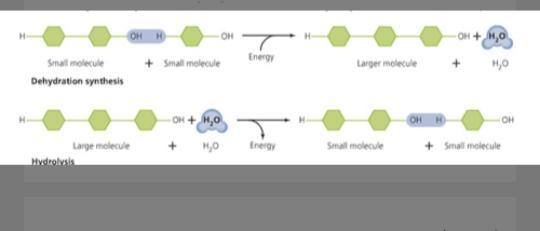
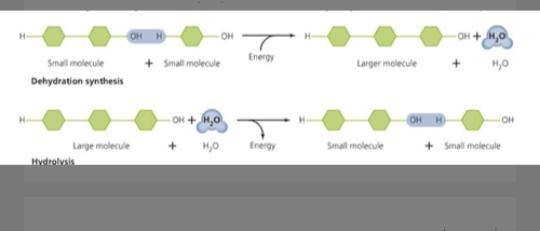
While writing your lecture notes, you are trying to develop a way to impart to your students how the removal of a water molecule

, a hydroxyl and a hydrogen atom, will be used in making macromolecules. A molecule is a collection of atoms joined through different types of bonds. A macromolecule is the joining of numerous molecules into something that is relatively quite large. The addition of a molecule to a macromolecule, as well as the removal of a molecule from the macromolecule, involves a molecule of water. From past experience you are aware that when you state this to your students many will unfortunately assume you are referring to liquid water. Your students must understand that in biological reactions water, H2O, is actually a hydroxyl group (-OH) and a hydrogen atom (H+) that will be removed or added when altering macromolecules. A dehydration synthesis (removal of water) reforms atomic bonds between molecules to create a larger macromolecule. In a dehydration reaction, a hydroxyl group is removed from one reactant molecule while a hydrogen atom is stripped from another reactant molecule.
Reactant (with hydroxyl group) + Reactant (with hydrogen ion) = Product + H2O

The open bonds will be reformed joining the two molecules, while the hydroxyl and hydrogen atom will be released as water. The reverse of a dehydration synthesis is a hydrolysis reaction, in which a bond between two molecules is stressed by an enzyme and a hydroxyl group when a hydrogen atom is added into the bond. Whereas a dehydration synthesis creates a macromolecule, a hydrolysis reaction breaks one apart.

Biology
1 answer:
Julli [10]2 years ago
8 0

Answer:

It is important to note that energy is used up by an enzyme in removing a hydroxyl group from the carboxyl group of a particular amino acid and a hydrogen atom from the amino group of another amino acid to combine the amino acids in a dehydration synthesis reaction to produce water.

On the other hand, another enzyme disrupts the peptide bond, enploying water molecule to combine the hydroxyl group to the carboxyl group of a particular amino acid and a hydrogen atom to the amino group of another amino acid in a hydrolysis reaction.

You might be interested in
Acentric chromosomes, which lack centromeres, can form as a result of chromosome breakage or as a consequence of inversion with
Furkat [3]

Answer:

It wouldn't be able to migrate to the cell's poles.

Explanation:

During anaphase, microtubules attach the chromosome's centromeres and start dragging them towards the poles of the cell. In mitosis, this causes the separation of both sister chromatids for each chromosome, and each chromatid migrates to a different pole. In meiosis, first each homologous chromosome is separated by the same process, and then the sister chromatids are separated during anaphase II. If a chromosome doesn't have centromeres, microtubules are unable to attach the chromosomes, and so the separation of either sister chromatids or homologous chromosomes can't take place.

8 0
2 years ago
Black mice and tan mice are native species that are observed in a particular region. Human habitation in the region caused an in
4vir4ik [10]

Answer:

A

Explanation:

The correct answer would be that <u>the availability of food resources for black mice and brown mice will decrease.</u>

<em>Since the food requirements of the black mice are the same as that of the invasive brown mice, the available food supply that used to be only for the black mice would now be shared by the two strains of mice. Hence, the available food for the two groups of mice will naturally decrease.</em>

There is no sufficient information to conclude that the population of tan mice will decrease, hence, option B is incorrect.

The black mice and tan mice have different food requirements going by the information available in the illustration, hence, both cannot compete for food resources. Option C is, therefore, incorrect. In the same vein, option D is incorrect because the tan mice have different food requirements from the brown mice.

<u>The only correct option is A.</u>

3 0
2 years ago
The term secretion refers to Group of answer choices A.the process by which a cell releases a substance into the extracellular s
emmasim [6.3K]

Answer:

The term secretion refers to the cell that releases a substance into the extracellular space.

Explanation:

When a cell or organ or gland produce and secretes substance in to extracellular space,this biochemical process is called as secretion.

The secretory products may be hormone, enzymes etc.

This process facilitates the movement of material from one place to another place.

For example, Pituitary gland produce and release prolactin hormone that induces breast cells to produce lactation during sucking process done by baby.

Pituitary gland also secrete different hormones that acts on different glands like adrenal, testes, ovary, thyroid gland etc that in turn produce different hormones like adrenaline,testosterone,estrogen,progesterone, TSH,T3, hormone etc.

3 0
2 years ago
What 2 chemicals are inside skeletal muscle?
marta [7]

Answer:

Skeletal muscle tissue is composed of cells called muscle fibers. When the nervous system signal reaches the neuromuscular junction a chemical message is released by the motor neuron. The chemical message, a neurotransmitter called acetylcholine, binds to receptors on the outside of the muscle fiber.

8 0
1 year ago
Cell bodies of sensory neurons may be located in ganglia lying outside the central nervous system. Cell bodies of sensory neuron
AlekseyPX

Answer:

True

Explanation:

Sensory neurons are the neurons present in the nerves which can convert the external stimuli into an electrical signal and can transmit the signals from the organs to the central nervous system.

The structure of sensory neuron in pseudounipolar that is at one end it has dendrites and another end transmits the signals to the CNS. The cell bodies  (nucleus) of these sensory neurons are located in the structures called ganglia located outside the CNS.

Thus, True is the correct answer.
7 0
2 years ago
Other questions:
  • Fill in the blank:
    13·1 answer
  • How are humans activities disturbing carbon dioxide levels are affecting marine life
    10·2 answers
  • Examination of a cell by transmission electron microscopy reveals a high density of ribosomes in the cytoplasm. This observation
    9·1 answer
  • A biologist ground up some plant leaf cells and then centrifuged the mixture to fractionate the organelles. Organelles in one of
    11·2 answers
  • Loss of biodiversity matters not only with regard to mammals or other vertebrates, but also microbes. What statement below would
    10·1 answer
  • What was the narrator referring when he said that the flood risk to Tokyo sounded like something out of a disaster movie?
    7·2 answers
  • During the Krebs Cycle, high-energy electrons and hydrogen ions are transferred to carrier molecules to form NADH and FADH2. Wha
    13·2 answers
  • A situation in which the coefficient of coincidence is greater than 1.0 would indicate that: A. no double crossovers were found
    13·1 answer
  • Using the sliding flament theory, explain (or draw) the process of sarcomere shortening. Start from the point where calcium woul
    6·1 answer
  • Chloroplasts play an important role in energy production in plant cells. However, some parts of a plant, like the roots, lack ch
    13·2 answers
Add answer
Login
Not registered? Fast signup
Signup
Login Signup
Ask question!