answer.
Ask question
Login Signup
Ask question
All categories
  • English
  • Mathematics
  • Social Studies
  • Business
  • History
  • Health
  • Geography
  • Biology
  • Physics
  • Chemistry
  • Computers and Technology
  • Arts
  • World Languages
  • Spanish
  • French
  • German
  • Advanced Placement (AP)
  • SAT
  • Medicine
  • Law
  • Engineering
ahrayia [7]
2 years ago
4

Using the Brønsted-Lowry concept of acids and bases, identify the Brønsted-Lowry acid and base in each of the following reaction

s: HS−(aq)+H2O(l)→H2S(aq)+OH−(aq) (CH3)3N(g)+BCl3(g)→(CH3)3NBCl3(s)
Chemistry
1 answer:
Helen [10]2 years ago
5 0

Answer:

Explanation:

A Brønsted-Lowry acid is any species capable of donating a proton (H +).

A Brönsted-Lowry base is a substance capable of winning or accepting a proton (H +).

Then there is a transfer of protons that requires the presence of a proton donor, that is, an acid and a base that accepts them. Thus, the acid-base reaction is one in which the acid transfers a proton to a base.

In the first case you have:

<u><em>HS⁻ + H₂O → H₂S + OH⁻ </em></u>

You can see that the HS⁻ has become H₂S. This indicates that it has accepted a proton (H⁺), so, according to the definitions seen, it is a Brønsted-Lowry base.  

H₂O has become OH⁻. As it has an H + less proton, it is possible to say that it has donated said proton, so it is a Brønsted-Lowry acid.

When an acid donates a proton, this acid is called a conjugate base. On the contrary, when a base receives a proton it is known as conjugate acid. This is called conjugate acid-base pairs. And this is what occurs in this case.

In the other case you have:

<u><em>(CH₃)₃N(g)+BCl₃(g)→(CH₃)₃NBCl₃(s)</em></u>

In this case there is no transfer of a proton from an acid to a base. So this reaction cannot be explained by the Brønsted-Lowry theory.

You might be interested in
PLZ HELP ASAP PLATO!!! BRAINLIEST TO WHOEVER ANSWERS CORRECTLY!!!
katen-ka-za [31]

Explanation:

a. 0.0093

Number of significant figures = 2

All zero’s preceding the first integers are never significant

b. 120.9

Number of significant figures = 4

All zero’s between integers are always significant.

c. 1,000

Number of significant figures = 1

All zeroes used solely for spacing the decimal point are not significant.

d. 1.008

Number of significant figures = 4

All zero’s between integers are always significant.

All zero’s after the decimal point are always significant.

e. 670

Number of significant figures = 2

All zeroes used solely for spacing the decimal point are not significant.

f. 0.184

Number of significant figures = 3

All zero’s after the decimal point are always significant.

g. 1.30

Number of significant figures = 3

All zero’s after the decimal point are always significant.

3 0
2 years ago
Equimolar samples of CH3OH(l) and C2H5OH(l) are placed in separate, previously evacuated, rigid 2.0 L vessels. Each vessel is at
UkoKoshka [18]

Answer:

Complete Question:  

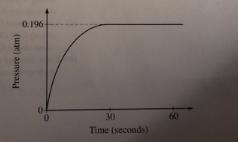
Equimolar samples of CH3OH(l) and C2H5OH(l) are placed in separate, previously evacuated, rigid 2.0 L vessels. Each vessel is attached to a pressure gauge, and the temperatures are kept at 300 K. In both vessels, liquid is observed to remain present at the bottom of the container at all times. The change in pressure inside the vessel containing CH3OH(l) is shown below.

Compared to the equilibrium vapor pressure of CH3OH(l) at 300 K, the equilibrium vapor pressure of C2H5OH(l) at 300 K is

ANSWER : lower, because London dispersion forces among C2H5OH molecules are greater than those among CH3OH molecules

Explanation:

In Order to get a good understanding the answer above let first define some terms

The London dispersion force is the weakest inter-molecular force. The London dispersion force is a temporary attractive force that results when the electrons in two adjacent atoms occupy positions that make the atoms form temporary dipoles.  

The vapor pressure of a liquid is the equilibrium pressure of a vapor above its liquid (or solid); that is, the pressure of the vapor resulting from evaporation of a liquid (or solid) above a sample of the liquid (or solid) in a closed container

The pressure will be Lower, because London dispersion forces among C2H5OH molecules are greater than those among CH3OH molecules ,What this means is that the stronger the inter-molecular forces, the stronger the interactions that hold the substance together, hence the lower the vapor pressure of the liquid at a given temperature, and the harder it is to vaporize the  substance.

Note: London dispersion force among C2H5OH molecules is higher than that among CH3OH molecules because the number of electrons in C2H5OH is greater than that in CH3OH.

3 0
2 years ago
Name the type of reaction and give the coefficients needed to balance the following skeleton reaction: ___Mg + ___Fe2O3 → ___Fe
Katen [24]

the answer is c a tries to trick people by using the same numbers


6 0
2 years ago
Read 2 more answers
. Un cuerpo irregular se introduce dentro de una probeta que inicialmente tiene un volumen de 20 ml como muestra la figura Despu
MrMuchimi

Answer:

El volumen del cuerpo es el mismo al comienzo de la experiencia.

Explicación:

El volumen del cuerpo es el mismo al principio porque el volumen no cambia si la temperatura permanece igual. Si cambiamos la temperatura i. mi. Al aumentar la temperatura, las moléculas comienzan a expandirse y se produce un aumento de volumen mientras que cuando disminuimos la temperatura, las moléculas de esa sustancia comienzan a contraerse y el volumen de esa sustancia disminuye. Entonces concluimos que el volumen depende de la temperatura.

6 0
2 years ago
A chamber contains equal molar amounts of He, Ne, Ar, and Kr. If the total chamber pressure is 1 atm, then the partial pressure
quester [9]

Answer:

The correct answer is 0.25 atm.

Explanation:

As mentioned in the given question that the chamber comprises equal molar concentrations of He, Ne, Ar and Kr gas. So, let us assume that the moles of all the gases will be x then the total number of moles will be 4x.  

The formula for calculating mole fraction is,  

Mole fraction = mole of the substance/total moles  

The mole fraction of Kr = x/4x = 0.25

The total pressure given in the chamber is 1 atm. Therefore, the partial pressure will be,  

Partial pressure = mole fraction * Total pressure

Partial pressure = 0.25 * 1 = 0.25 atm.  

4 0
2 years ago
Other questions:
  • The density of methanol is 0.7918g/mL. Calculate the mass of 89.9mL of this liquid.
    6·1 answer
  • How many SO32- ions are contained in 99.6 mg of Na2SO3? The molar mass of Na2SO3 is 126.05 g/mol.
    8·2 answers
  • What is the conjugate acid of ClCH2CO2-?
    5·1 answer
  • Consider a triprotic acid like phosphoric acid or citric acid. which expression correctly describes the relative magnitudes of t
    11·1 answer
  • Ancient metalworkers in East Africa knew the secrets of strengthening their iron. They knew that if they melted their iron in a
    9·1 answer
  • Addition of 6 M HCl to which substance will NOT result
    10·2 answers
  • A 40.0 mL sample of 0.25 M KOH is added to 60.0 mL of 0.15 M Ba(OH)2. What is the molar concentration of OH-(aq) in the resultin
    7·2 answers
  • Liquid X is known to have a higher surface tension and higher viscosity than Liquid Y Use these facts to predict the result of b
    12·1 answer
  • When performing a flame test using the method described in the manual, you complete the flame test of KNO3 and find a yellow col
    7·1 answer
  • Sugar is made up of clear, colorless crystals that dissolve easily in water, but the crystals and their solution do not conduct
    10·2 answers
Add answer
Login
Not registered? Fast signup
Signup
Login Signup
Ask question!