answer.
Ask question
Login Signup
Ask question
All categories
  • English
  • Mathematics
  • Social Studies
  • Business
  • History
  • Health
  • Geography
  • Biology
  • Physics
  • Chemistry
  • Computers and Technology
  • Arts
  • World Languages
  • Spanish
  • French
  • German
  • Advanced Placement (AP)
  • SAT
  • Medicine
  • Law
  • Engineering
Law Incorporation [45]
2 years ago
6

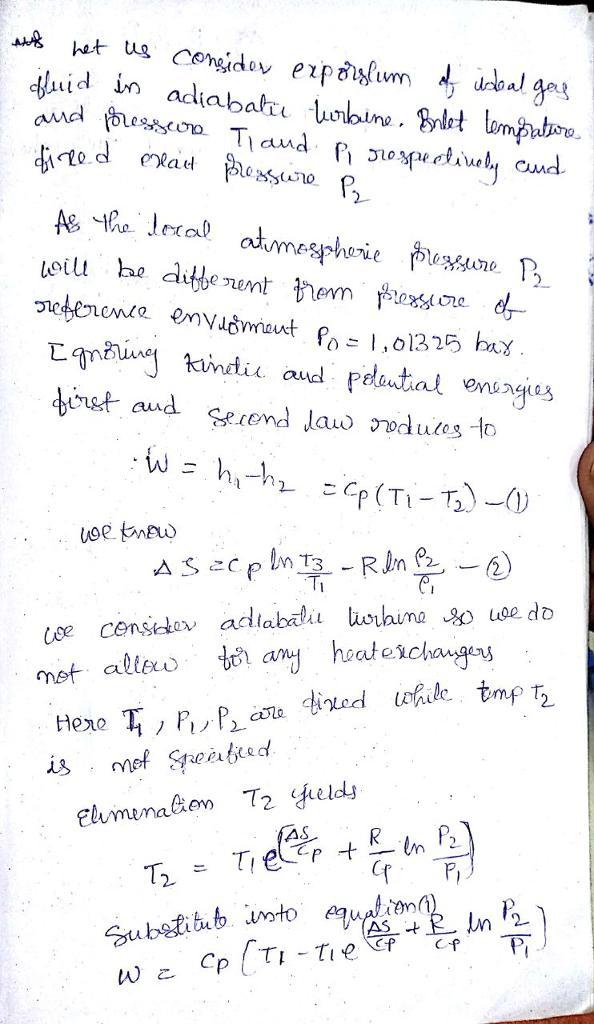
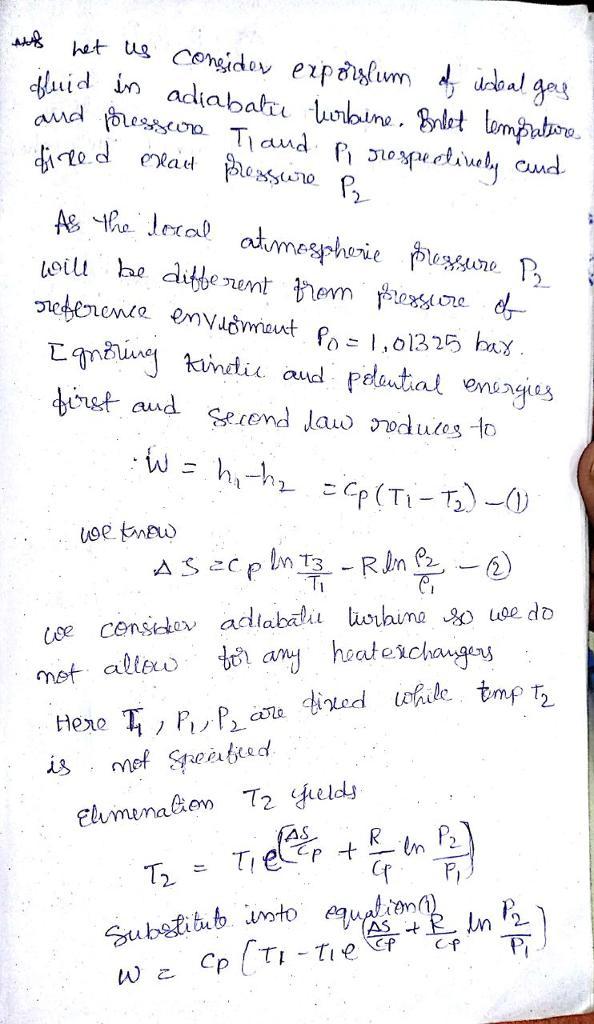
An adiabatic turbine is operating with an ideal gas working fluid of fixed inlet temperature and pressure (T1, P1) and a fixed e

xit pressure, P2.
a) Show that the minimum outlet temperature, T2, occurs when the turbine operates reversibly.

b) Show that the maximum work can be obtained when Sgen=0

Engineering
1 answer:
e-lub [12.9K]2 years ago
5 0

Answer:

Answer for the question:

An adiabatic turbine is operating with an ideal gas working fluid of fixed inlet temperature and pressure (T1, P1) and a fixed exit pressure, P2.

a) Show that the minimum outlet temperature, T2, occurs when the turbine operates reversibly.

b) Show that the maximum work can be obtained when Sgen=0

is given in the attachment.

Explanation:

You might be interested in
What is the damped natural frequency (in rad/s) of a second order system whose undamped natural frequency is 25 rad/s and has a
TiliK225 [7]

Answer:

damped natural frequency = 23.84 rad/s

Explanation:

given data

damping ratio = 0.3

undamped natural frequency = 25 rad/s

to find out

damped natural frequency of a second order system

solution

we know that if damping ratio is = 0

then it is undamped system

and if damping ratio is > 1

then it is overdamped system

and  and if damping ratio is ≈ 1

then it is critical damped system

so damped natural frequency of a second order system formula is

damped natural frequency = wn × \sqrt{1-r^2}

here wn is undamped natural frequency and r is damping ratio

damped natural frequency = 25 × \sqrt{1-0.3^2}

damped natural frequency = 23.84 rad/s

3 0
2 years ago
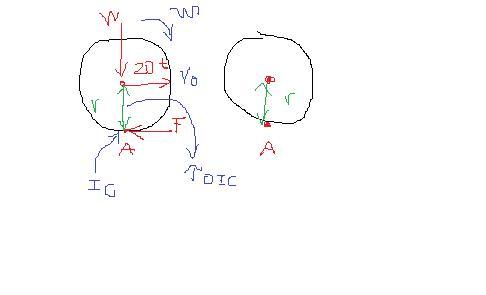
The 30-kg gear is subjected to a force of P=(20t)N where t is in seconds. Determine the angular velocity of the gear at t=4s sta
tatyana61 [14]

Answer:

\omega =\frac{24}{1.14375}=20.983\frac{rad}{s}

Explanation:

Previous concepts

Angular momentum. If we consider a particle of mass m, with velocity v, moving under the influence of a force F. The angular  momentum about point O is defined as the “moment” of the particle’s linear momentum, L, about O. And the correct formula is:

H_o =r x mv=rxL

Applying Newton’s second law to the right hand side of the above equation, we have that r ×ma = r ×F =

MO, where MO is the moment of the force F about point O. The equation expressing the rate of change  of angular momentum is this one:

MO = H˙ O

Principle of Angular Impulse and Momentum

The equation MO = H˙ O gives us the instantaneous relation between the moment and the time rate of change of angular  momentum. Imagine now that the force considered acts on a particle between time t1 and time t2. The equation MO = H˙ O can then be integrated in time to obtain this:

\int_{t_1}^{t_2}M_O dt = \int_{t_1}^{t_2}H_O dt=H_0t2 -H_0t1

Solution to the problem

For this case we can use the principle of angular impulse and momentum that states "The mass moment of inertia of a gear about its mass center is I_o =mK^2_o =30kg(0.125m)^2 =0.46875 kgm^2".

If we analyze the staritning point we see that the initial velocity can be founded like this:

v_o =\omega r_{OIC}=\omega (0.15m)

And if we look the figure attached we can use the point A as a reference to calculate the angular impulse and momentum equation, like this:

H_Ai +\sum \int_{t_i}^{t_f} M_A dt =H_Af

0+\sum \int_{0}^{4} 20t (0.15m) dt =0.46875 \omega + 30kg[\omega(0.15m)](0.15m)

And if we integrate the left part and we simplify the right part we have

1.5(4^2)-1.5(0^2) = 0.46875\omega +0.675\omega=1.14375\omega

And if we solve for \omega we got:

\omega =\frac{24}{1.14375}=20.983\frac{rad}{s}

8 0
2 years ago
A thermal energy storage unit consists of a large rectangular channel, which is well insulated on its outer surface and encloses
yaroslaw [1]

Answer:

the temperature of the aluminum at this time is 456.25° C

Explanation:

Given that:

width w of the aluminium slab = 0.05 m

the initial temperature T_1 = 25° C

T{\infty} =600^0C

h = 100 W/m²

The properties of Aluminium at temperature of 600° C by considering the conditions for which the storage unit is charged; we have ;

density ρ = 2702 kg/m³

thermal conductivity k = 231 W/m.K

Specific heat c = 1033 J/Kg.K

Let's first find the Biot Number Bi which can be expressed by the equation:

Bi = \dfrac{hL_c}{k} \\ \\ Bi = \dfrac{h \dfrac{w}{2}}{k}

Bi = \dfrac{hL_c}{k} \\ \\ Bi = \dfrac{100 \times \dfrac{0.05}{2}}{231}

Bi = \dfrac{2.5}{231}

Bi = 0.0108

The time constant value \tau_t is :

\tau_t = \dfrac{pL_cc}{h} \\ \\ \tau_t = \dfrac{p \dfrac{w}{2}c}{h}

\tau_t = \dfrac{2702* \dfrac{0.05}{2}*1033}{100}

\tau_t = \dfrac{2702* 0.025*1033}{100}

\tau_t = 697.79

Considering Lumped capacitance analysis since value for Bi is less than 1

Then;

Q= (pVc)\theta_1 [1-e^{\dfrac {-t}{ \tau_1}}]

where;

Q = -\Delta E _{st} which correlates with the change in the internal energy of the solid.

So;

Q= (pVc)\theta_1 [1-e^{\dfrac {-t}{ \tau_1}}]= -\Delta E _{st}

The maximum value for the change in the internal energy of the solid  is :

(pVc)\theta_1 = -\Delta E _{st}max

By equating the two previous equation together ; we have:

\dfrac{-\Delta E _{st}}{\Delta E _{st}{max}}= \dfrac{  (pVc)\theta_1 [1-e^{\dfrac {-t}{ \tau_1}}]} { (pVc)\theta_1}

Similarly; we need to understand that the ratio of the energy storage to the maximum possible energy storage = 0.75

Thus;

0.75=  [1-e^{\dfrac {-t}{ \tau_1}}]}

So;

0.75=  [1-e^{\dfrac {-t}{ 697.79}}]}

1-0.75=  [e^{\dfrac {-t}{ 697.79}}]}

0.25 =  e^{\dfrac {-t}{ 697.79}}

In(0.25) =  {\dfrac {-t}{ 697.79}}

-1.386294361= \dfrac{-t}{697.79}

t = 1.386294361 × 697.79

t = 967.34 s

Finally; the temperature of Aluminium is determined as follows;

\dfrac{T - T _{\infty}}{T_1-T_{\infty}}= e ^ {\dfrac{-t}{\tau_t}}

\dfrac{T - 600}{25-600}= e ^ {\dfrac{-967.34}{697.79}

\dfrac{T - 600}{25-600}= 0.25

\dfrac{T - 600}{-575}= 0.25

T - 600 = -575 × 0.25

T - 600 = -143.75

T = -143.75 + 600

T = 456.25° C

Hence; the temperature of the aluminum at this time is 456.25° C

3 0
2 years ago
A thermometer requires 1 minute to indicate 98% of the response to a unit step input. Assuming the thermometer to be a first ord
Rama09 [41]

Answer:

Time constant = 15.34 seconds

The thermometer shows an error of 0.838°

Explanation:

Given

t = 1 minute = 60 seconds

c(t) = 98% = 0.98

According to the question, the thermometer is a first order system.

The first order system transfer function is given as;

C(s)/R(s) = 1/(sT + 1).

To calculate the time constant, we need to calculate the step response.

This is given as

r(t) = u(t) --- Take Laplace Transformation

R(s) = 1/s

Substitute 1/s for R(s) in C(s)/R(s) = 1/(sT + 1).

We have

C(s)/1/s = 1/(sT + 1)

C(s) = 1/(sT + 1) * 1/s

C(s) = 1/s - 1/(s + 1/T) --- Take Inverse Laplace Transformation

L^-1(C(s)) = L^-1(1/s - 1/(s + 1/T))

Since, e^-t <–> 1/(s + 1) --- {L}

1 <–> 1/s {L}

So, the unit response c(t) = 1 - e^-(t/T)

Substitute 0.98 for c(t) and 60 for t

0.98 = 1 - e^-(60/T)

0.98 - 1 = - e^-(60/T)

-0.02 = - e^-(60/T)

e^-(60/T) = 0.02

ln(e^-(60/T)) = ln(0.02)

-60/T = -3.912

T = -60/-3.912

T = 15.34 seconds

Time constant = 15.34 seconds

The error signal is given as

E(s) = R(s) - C(s)

Where the temperature changes at the rate of 10°/min; 10°/60 s = 1/6

So.

E(s) = R(s) - 1/6 C(s)

Calculating C(s)

C(s) = 1/s - 1/(s + 1/T)

C(s) = 1/s - 1/(s + 1/15.34)

Remember that R(s) = 1/s

So, E(s) becomes

E(s) = 1/s - 1/6(1/s - 1/(s + 1/15.34))

E(s) = 1/s - 1/6(1/s - 1/(s + 0.0652)

E(s) = 1/s - 1/6s + 1/(6(s+0.0652))

E(s) = 5/6s + 1/(6(s+0.0652))

E(s) = 0.833/s + 1/(6(s+0.0652)) ---- Take Inverse Laplace Transformation

e(t) = 1/6e^-0.652t + 0.833

For a first order system, the system attains a steady state condition when time is 4 times of Time constant.

So,

Time = 4 * 15.34

Time = 61.36 seconds

So, e(t) becomes

e(t) = 1/6e^-0.652t + 0.833

e(t) = 1/(6e^-0.652(61.36)) + 0.833

e(t) = 0.83821342824942664566211

e(t) = 0.838 --- Approximated

Hence, the thermometer shows an error of 0.838°
4 0
2 years ago
Read 2 more answers
A rectangular tank is filled with water to a depth of 1.5 m. Its longest side measures 2.5 m. What is the moment of the force ab
marishachu [46]

Answer:

The correct answer is option 'c': 13.8 kNm

Explanation:

We know that moment of a force equals

Moment=Force\times Arm

The hydro static force is given by Force=Pressure\times Area

We know that the hydrostatic pressure on a rectangular surface in vertical position is given by Pressure=\rho \times g\times h_{c.g}

For the given rectangular surface we have h_{c.g}=\frac{h}{2}=\frac{1.5}{2}=0.75m

Thus applying the values we get force as

Force=1000\times 9.81\times 0.75\times 1.5\times 2.5=27.59kN

This pressure will act at center of pressure of the rectangular plate whose co-ordinates is given by h/3 from base

Thus applying the calculated values we get

Moment=27.59\times \frac{1.5}{3}=13.8kN.m

8 0
2 years ago
Other questions:
  • The rigid bar CDE is attached to a pin support at E and rests on the 30 mm diameter brass cylinder BD. A 22 mm diameter steel ro
    8·1 answer
  • Current density is given in cylindrical coordinates as J = −106z1.5az A/m2 in the region 0 ≤ rho ≤ 20 µm; for rho ≥ 20 µm, J = 0
    13·1 answer
  • A steady tensile load of 5.00kN is applied to a square bar, 12mm on a side and having a length of 1.65m. compute the stress in t
    13·1 answer
  • In a parallel one-dimensional flow in the positive x direction, the velocity varies linearly from zero at y = 0 to 32 m/s at y =
    8·1 answer
  • Use Lagrange multiplier techniques to find the local extreme values of the given function subject to the stated constraint. If a
    15·1 answer
  • The purification of hydrogen gas is possible by diffusion through a thin palladium sheet. Calculate the number of kilograms of h
    8·1 answer
  • Refrigerant-134a enters the coils of the evaporator of a refrigeration system as a saturated liquid–vapor mixture at a pressure
    5·1 answer
  • An ideal Stirling cycle filled with air uses a 75 F energy reservoir as a sink. The engine is designed to so that the maximum ai
    8·1 answer
  • NEEDS TO BE IN PYTHON:ISBN-13 is a new standard for indentifying books. It uses 13 digits d1d2d3d4d5d6d7d8d910d11d12d13 . The la
    15·1 answer
  • A surface grinding operation is used to finish a flat plate that is 5.50 in wide and 12.500 in long. The starting thickness is 1
    9·1 answer
Add answer
Login
Not registered? Fast signup
Signup
Login Signup
Ask question!