answer.
Ask question
Login Signup
Ask question
All categories
  • English
  • Mathematics
  • Social Studies
  • Business
  • History
  • Health
  • Geography
  • Biology
  • Physics
  • Chemistry
  • Computers and Technology
  • Arts
  • World Languages
  • Spanish
  • French
  • German
  • Advanced Placement (AP)
  • SAT
  • Medicine
  • Law
  • Engineering
torisob [31]
2 years ago
8

An ideal gas initially at 300 K and 1 bar undergoes a three-step mechanically reversible cycle in a closed system. In step 12, p

ressure increases isothermally to 5 bar; in step 23, pressure increases at constant volume; and in step 31, the gas returns adiabatically to its initial state. Take CP=(7/2)R and CV=(5/2)R. (a) Sketch the cycle on a PV diagram. (b) Determine (where unknown) V, T, and P for states 1, 2, and 3. (c) Calculate Q, W, ΔU, and ΔH for each step of the cycle.

Engineering
1 answer:
Veseljchak [2.6K]2 years ago
3 0

Answer:

Ts =Ta E)- 300(

569.5 K

5

Q12-W12 = -4014.26

Mol

AU2s = Q23= 5601.55

Mol

AUs¡ = Ws¡ = -5601.55

Explanation:

A clear details for the question is also attached.

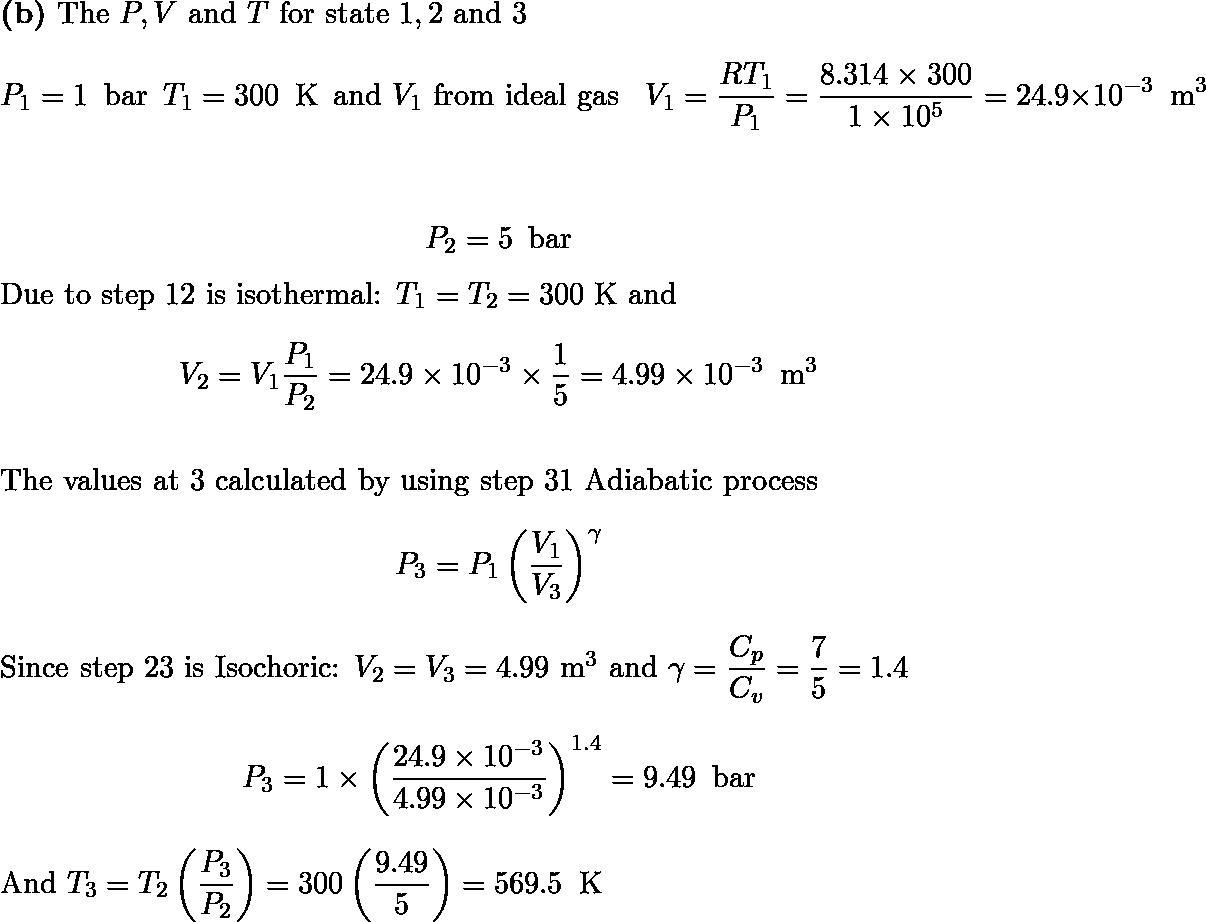
(b) The P,V and T for state 1,2 and 3

P =1 bar Ti = 300 K and Vi from ideal gas Vi=

10

24.9x10 m

=

P-5 bar

Due to step 12 is isothermal: T1 = T2= 300 K and

VVi24.9 x 10x-4.9 x 10⁻³ *

The values at 3 calclated by Uing step 3l Adiabatic process

B-P ()

Since step 23 is Isochoric: Va =Vs= 4.99 m* and 7=

14

Ps-1x(4.99 x 103

P-1x(29x 10)

9.49 barr

And Ts =Ta E)- 300(

569.5 K

5

(c) For step 12: Isothermal, Since AT = 0 then AH12 = AU12 = 0 and

Work done for Isotermal process define as

8.314 x 300 In =4014.26

Wi2= RTi ln

mol

And fromn first law of thermodynamic

AU12= W12 +Q12

Q12-W12 = -4014.26

Mol

F'or step 23 Isochoric: AV = 0 Since volume change is zero W23= 0 and

Alls = Cp(L3-12)=5 x 8.311 (569.5 - 300) = 7812.18-

AU23= C (13-72) =5 x 8.314 (569.3 - 300) = 5601.53

Inol

Now from first law of thermodynamic the Q23

AU2s = Q23= 5601.55

Mol

For step 3-1 Adiabatic: Since in this process no heat transfer occur Q31= 0

and

AH

C,(T -Ts)=x 8.314 (300- 569.5)= -7842.18

mol

AU=C, (T¡-T)= x 8.314 (300

-5601.55

569.5)

mol

Now from first law of thermodynamie the Ws1

J

mol

AUs¡ = Ws¡ = -5601.55
You might be interested in
A system consisting of 3 lb of water vapor in a piston–cylinder assembly, initially at 350°F and a volume of 71.7 ft3, is expand
Alla [95]

Answer:

isobaric expansion = 281.09 Btu

isothermal compression= 72 Btu

Explanation:

The first law of thermodynamics is:

Q_{AB}=W_{AB}+deltaU_{AB}

where:

Q=heat transferred

W= work

U=internal energy  

W_{AB}=P*(V_{B}-V_{A})

U_{AB}=n*C_{v}(T_{2}-T_{1})

P=pressure, V= volume, T= temperature, n =  moles, Cv= specific heat at constant volume.

In a isobaric process heat transferred is:

Q=P*(V_{B}-V_{A})+n*C_{v}(T_{2}-T_{1})

For an isothermal process (T2-T1 = 0) so

Q=P*(V_{B}-V_{A})= W_{AB}

From the data we know that the energy transferred to the system in the isothermal compression by work was 72 Btu that is the heat transferred to the system.

For the first process

Q=P*(V_{B}-V_{A})+n*C_{v}(T_{2}-T_{1})

we have to properties at the beginning of the process : temperature (350°F) and specific volume (V/mass)

specific-volume=\frac{71.7 ft^{3}}{3Lb}=23.9\frac{ft^{3}}{Lb}

we use this information in the appropriate unit to find the pressure in thermodynamic tables.

T1= 176°C

v1= 1.49 m^3/kg

P=1.37 bar

in the second state we have

P=1.37 bar =137000Pa

v_{2}=\frac{85.38ft^{3}}{3Lb}= 28.46\frac{ft^{3}}{Lb}

with thee properties we check in the thermodynamic tables

T2= 255°C

n=mass/Mw = 3Lb*\frac {1kg}{2.2Lb}*\frac{1000gr}{1kg}*\frac{1mol}{18gr}=75.75 mol

we usually find Cp on tables for water but from the Mayer relation we have:

C_{v}=C_{p}+R

Cp for water vapor is: 33.12 J/mol*K

R=8.314 J/mol*K

Cv= 41.434 J/mol*K

replacing in the equation for Q

Q=137000 Pa*(2.41m^{3}-2.030m^{3})+75.75mol*41.434\frac{ J}{mol*K}*(528.15-449.81 K)=296569J

296569J =281.09 Btu

5 0
2 years ago
Explain why failure of this garden hose occurred near its end and why the tear occurred along its length. Use numerical values t
alukav5142 [94]

Answer:

  • hoop stress
  • longitudinal stress
  • material used

all this could led to the failure of the garden hose and the tear along the length

Explanation:

For the flow of water to occur in any equipment, water has to flow from a high pressure to a low pressure. considering the pipe, water is flowing at a constant pressure of 30 psi inside the pipe which is assumed to be higher than the allowable operating pressure of the pipe. but the greatest change in pressure will occur at the end of the hose because at that point the water is trying to leave the hose into the atmosphere, therefore the great change in pressure along the length of the hose closest to the end of the hose will cause a tear there. also the other factors that might lead to the failure of the garden hose includes :

hoop stress ( which acts along the circumference of the pipe):

αh = \frac{PD}{2T}     EQUATION 1

and Longitudinal stress ( acting along the length of the pipe )

αl = \frac{PD}{4T}       EQUATION 2

where p = water pressure inside the hose

          d = diameter of hose, T = thickness of hose

we can as well attribute the failure of the hose to the material used in making the hose .

assume for a thin cylindrical pipe material used to be

\frac{D}{T} ≥  20

insert this value into equation 1

αh = \frac{20 *30}{2}  = 60/2 = 30 psi

the allowable hoop stress was developed by the material which could have also led to the failure of the garden hose

8 0
2 years ago
The closed tank of a fire engine is partly filled with water, the air space above being under pressure. A 6 cm bore connected to
skelet666 [1.2K]

Answer:

The air pressure in the tank is 53.9 kN/m^{2}

Solution:

As per the question:

Discharge rate, Q = 20 litres/ sec = 0.02\ m^{3}/s

(Since, 1 litre = 10^{-3} m^{3})

Diameter of the bore, d = 6 cm = 0.06 m

Head loss due to friction, H_{loss} = 45 cm = 0.45\ m

Height, h_{roof} = 2.5\ m

Now,

The velocity in the bore is given by:

v = \frac{Q}{\pi (\frac{d}{2})^{2}}

v = \frac{0.02}{\pi (\frac{0.06}{2})^{2}} = 7.07\ m/s

Now, using Bernoulli's eqn:

\frac{P}{\rho g} + \frac{v^{2}}{2g} + h = k                  (1)

The velocity head is given by:

\frac{v_{roof}^{2}}{2g} = \frac{7.07^{2}}{2\times 9.8} = 2.553

Now, by using energy conservation on the surface of water on the roof and that in the tank :

\frac{P_{tank}}{\rho g} + \frac{v_{tank}^{2}}{2g} + h_{tank} = \frac{P_{roof}}{\rho g} + \frac{v_{tank}^{2}}{2g} + h_{roof} + H_{loss}

\frac{P_{tank}}{\rho g} + 0 + 0 = \0 + 2.553 + 2.5 + 0.45

P_{tank} = 5.5\times \rho \times g

P_{tank} = 5.5\times 1\times 9.8 = 53.9\ kN/m^{2}

4 0
2 years ago
Fix the code so the program will run correctly for MAXCHEESE values of 0 to 20 (inclusive). Note that the value of MAXCHEESE is
GarryVolchara [31]

Answer:

Code fixed below using Java

Explanation:

<u>Error.java </u>

import java.util.Random;

public class Error {

   public static void main(String[] args) {

       final int MAXCHEESE = 10;

       String[] names = new String[MAXCHEESE];

       double[] prices = new double[MAXCHEESE];

       double[] amounts = new double[MAXCHEESE];

       // Three Special Cheeses

       names[0] = "Humboldt Fog";

       prices[0] = 25.00;

       names[1] = "Red Hawk";

       prices[1] = 40.50;

       names[2] = "Teleme";

       prices[2] = 17.25;

       System.out.println("We sell " + MAXCHEESE + " kind of Cheese:");

       System.out.println(names[0] + ": $" + prices[0] + " per pound");

       System.out.println(names[1] + ": $" + prices[1] + " per pound");

       System.out.println(names[2] + ": $" + prices[2] + " per pound");

       Random ranGen = new Random(100);

       // error at initialising i

       // i should be from 0 to MAXCHEESE value

       for (int i = 0; i < MAXCHEESE; i++) {

           names[i] = "Cheese Type " + (char) ('A' + i);

           prices[i] = ranGen.nextInt(1000) / 100.0;

           amounts[i] = 0;

           System.out.println(names[i] + ": $" + prices[i] + " per pound");

       }        

   }

}

7 0
2 years ago
Explain why the fundamental software engineering principles of process, dependability, requirements management, and reuse are re
Svet_ta [14]

Answer:

1. Costs and frequency of change.

2. The most important ‘non-functional’ requirements. Different systems have different priorities for non-functional requirements.

3. The software lifetime and delivery schedule.

Explanation:

The process of requirement gathering is required in both generic and customized software.

• A document to define the development process is required in all type of software application.

• Updating is required in each type of software. For doing so, new version of each type of software is released.

• Maintenance is an important part of software development. It is required in each type of application development.

• Software has some minimum requirements to execute. So, platform dependability is considered in all software development.

5 0
2 years ago
Read 2 more answers
Other questions:
  • Steam enters a turbine operating at steady state at 1 MPa, 200 °C and exits at 40 °C with a quality of 83%. Stray heat transfer
    9·1 answer
  • Universal Containers (UC) has a requirement to expose a web service to their business partners. The web service will be used to
    10·1 answer
  • A steam power plant operates on an ideal reheat- regenerative Rankine cycle and has a net power output of 80 MW. Steam enters th
    10·1 answer
  • Which statement concerning symbols used on plans is true?
    10·1 answer
  • The Gill Art Gallery wishes to maintain data on their customers, artists and paintings. They may have several paintings by each
    7·1 answer
  • Benzene vapor at 480°C is cooled and converted to a liquid at 25°C in a continuous condenser. The condensate is drained into 1.7
    15·1 answer
  • Consider a steady developing laminar flow of water in a constant-diameter horizontal discharge pipe attached to a tank. The flui
    14·1 answer
  • What ratio between differential gain and common-mode gain is called​
    9·1 answer
  • 11 Notează, în caiet, trăsăturile personajelor ce se pot
    13·1 answer
  • The signboard truss is designed to support a horizontal wind load of 800 lb. A separate analysis shows that 5 8 of this force is
    12·1 answer
Add answer
Login
Not registered? Fast signup
Signup
Login Signup
Ask question!