answer.
Ask question
Login Signup
Ask question
All categories
  • English
  • Mathematics
  • Social Studies
  • Business
  • History
  • Health
  • Geography
  • Biology
  • Physics
  • Chemistry
  • Computers and Technology
  • Arts
  • World Languages
  • Spanish
  • French
  • German
  • Advanced Placement (AP)
  • SAT
  • Medicine
  • Law
  • Engineering
Anna007 [38]
2 years ago
9

Look at the reaction below and state which direction the reaction would shift:

Chemistry
1 answer:
lorasvet [3.4K]2 years ago
4 0

Answer:

there is no change at all!!!

You might be interested in
Write a net ionic equation for the reaction that occurs when nickel(ii carbonate and excess hydrobromic acid (aq are combined.
seropon [69]
First, we write the reaction equation:
NiCO₃ + 2HBr → NiBr₂ + H₂CO₃

Now, writing this in ionic form:
NiCO₃ + 2H⁺ + 2Br⁻ → NiBr₂ + 2H⁺ + CO₃⁻²

(NiCO₃ is insoluble so it does not dissociate in to ions very readily)

Overall equation:
NiCO₃ + 2Br⁻ → NiBr₂ + CO₃⁻²
7 0
2 years ago
28 ml of 0.10 m hcl is added to 60 ml of 0.10 m sr(oh)2. determine the concentration of oh− in the resulting solution.
Blababa [14]
Here is an acid-base reaction. Hydrochloric acid (HCl) reacts with strontium hydroxide [ Sr(OH)2 ]

Ions H+ and OH- neutralize each other. If the amounts are not equal, one of them will be in excess. 
Follow the steps as

1. Find moles of ions: mole= Molarity * Volume (in liter) ; n= M * V OR millimole = Molarity * Volume (in ml) ;
2. Write the equation
3. Find out excess ion
4. Use final volume (V acid + V base ) to calculate concentration of excess ion.

n HCI = 28 ml * 0.10 M = 0.28 mmol, releases 0.28 mmol H+ ions
n Sr(OH)2= 60 ml * 0.10 M= 0.60 mmol, releases 2* 0.60=1.20 mmol OH- ions
since Sr(OH)2⇒ Sr2+ + 2OH-

Neutralization reaction is OH- + H+ ---> H2O. The ratio is 1:1. That means 1 mmol hydroxide ions will neutralize 1 mmol hydrogen ions. Since OH- ions are greater in amount, they will be in excess

n(OH-) - n(H+)= 1.20 - 0.28 = 0.92 mmol OH- ions UNREACTED.

Total volume= V acid + V base= 28 ml + 60 ml = 98 ml

Molarity of OH- ions= mole / Vtotal = 0.92/98= 0.009 M

The answer is 0.009 M.


5 0
2 years ago
Read 2 more answers
If 8.00 g NH4NO3 is dissolved in 1000 g of water, the water decreases in temperature from 21.00 degrees Celsius to 20.39 degrees
telo118 [61]

Answer:

25.7 kJ/mol

Explanation:

There are two heats involved.

heat of solution of NH₄NO₃ + heat from water = 0

q₁  +  q₂  =  0

n  =  moles of NH₄NO₃  =  8.00 g NH₄NO₃  ×  1 mol NH₄NO₃/80.0 g NH₄NO₃          

∴ n =   0.100 mol NH₄NO₃

q₁ = n * ΔHsoln = 0.100 mol * ΔHsoln

m  =  mass of solution  =  1000.0 g + 8.00 g  =  1008.0 g

q₂  =  mcΔT  = 58.0 g  ×  4.184 J°C⁻¹  g⁻¹  × ((20.39-21)°C) = -2570.19 J

q₁  +  q₂  =  0.100 mol  ×ΔHsoln  – 2570.19 J  =  0

ΔHsoln  =  +2570.19 J  /0.100 mol  =  +25702 J/mol  =  +25.7 kJ/mol

7 0
2 years ago
a carbon-12 atom has a mass defect of 0.9564 amu. what is its nuclear binding energy? round to 3 significant figures.
emmasim [6.3K]

Answer:

Explanation:

A carbon-12 atom has a mass defect of 0.09564 amu. What is its nuclear binding energy? Round to 3 significant figures. x 10 J per carbon-12 atom

First use the formula;

1 amu =934 MeV

therefore 0.09564 will have

934 x 934

= 89.3 MeV

7 0
2 years ago
Read 2 more answers
A mysterious white powder could be powdered sugar (C12H22O11), cocaine (C17H21NO4), codeine (C18H21NO3), norfenefrine (C8H11NO2)
rodikova [14]

Norfenefrine (C₈H₁₁NO₂).

<h3>Further explanation</h3>

We will solve a case related to one of the colligative properties, namely freezing point depression.

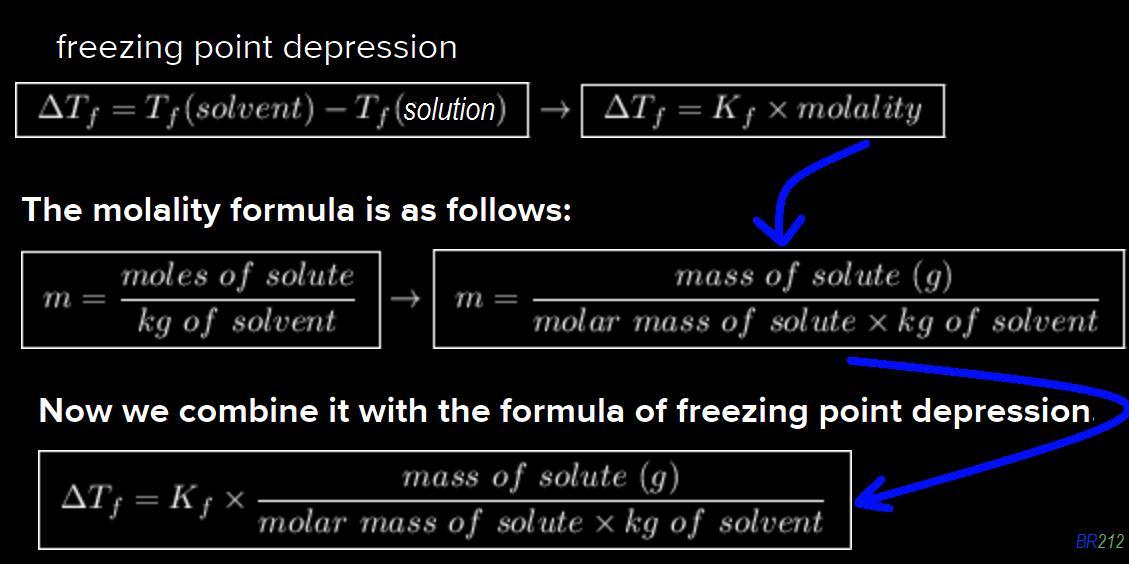
The freezing point of the solution is the temperature at which the solution begins to freeze. The difference between the freezing point of the solvent and the freezing point of the solution is called freezing point depression.

\boxed{ \ \Delta T_f = T_f(solvent) - T_f(solution) \ } \rightarrow \boxed{ \ \Delta T_f = K_f \times molality \ }

<u>Given:</u>

A mysterious white powder could be,

  • powdered sugar (C₁₂H₂₂O₁₁) with a molar mass of 342.30 g/moles,
  • cocaine (C₁₇H₂₁NO₄) with a molar mass of 303.35 g/moles,
  • codeine (C₁₈H₂₁NO₃) with a molar mass of 299.36 g/moles,
  • norfenefrine (C₈H₁₁NO₂) with a molar mass of 153.18 g/moles, or
  • fructose (C₆H₁₂O₆) with a molar mass of 180.16 g/moles.

When 82 mg of the powder is dissolved in 1.50 mL of ethanol (density = 0.789 g/cm³, normal freezing point −114.6°C, Kf = 1.99°C/m), the freezing point is lowered to −115.5°C.

<u>Question: </u>What is the identity of the white powder?

<u>The Process:</u>

Let us identify the solute, the solvent, initial, and final temperatures.

  • The solute = the powder
  • The solvent = ethanol
  • The freezing point of the solvent = −114.6°C
  • The freezing point of the solution = −115.5°C

Prepare masses of solutes and solvents.

  • Mass of solute = 82 mg = 0.082 g
  • Mass of solvent = density x volume, i.e., \boxed{ \ 0.789 \ \frac{g}{cm^3} \times 1.50 \ cm^3 = 1.1835 \ g = 0.00118 \ kg  \ }

We must prepare the solvent mass unit in kg because the unit of molality is the mole of the solute divided by the mass of the solvent in kg.

The molality formula is as follows:

\boxed{ \ m = \frac{moles \ of \ solute}{kg \ of \ solvent} \ } \rightarrow \boxed{ \ m = \frac{mass \ of \ solute \ (g)}{molar \ mass \ of \ solute \times kg \ of \ solvent} \ }

Now we combine it with the formula of freezing point depression.

\boxed{ \ \Delta T_f =  K_f \times \frac{mass \ of \ solute \ (g)}{molar \ mass \ of \ solute \times kg \ of \ solvent} \ }

It is clear that we will determine the molar mass of the solute (denoted by Mr).

We enter all data into the formula.

\boxed{ \ -114.6^0C - (-115.5^0C) = 1.99 \frac{^0C}{m} \times \frac{0.082 \ g}{Mr \times 0.00118 \ kg} \ }

\boxed{ \ 0.9 = \frac{1.99 \times 0.082}{Mr \times 0.00118} \ }

\boxed{ \ Mr = \frac{0.16318}{0.9 \times 0.00118} \ }

We get \boxed{ \ Mr = 153.65 \ }

These results are very close to the molar mass of norfenefrine which is 153.18 g/mol. Thus the white powder is norfenefrine.

<h3>Learn more</h3>
  1. The molality and mole fraction of water brainly.com/question/10861444
  2. About the mass and density of ethylene glycol as an  antifreeze brainly.com/question/4053884
  3. About the solution as a homogeneous mixture  brainly.com/question/637791

Keywords: a mysterious white powder, sugar, cocaine, codeine, norfenefrine, fructose, the solute, the solvent, dissolved, ethanol, normal freezing point, the freezing point depression, the identity


7 0
2 years ago
Read 2 more answers
Other questions:
  • What is the oxidation state of each element in FeBr2
    14·2 answers
  • A hydrate of CoCl2 with a mass of 6.00 g is heated strongly. after cooling the mass the anhydrate is 3.27g
    14·2 answers
  • A group of students is investigating how the addition of salt impacts the floatation of an egg in water. Four identical cups wer
    15·2 answers
  • An increase in the ratio of insulin to glucagon will increase the activity of which of the following enzymes (+ indicates activi
    8·1 answer
  • Energy may not be created or destroyed, but it may be converted into different types. Categorize the examples below as either Po
    7·1 answer
  • A beaker holds 962 g of a brine solution that is 6.20 percent salt. If 123g of water are evaporated from the beaker, how much sa
    15·1 answer
  • Which equation represents a reduction half-reaction?
    12·1 answer
  • Identify the true statements regarding alpha-1,6 linkages in glycogen.
    11·1 answer
  • The density of honey is 1.42 g/mL. If you poured honey into a glass of water, would it sink to the bottom or float on top? Expla
    11·1 answer
  • When the following equation is balanced, the coefficients are __________. Al(NO3)3 + Na2S → Al2S3 + Na(NO3)
    11·1 answer
Add answer
Login
Not registered? Fast signup
Signup
Login Signup
Ask question!