answer.
Ask question
Login Signup
Ask question
All categories
  • English
  • Mathematics
  • Social Studies
  • Business
  • History
  • Health
  • Geography
  • Biology
  • Physics
  • Chemistry
  • Computers and Technology
  • Arts
  • World Languages
  • Spanish
  • French
  • German
  • Advanced Placement (AP)
  • SAT
  • Medicine
  • Law
  • Engineering
Alchen [17]
2 years ago
12

A mysterious white powder could be powdered sugar (C12H22O11), cocaine (C17H21NO4), codeine (C18H21NO3), norfenefrine (C8H11NO2)

, or fructose (C6H12O6). When 82 mg of the powder is dissolved in 1.50 mL of ethanol (d = 0.789 g/cm3, normal freezing point −114.6 ∘C, Kf = 1.99 ∘C/m), the freezing point is lowered to −115.5 ∘C. What is the identity of the white powder?

Chemistry
2 answers:
rodikova [14]2 years ago
7 0

Norfenefrine (C₈H₁₁NO₂).

<h3>Further explanation</h3>

We will solve a case related to one of the colligative properties, namely freezing point depression.

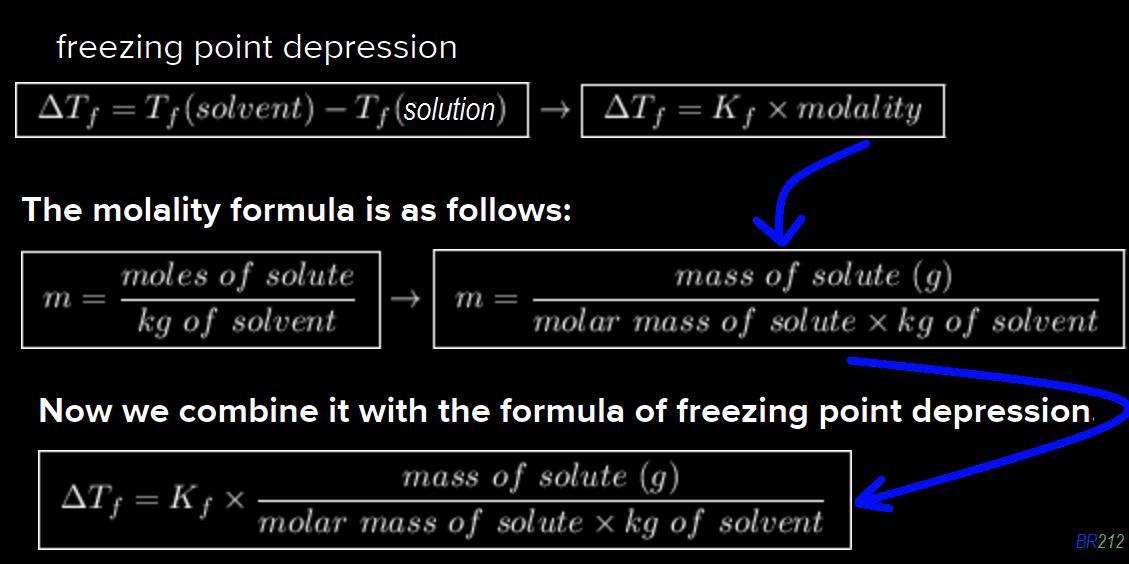
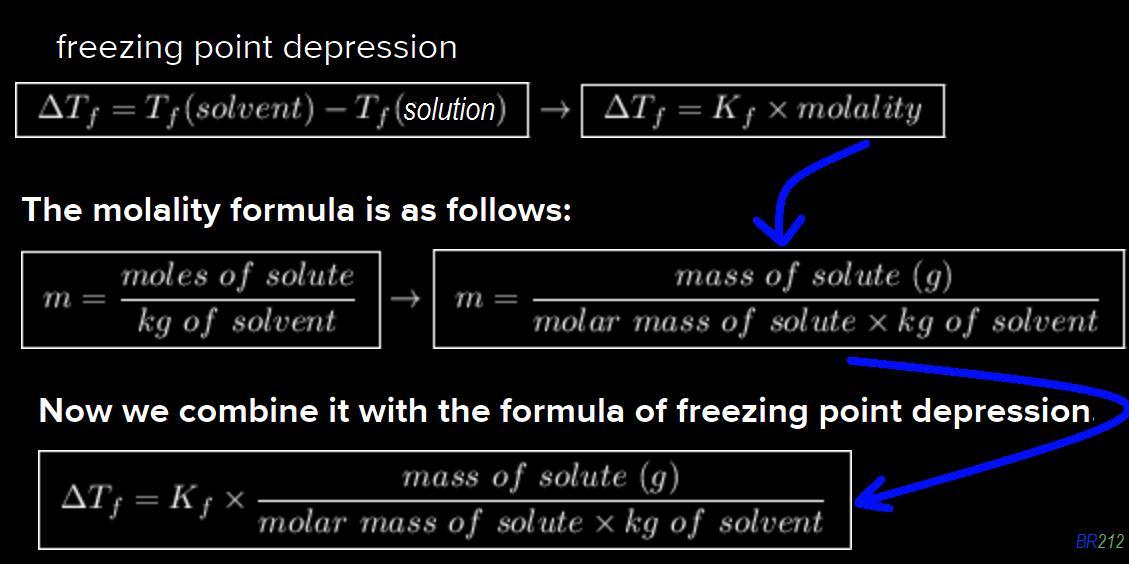
The freezing point of the solution is the temperature at which the solution begins to freeze. The difference between the freezing point of the solvent and the freezing point of the solution is called freezing point depression.

\boxed{ \ \Delta T_f = T_f(solvent) - T_f(solution) \ } \rightarrow \boxed{ \ \Delta T_f = K_f \times molality \ }

<u>Given:</u>

A mysterious white powder could be,

  • powdered sugar (C₁₂H₂₂O₁₁) with a molar mass of 342.30 g/moles,
  • cocaine (C₁₇H₂₁NO₄) with a molar mass of 303.35 g/moles,
  • codeine (C₁₈H₂₁NO₃) with a molar mass of 299.36 g/moles,
  • norfenefrine (C₈H₁₁NO₂) with a molar mass of 153.18 g/moles, or
  • fructose (C₆H₁₂O₆) with a molar mass of 180.16 g/moles.

When 82 mg of the powder is dissolved in 1.50 mL of ethanol (density = 0.789 g/cm³, normal freezing point −114.6°C, Kf = 1.99°C/m), the freezing point is lowered to −115.5°C.

<u>Question: </u>What is the identity of the white powder?

<u>The Process:</u>

Let us identify the solute, the solvent, initial, and final temperatures.

  • The solute = the powder
  • The solvent = ethanol
  • The freezing point of the solvent = −114.6°C
  • The freezing point of the solution = −115.5°C

Prepare masses of solutes and solvents.

  • Mass of solute = 82 mg = 0.082 g
  • Mass of solvent = density x volume, i.e., \boxed{ \ 0.789 \ \frac{g}{cm^3} \times 1.50 \ cm^3 = 1.1835 \ g = 0.00118 \ kg  \ }

We must prepare the solvent mass unit in kg because the unit of molality is the mole of the solute divided by the mass of the solvent in kg.

The molality formula is as follows:

\boxed{ \ m = \frac{moles \ of \ solute}{kg \ of \ solvent} \ } \rightarrow \boxed{ \ m = \frac{mass \ of \ solute \ (g)}{molar \ mass \ of \ solute \times kg \ of \ solvent} \ }

Now we combine it with the formula of freezing point depression.

\boxed{ \ \Delta T_f =  K_f \times \frac{mass \ of \ solute \ (g)}{molar \ mass \ of \ solute \times kg \ of \ solvent} \ }

It is clear that we will determine the molar mass of the solute (denoted by Mr).

We enter all data into the formula.

\boxed{ \ -114.6^0C - (-115.5^0C) = 1.99 \frac{^0C}{m} \times \frac{0.082 \ g}{Mr \times 0.00118 \ kg} \ }

\boxed{ \ 0.9 = \frac{1.99 \times 0.082}{Mr \times 0.00118} \ }

\boxed{ \ Mr = \frac{0.16318}{0.9 \times 0.00118} \ }

We get \boxed{ \ Mr = 153.65 \ }

These results are very close to the molar mass of norfenefrine which is 153.18 g/mol. Thus the white powder is norfenefrine.

<h3>Learn more</h3>
  1. The molality and mole fraction of water brainly.com/question/10861444
  2. About the mass and density of ethylene glycol as an  antifreeze brainly.com/question/4053884
  3. About the solution as a homogeneous mixture  brainly.com/question/637791

Keywords: a mysterious white powder, sugar, cocaine, codeine, norfenefrine, fructose, the solute, the solvent, dissolved, ethanol, normal freezing point, the freezing point depression, the identity

Kaylis [27]2 years ago
7 0

The identity of the white powder is \boxed{\text{norfenefrine}(\text{C}_{8}\text{H}_{11}\text{NO}_{2})} .

Further Explanation:

Colligative properties

These are the properties that depend on the number of solute particles and not on their mass or identities. Following are the four colligative properties:

1. Relative lowering of vapor pressure

2. Elevation in boiling point

3. Depression in freezing point

4. Osmotic pressure

The temperature where a substance in its liquid form is converted into the solid state is known as freezing point. Freezing point depression is a colligative property because it depends on the number of moles of solute particles.

The expression for the freezing point depression is as follows:

\Delta\text{T}_\text{f}=\text{K}_\text{f}\,\text{m}       …… (1)


Here,

\Delta\text{T}_\text{f} is the depression in freezing point.

\text{K}_\text{f} is the cryoscopic constant.

m is the molality of the solution.

The formula to calculate the density of substance is as follows:

\text{Density of substance}=\dfrac{\text{Mass of substance}}{\text{Volume of substance}}                                                      …… (2)

Rearrange equation (2) for the mass of substance.

\text{Mass of substance}=(\text{Density of substance })(\text{Volume of substance})                                 …… (3)

The volume of the substance is to be converted into  . The conversion factor for this is,

1\,\text{ml}=1\,\text{cm}^3  

Therefore the volume of the substance can be calculated as follows:

\begin{aligned}\text{Volume}&=(1.50\,\text{mL})\left(\frac{1\,\text{cm}^3}{1\,\text{mL}}\right)\\&=1.50\,\text{cm}^3\end{aligned}  

Substitute 1.50\,\text{cm}^3 for the volume of substance and 0.789\,\text{g/gm}^3 for the density of the substance in equation (3) to calculate the mass of solvent.

\begin{aligned}\text{Mass of solvent}&=\left(\dfrac{0.789\,\text{g}}{1\,\text{cm}^3}\right)(1.50\,\text{cm}^3)\\&=1.1835\,\text{g}\end{aligned}  

This mass is to be converted into kg. The conversion factor for this is,

1\,\text{g}=10^{-3}\,\text{kg}  

Therefore the mass of solvent can be calculated as follows:

\begin{aligned}\text{Mass of solvent}&=(1.1835\,\text{g})\left(\dfrac{10^{-3}\,\text{kg}}{1\,\text{g}}\right)\\&=0.0011835\,\text{kg}\end{aligned}  

The mass of solute is to be converted into g. The conversion factor for this is,

 1\,\text{mg}=10^{-3}\,\text{g}

Therefore the mass of solute can be calculated as follows:

\begin{aligned}\text{Mass of solute}&=(82\,\text{mg})\left(\dfrac{10^{-3}\,\text{g}}{1\,\text{g}}\right)\\&=0.082\,\text{g}\end{aligned}  

The freezing point depression can be calculated as follows:

\begin{aligned}\Delta\text{T}_\text{f}&=-114.6\,^\circ\text{C}-(-115.5\,^\circ\text{C})\\&=0.9\,\circ\text{C}\end{aligned}

The formula to calculate the molality of solution is as follows:

\text{Molality of solution}=\dfrac{\text{Amount (mol) of solute}}{\text{Mass (kg) of solvent}}                                                        …… (4)

The formula to calculate the amount of solute is as follows:

\text{Amount of solute}=\dfrac{\text{Mass of solute}}{\text{Molar mass of solute}}                                                              …… (5)

Incorporating equation (5) into equation (4),

\text{Molality of solution}=\dfrac{\text{Mass of solute}}{(\text{Mass of solvent})(\text{Molar mass of solute})}                               …… (6)

Incorporating equation (6) into equation (1),

\Delta\text{T}_\text{f}=\text{k}_\text{f}\left(\dfrac{\text{Mass of solute}}{(\text{Mass of solvent})(\text{Molar mass of solute})}\right)                                           …… (7)

Rearrange equation (7) to calculate the molar mass of solute.

\text{Molar mass of solute}=\dfrac{\text{k}_\text{f}}{\Delta\text{T}_\text{f}}\left(\dfrac{\text{Mass of solute}}{\text{Mass of solvent}}\right)                                                        …… (8)

Substitute 1.99\,^\circ\text{C/m} for \text{k}_\text{f}, 0.9\,^\circ\text{C} for \Delta\text{T}_\text{f}, 0.082 g for the mass of solute and 0.0011835 kg for the mass of solvent in equation (8).

\begin{aligned}\text{Molar mass of solute}&=\left(\dfrac{1.99}{0.9}\right)\left(\dfrac{0.082}{0.0011835}\right)\\&=153.199\,\text{g/mol}\\&=\approx153.2\,\text{g/mol}\end{aligned}  

The molar mass of powdered sugar is 342.3 g/mol.

The molar mass of cocaine is 303.4 g/mol.

The molar mass of codeine is 299.4 g/mol.

The molar mass of norfenefrine is 153.2 g/mol.

The molar mass of fructose is 180.2 g/mol.

The calculated molar mass of solute is similar to that of norfenefrine. So the identity of the white powder is norfenefrine.

Learn more:

  1. What is the concentration of alcohol in terms of molarity? brainly.com/question/9013318
  2. What is the molarity of the stock solution? brainly.com/question/2814870

Answer details:

Grade: Senior School

Chapter: Solutions

Subject: Chemistry

Keywords: colligative properties, depression in freezing point, cryoscopic constant, freezing point, 153.199 g/mol, norfenefrine.

You might be interested in
A gas effuses 1.55 times faster than propane (C3H8)at the
stepladder [879]

Answer:  The mass of the gas is 18.3 g/mol.

Explanation:

To calculate the rate of diffusion of gas, we use Graham's Law.

This law states that the rate of effusion or diffusion of gas is inversely proportional to the square root of the molar mass of the gas. The equation given by this law follows:

\text{Rate of diffusion}\propto \frac{1}{\sqrt{\text{Molar mass of the gas}}}

\frac{Rate_{X}}{Rate_{C_3H_8}}=1.55

\frac{Rate_{X}}{Rate_{C_3H_8}}=\sqrt{\frac{M_{C_3H_8}}{M_{X}}}

1.55=\sqrt{\frac{44}{M_{X}}

Squaring both sides and solving for M_{X}

M_{X}=18.3g/mol

Hence, the molar mas of unknown gas is 18.3 g/mol.

5 0
2 years ago
Read 2 more answers
Student Exploration: Collision Theory Vocabulary: activated complex, catalyst, chemical reaction, concentration, enzyme, half-li
Alika [10]

Answer:

1. Hot water

2. A pile of wood shavings

Explanation:

Sugar can dissolve more quickly in hot water than in cold water because there is more energy in hot water molecules. Because they are moving faster, they have more energy to break the bonds that hold sugar together. There is also more energy available to break the hydrogen bonds that hold water together.

Wood shavings have a greater contact surface than the solid hunk of wood, which is why they have a higher calorific value and then they will catch fire more easily.

4 0
2 years ago
The concentration of sodium chloride in an aqueous solution that is 2.23 M and that has a density of 1.01 g/mL is __________% by
amm1812

Answer:

The concentration of sodium chloride in an aqueous solution that is 2.23 M and that has a density of 1.01 g/mL is 12.90% by mass

Explanation:

2.23 M aqueous solution of NaCl means there are 2.23 moles of NaCl in 1000 mL of solution.

We know that density is equal to ratio of mass to volume.

Here density of solution is 1.01 g/mL.

So mass of 1000 mL solution = (1.01\times 1000) g = 1010 g

molar mass of NaCl = 58.44 g/mol

So mass of 2.23 moles of NaCl = (2.23\times 58.44) g = 130.3 g

% by mass  is ratio of mass of solute to mass of solution and then  multiplied by 100.

Here solute is NaCl.

So % by mass of 2.23 M aqueous solution of NaCl = \frac{130.0}{1010}\times 100% = 12.90%

3 0
2 years ago
Phosphorous acid, H3PO3(aq), is a diprotic oxyacid that is an important compound in industry and agriculture. K pKa1 K pKa2 1.30
FrozenT [24]

Answer:

* Before addition of any KOH:

pH = 0,0301

*After addition of 25.0 mL KOH:

pH = 1,30

*After addition of 50.0 mL KOH:

pH = 2,87

*After addition of 75.0 mL KOH:

pH = 6,70

*After addition of 100.0 mL KOH:

pH = 10,7

Explanation:

H₃PO₃ has the following equilibriums:

H₃PO₃ ⇄ H₂PO₃⁻ H⁺

k = [H₂PO₃⁻] [H⁺] / [H₃PO₃] k = 10^-(1,30) <em>(1)</em>

H₂PO₃⁻ ⇄ HPO₃²⁻ + H⁺

k = [HPO₃²⁻] [H⁺] / [H₂PO₃⁻] k = 10^-(6,70) <em>(2)</em>

Moles of H₃PO₃ are:

0,0500L×(1,8mol/L) = 0,09 moles of H₃PO₃

* Before addition of any KOH:

Using (1), moles in equilibrium are:

H₃PO₃: 0,09-x

H₂PO₃⁻: x

H⁺: x

Replacing:

10^{-1.30} = \frac{x^2}{0.09-x}

4.51x10⁻³ - 0.050x -x² = 0

The right solution of x is:

x = 0.0466589

As volume is 0,050L

[H⁺] = 0.0466589moles / 0,050L = 0,933M

As pH = -log [H⁺]

<em>pH = 0,0301</em>

*After addition of 25.0 mL KOH:

0,025L×1,8M = 0,045 moles of KOH that reacts with H₃PO₃ thus:

KOH + H₃PO₃ → H₂PO₃⁻ + H₂O

That means moles of KOH will be the same of H₂PO₃⁻ and moles of H₃PO₃ are 0,09moles - 0,045moles = 0,045moles

Henderson-Hasselbalch formula is:

pH = pka + log₁₀ [A⁻] /[HA]

Where A⁻ is H₂PO₃⁻ and HA is H₃PO₃.

Replacing:

pH = 1,30 + log₁₀ [0,045mol] / [0,045mol]

<em>pH = 1,30</em>

*After addition of 50.0 mL KOH:

The addition of 50.0 mL KOH consume all H₃PO₃. Thus, in the solution you will have just H₂PO₃⁻. Thus, moles in solution for the equilibrium will be:

H₂PO₃⁻: 0,09-x

HPO₃²⁻: x

H⁺: x

Replacing:

10^{-6.70} = \frac{x^2}{0.09-x}

1.8x10⁻⁸ - 2x10⁻⁷x - x² = 0

The right solution of x is:

x = 0.000134064

As volume is 50,0mL + 50,0mL = 100,0mL

[H⁺] = 0.000134064moles / 0,100L = 1.34x10⁻³M

As pH = -log [H⁺]

<em>pH = 2,87</em>

*After addition of 75.0 mL KOH:

Applying Henderson-Hasselbalch formula you will have 0,045 moles of both H₂PO₃⁻ HPO₃²⁻ and pka: 6,70:

pH = 6,70 + log₁₀ [0,045mol] / [0,045mol]

<em>pH = 6,70</em>

*After addition of 100.0 mL KOH:

You will have just 0,09moles of HPO₃²⁻, the equilibrium will be:

HPO₃²⁻ + H₂O ⇄ H₂PO₃⁻ + OH⁻ with kb = kw/ka = 1x10⁻¹⁴/10^-(6,70) = 5,01x10⁻⁸

kb = [H₂PO₃⁻] [OH⁻] / [HPO₃²⁻]

Moles are:

H₂PO₃⁻: x

OH⁻: x

HPO₃²⁻: 0,09-x

Replacing:

5.01x10^{-8} = \frac{x^2}{0.09-x}

4.5x10⁻⁹ - 5.01x10⁻⁸x - x² = 0

The right solution of x is:

x = 0.000067057

As volume is 50,0mL + 100,0mL = 150,0mL

[OH⁻] = 0.000067057moles / 0,150L = 4.47x10⁻⁴M

As pH = 14-pOH; pOH = -log [OH⁻]

<em>pH = 10,7</em>

<em></em>

I hope it helps!

6 0
2 years ago
Starting with 1.5052g of BaCl2•2H2O and excessH2SO4, how many grams of BaSO4 can be formed?
muminat
1.5052g BaCl2.2H2O => 1.5052g / 274.25 g/mol = 0.0054884 mol
=> 0.0054884 mol Ba 
<span>This means that at most 0.0054884 mol BaSO4 can form since Ba is the limiting reagent. </span>
<span>0.0054884 mol BaSO4 => 0.0054884 mol * 233.39 g/mol = 1.2809 g BaSO4</span>
6 0
2 years ago
Read 2 more answers
Other questions:
  • Given that the molar mass of NaNO3 is 85.00 g/mol, what mass of NaNO3 is needed to make 4.50 L of a 1.50 M NaNO3 solution?
    11·2 answers
  • If 14c-labeled uracil is added to the growth medium of cells, what macromolecules will be labeled?
    7·2 answers
  • Which mass of urea CO(NH2)2 contains same mass of nitrogen as 101.1 g of potassium nitrate?
    5·1 answer
  • In the preceding information section there is a "bohr's diagram" of an atom. Which atom is it?
    9·1 answer
  • The half-life of C-14 is 5470 years. If a particular archaeological sample has one-quarter of its original radioactivity remaini
    15·2 answers
  • A student did not read the direction to the experiment properly and mixed up where to place the NaOH solution and the vinegar. H
    8·1 answer
  • A reaction produces a gas, which is collected in a glass cylinder. When a glowing splint is placed inside the container, it burn
    15·1 answer
  • Mercury and bromine willreact with each other to produce mercury (II) bromide:Hg(l)+Br2(l)--&gt;HgBr2(s)Consider an experimentwh
    5·2 answers
  • Stabiliţi numerele de oxidare ale tuturor elementelor prezente în următoarele substanţe chimice, ţinând cont de principalele reg
    10·1 answer
  • What are minerals the building blocks of?
    5·2 answers
Add answer
Login
Not registered? Fast signup
Signup
Login Signup
Ask question!