answer.
Ask question
Login Signup
Ask question
All categories
  • English
  • Mathematics
  • Social Studies
  • Business
  • History
  • Health
  • Geography
  • Biology
  • Physics
  • Chemistry
  • Computers and Technology
  • Arts
  • World Languages
  • Spanish
  • French
  • German
  • Advanced Placement (AP)
  • SAT
  • Medicine
  • Law
  • Engineering
Ksivusya [100]
2 years ago
5

What are minerals the building blocks of?

Chemistry
2 answers:
Elenna [48]2 years ago
4 0

Answer:?

Explanation:

Elina [12.6K]2 years ago
4 0

Answer:

Minerals are the building blocks of rocks. Nature cements combinations of minerals together to form rocks.

Explanation:

You might be interested in
The electron in a ground-state H atom absorbs a photon of wavelength 97.20 nm. To what energy level does it move?
Lunna [17]

Answer:

E = h v = 6.626 x 10^{-34} x 97.20 x 10^{-9} = 6.44 x 10^{-41} J = 4.01 x 10^{-22} eV

n = Energy Level = -E^{0} / E = -13.6 / 4.01 x 10^{-22} = 3.39 x 10^{22} = 1.84 x 10^{11} energy level...

7 0
2 years ago
What is the reaction energy Q of this reaction? Use c2=931.5MeV/u. Express your answer in millions of electron volts to three si
emmasim [6.3K]

Answer:

Energy= 2.7758 × 10^-11 J ;

71.112×10^-6 kJ.

Mass defect in Kilogram= 3.0885×10^-28 kg.

That is; 3.1×10^-28 kg(to two significant figure).

Explanation:

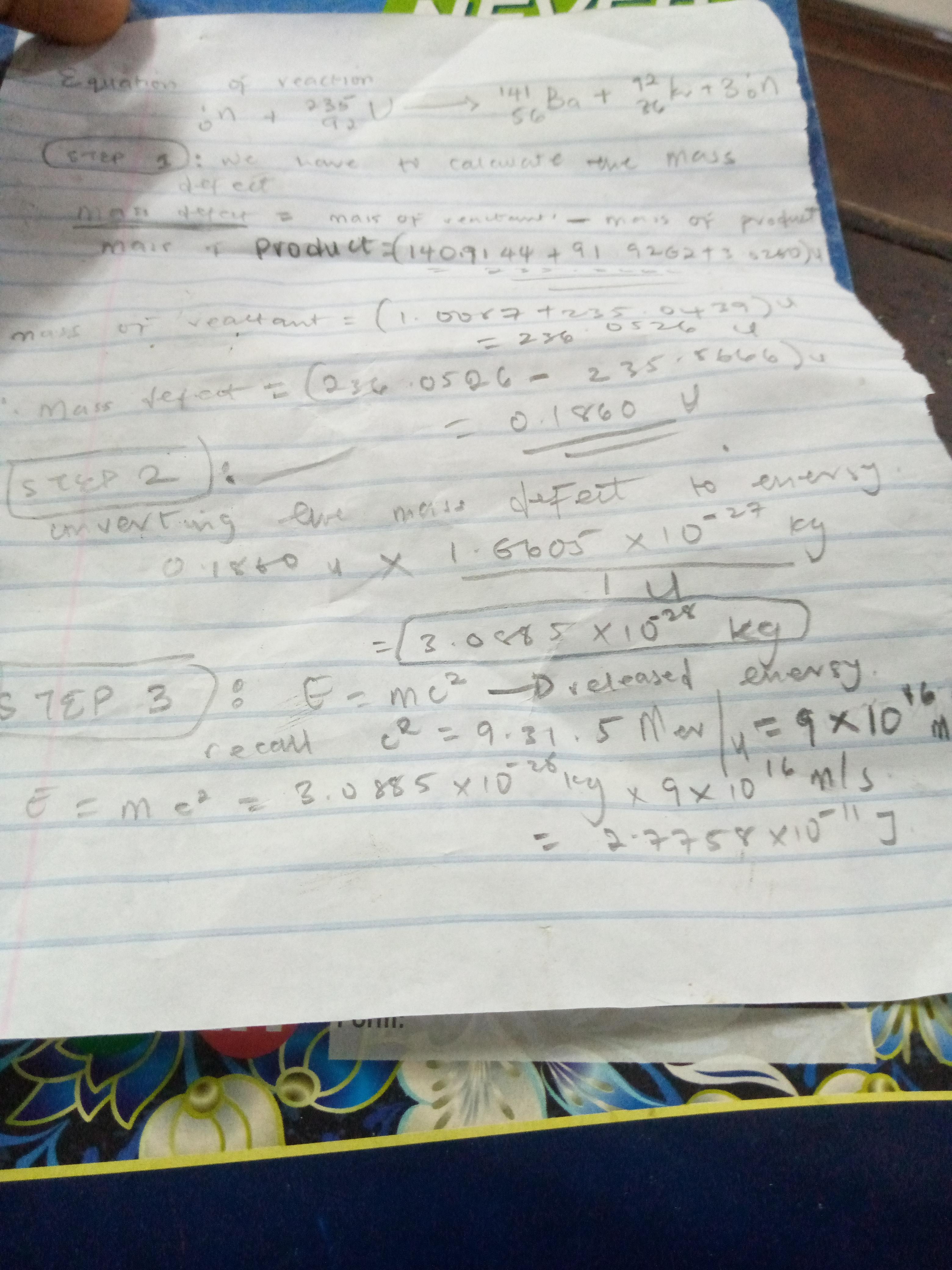
(Note: Check equation of reaction in the attached file/picture).

STEP ONE: we have to calculate the Mass defect.

Mass defect= Mass of reactants -- Mass of products.

Mass of the products: (140.9144+91.9262+3.060) u.

= 235.8666 u.

Mass of reactants: (1.0087+235.0439) u= 236.0526 u.

Therefore, the Mass defect= (236.0526 -- 235.8666) u

= 0.1860 u.

STEP TWO: Converting the Mass defect to energy;

0.18860 × 1.6605 × 10^27 kg

= 3.0885× 10^-28 kg

STEP THREE: Calculating energy released . Recall(from the question) c^2= 931.5 Mev/u. This is also equals to 9×10^16 m/s.

E=Mc^2.

Where E= energy released, c= speed of light, M= Mass.

Slotting in the values;

E= 3.0885×10^-28 kg × 9×10^16 m/s.

E=2.7758 × 10^-11 J.

Know that;( 1g of uranium × 1 mol of uranium ÷ 235.0439 g of uranium) × (6.002×10^23 atom of uranium/ 1 mol of uranium) × 2.7758× 10^-11.

=7.1112×10^-10 J

= 71.112×10^6 kJ.

3 0
2 years ago
A student heats a sample of Copper (II) sulfate in a crucible and records the data shown in the table. What is the complete form
liberstina [14]

Explanation:

Copper (II) sulfate is usually present as a hydrous state, which is of the form CuSO4 * nH2O, where n is a whole number.

Mass of sample (CuSO4 * nH2O)

= 152.00g - 128.10g = 23.90g.

Mass of water loss during heating

= 152.00g - 147.60g = 4.40g.

Molar mass of H2O = 18g/mol

Moles of H2O in sample

= 4.40g / (18g/mol) = 0.244mol.

Mass of anhydrous sample (CuSO4)

= 23.90g - 4.40g = 19.50g

Molar mass of CuSO4 = 159.61g/mol

Moles of CuSO4 in sample

= 19.50g / (159.61g/mol) = 0.122mol.

Since mole ratio of CuSO4 to H2O

= 0.122mol : 0.244mol = 1:2, n = 2.

Hence we have CuSO4 * 2H2O.

6 0
2 years ago
Read 2 more answers
Use the virtual lab to prepare 150.0 ml of an iodine solution with a concentration of 0.06 g/ ml from the bottle of 0.12g/ml iod
son4ous [18]

Answer:

Explanation:

In 150 ml of .06 g / ml solution , gram of iodine = 150 x .06 g = 9 g

Let volume of given concentration of .12 g / ml required be V

In volume V , gram of iodine = V x .12 g

According to question

V x .12 = 9 g

V = 9 / .12 = 75 ml

So, 75 ml of .12 g/ml will be taken and it is diluted to the volume of 150 ml to get the solution of required concentration .

8 0
2 years ago
84. Heavy water, D2O (molar mass = 20.03 g mol–1), can be separated from ordinary water, H2O (molar mass = 18.01), as a result o
ipn [44]

Answer:

relative rate of diffusion is 1.05

Explanation:

According to Graham's law of difussion:

Rate of diffusion is inversely proportional to the square root of molecular weight of a molecule.

For two given molecules:

\frac{(rate)_{1}}{(rate)_{2}}=\frac{\sqrt{M_{2}} }{\sqrt{M_{1}}}

The given molecules are

Water = 18.01

Heavy water =20.03

Thus the relative rate of diffusion will be:

\frac{(rate)_{water}}{(rate)_{heavywater}}=\sqrt{ \frac{20.03}{18.01}}=1.05

8 0
2 years ago
Other questions:
  • Which term names the metamorphic change to a rock that results mainly from the heat energy of nearby magma? A. local metamorphis
    5·2 answers
  • Explain how a solution can be both dilute and saturated.
    7·2 answers
  • Explain why c6h5ch2ch2br is not formed during the radical bromination of c6h5ch2ch3. select the single best answer.
    8·1 answer
  • What tool would you need discover whether a mineral has fracture?
    7·1 answer
  • Consider the nuclear equation below. Superscript 124 subscript 56 B a right arrow superscript 124 subscript 55 upper C s plus qu
    14·2 answers
  • 2. After quenching your solution with ice, the resulting aqueous layer became acidic. Use a chemical equation to explain how the
    12·1 answer
  • Determine whether or not the mixing of each of the two solutions indicated below will result in a buffer.
    6·1 answer
  • 6. Un volumen de 1.0 mL de agua de mar contiene casi 4 x 10-12 g de Au. El volumen total de agua en los océanos es de 1.5 x 10²¹
    10·1 answer
  • Could the other molecules in this simulation (argon, oxygen, and water) be considered pure substances? Explain your thinking.
    14·1 answer
  • The mass of a container is determined to be 1.2 g. A sample of a compound is transferred to this container, and the mass of the
    10·1 answer
Add answer
Login
Not registered? Fast signup
Signup
Login Signup
Ask question!