answer.
Ask question
Login Signup
Ask question
All categories
  • English
  • Mathematics
  • Social Studies
  • Business
  • History
  • Health
  • Geography
  • Biology
  • Physics
  • Chemistry
  • Computers and Technology
  • Arts
  • World Languages
  • Spanish
  • French
  • German
  • Advanced Placement (AP)
  • SAT
  • Medicine
  • Law
  • Engineering
icang [17]
2 years ago
6

The acrylic plastic rod is 200 mm long and 15 mm in diameter. If an axial load of 300 N is applied to it, determine the change i

n its length and the change in its diameter. Ep=2.70 GPa, np=0.4.
Engineering
1 answer:
ehidna [41]2 years ago
8 0

Answer:

Change in length = 0.1257 mm

Change in diameter= -0.03771mm

Explanation:

Given

Diameter, d = 15 mm

Length of rod, L = 200mm

F = Force= 300N

d = 0.015m

Ep=2.70 GPa, np=0.4.

First, we have to calculate the normal stress using

σ = F/A where F = Force acting on the Cross-sectional area

A = Area

Area is calculated as πd²/4 where d = 0.015m

A = 22/7 * 0.015²/4

A = 0.000176785714285m²

A = 1.768E-4m²

So, stress. σ = 300N/1.768E-4m²

σ = 1696832.579185520Pa

σ = 1.697MPa

Calculating E(long)

E(long) = σ /Ep

E(long) = 1.697E-3/2.70

E(long) = 0.0006285

At this point, we fan now calculate the change in length of the element;

∆L = E(long) * L

∆L = 0.0006285 * 200mm

∆L = 0.1257mm

Calculating E(lat)

E(lat) = -np * E(long)

E(lat) = -4 * 0.0006285

E(lat) = -0.002514

At this point, we can now calculate the change in diameter of the element;

∆D = E(lat) * D

∆L = -0.002514 * 15mm

∆L = -0.03771mm

You might be interested in
The closed tank of a fire engine is partly filled with water, the air space above being under pressure. A 6 cm bore connected to
skelet666 [1.2K]

Answer:

The air pressure in the tank is 53.9 kN/m^{2}

Solution:

As per the question:

Discharge rate, Q = 20 litres/ sec = 0.02\ m^{3}/s

(Since, 1 litre = 10^{-3} m^{3})

Diameter of the bore, d = 6 cm = 0.06 m

Head loss due to friction, H_{loss} = 45 cm = 0.45\ m

Height, h_{roof} = 2.5\ m

Now,

The velocity in the bore is given by:

v = \frac{Q}{\pi (\frac{d}{2})^{2}}

v = \frac{0.02}{\pi (\frac{0.06}{2})^{2}} = 7.07\ m/s

Now, using Bernoulli's eqn:

\frac{P}{\rho g} + \frac{v^{2}}{2g} + h = k                  (1)

The velocity head is given by:

\frac{v_{roof}^{2}}{2g} = \frac{7.07^{2}}{2\times 9.8} = 2.553

Now, by using energy conservation on the surface of water on the roof and that in the tank :

\frac{P_{tank}}{\rho g} + \frac{v_{tank}^{2}}{2g} + h_{tank} = \frac{P_{roof}}{\rho g} + \frac{v_{tank}^{2}}{2g} + h_{roof} + H_{loss}

\frac{P_{tank}}{\rho g} + 0 + 0 = \0 + 2.553 + 2.5 + 0.45

P_{tank} = 5.5\times \rho \times g

P_{tank} = 5.5\times 1\times 9.8 = 53.9\ kN/m^{2}

4 0
2 years ago
Laminar flow normally persists on a smooth flat plate until a critical Reynolds number value is reached. However, the flow can b
grandymaker [24]

Answer:

At L = 0.1 m

h⁻_lam = 11.004K   W/m^1.5

h⁻_turb = 7.8848K   W/m^1.8

At L = 1 m

h⁻_lam = 3.48K   W/m^1.5

h⁻_turb = 4.975K   W/m^1.8

Explanation:

Given that;

h_lam(x)= 1.74 W/m^1.5. Kx^-0.5

h_turb(x)= 3.98 W/m^1.8 Kx^-0.2

conditions for plates of length L = 0.1 m and 1 m

Now

Average heat transfer coefficient is expressed as;

h⁻ = 1/L ₀∫^L hxdx

so for Laminar flow

h_lam(x)= 1.74 . Kx^-0.5  W/m^1.5

from the expression

h⁻_lam = 1/L ₀∫^L 1.74 . Kx^-0.5   dx

= 1.74k / L { [x^(-0.5+1)] / [-0.5 + 1 ]}₀^L

= 1.74k/L = [ (x^0.5)/0.5)]⁰^L

= 1.74K × L^0.5 / L × 0.5

h⁻_lam= 3.48KL^-0.5

For turbulent flow

h_turb(x)= 3.98. Kx^-0.2 W/m^1.8

form the expression

1/L ₀∫^L 3.98 . Kx^-0.2   dx

= 3.98k / L { [x^(-0.2+1)] / [-0.2 + 1 ]}₀^L

= (3.98K/L) × (L^0.8 / 0.8)

h⁻_turb = 4.975KL^-0.2

Now at L = 0.1 m

h⁻_lam = 3.48KL^-0.5  =  3.48K(0.1)^-0.5  W/m^1.5

h⁻_lam = 11.004K   W/m^1.5

h⁻_turb = 4.975KL^-0.2 = 4.975K(0.1)^-0.2

h⁻_turb = 7.8848K   W/m^1.8

At L = 1 m

h⁻_lam = 3.48KL^-0.5  =  3.48K(1)^-0.5  W/m^1.5

h⁻_lam = 3.48K   W/m^1.5

h⁻_turb = 4.975KL^-0.2 = 4.975K(1)^-0.2

h⁻_turb = 4.975K   W/m^1.8

Therefore

At L = 0.1 m

h⁻_lam = 11.004K   W/m^1.5

h⁻_turb = 7.8848K   W/m^1.8

At L = 1 m

h⁻_lam = 3.48K   W/m^1.5

h⁻_turb = 4.975K   W/m^1.8

3 0
2 years ago
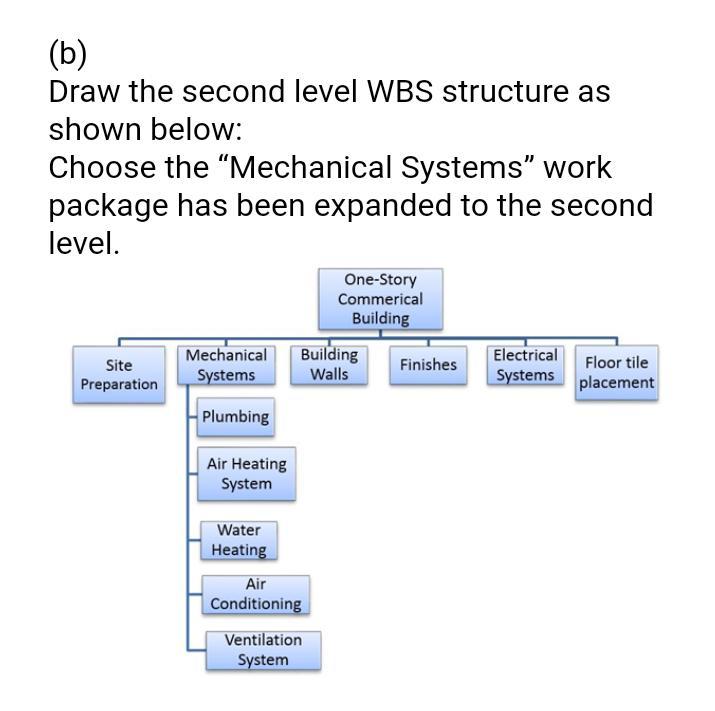
Develop a preliminary work breakdown structure (WBS) for a small one-story commercial building to be constructed on the site of
Zielflug [23.3K]

Answer:

The preliminary work breakdown structure will be divided into two steps, the first is to draw the first level and the second is to draw the second level.

Explanation:

Please look at attachment.

6 0
2 years ago
Read 2 more answers
The 8-mm-thick bottom of a 220-mm-diameter pan may be made from aluminum (k = 240 W/m ⋅ K) or copper (k = 390 W/m ⋅ K). When use
Artemon [7]

Answer:

For aluminum 110.53 C

For copper 110.32 C

Explanation:

Heat transmission through a plate (considering it as an infinite plate, as in omitting the effects at the borders) follows this equation:

q = \frac{k * A * (th - tc)}{d}

Where

q: heat transferred

k: conduction coeficient

A: surface area

th: hot temperature

tc: cold temperature

d: thickness of the plate

Rearranging the terms:

d * q = k * A * (th - tc)

\frac{d * q}{k * A} = th - tc

th = \frac{d * q}{k * A} + tc

The surface area is:

A = \frac{\pi * d^2}{4}

A = \frac{\pi * 0.22^2}{4} = 0.038 m^2

If the pan is aluminum:

th = \frac{0.008 * 600}{240 * 0.038} + 110 = 110.53 C

If the pan is copper:

th = \frac{0.008 * 600}{390 * 0.038} + 110 = 110.32 C

7 0
2 years ago
A single crystal of a metal that has the FCC crystal structure is oriented such that a tensile stress is applied parallel to the
bagirrra123 [75]

The magnitude of applied stress in the direction of 101 is 12.25 MPA and in the direction of 011, it is not defined.                                          

Explanation:        

Given:

tensile stress is applied parallel to the [100] direction

Shear stress is 0.5 MPA.

To calculate:

The magnitude of applied stress in the direction of [101] and [011].

Formula:

zcr=σ cosФ cosλ

Solution:

For in the direction of 101

cosλ = (1)(1)+(0)(0)+(0)(1)/√(1)(2)

cos λ = 1/√2

The magnitude of stress in the direction of 101 is 12.25 MPA

In the direction of 011

We have an angle between 100 and 011

cosλ = (1)(0)+(0)(-1)+(0)(1)/√(1)(2)

cosλ  = 0

Therefore the magnitude of stress to cause a slip in the direction of 011 is not defined.                                                                                                                                      

6 0
2 years ago
Other questions:
  • Mary is interested in developing new machines that would increase the productivity of small scale farmers. After high school, wh
    8·1 answer
  • A closed system consisting of 4 lb of a gas undergoes a process during which the relation between pressure and volume is pVn 5 c
    7·1 answer
  • A 0.2-m^3 rigid tank equipped with a pressure regulator contains steam at 2MPa and 320C. The steam in the tank is now heated. Th
    9·1 answer
  • A sign erected on uneven ground is guyed by cables EF and EG. If the force exerted by cable EF at E is 46 lb, determine the mome
    13·1 answer
  • An electric field is expressed in rectangular coordinates by E = 6x2ax + 6y ay +4az V/m.Find:a) VMN if point M and N are specifi
    14·1 answer
  • Add a calculated field named AccountTime that calculates the number of days each client's accounts have been open. Assume today'
    6·1 answer
  • Can crushers help us recycle in a space efficient way which is good for saving the earth and for giving you more room in your ap
    7·1 answer
  • What ratio between differential gain and common-mode gain is called​
    9·1 answer
  • Water at 70 kPa and 1008C is compressed isentropically in a closed system to 4 MPa. Determine the final temperature of the water
    6·1 answer
  • Mr. Ray deposited $200,000 in the Old and Third National Bank. If the bank pays 8% interest, how much will he have in the accoun
    10·2 answers
Add answer
Login
Not registered? Fast signup
Signup
Login Signup
Ask question!