answer.
Ask question
Login Signup
Ask question
All categories
  • English
  • Mathematics
  • Social Studies
  • Business
  • History
  • Health
  • Geography
  • Biology
  • Physics
  • Chemistry
  • Computers and Technology
  • Arts
  • World Languages
  • Spanish
  • French
  • German
  • Advanced Placement (AP)
  • SAT
  • Medicine
  • Law
  • Engineering
maks197457 [2]
2 years ago
10

A single crystal of a metal that has the FCC crystal structure is oriented such that a tensile stress is applied parallel to the

[110] direction. If the critical resolved shear stress for this material is 1.75 MPa, calculate the magnitude(s) of applied stresses necessary to cause slip to occur on the (111) plane in each of the [11 0], [101] and [011] directions.
Engineering
1 answer:
bagirrra123 [75]2 years ago
6 0

The magnitude of applied stress in the direction of 101 is 12.25 MPA and in the direction of 011, it is not defined.                                          

Explanation:        

Given:

tensile stress is applied parallel to the [100] direction

Shear stress is 0.5 MPA.

To calculate:

The magnitude of applied stress in the direction of [101] and [011].

Formula:

zcr=σ cosФ cosλ

Solution:

For in the direction of 101

cosλ = (1)(1)+(0)(0)+(0)(1)/√(1)(2)

cos λ = 1/√2

The magnitude of stress in the direction of 101 is 12.25 MPA

In the direction of 011

We have an angle between 100 and 011

cosλ = (1)(0)+(0)(-1)+(0)(1)/√(1)(2)

cosλ  = 0

Therefore the magnitude of stress to cause a slip in the direction of 011 is not defined.                                                                                                                                      

You might be interested in
Six years ago, an 80-kW diesel electric set cost $160,000. The cost index for this class of equipment six years ago was 187 and
exis [7]

Answer:

new boiler total cost = $229706.825

new boiler total cost = $127512

Explanation:

given data

power p1 = 80 kW

cost C = $160000

cost index CI 1 = 187

cost index CI 2= 194

cost capacity factor f = 0.6

power p2 = 120 kW

current cost = $18000

to find out

total cost and cost of 40 kW

solution

we consider here CN cost for new boiler and CO cost for old boiler

and x is capacity of new boiler

first we find old boiler current cost that is

current cost CO = C × \frac{CI 1 }{CI 2 }   .............1

put here value

current cost = 160000 × \frac{194 }{187 }

new current cost = $165989.304

and

use here power sizing technique for 124 kW

CN/CO = (\frac{p2}{p1} )^{f}    ...............2

put here value and find CN

CN/CO = (\frac{p2}{p1} )^{f}  

CN / 165989.304 = (\frac{120}{80} )^{0.6}  

CN = 211706.825

so new cost = $211706.825

so

total cost for new boiler is

total cost = new cost + current cost

total cost = 211706.825 + 18000

new boiler total cost = $229706.825

and

for 40 kW new cost will be

use equation 2

CN/CO = (\frac{p2}{p1} )^{f}

CN / 165989.304 = (\frac{40}{80} )^{0.6}  

CN = 109512

so new cost is $109512

so

total cost for new boiler is

total cost = new cost + current cost

total cost = 109512 + 18000

new boiler total cost = $127512

7 0
2 years ago
A person puts a few apples into the freezer at -15oC to cool them quickly for guests who are about to arrive. Initially, the app
frosja888 [35]

Answer:

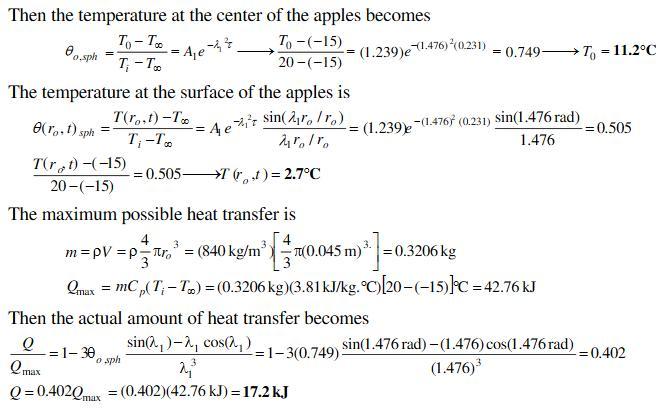
Temperature at center of apples = 11.2⁰C

Temperature at surface of apples = 2.7⁰C

Amount of Heat transferred = 17.2kJ

Explanation:

The properties of apple are given as:

k = 0.418 W/m.°C

ρ = 840 kg/m³

Cр = 3.81 kJ/kg.°C

α = 1.3*10 ⁻⁷ m²/s

h = 8 W/m².°C

d = 0.09m

r = 0.045m

t = 1 hour = 3600s

<h2>Solution</h2>

Biot number is given as:

Bi = \frac{hr}{k}= \frac{8\cdot0.045}{0.418}=0.861

The constants λ₁ and A₁ corresponding to Biot number (from the table) are:

λ₁ = 1.476

A₁ = 1.239

Fourier Number is:

T = \frac{a\cdot{t}}{r^2} = \frac{(1.3\cdot10^{-7})(3600)}{0.045^2}= 0.231> 0.2

As Fourier Number > 0.2 , one term approximates solutions are applicable

The temperature at the center of apples, The temperature at surface of apples and Amount of heat transfer is found in the ATTACHMENT.

8 0
2 years ago
Which of the following is NOT true about hydraulic valves? A. Directional control valves determine the path of a fluid in a give
Lelechka [254]

Answer: Option D is not true of hydraulic valves. A hydraulic valve is a device that can change the opening degree of liquid flow path

Explanation:

The pilot check valve allows flow of liquid in one direction and blocks flow in the opposite direction

5 0
2 years ago
A fatigue test was conducted in which the mean stress was 46.2 MPa and the stress amplitude was 219 MPa.
sleet_krkn [62]

Answer:

a)σ₁ = 265.2 MPa

b)σ₂ = -172.8 MPa

c)Stress\ ratio =-0.65

d)Range = 438 MPa

Explanation:

Given that

Mean stress ,σm= 46.2 MPa

Stress amplitude ,σa= 219 MPa

Lets take

Maximum stress level = σ₁

Minimum stress level =σ₂

The mean stress given as

\sigma_m=\dfrac{\sigma_1+\sigma_2}{2}

2\sigma_m={\sigma_1+\sigma_2}

2 x 46.2 =  σ₁ +  σ₂

 σ₁ +  σ₂ = 92.4 MPa    --------1

The amplitude stress given as

\sigma_a=\dfrac{\sigma_1-\sigma_2}{2}

2\sigma_a={\sigma_1-\sigma_2}

2 x 219 =  σ₁ -  σ₂

 σ₁ -  σ₂ = 438 MPa    --------2

By adding the above equation

2  σ₁ = 530.4

σ₁ = 265.2 MPa

-σ₂ = 438 -265.2 MPa

σ₂ = -172.8 MPa

Stress ratio

Stress\ ratio =\dfrac{\sigma_{min}}{\sigma_{max}}

Stress\ ratio =\dfrac{-172.8}{265.2}

Stress\ ratio =-0.65

Range = 265.2 MPa - ( -172.8 MPa)

Range = 438 MPa

8 0
2 years ago
At an impaired driver checkpoint, the time required to conduct the impairment test varies (according to an exponential distribut
professor190 [17]

Answer:

Option (d) 2 min/veh

Explanation:

Data provided in the question:

Average time required = 60 seconds

Therefore,

The maximum capacity that can be accommodated on the system, μ = 60 veh/hr

Average Arrival rate, λ = 30 vehicles per hour

Now,

The average time spent by the vehicle is given as

⇒ \frac{1}{\mu(1-\frac{\lambda}{\mu})}

thus,

on substituting the respective values, we get

Average time spent by the vehicle = \frac{1}{60(1-\frac{30}{60})}

or

Average time spent by the vehicle = \frac{1}{60(1-0.5)}

or

Average time spent by the vehicle = \frac{1}{60(0.5)}

or

Average time spent by the vehicle = \frac{1}{30} hr/veh

or

Average time spent by the vehicle = \frac{1}{30}\times60 min/veh

[ 1 hour = 60 minutes]

thus,

Average time spent by the vehicle = 2 min/veh

Hence,

Option (d) 2 min/veh

7 0
2 years ago
Other questions:
  • We are undergoing a period of rapid technology change with cloud computing, artificial intelligence, robotics, mobile devices, w
    12·1 answer
  • Your roommate wants to learn about organizational chart. You can tell her that these charts can tell you all of these about an o
    10·1 answer
  • The velocity of a particle which moves along the s-axis is given by v = 2-4t+5t^(3/2), where t is in seconds and v is in meters
    11·2 answers
  • Show that a chirped Gaussian pulse is compressed initially inside a single-mode fiber when ftC &lt; 0. Derive expressions for th
    12·1 answer
  • Refrigerant-134a is compressed from 2 bar, saturated vapor, to 10 bar, 90o C in a compressor operating at steady state. The mass
    11·1 answer
  • Anytime scaffolds are assembled or __________, a competent person must oversee the operation.
    15·2 answers
  • The total floor area of a building, including below-grade space but excluding unenclosed areas, measured from the exterior of th
    8·1 answer
  • Technician A says that weld-through primer can be removed from the immediate weld area to improve weld quality. Technician B say
    7·1 answer
  • An airplane in level flight at an altitude h and a uniform speed v passes directly over a radar tracking station A. Calculate th
    5·1 answer
  • if the mine winch drum diameter is 6 m, calculate how far the cage will drop for each single rotation of the drum
    9·1 answer
Add answer
Login
Not registered? Fast signup
Signup
Login Signup
Ask question!