answer.
Ask question
Login Signup
Ask question
All categories
  • English
  • Mathematics
  • Social Studies
  • Business
  • History
  • Health
  • Geography
  • Biology
  • Physics
  • Chemistry
  • Computers and Technology
  • Arts
  • World Languages
  • Spanish
  • French
  • German
  • Advanced Placement (AP)
  • SAT
  • Medicine
  • Law
  • Engineering
mart [117]
2 years ago
13

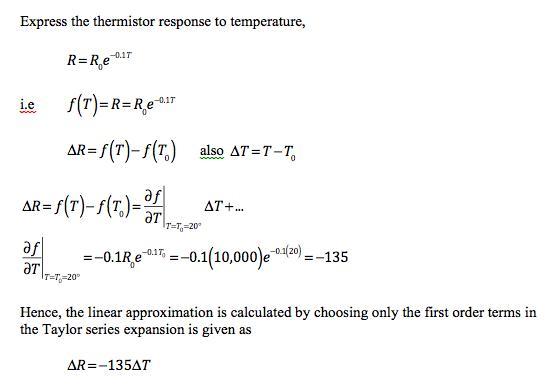
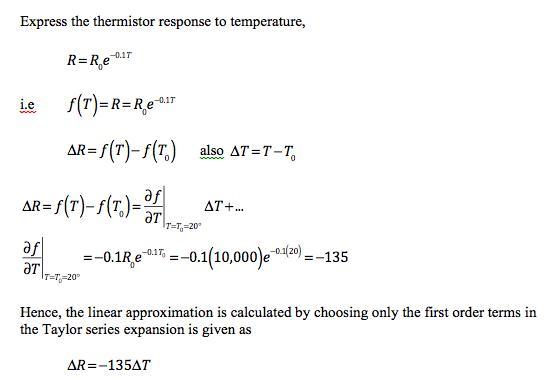
A thermistor has a response to temperature represented by R = Roe-0.1T where Ro = 10,000 Ώ, R = resistance, and T = temperature

in degrees Celsius. Find the linear model for the thermistor operating at T = 20°C and for a small range of variation of temperature. Answer: ∆R = -135 ∆T

Engineering
1 answer:
Zolol [24]2 years ago
7 0

Answer:

The problem is solved in the attachments

You might be interested in
A charge of 2.0 × 10⁻¹⁰ C is to be stored on each plate of a parallel-plate capacitor having an area of 650 mm2 (1.0 in.2 ) and
IgorLugansk [536]

Answer: a) 43.7 V b) 153 V c) a) 5 pf b) 1.43 pf d) 0.34 μC/m²

              e) 0.24 μC/m²

Explanation:

a) By definition, the capacitance is given by the following relationship between the charge on one of the plates, and the voltage between them:

C= Q/V

For a parallel-plate capacitor, C is also obtained as a constant given by the geometry and the material of the dielectric, as follows:

C= εA/d, where A is the area of one of the plates, and d the separation between them.

ε refers to the permitivitty of the dielectric material, and is related with the dielectric constant of the material, as follows:

ε = ε₀ .εr , where ε₀ = 8.85. 10⁻¹² farad/m, and εr = 3.5

Equating both expressions for C, and solving for V, we have:

V = Q. d / ε₀ εr A

Replacing for the values, we finally arrive to this value for V:

V = 43.7 V

b) If we look to the expression for C, that depends on ε, for vacuum, εr=1, so same considerations apply, and we find the new value for V, as follows:

V = 43.7 x 3.5 = 153 V

c) Applying the definition of capacitance, and assuming that charge on the plates remains constant, as voltage can be obtained from a) and b) above. we get:

C1 = 5 pF

C2 = 1.43 pF

d) Applying Gauss' Law, and the definition of electric flux, it can be showed that there exist a relationship between the dielectric displacement D and the electric field E, as follows:

D = εE =ε₀εrE

In a capacitor, the electric field (assumed constant) is related with the voltage between plates, as follows:

E = V/d where d is the separation between plates.

So we can find D, replacing E by V/d, so we have:

D = (ε₀εrV)/d=8.85. 10⁻¹² F/m.3.5. 43.7 V / 4.10⁻³ m = 0.34 μC/m²

e) When a dielectric is put in a place where an electric field is present, it is produced a relative reorientation of his atoms, causing an internal electric field that opposes to the external one, reducing his effect overall.

One way to explain this, is due to the existence of an internal field, representented by a vector called polarization, that is related with the dielectric displacement and the electric field as follows:

D = ε₀E + P

P = D - ε₀E

With the values for D and E from d) above, we get P:

P = 0.24 μC / m²

6 0
2 years ago
A commercial refrigerator with refrigerant-134a as the working fluid is used to keep the refrigerated space at -30C by rejecting
chubhunter [2.5K]

Answer:

a) x = 0.4795

b) QL = 5.85 KW

c) COP = 2.33

d) QL_max = 12.72 KW

Explanation:

Solution:-

- Assuming the steady state flow conditions for both fluids R-134a and water.

- The thermodynamic properties remain constant for respective independent intensive properties.

- We will first evaluate the state properties of the R-134a and water.

- Compressor Inlet, ( Saturated Vapor ) - Ideal R-134a vapor cycle

              P1 = 60 KPa, Tsat = -36.5°C  

              T1 = -34°C , h1 = hg = 230.03 KJ/kg

              Qin = 450 W - surrounding heat  

- Condenser Inlet, ( Super-heated R-134a vapor ):

              P2 = 1.2 MPa , Tsat = 46.32°C  

              T2 = 65°C   , h2 = 295.16 KJ/kg

- Condenser Outlet, ( Saturation R-134a point ):

             P3 = P2 = 1.2 MPa , Tsat = 46.32°C

             T3 = 42°C   , h3 = hf = 111.23 KJ/kg

- R-134a is throttled to the pressure of P4 = compressor pressure = P1 = 60 KPa by an "isenthalpic - constant enthalpy pressure reduction" expansion valve.

- Inlet of Evaporator - ( liquid-vapor state )

             P4 = P1 = 60 KPa, hf = 3.9 KJ/kg , hfg = 223.9 KJ/kg

             h4 = h3 = 111.23 KJ/kg

- The quality ( x ) of the liquid-vapor R-134a at evaporator inlet can be determined:

             x4 = ( h4 - hf ) / hfg

             x4 = ( 111.23 - 3.9 ) / 223.9

             x4 = 0.4795      Answer ( a )        

- Water stream at a flow rate flow ( mw ) = 0.25 kg/s is used to take away heat from the R-134a.

- Condenser Inlet, ( Saturated liquid water ):

             Ti = 18°C , h = hf = 75.47 KJ/kg  

- Condenser Outlet, ( Saturated liquid water ):

             To = 26°C , h = hf = 108.94 KJ/kg

- Since the heat of R-134a was exchanged with water in the condenser. The amount of heat added to water (Qh) is equal to amount of heat lost from refrigerant R-134a.

- Apply thermodynamic balance on the R-134a refrigerant in the condenser:

             Qh = flow (mr) * [ h2 - h3 ]

Where,

flow ( mr ) : The flow rate of R-134a gas in the refrigeration cycle

             flow ( mr ) = Qh / [ h2 - h3 ]

             flow ( mr ) = 8.3675 / [ 295.16 - 111.23 ]

             flow ( mr ) = 0.0455 kg/s

- The cooling load of the refrigeration cycle ( QL ) is determined from energy balance of the cycle net work input ( Compressor work input ) - "Win" and the amount of heat lost from R-134a in condenser ( Qh ).

- Apply the thermodynamic balance for the compressor:


            Win = flow ( mr )*[ h2 - h1 ] - Qin

            Win = 0.0455*[ 295.16 - 230.03] KW - 0.45 KW

            Win = 2.513 KW

- The cooling load ( QL ) for the refrigeration cycle can now be calculated. Apply thermodynamic balance for the refrigeration cycle:

            QL = Qh - Win

            QL = 8.3675 - 2.513

            QL= 5.85 KW  .... Refrigeration Load, Answer ( b )

- The COP of the refrigeration cycle is calculated as the ratio of useful work and total work input required:


             COP = QL / Win

             COP = 5.85 / 2.513

             COP =  2.33      Answer ( c )            

- For a compressor to be working at 100% efficiency or ideal then the maximum COP for the refrigeration cycle would be:


             COP_max = [ TL ] / [ Th - TL ]

Where,

            TL : The absolute temperature of heat sink, refrigerated space

            TH : The absolute temperature of heat source, water inlet


            COP_max = [ -30+273 ] / [ (18+273) - (-30+273) ]          

            COP_max = 5.063

- The theoretical ideal refrigeration load ( QL max ) would be:


           COP_max = QL_max / Win

           QL_max = Win*COP_max

           QL_max = 2.513*5.063

           QL_max = 12.72 KW     Answer ( d )
5 0
2 years ago
The procedure for determining the presence of Non-Condensable Gasses in refrigerant contained in an external recovery tank utili
natta225 [31]

Answer:

The procedure for determining the presence of non-condensable gases in refrigerant contained in an external recovery tank utilizes the principle that non-condensable gases increases the pressure of the refrigerant (compared to the saturation pressure).

Explanation:

The existence of non-condensable gases gives rise to an increase in the pressure of the refrigerant, this generates supplementary thermal resistance in the refrigeration circuit, which in turn decreases the efficiency of the system.

6 0
2 years ago
Read 2 more answers
John was a high school teacher earning $ 80,000 per year. He quit his job to start his own business in pizza catering. In order
Anton [14]

Answer:

John should continue with his catering business because accounting and economic profits from pizza catering are more than his annual salary from teaching.

Explanation:

John can earn from teaching $80,000 annually

For starting business of pizza catering John will incur following expense

Tuition for catering skills $2,000

Opportunity cost for withdrew of funds ($110,000 * 5%) $5,500

Interest for Borrowing from friend ($50,000 * 6%) $3,000

Opportunity cost of Rent from premises $12,000

Total opportunity cost $22,500

Revenue:

Revenues from Pizza $400,000

Revenue from Beverages $190,000

Total revenue $590,000

Expenses:

Cashier wages ($55,000 * 2) $110,000

Pizza ingredients $50,000

Manager salary $75,000

Pizza bakers wages ($60,000 * 3) $180,000

Equipment $10,000

Total Expense $425,000

Net Income - Accounting Profit ($590,000 - $425,000) = $165,000

Less opportunity cost $22,500

Economic Profit $142,500

4 0
2 years ago
The rigid bar CDE is attached to a pin support at E and rests on the 30 mm diameter brass cylinder BD. A 22 mm diameter steel ro
Leno4ka [110]

Answer:

stress = 38.84 MPa

Explanation:

S_{D} = \alpha _{brass} * (delta T) *(L_{BD} )\\= (18.8 * 10^(-6) )*(30)*(0.3)\\= 0.0001692 m\\\\E_{BD} = stress / strain\\stress = E_{BD} * S_{D}\\stress = (200 *10^9) * (0.0001692)\\stress = 33.84 MPa

3 0
2 years ago
Other questions:
  • At a certain college, 30% of the students major in engineering, 20% play club sports, and 10% both major in engineering and play
    14·1 answer
  • Prompt the user to enter five numbers, being five people's weights. Store the numbers in an array of doubles. Output the array's
    11·2 answers
  • What is the PW (at i 5%) of SuperTool's new test equipment? The development cost is $1.2M. Net revenues will begin at $300,000 f
    9·1 answer
  • The components of an electronic system dissipating 90 W are located in a 1-m-long circular horizontal duct of 15-cm diameter. Th
    11·1 answer
  • Define initial set and final set. Briefly discuss one method used to determine them. The following laboratory tests are performe
    12·1 answer
  • Two airstreams are mixed steadily and adiabatically. The first stream enters at 35°C and 30 percent relative humidity at a rate
    6·1 answer
  • Oil enters a counterflow heat exchanger at 600 K with a mass flow rate of 10 kg/s and exits at 200 K. A separate stream of liqui
    12·1 answer
  • Milton has been tracking the migrating patterns of whales in the northwest Atlantic Ocean for five years. He knows where and whe
    5·2 answers
  • 11 Notează, în caiet, trăsăturile personajelor ce se pot
    13·1 answer
  • What are practical considerations you might encounter when you increase the moment of inertia (I) while keeping the cross-sectio
    13·1 answer
Add answer
Login
Not registered? Fast signup
Signup
Login Signup
Ask question!