answer.
Ask question
Login Signup
Ask question
All categories
  • English
  • Mathematics
  • Social Studies
  • Business
  • History
  • Health
  • Geography
  • Biology
  • Physics
  • Chemistry
  • Computers and Technology
  • Arts
  • World Languages
  • Spanish
  • French
  • German
  • Advanced Placement (AP)
  • SAT
  • Medicine
  • Law
  • Engineering
quester [9]
2 years ago
4

How much heat is released at constant pressure if 12.3 mL of 0.161 M silver nitrate is mixed with 41.7 mL of 0.493 M potassium c

hloride? AgNO3(aq) + KCl(aq) → AgCl(s) + KNO3(aq); ΔH° = –65.5 kJ

Chemistry
2 answers:
prohojiy [21]2 years ago
7 0

Explanation:

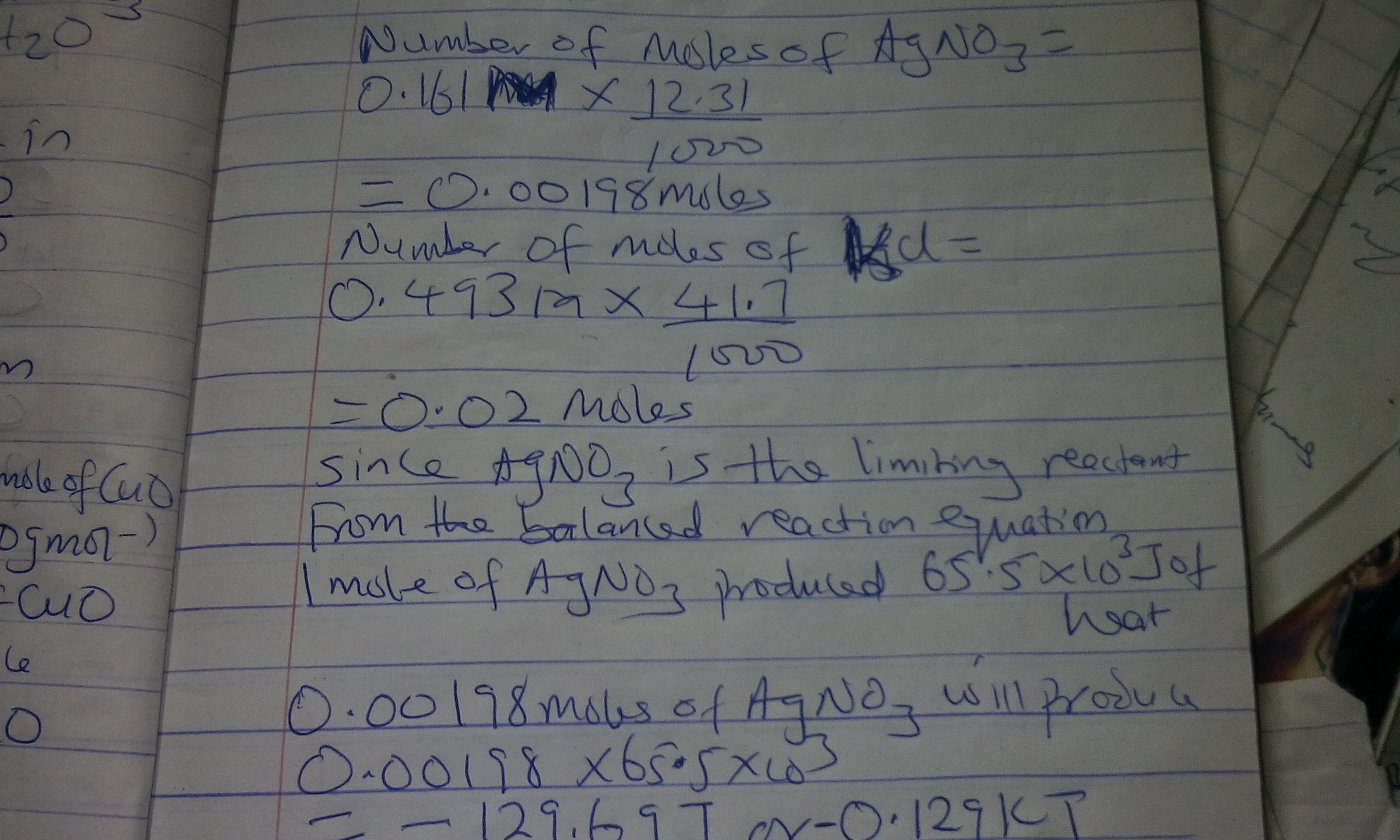
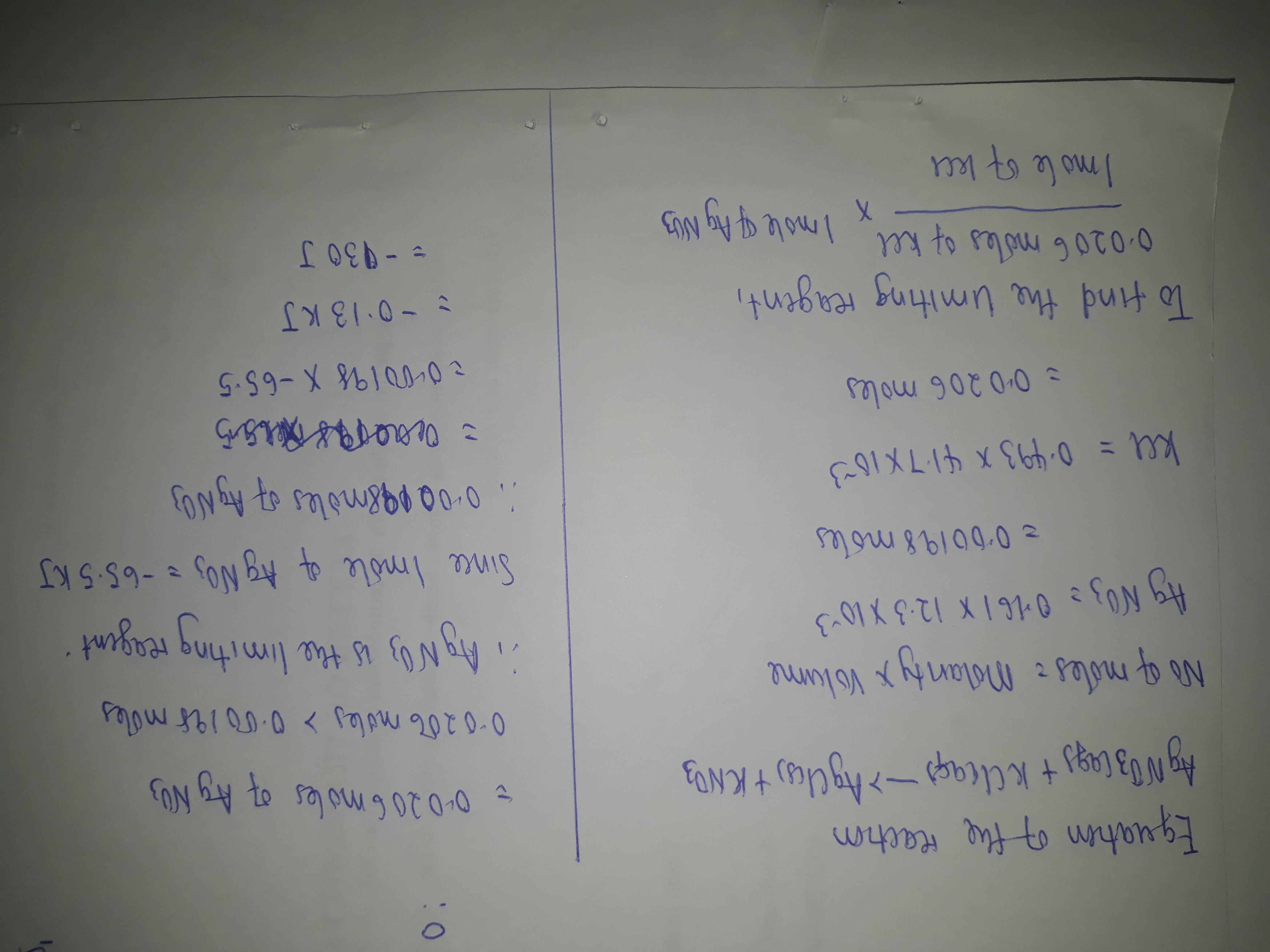
Below is an attachment containing the solution.

ikadub [295]2 years ago
3 0

Answer:

-129.69J or -0.129KJ

Explanation:

First, we must determine the number of moles of silver nitrate and potassium chloride involved in the reaction according to the balanced chemical reaction equation as shown in the question.

From the number of moles, we determine the limiting reactant(the one having the least number of moles). This is the used to obtain the heat evolved as shown in the image attached.

You might be interested in
What mass of powdered drink mix is needed to make a 0.5 M solution of 100 mL?
Maru [420]

Answer:

There is 17,114825 g of powdered drink mix needed

Explanation:

<u>Step 1 :</u> Calculate moles

As given, the concentration of the drink is 0.5 M, this means 0.5 mol / L

Since the volume is 100mL, we have to convert the concentration,

⇒0.5 / 1   =  x /0.1    ⇒ 0.5* 0.1  = x = 0.05 M

This means there is 0.05 mol per 100mL

e

<u>Step 2 </u>: calculate mass of the powdered drink

here we use the formula n (mole) = m(mass) / M (Molar mass)

⇒ since powdered drink mix is usually made of sucrose (C12H22O11) and has a molar mass of 342.2965 g/mol.

0.05 mol = mass / 342.2965 g/mol

To find the mass, we isolate it ⇒0.05 mol * 342.2965 g/mol = 17,114825g

There is 17,114825 g of powdered drink mix needed

3 0
2 years ago
Read 2 more answers
A particular radioactive isotope has a half-life of (2.50+a) hours. if you have (24.5+b) g of the isotope at 10:00 am, how much
gavmur [86]
Its a not b and i dont know the reast

3 0
2 years ago
What is the percent CdSO4 by mass in a 1.00 m aqueous CdSO4 solution?
Svet_ta [14]
I don't know but I'm wasting 5 seconds of your time you can't take back sorry
3 0
2 years ago
We know from the relative amounts of 16O and 18O that global temperatures and global climate have changed over time. Why is it i
Andru [333]

Answer:

In order to take steps by humans for controlling the change in climate.

Explanation:

It is important that scientist find out the change which occurs in the climate with the passage of time by performing experiments and also repeat the experiments in order to verify their findings. Due to these experiments, scientists also find out the reasons behind of climate change which enable us to take steps in preventing the change that occurs in the environment. it is also important for scientists to be able to explain how they know that climate has changed over time in order to explain that he is not assuming or making predictions, he has to provide evidence for his statement which is only be possible through experiments.

3 0
2 years ago
Which reactions performed in the experiment involved chemical changes? crushing calcium carbonate mixing calcium carbonate and h
lisov135 [29]
Mixing calcium carbonate and HCl. 
Heating copper sulfate pentahydrate. 
Mixing potassium iodide and lead nitrate. 
Combining magnesium and hcl. 
Burning the candle. 
 Let's look at the available options and see what are chemical changes and what are physical changes. As a side note, line breaks, capitalization, and punctuation are VERY important. I spent almost as much time attempting to actually figure out what your options were as I spent in distinguishing between what were chemical reactions and physical changes. 
 Crushing calcium carbonate.
 * This is a mere physical change. You start with large pieces of calcium carbonate and end up with smaller pieces. So this is a bad choice. 
 Mixing calcium carbonate and HCl.
 * This is a chemical reaction where the calcium carbonate and hydrochloric acid react with each other and produce carbon dioxide plus other compounds. So this is a good choice. 
 Boiling water.
 * Another physical change from liquid to vapor. You can cool down the resulting vapor and end up with the original water. So this is a bad choice. 
 Heating copper sulfate pentahydrate.
 * This is a chemical change in that you're converting CuSO4 . 5H2O(s) into CuSO4 and H2O. So this too is a good choice. 
 Separating iron filing and sulfur.
 * You start out with iron filings and sulfur and end up with iron filings and sulfur. Things are a bit more orderly, but no chemical reactions have occurred. So this is a bad choice. 
 Mixing potassium iodide and lead nitrate. * You start with 2 white solids and upon mixing them, you get a yellow solid.
A chemical reaction has occurred. So this is a good choice. 

 Combining magnesium and hcl.
 * When you combine these two items, you get hydrogen gas as a product. So you have a chemical reaction. And this is a good choice. 
 Burning the candle.
 * Another chemical reaction. The wax combines with the oxygen in the air and produces water vapor and carbon dioxide. So this is a good choice.
5 0
2 years ago
Read 2 more answers
Other questions:
  • 6.285×10^3 mg = _____? _____ kg
    12·2 answers
  • If the human body were a car, glucose would be:
    11·1 answer
  • Two sets of flasks are connected by a hollow copper pipe, as shown. Which set will change the temperature most quickly?
    11·2 answers
  • A penny has a mass of
    9·2 answers
  • How many molecules of glucose are in 1 l of a 100 mm glucose solution?
    6·1 answer
  • Addition of 6 M HCl to which substance will NOT result
    10·2 answers
  • What is the limiting reactant for the following reaction given we have 3.4 moles of Ca(NO3)2 and 2.4 moles of Li3PO4?Reaction: 3
    7·2 answers
  • When 15.3 g of sodium nitrate, NaNO₃, was dissolved in water in a constant-pressure calorimeter, the temperature fell from 25.00
    8·2 answers
  • Consider the following voltaic cell. Identify the anode and cathode, and indicate the direction of Na ion and NO3- ion flow from
    6·1 answer
  • The structure of haloacetic acids, XCH,COOH (where X is either F.CI, Br, or I), is shown above. The dissociation constants and m
    5·1 answer
Add answer
Login
Not registered? Fast signup
Signup
Login Signup
Ask question!