answer.
Ask question
Login Signup
Ask question
All categories
  • English
  • Mathematics
  • Social Studies
  • Business
  • History
  • Health
  • Geography
  • Biology
  • Physics
  • Chemistry
  • Computers and Technology
  • Arts
  • World Languages
  • Spanish
  • French
  • German
  • Advanced Placement (AP)
  • SAT
  • Medicine
  • Law
  • Engineering
WITCHER [35]
2 years ago
4

A 3.27-m3 tank contains 100 kg of nitrogen at 175 K. Determine the pressure in the tank using (a) the ideal-gas equation, (b) th

e van der Waals equation, and (c) the Beattie- Bridgeman equation. Compare your results with the actual value of 1505 kPa.
Engineering
1 answer:
eduard2 years ago
3 0

Answer:

a) P = 1588.329\,kPa, greater than experimental value. b) P = 1657.073\,kPa, greater than experimental value.  c) P = 1364.841\,kPa, lesser than experimental value.

Explanation:

a) The mathematical model of the equation of state is:

P\cdot V = \frac{m}{M}\cdot R_{u}\cdot T

The expression required to determine the pressure is:

P = \frac{m\cdot R_{u}\cdot T}{V\cdot M}

P = \frac{(100\,kg)\cdot (8.314\,\frac{kPa\cdot m^{3}}{kmol\cdot K} )\cdot (175\,K)}{(3.27\,m^{3})\cdot (28.013\,\frac{kg}{kmol} )}

P = 1588.329\,kPa

Which is greater than experimental value.

b) The mathematical model of the equation of state is:

\left(P+\frac{a}{\nu^{2}} \right)\cdot (\nu-b)=\frac{R_{u}\cdot T}{M}, where:

a = \frac{27\cdot R_{u}^{2}\cdot T_{cr}^{2}}{64\cdot P_{cr}\cdot M^{2}} and b = \frac{R_{u}\cdot T_{cr}}{8\cdot M\cdot P_{cr}}

Then:

a = \frac{27\cdot (8.314\,\frac{kPa\cdot m^{3}}{kmol\cdot K} )^{2}\cdot (126.2\,K)}{64\cdot(3390\,kPa)\cdot(28.013\,\frac{kg}{kmol} )^{2}}

a = 1.383\times 10^{-3}\,\frac{kPa\cdot m^{6}}{kg^{2}}

b = \frac{(8.314\,\frac{kPa\cdot m^{3}}{kmol\cdot K} )\cdot (126.2\,K)}{8\cdot (28.013\,\frac{kg}{kmol} )\cdot (3390\,kPa)}

b = 1.381\times 10^{-3}\,\frac{m^{3}}{kg}

The specific volume is:

\nu = \frac{3.27\,m^{3}}{100\,kg}

\nu = 32.7\times 10^{-3}\,\frac{m^{3}}{kg}

Finally, the pressure is cleared in the equation:

P=\frac{R_{u}\cdot T}{M\cdot(\nu-b)}-\frac{a}{\nu^{2}}

P=\frac{(8.314\,\frac{kPa\cdot m^{3}}{kmol\cdot K} )\cdot (175\,K)}{(28.013\,\frac{kg}{kmol} )\cdot (32.7\times 10^{-3}\,\frac{m^{3}}{kg}-1.381\times 10^{-3}\,\frac{m^{3}}{kg})} -\frac{1.383\cdot 10^{-3}\,\frac{kPa\cdot m^{6}}{kg^{2}}}{(32.7\times 10^{-3}\,\frac{m^{3}}{kg} )^{2}}

P = 1657.073\,kPa

Which is greater than experimental value.

c) The mathematical model of the equation of state is:

P = \frac{R_{u}\cdot T}{\bar \nu^{2}}\cdot \left( 1 - \frac{c}{\nu\cdot T^{3}} \right)\cdot \left(\bar \nu + B \right) - \frac{A}{\bar \nu^{2}}

Where A = A_{o}\cdot \left(1-\frac{a}{\bar \nu}  \right) and B = B_{o}\cdot (1-\frac{b}{\bar \nu} ).

The specific molar volume of the nitrogen is:

\bar \nu=\frac{(3.27\,m^{3})}{\frac{100\,kg}{28.013\,\frac{kg}{kmol}} }

\bar \nu = 0.916\,\frac{m^{3}}{kmol}

a = 0.02617, b = -0.00691

A_{o} = 136.2315, B_{o} = 0.05046

A = 136.2315\cdot \left(1 - \frac{0.02617}{0.916} \right)

A = 132.339

B = 0.05046\cdot \left[ 1 - \frac{(-0.00691)}{0.916}  \right]

B = 0.05084

c = 4.20\times 10^{4}

Finally, the pressure is determined:

P =\frac{(8.314\,\frac{kPa\cdot m^{3}}{kmol\cdot K} )\cdot (175\,K)}{0.916\,\frac{m^{3}}{kmol} }\cdot \left[1 - \frac{4.20\times 10^{4}}{(0.916\,\frac{m^{3}}{kmol} )\cdot (175\,K)^{3}} \right]\cdot (0.916\,\frac{m^{3}}{kmol} + 0.05084)-\frac{132.339}{(0.916\,\frac{m^{3}}{kmol} )^{2}}

P = 1364.841\,kPa

Which is lesser than experimental value.

You might be interested in
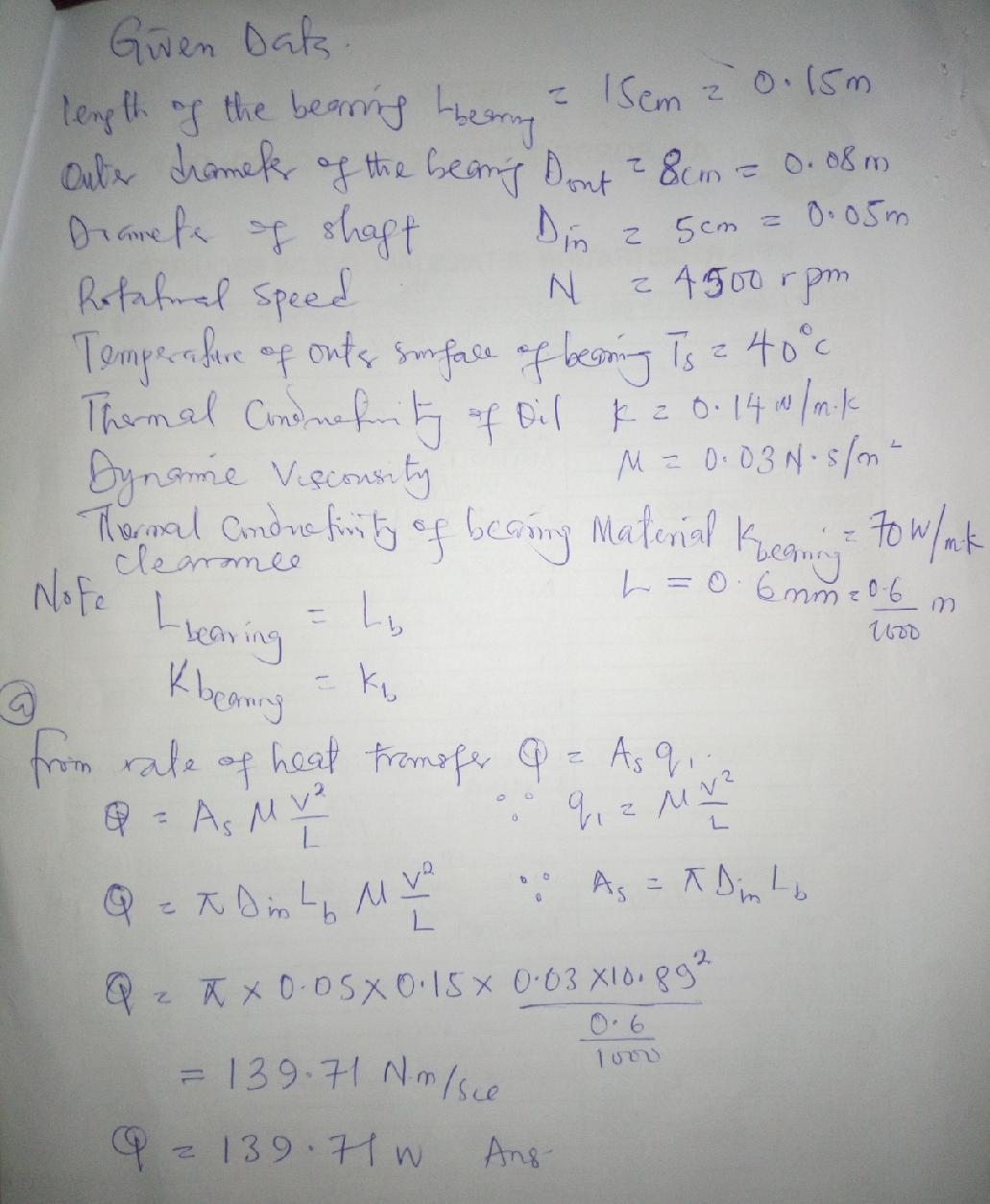
A 5-cm-diameter shaft rotates at 4500 rpm in a 15-cmlong, 8-cm-outer-diameter cast iron bearing (k = 70 W/m·K) with a uniform cl
-BARSIC- [3]

Answer:

(a) the rate of heat transfer to the coolant is Q = 139.71W

(b) the surface temperature of the shaft T = 40.97°C

(c) the mechanical power wasted by the viscous dissipation in oil 22.2kW

Explanation:

See explanation in the attached files

5 0
2 years ago
CHALLENGE ACTIVITY 2.8.1: Using constants in expressions. The cost to ship a package is a flat fee of 75 cents plus 25 cents per
mihalych1998 [28]

Answer:

Weight(lb): 10

Flat fee(cents): 75

Cents per pound: 25

Shipping cost(cents): 325

Explanation:

we run this as a jave programming language

import java.util.Scanner;

public class Shipping Calculator {

   public static void main (String [] args) {

       int shipWeightPounds = 10;

       int shipCostCents = 0;

       final int FLAT_FEE_CENTS = 75;


        final int CENTS_PER_POUND = 25;

       shipCostCents = FLAT_FEE_CENTS + CENTS_PER_POUND * shipWeightPound

       /* look up the solutioin above */

       System.out.println("Weight(lb): " + shipWeightPounds);

       System.out.println("Flat fee(cents): " + FLAT_FEE_CENTS);

       System.out.println("Cents per pound: " + CENTS_PER_POUND);

       System.out.println("Shipping cost(cents): " + shipCostCents);

   }

}

7 0
2 years ago
A thin-walled tube with a diameter of 12 mm and length of 25 m is used to carry exhaust gas from a smoke stack to the laboratory
nlexa [21]

Answer:

(a)  h₁   = 204.45 W/m²k

(b) h₀ = 46.80 W/m².k

(c) T = T = 15.50°C

Explanation:

Given Data;

Diameter = 12mm

Length = 25 m

Entry temperature = 200°C

Flow rate = 0.006 kg/s

velocity = 2.5 m/s.

Step 1: Calculating the mean temperature;

(200 + 15)/2

Mean temperature = 107.5°C = 380.5 K

The properties of air at mean temperature 380.5 K are given as:

v = 24.2689*10⁻⁶m²/s

a = 35.024*10⁻⁶m²/s

μ    = 221.6 *10⁻⁷Ns/m²

k = 0.0323 W/m.k

Cp = 1012 J/kg.k

Step 2: Calculating the prantl number using the formula;

Pr = v/a

   = 24.2689*10⁻⁶/ 35.024*10⁻⁶

   = 0.693

Step3: Calculating the reynolds number using the formula;

Re = 4m/πDμ

    = 4 *0.006/π*12*10⁻³ * 221.6 *10⁻⁷

    = 0.024/8.355*10⁻⁷

    = 28725

Since Re is greater than 2000, the flow is turbulent. Nu becomes;

Nu = 0.023Re^0.8 *Pr^0.3

Nu = 0.023 * 28725^0.8 * 0.693^0.3

     = 75.955

(a) calculating the heat transfer coefficient:

Nu = hD/k

h = Nu *k/D

  = (75.955 * 0.0323)/12*10^-3

h   = 204.45 W/m²k

(b)

Properties of air at 15°C

v = 14.82 *10⁻⁶m²/s

k = 0.0253 W/m.k

a = 20.873 *10⁻⁶m²/s

Pr(outside) = v/a

                  = 14.82 *10⁻⁶/20.873 *10⁻⁶

                 = 0.71

Re(outside) = VD/v

                   = 2.5 * 12*10⁻³/14.82*10⁻⁶

                    =2024.29

Using Zakauskus correlation,

Nu = 0.26Re^0.6 * Pr^0.37 * (Pr(outside)/Pr)^1/4

    = 0.26 * 2024.29^0.6 *  0.71^0.37 * (0.71/0.693)^1/4

    = 22.199

Nu = h₀D/k

h₀ = Nu*k/D

     = 22.199* 0.0253/12*10⁻³

h₀ = 46.80 W/m².k

 (c)

Calculating the overall heat transfer coefficient using the formula;

1/U =1/h₁ +1/h₀

1/U = 1/204.45 + 1/46.80

1/U = 0.026259

U = 1/0.026259

U = 38.08

Calculating the temperature of the exhaust using the formula;

T -T₀/T₁-T₀ = e^-[uπDL/Cpm]

T - 15/200-15 = e^-[38.08*π*12*10⁻³*25/1012*0.006]

T - 15/185 = e^-5.911

T -15 = 185 * 0.002709

T = 15+0.50

T = 15.50°C

6 0
2 years ago
) A shaft encoder is to be used with a 50 mm radius tracking wheel to monitor linear displacement. If the encoder produces 256 p
andrey2020 [161]

Answer:

number of pulses produced =  162 pulses

Explanation:

give data

radius = 50 mm

encoder produces = 256 pulses per revolution

linear displacement = 200 mm

solution

first we consider here roll shaft encoder on the flat surface without any slipping

we get here now circumference that is

circumference = 2 π r .........1

circumference = 2 × π × 50

circumference = 314.16 mm

so now we get number of pulses produced

number of pulses produced = \frac{linear\ displacement}{circumference} × No of pulses per revolution .................2

number of pulses produced = \frac{200}{314.16} × 256

number of pulses produced =  162 pulses

5 0
2 years ago
(3) Calculate the heat flux through a sheet of brass 7.5 mm (0.30 in.) thick if the temperatures at the two faces are 150°Cand 5
bezimeni [28]

Answer:

a.) 1.453MW/m2,  b.)  2,477,933.33 BTU/hr  c.) 22,733.33 BTU/hr  d.) 1,238,966.67 BTU/hr

Explanation:

Heat flux is the rate at which thermal (heat) energy is transferred per unit surface area. It is measured in W/m2

Heat transfer(loss or gain) is unit of energy per unit time. It is measured in W or BTU/hr

1W = 3.41 BTU/hr

Given parameters:

thickness, t = 7.5mm = 7.5/1000 = 0.0075m

Temperatures 150 C = 150 + 273 = 423 K

                        50 C = 50 + 273 = 323 K

Temperature difference, T = 423 - 323 = 100 K

We are assuming steady heat flow;

a.) Heat flux, Q" = kT/t

K= thermal conductivity of the material

The thermal conductivity of brass, k = 109.0 W/m.K

Heat flux, Q" = \frac{109 * 100}{0.0075} = 1,453,333.33 W/m^{2} \\ Heat flux, Q" = 1.453MW/m^{2} \\

b.) Area of sheet, A = 0.5m2

Heat loss, Q = kAT/t

Heat loss, Q = \frac{109*0.5*100}{0.0075} = 726,666.667W

Heat loss, Q = 726,666.667 * 3.41 = 2,477,933.33 BTU/hr

c.) Material is now given as soda lime glass.

Thermal conductivity of soda lime glass, k is approximately 1W/m.K

Heat loss, Q=\frac{1*0.5*100}{0.0075} = 6,666.67W

Heat loss, Q = 6,666.67 * 3.41 = 22,733.33 BTU/hr

d.) Thickness, t is given as 15mm = 15/1000 = 0.015m

Heat loss, Q=\frac{109*0.5*100}{0.015} =363,333.33W

Heat loss, Q = 363,333.33 * 3.41 = 1,238,966.67 BTU/hr

5 0
2 years ago
Other questions:
  • Tin atoms are introduced into a FCC copper crystal, producing an alloy with a lattice pa- rameter of 3.7589 x 10⁻⁸ cm and a dens
    8·1 answer
  • Oil in an engine is being cooled by air in a cross-flow heat exchanger, where both fluids are unmixed. Oil (cp = 2000 J/kg. K) f
    12·1 answer
  • 4-6. A vertical cylindrical storage vessel is 10 m high and 2 m in diameter. The vessel contains liquid cyclohexane currently at
    10·1 answer
  • A thin-walled tube with a diameter of 6 mm and length of 20 m is used to carry exhaust gas from a smoke stack to the laboratory
    7·1 answer
  • An inventor claims to have developed an engine that does not use fuel but operates as a power cycle at steady state while receiv
    10·2 answers
  • Refrigerant-134a is compressed from 2 bar, saturated vapor, to 10 bar, 90o C in a compressor operating at steady state. The mass
    11·1 answer
  • or a metal pipe used to pump tomato paste, the overall heat- transfer coefficient based on internal area is 2 W/(m2 K). The insi
    14·1 answer
  • Question 14<br> Which of these is true of a spray wash cabinet?
    6·1 answer
  • A dryer is shaped like a long semi-cylindrical duct of diameter 1.5 m. The base of the dryer is occupied with water-soaked mater
    9·1 answer
  • Most fatal collisions in Florida happen during
    8·2 answers
Add answer
Login
Not registered? Fast signup
Signup
Login Signup
Ask question!