answer.
Ask question
Login Signup
Ask question
All categories
  • English
  • Mathematics
  • Social Studies
  • Business
  • History
  • Health
  • Geography
  • Biology
  • Physics
  • Chemistry
  • Computers and Technology
  • Arts
  • World Languages
  • Spanish
  • French
  • German
  • Advanced Placement (AP)
  • SAT
  • Medicine
  • Law
  • Engineering
Talja [164]
2 years ago
7

A 600-ha farmland receives annual rainfall of 2500 mm. There is a river flowing through the farmland with an inflow rate of 5 m3

/s and outflow rate of 4 m3/s. The annual water storage is the farmland increases by 2.5 x 10⁶ m3. Based on the hydrologic budget equation, determine the annual evapotranspiration amount in mm. (1 ha
Engineering
1 answer:
shepuryov [24]2 years ago
3 0

Answer:

E = 7333.33 mm

Explanation:

The annual evapotranspiration (E) amount can be calculated using the water budget equation:

P*A + Q_{in}*\Delta t = E*A + \Delta S + Q_{out}*\Delta t   (1)

<u>Where</u>:

<em>P: is the precipitation = 2500 mm, </em>

<em>Q(in): is the water flow into the river of the farmland = 5 m³/s, </em>

<em>ΔS: is the change in water storage = 2.5x10⁶ m³,  </em>

<em>Q(out): is the water flow out of the river of the farmland = 4 m³/s.</em>

<em>Δt: is the time interval = 1 year = 3.15x10⁷ s </em>

<em>A: is the surface area of the farmland = 6.0x10⁶ m² </em>  

Solving equation (1) for ET we have:

E = \frac{P*A + Q_{in}*\Delta t - \Delta S - Q_{out}*\Delta t}{A}

E = \frac{2.5 m \cdot 6.0 \cdot 10^{6} m^{2} + 5 m^{3}/s \cdot 3.15 \cdot 10^{7} s - 2.5 \cdot 10^{6} m^{3} - 4 m^{3}/s \cdot 3.15 \cdot 10^{7} s}{6.0\cdot 10^{6} m^{2}}                                  

E = 7333.33 mm

Therefore, the annual evapotranspiration amount is 7333.33 mm.

I hope it helps you!  

You might be interested in
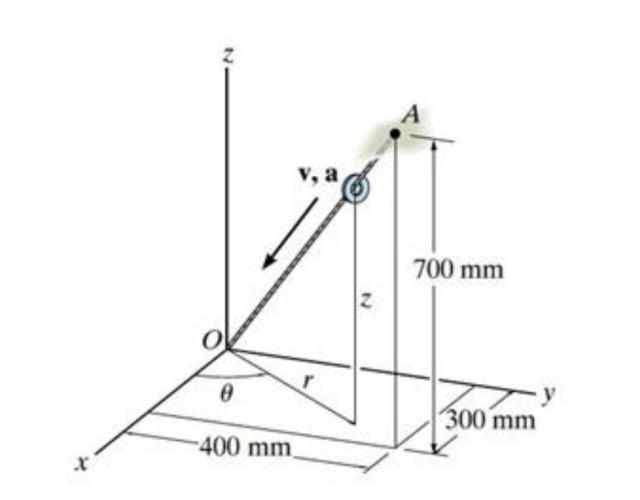
The small washer is sliding down the cord OA. When it is at the midpoint, its speed is 28 m/s and its acceleration is 7 m/s 2 .
Neporo4naja [7]

Answer:

Velocity components

V_r = -16.28 m/s

V_z = -22.8 m/s

V_q = 0 m/s

For Acceleration components;

a_r = -4.07m/s^2

a_z = -5.70m/s^2

a_q = 0m/s^2

Explanation:

We are given:

Speed v_o = 28 m/s

Acceleration a_o= 7 m/s^2

We first need to find the radial position r of washer in x-y plane.

Therefore

r = \sqrt{300^2 + 400^2}

r = 500 mm

To find length along direction OA we have:

L = \sqrt{500^2 + 700^2}L = 860 mm

Therefore, the radial and vertical components of velocity will be given as:

V_r = V_o*cos(Q)

V_z = V_o*sin(Q)

Where Q is the angle between OA and vector r.

Therefore,

V_r = 28 * \frac{r}{L} = > 28 * \frac{500}{860}

V_r = -16.28 m/s

• V_z = 28 * \frac{700}{860} = -22.8

• V_q = 0 m/s

The radial and vertical components of acceleration will be:

a_r = a_o*cos(Q)

a_z = a_o*sin(Q)

Therefore we have:

• a_r = 7* \frac{500}{860} = -4.07m/s^2

• a_z = 7 * \frac{700}{860} = -5.70 m/s^2

• a_q = 0 m/s^2

Note : image is missing, so I attached it

3 0
2 years ago
A fuel oil is burned with air in a furnace. The combustion produces 813 kW of thermal energy, of which 65% is transferred as hea
DENIUS [597]

Answer:

im not sure

Explanation:

8 0
2 years ago
An automobile having a mass of 900 kg initially moves along a level highway at 100 km/h relative to the highway. It then climbs
creativ13 [48]

Answer:

ΔKE=-347.278 kJ

ΔPE= 441.45 kJ

Explanation:

given:

mass m=900 kg

the gravitational acceleration g=9.81 m/s^2

the initial velocity V_{1}=100 km/h-->100*10^3/3600=27.78 m/s

height above the highway h=50 m

h1=0m

the final velocity V_{F}=0 m/s

<u>To find:</u>

the change in kinetic energy ΔKE

the change in potential energy ΔPE

<u>assumption:</u>

We take the highway as a datum

<u>solution:</u>

ΔKE=5*m*(V_{F}^2-V_{1}^2)

      =-347.278 kJ

ΔPE=m*g*(h-h1)

      = 441.45 kJ

5 0
2 years ago
A cylindrical drum (2 ft. dia ,3 ft height) is filled with a fluid whose density is 40 lb/ft^3. Determine (a. the total volume o
Ksivusya [100]

Answer:

a)V=9.42\ ft^3

b)Mass in lb = 376.8 lb

Mass in slug = 11.71 slug

c)v=0.025\ ft^3/lb

d)w=1276 \ lb/ft.s^2

Explanation:

Given that

d= 2 ft

r= 1 ft

h= 3 ft

Density

\rho = 40\ lb/ft^3

a)

We know that volume V given as

V=\pi r^2 h

V=\pi \times 1^2\times 3

V=9.42\ ft^3

b)

Mass = Density x volume

mass =40\times 9.42\ lb

mass= 376.8 lb

We know that

1 lb = 0.031 slug

So 376.8 lb= 11.71 slug

Mass in lb = 376.8 lb

Mass in slug = 11.71 slug

c)

we know that specific volume(v) is the inverse of density.

v=\dfrac{1}{\rho}\ ft^3/lb

v=\dfrac{1}{40}\ ft^3/lb

v=0.025\ ft^3/lb

d)

Specific weight(w) is the product of density and the gravity(g).

w= ρ X g

w = 40 x 31.9

w=1276 \ lb/ft.s^2

8 0
2 years ago
Superheated steam at an average temperature 200 C is transported through a steel pipe (k=50 W/mK, D_0=8.0 cm,D_i=6.0 cm,and L=20
Zarrin [17]

The total amount of daily heat transfer is 1382.38 M w.

The temperature on the outside surface of the gypsum plaster insulation is 17.96 ° C.

<u>Explanation:</u>

Given data,

T_{\infty} = 10° C

h_{0} = 250 w/ m^{2} k

Pipe length = 20 m

Inner diameter d_{1} = 6 cm, r_{1} = 3 cm

Outer diameter d_{2} = 8 cm, r_{2} = 4 cm

The thickness of insulation is 4 cm.

r_{3} = r_{2} + 4

= 4+4

r_{3} = 8 cm

h_{0} is the heat transfer coefficient of  convection inside, h_{i} is the heat transfer coefficient of  convection outside.

The heat transfer rate between ambient and steam is

q=\frac{T_{S}-T_{\infty}}{\frac{1}{h_{i}\left(2 \pi r_{1} L\right)}+\frac{\ln \left(r_{2} / r_{1}\right)}{2 \pi K_{1} L}+\frac{\ln \left(r_{3}/ r_{2}\right)}{2 \pi K_{2} L}+\frac{1}{h_{0}\left(2 \pi r_{3} L\right)}} watt

=  \begin{aligned}&\frac{1}{800(2 \pi x \cdot 03 \times 20)}\++\frac{\ln (4 / 3)}{2 \pi \times 50 \times 20}+\frac{\ln (8 / 4)}{2 \pi \times 0.5 \times 20}+\frac{1}{200(2 \pi x \cdot 08 \times 20)}\end{aligned} watt

= \frac{190}{0.0003317+0.0000458+0.0110+0.0004976} watt

q = 15999.86 watt

The total amount of daily heat transfer = 15999.86 × 86400

= 1382.387904 watt

= 1382.38 M w

The total amount of daily heat transfer is 1382.38 M w.

b) The temperature on the outside surface of the gypsum plaster insulation.

q = \frac{T_{3}-T_{\infty}}{\frac{1}{\ln \left(2 \pi \ r_{3} L\right)}}

15999.86   =\frac{\frac{1}{T_3}-10}{\frac{1}{200(2 \pi . 08 \times 20)}}

T_{3} - 10 = 7.96

T_{3} = 17.96 ° C.

4 0
2 years ago
Other questions:
  • A rod is 2m long at temperature of 10oC. Find the expansion of the rod, when the temperature is raised to 80oC. If this expansio
    7·1 answer
  • Consider a plane composite wall that is composed of two materials of thermal conductivities kA 0.1 W/mK and kB 0.04 W/mK and thi
    14·1 answer
  • What can your employer do to protect you from overhead power lines?
    8·1 answer
  • Steam at 40 bar and 500o C enters the first-stage turbine with a volumetric flow rate of 90 m3 /min. Steam exits the turbine at
    9·1 answer
  • Discuss your interpretation of the confidence-precision trade-off, and provide a few examples of how you might make a choice in
    14·1 answer
  • Milton has been tracking the migrating patterns of whales in the northwest Atlantic Ocean for five years. He knows where and whe
    5·2 answers
  • Water at 70 kPa and 1008C is compressed isentropically in a closed system to 4 MPa. Determine the final temperature of the water
    6·1 answer
  • 1. A _____ is applied to a wall or roof rafters to add strength and keep the building straight and plumb.
    9·1 answer
  • A surface grinding operation is used to finish a flat plate that is 5.50 in wide and 12.500 in long. The starting thickness is 1
    9·1 answer
  • Mr. Ray deposited $200,000 in the Old and Third National Bank. If the bank pays 8% interest, how much will he have in the accoun
    10·2 answers
Add answer
Login
Not registered? Fast signup
Signup
Login Signup
Ask question!