Answer:
option B is correct. Fracture will definitely not occur
Explanation:
The formula for fracture toughness is given by;
K_ic = σY√πa
Where,
σ is the applied stress
Y is the dimensionless parameter
a is the crack length.
Let's make σ the subject
So,
σ = [K_ic/Y√πa]
Plugging in the relevant values;
σ = [50/(1.1√π*(0.5 x 10^(-3))]
σ = 1147 MPa
Thus, the material can withstand a stress of 1147 MPa
So, if tensile stress of 1000 MPa is applied, fracture will not occur because the material can withstand a higher stress of 1147 MPa before it fractures. So option B is correct.
Answer:
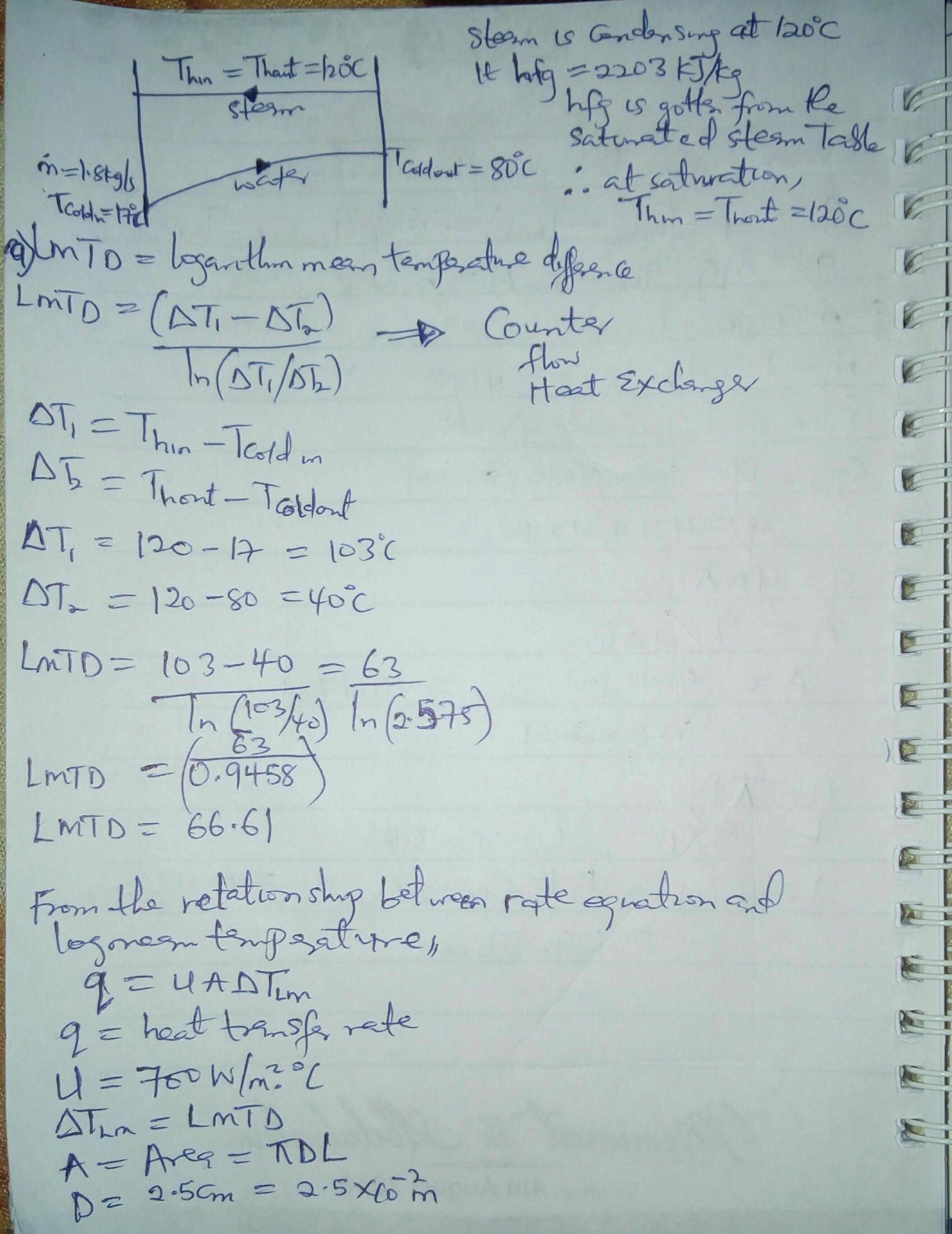
Length = 129.55m, 129.55m
Explanation:
Given:
cp of water = 4180 J/kg·°C
Diameter, D = 2.5 cm
Temperature of water in = 17°C
Temperature of water out = 80°C
mass rate of water =1.8 kg/s.
Steam condensing at 120°C
Temperature at saturation = 120°C
hfg of steam at 120°C = 2203 kJ/kg
overall heat transfer coefficient of the heat exchanger = 700 W/m2 ·°C
U = 700 W/m2 ·°C
Since Temperature of steam is at saturation,
temperature of steam going in = temperature of steam out = 120°C
Energy balance:
Heat gained by water = Heat loss by steam
Let specific capacity of steam = 2010kJ/Kg .°C
Find attached the full solution to the question.
Answer:

Explanation:
Previous concepts
Angular momentum. If we consider a particle of mass m, with velocity v, moving under the influence of a force F. The angular momentum about point O is defined as the “moment” of the particle’s linear momentum, L, about O. And the correct formula is:

Applying Newton’s second law to the right hand side of the above equation, we have that r ×ma = r ×F =
MO, where MO is the moment of the force F about point O. The equation expressing the rate of change of angular momentum is this one:
MO = H˙ O
Principle of Angular Impulse and Momentum
The equation MO = H˙ O gives us the instantaneous relation between the moment and the time rate of change of angular momentum. Imagine now that the force considered acts on a particle between time t1 and time t2. The equation MO = H˙ O can then be integrated in time to obtain this:

Solution to the problem
For this case we can use the principle of angular impulse and momentum that states "The mass moment of inertia of a gear about its mass center is  ".
".
If we analyze the staritning point we see that the initial velocity can be founded like this:

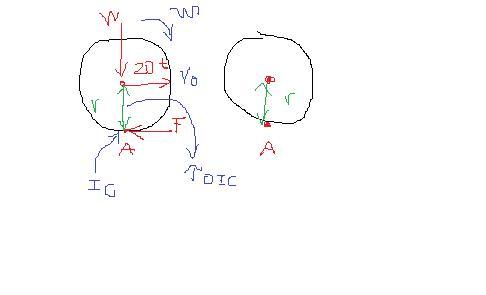
And if we look the figure attached we can use the point A as a reference to calculate the angular impulse and momentum equation, like this:

](https://tex.z-dn.net/?f=0%2B%5Csum%20%5Cint_%7B0%7D%5E%7B4%7D%2020t%20%280.15m%29%20dt%20%3D0.46875%20%5Comega%20%2B%2030kg%5B%5Comega%280.15m%29%5D%280.15m%29)
And if we integrate the left part and we simplify the right part we have

And if we solve for  we got:
Answer:
It's indeed safer to suggest a 150 VA transformer. Following table however is the clarification given.
Explanation:
For 2 motors with 0.1 A, the Power will be:
P = 
= 
For 4 motors with 0.18 A, the Power will be:
P = 
= 
As we know, for 6 pilot lamps, the power is "5 W".
So,
The total power will be:
⇒ P = 
= 
Now,
Consider the power factor to be "0.95"
VA of transformer is:
= 
= 
= 
Answer:
During film condensation on a vertical plate, heat flux at the top will be higher since the thickness of the film at the top, and thus its thermal resistance, is lower.
Explanation:
https://www.docsity.com/pt/cengel-solution-heat-and-mass-transfer-2th-ed-heat-chap10-034/4868218/
https://arc.aiaa.org/doi/pdf/10.2514/1.43136
https://arxiv.org/ftp/arxiv/papers/1402/1402.5018.pdf