answer.
Ask question
Login Signup
Ask question
All categories
  • English
  • Mathematics
  • Social Studies
  • Business
  • History
  • Health
  • Geography
  • Biology
  • Physics
  • Chemistry
  • Computers and Technology
  • Arts
  • World Languages
  • Spanish
  • French
  • German
  • Advanced Placement (AP)
  • SAT
  • Medicine
  • Law
  • Engineering
Klio2033 [76]
2 years ago
6

An ideal Otto cycle has a compression ratio of 8. At the beginning of the compression process, air is at 95 kPa and 278C, and 75

0 kJ/kg of heat is transferred to air during the constant-volume heat-addition process. Taking into account the variation of specific heats with temperature, determine (a) the pressure and temperature at the end of the heat- addition process, (b) the net work output, (c) the thermal efficiency, and (d) the mean effective pressure for the cycle
Engineering
1 answer:
Inessa [10]2 years ago
4 0

Answer:

(a). The value of temperature at the end of heat addition process            T_{3} = 2042.56 K

(b). The value of pressure at the end of heat addition process                    P_{3} = 1555.46 k pa

(c). The thermal efficiency of an Otto cycle   E_{otto} = 0.4478

(d). The value of mean effective pressure of the cycle P_{m} = 1506.41 \frac{k pa}{kg}

Explanation:

Compression ratio r_{p} = 8

Initial pressure P_{1} = 95 k pa

Initial temperature T_{1} = 278 °c = 551 K

Final pressure P_{2} = 8 × P_{1} = 8 × 95 = 760 k pa

Final temperature T_{2} = T_{1} × r_{p} ^{\frac{\gamma - 1}{\gamma} }

Final temperature T_{2} = 551 × 8 ^{\frac{1.4 - 1}{1.4} }

Final temperature T_{2} = 998 K

Heat transferred at constant volume Q = 750 \frac{KJ}{kg}

(a). We know that Heat transferred at constant volume Q_{S} = m C_{v} ( T_{3} - T_{2}  )

⇒ 1 × 0.718 × ( T_{3} - 998 ) = 750

⇒ T_{3} = 2042.56 K

This is the value of temperature at the end of heat addition process.

Since heat addition is constant volume process. so for that process pressure is directly proportional to the temperature.

⇒ P ∝ T

⇒ \frac{P_{3} }{P_{2} } = \frac{T_{3} }{T_{2} }

⇒ P_{3} = \frac{2042.56}{998} × 760

⇒ P_{3} = 1555.46 k pa

This is the value of pressure at the end of heat addition process.

(b). Heat rejected from the cycle Q_{R} = m C_{v} ( T_{4} - T_{1}  )

For the compression and expansion process,

⇒ \frac{T_{3} }{T_{2} } = \frac{T_{4} }{T_{1} }

⇒ \frac{2042.56}{998} = \frac{T_{4} }{551}

⇒ T_{4} = 1127.7 K

Heat rejected Q_{R} = 1 × 0.718 × ( 1127.7 - 551)

⇒ Q_{R} = 414.07 \frac{KJ}{kg}

Net heat interaction from the cycle Q_{net} = Q_{S} - Q_{R}

Put the values of Q_{S} & Q_{R}  we get,

⇒ Q_{net} = 750 - 414.07

⇒ Q_{net} = 335.93 \frac{KJ}{kg}

We know that for a cyclic process net heat interaction is equal to net work transfer.

⇒ Q_{net} = W_{net}

⇒ W_{net} = 335.93 \frac{KJ}{kg}

This is the net work output from the cycle.

(c). Thermal efficiency of an Otto cycle is given by

E_{otto} = 1- \frac{T_{1} }{T_{2} }

Put the values of T_{1} & T_{2} in the above formula we get,

E_{otto} = 1- \frac{551 }{998 }

⇒ E_{otto} = 0.4478

This is the thermal efficiency of an Otto cycle.

(d). Mean effective pressure P_{m} :-

We know that mean effective pressure of  the Otto cycle is  given by

P_{m} = \frac{W_{net} }{V_{s} } ---------- (1)

where V_{s} is the swept volume.

V_{s} = V_{1}  - V_{2} ---------- ( 2 )

From ideal gas equation P_{1} V_{1} = m × R × T_{1}

Put all the values in above formula we get,

⇒ 95 × V_{1} = 1 × 0.287 × 551

⇒ V_{1} = 0.6 m^{3}

From the same ideal gas equation

P_{2} V_{2} = m × R × T_{2}

⇒ 760 × V_{2} = 1 × 0.287 × 998

⇒ V_{2} = 0.377 m^{3}

Thus swept volume V_{s} = 0.6 - 0.377

⇒ V_{s} = 0.223 m^{3}

Thus from equation 1 the mean effective pressure

⇒ P_{m} = \frac{335.93}{0.223}

⇒ P_{m} = 1506.41 \frac{k pa}{kg}

This is the value of mean effective pressure of the cycle.

You might be interested in
The in situ moist unit weight of a soil is 17.3 kN/m3 and the moisture content is 16%. The specific gravity of soil solids is 2.
Temka [501]

Answer:

Explanation:

Given that,

Moist content w = 16%

The in situ moist unit weight of the soil : γ(in situ) = 17.3 kN/m³

Specific gravity of the soil

G(s) = 2.72

Minimum dry unit weight of the soil

γd(compacted) = 18.1 kN/m³

Moist content is same as above

w = 16%

Question

how many cubic meters of soil from the excavation site are needed to produce 2000 m³ of compacted fill?

Let determine the in situ dry unit weight γd(in-situ) using the relation

γd(in-situ) = γ(in-situ) / [1 + (w/100)]

γd(in-situ) = 17.3/ [1 + (18/100)]

γd(in-situ) = 17.3 / ( 1 + 0.18)

γd(in-situ) = 17.3 / 1.18

γd(in-situ) = 14.66 kN/m³

To determine the Volume of the soil to be excavated (Vex)

Let the Volume to be excavated = V

We can use the relation

V=V(fill) × γd(compacted) / γd(in situ)

Given that, V(fill) = 2000m³

V(fill) is the volume of the compacted fill

Therefore,

V=V(fill) × γd(compacted) / γd(in situ)

Vex = 2000 × 18.1 / 14.66

Vex = 2469.13 m³

So, the excavated volume of the soil is 2469.13 m³

3 0
2 years ago
You want to determine whether the race of the defendant has an impact on jury verdicts. You assign participants to watch a trial
Andru [333]

Answer:

The confidence scale represents an ordinal scale of measurement

Explanation:

An ordinal scale or level of measurement is used to measure attributes that can be ranked or ordered, but the interval between the attributes do not have quantitative significance. In this case, the measurement was done on a scale of 1 - 7, with a "1" being; not all that race of defendant has an impact on jury verdicts and a "7" being "very" meaning that race indeed has impact on jury verdicts. Another example can be a survey carried out on the level of customer satisfaction on a particular product, with "1" most dissatisfied and "10 " representing most satisfied. In the first example, it is wrong to say that the difference between 1 being "not at all" and maybe 3 is the same as the difference between 5 and 7 which have different connotations, because the numbers are merely for tagging and not to quantify.

Other levels of measurement include:

1. Nominal: this is the simplest level of measurement and it is simply used to categorize the attributes. Example is taking a survey on gender in the categories of male, female and transgender.

2. Interval: the interval scale is used when the distance between two attributes have meanings but there is no true zero value associated with the scale.

3. Ratio: this combines all the other three levels of measurement and is used to categorize, used to show ranking, has meaningful distances between the attributes and the scale has a true zero point. Example is the measurement of temperature using the celcius scale thermometer, where there is a true zero point at 0°C and the distance between 5°C and 10°C is the same as the distance between 10°C and 15°C.

6 0
2 years ago
Chapter 19: Diesel Engine Operation and Diagnosis -Chapter Quiz
Llana [10]

Answer: See explanation

Explanation:

1. How is diesel fuel ignited in a warm diesel engine?

B. Heat compression

2. Which type of diesel injection produces less noise?

A. Indirect injection (IDI)

3. Which diesel injection system requires the use of a glow plug?

A. Indirect injection (IDI)

4. The three phases of diesel ignition include:

C. Ignition delay, repaid combustion, controlled combustion.

5. What fuel system component is used in a vehicle equipped with a diesel engine that is seldom used on the same vehicle when it is equipped with a gasoline engine?

D. Water-fuel separator

6. The diesel injection pump is usually driven by a _________________.

A. Gear off the camshaft

7. Which diesel system supplies high-pressure diesel fuel to all the injectors all of the time?

C. High-pressure common rail

8. Glow plugs should have high resistance when _____________and lower resistance when __________________.

B. Warm/cold

9. Technician A says that glow plugs are used to help start a diesel engine and are shut off as soon as the engine starts. Technician B says that the glow plugs are turned off as soon as a flame is detected in the combustion chamber. Which Technician is correct?

D. Neither Technicians A NOR B

10. What part should be removed to test cylinder compression on a diesel engine?

D. A glow plug

6 0
2 years ago
) A shaft encoder is to be used with a 50 mm radius tracking wheel to monitor linear displacement. If the encoder produces 256 p
andrey2020 [161]

Answer:

number of pulses produced =  162 pulses

Explanation:

give data

radius = 50 mm

encoder produces = 256 pulses per revolution

linear displacement = 200 mm

solution

first we consider here roll shaft encoder on the flat surface without any slipping

we get here now circumference that is

circumference = 2 π r .........1

circumference = 2 × π × 50

circumference = 314.16 mm

so now we get number of pulses produced

number of pulses produced = \frac{linear\ displacement}{circumference} × No of pulses per revolution .................2

number of pulses produced = \frac{200}{314.16} × 256

number of pulses produced =  162 pulses

5 0
2 years ago
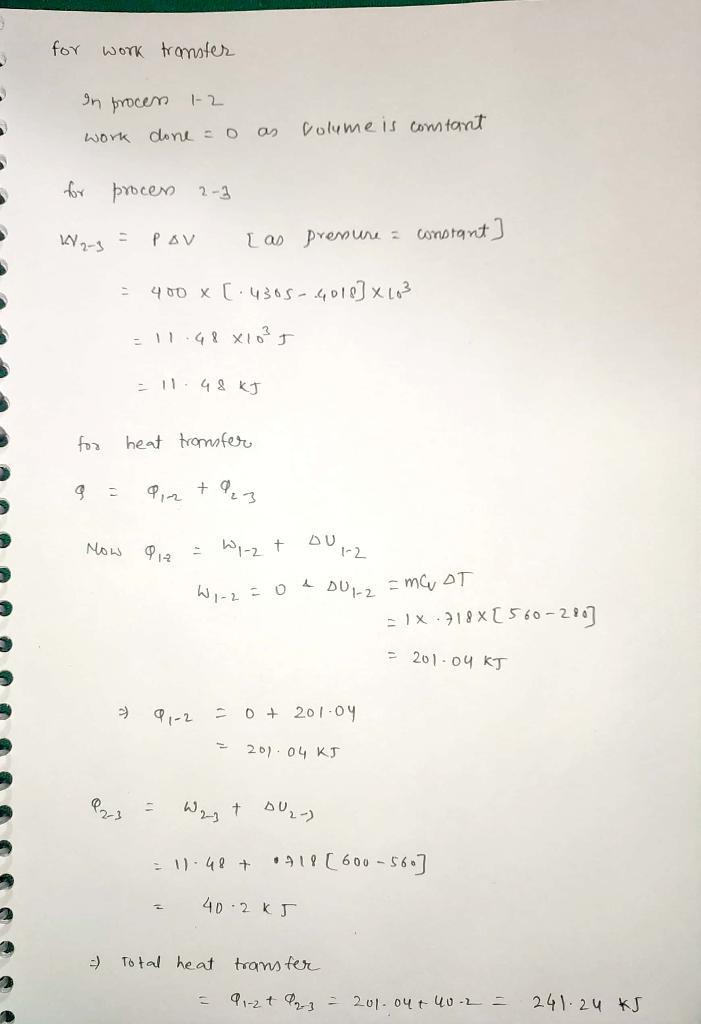
Air in tankBis at 200 kPa, 280 K and mass 1 kg. It is connected to an empty piston/cylinder with a float pressure of 400 kPa sim
Romashka [77]

Answer:

Explanation: see attachment

7 0
2 years ago
Other questions:
  • Consider a plane composite wall that is composed of two materials of thermal conductivities kA 0.1 W/mK and kB 0.04 W/mK and thi
    14·1 answer
  • Prompt the user to enter five numbers, being five people's weights. Store the numbers in an array of doubles. Output the array's
    11·2 answers
  • Given a 5x5 matrix for Playfair cipher a. How many possible keys does the Playfair cipher have? Ignore the fact that some keys m
    6·1 answer
  • Water flows downward through a vertical 10-mm-diameter galvanized iron pipe with an average velocity for 5.0 m/s and exits as a
    5·1 answer
  • An aircraft component is fabricated from an aluminum alloy that has a plane-strain fracture toughness of 40 MPa1m (36.4 ksi1in.)
    15·1 answer
  • Air is compressed adiabatically from p1 1 bar, T1 300 K to p2 15 bar, v2 0.1227 m3 /kg. The air is then cooled at constant volum
    13·1 answer
  • Sal has many options for how to spend her afternoon. She placed them in the order in which she values them: 1) go to a movie, 2)
    14·1 answer
  • An inventor claims to have developed an engine that does not use fuel but operates as a power cycle at steady state while receiv
    10·2 answers
  • Two airstreams are mixed steadily and adiabatically. The first stream enters at 35°C and 30 percent relative humidity at a rate
    6·1 answer
  • An air standard cycle with constant specific heats is executed in a closed pistoncylinder system and is composed of the followin
    10·1 answer
Add answer
Login
Not registered? Fast signup
Signup
Login Signup
Ask question!