answer.
Ask question
Login Signup
Ask question
All categories
  • English
  • Mathematics
  • Social Studies
  • Business
  • History
  • Health
  • Geography
  • Biology
  • Physics
  • Chemistry
  • Computers and Technology
  • Arts
  • World Languages
  • Spanish
  • French
  • German
  • Advanced Placement (AP)
  • SAT
  • Medicine
  • Law
  • Engineering
Sonbull [250]
2 years ago
6

Experimental technique: Tracking cytoplasmic Ca2+ distribution after a sperm enters the egg Based on what they knew about the fe

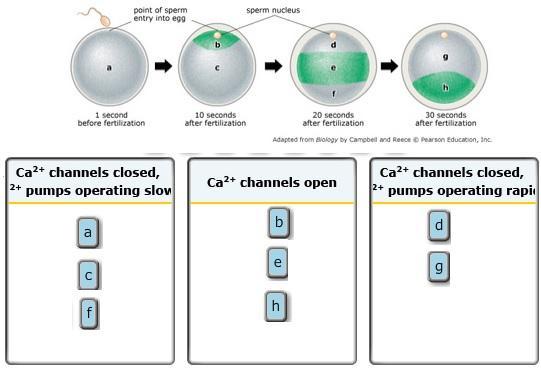
rtilization envelope (a protective layer that forms around the egg when a sperm fuses with it), Steinhardt, Shatten, and their colleagues hypothesized that changes in the distribution of Ca2+ ions in sea urchin eggs are involved in the formation of the fertilization envelope. In sea urchin eggs (as in most eukaryotic cells) the concentration of Ca2+ ions is much higher in the endoplasmic reticulum (ER) than in the cytoplasm. To see how cytoplasmic Ca2+ concentration changes in the egg during fertilization, the researchers injected a Ca2+-specific fluorescent dye into the cytoplasm of unfertilized eggs. After adding sperm to the eggs, they observed the eggs with a fluorescence microscope. The following images show the changes in fluorescence that occurred after a single sperm entered the egg. The fluorescence of the dye increased with increasing cytoplasmic Ca2+ concentration. The green color indicates the region of the cell with the highest fluorescence at that point in time.
Sort the labeled regions of the fertilized egg above based on the status of the ER Ca2+ channels and Ca2+ pumps in that region.

Biology
2 answers:
Rzqust [24]2 years ago
8 0

Answer:

Generally  the thickening of the fertilization envelop is aided by the level of concentration of calcium ions in the cytosol of cytoplasm.The higher the concentration of Ca+ in the cystosol the thicker the fertilisation envelope, and blockage of  penetration by  the sperm. This was necessary to prevent polyspermy. Naturally the Ca+ are  contained in the  eggs and are not  due to   influx  from external environments.

<u>Based on this, in this experiment</u>:therefore:

→At stage a, the calcium channels are closed. <u>The sperm has not penetrated yet,thus no release of calcium ion into the cytosol</u>. At c, and f, the calcium channels begins to open to release calcium, while the calcium pumps operated slowly to release calcium .Therefore concentration of calcium is rising slowly   in the cytosol. But because this is a slow process  the fluorescent dye is not indicated.

→At b, e,h, the calcium channels opens.The Fluorescent green dye is well pronounced because high concentration of Ca+ is released to the cytosol to aid thickening of the fertilization envelope to prevent any other fertilization.

→At d, g, Calcium channels are closed. Thus  the calcium pumps, pumped calcium ions  away  rapidly, with consequent drop in the Fluorescent dye.

Check attachments for images
Download docx
m_a_m_a [10]2 years ago
3 0

Answer:

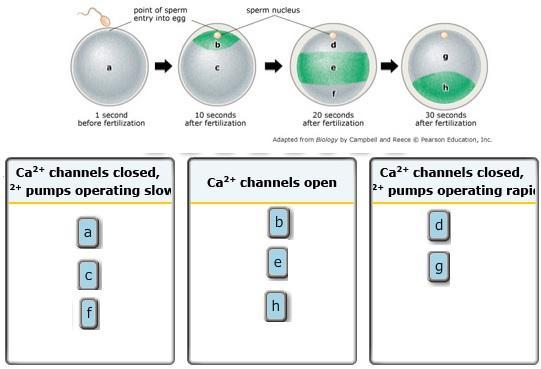
Ca2+ channels closed, Ca2+ pumps operating slowly: a, c, f

Ca2+ channels open: b, e, h

Ca2+ channels closed, Ca2+ pumps operating rapidly: d, g

Explanation:

Experimental technique: Tracking cytoplasmic Ca2+ distribution after a sperm enters the egg Based on what they knew about the fertilization envelope (a protective layer that forms around the egg when a sperm fuses with it), Steinhardt, Shatten, and their colleagues hypothesized that changes in the distribution of Ca2+ ions in sea urchin eggs are involved in the formation of the fertilization envelope. In sea urchin eggs (as in most eukaryotic cells) the concentration of Ca2+ ions is much higher in the endoplasmic reticulum (ER) than in the cytoplasm. To see how cytoplasmic Ca2+ concentration changes in the egg during fertilization, the researchers injected a Ca2+-specific fluorescent dye into the cytoplasm of unfertilized eggs. After adding sperm to the eggs, they observed the eggs with a fluorescence microscope. The following images show the changes in fluorescence that occurred after a single sperm entered the egg. The fluorescence of the dye increased with increasing cytoplasmic Ca2+ concentration. The green color indicates the region of the cell with the highest fluorescence at that point in time.

Sort the labeled regions of the fertilized egg above based on the status of the ER Ca2+ channels and Ca2+ pumps in that region.

Check the diagram attached.It includes the labeled region

You might be interested in
Tissue cultures (samples of cancer cells) are taken from cancer patients, and the cells are then grown in a laboratory. What is
yulyashka [42]

The purpose of growing cancer cells in a laboratory is to test medicinal treatments before giving them to patients.


Cancer cells<span> <span>are </span>cells<span> that grow and divide at a rapid and unregulated pace. Although </span>cancer cells<span> are regularly created in the body, the disease known as </span>cancer<span> only occurs when immune </span>cells<span> (particularly natural killer </span>cells) fail to recognize and/or destroy them.</span>


The correct answer between all the choices given is the first choice or letter A. I am hoping that this answer has satisfied your query and it will be able to help you in your endeavor, and if you would like, feel free to ask another question.

9 0
2 years ago
Read 2 more answers
Which molecules would you expect to find at the top of the diagram?
Fynjy0 [20]

Answer: Oxygen. Oxygen because both plants and animals need oxygen to breath. When the inhale its carbon dioxide but when they exhale its oxygen.

Explanation: im so sorry if its wrong i did a test on tath like two weeks ago sorry ◑﹏◐

6 0
1 year ago
How might the building of this shopping center affect the watershed? there may be -
enot [183]

Answer:

A i think if not im sorry

Explanation:

5 0
2 years ago
Read 2 more answers
If you examine a rock sample and observe fossils in it, what type of rock does the sample represent?
xxTIMURxx [149]
<span>If you examine a rock sample and observe fossils in it, the type of rock the sample represent in C - sedimentary. Igneous rock is  a melted and cooled rock and there are no remains of any kind of fossils. Still, can be found some fossils traces in some metamorphic rocks with the lowest grade of metamorphism but those are very very rare. 
the answer is C, sedimentary </span>
7 0
2 years ago
Read 2 more answers
How would the contractile vacuole of a freshwater amoeba respond if the organism was placed in seawater?
adoni [48]

Answer:

The answer is B

Explanation:

5 0
2 years ago
Read 2 more answers
Other questions:
  • Using complete sentences, compare conditions in the Belgian Congo with conditions in the Congo Free State under King Leopold II.
    6·2 answers
  • What role does intraspecies competition play in natural selection?
    14·1 answer
  • A food worker has just rinsed a dish after cleaning it what should he do next
    9·1 answer
  • In mice, black fur is dominant over white fur, and black eyes are dominant over red eyes. Assuming the parents are heterozygous
    10·2 answers
  • Mannitol salt agar (MSA) only allows the growth of halophiles (salt-loving microbes). Among the halophiles, mannitol fermenters
    15·2 answers
  • Methanogens are able to live in anaerobic conditions. <br><br> a. True <br><br> b. False
    11·2 answers
  • Secondary enrichment creates concentrations of metals by ________.
    15·1 answer
  • In the article, which technologies have been developed to enhance space exploration? Choose all that apply.
    15·2 answers
  • Part B<br> What are the strengths and weaknesses of the cell model?
    5·1 answer
  • Special lymphatic vessels, called lacteals, absorb dietary __________ that are not absorbed by the blood capillaries.
    10·1 answer
Add answer
Login
Not registered? Fast signup
Signup
Login Signup
Ask question!