answer.
Ask question
Login Signup
Ask question
All categories
  • English
  • Mathematics
  • Social Studies
  • Business
  • History
  • Health
  • Geography
  • Biology
  • Physics
  • Chemistry
  • Computers and Technology
  • Arts
  • World Languages
  • Spanish
  • French
  • German
  • Advanced Placement (AP)
  • SAT
  • Medicine
  • Law
  • Engineering
vagabundo [1.1K]
2 years ago
9

The hot combustion gases of a furnace are separated from the ambient air and its surroundings, which are at 25 oC, by a brick wa

ll 0.15 m thick. The brick has a thermalconductivity of 1.2 W/m.K and a surface emissivity of 0.8. Under steady state conditions an outer surface temperature of 100 oC is measured. Free convection heat transfer to the air adjoining this surface is characterized by a convection coefficient h = 20 W/m2.K. What is the inner surface temperature of the brick?
Engineering
1 answer:
yanalaym [24]2 years ago
7 0

Answer:

T1 = 625.54 K

Explanation:

We are given;

T_α = Tsur = 25°C = 298K

h = 20 W/m².K,

L = 0.15 m

K = 1.2 W/m.K

ε = 0.8

Ts = T2 = 100°C = 373K

T1 = ?

Assumption:

-Steady- state condition

-One- dimensional conduction

-No uniform heat generation

-Constant properties

From Energy balance equation;

E°in - E°out = 0

Thus,

q"cond – q"conv – q"rad = 0

K[(T1 - T2)/L] - h(Ts-T_α) - εσ (Ts⁴ – Tsur⁴)

Where σ is Stephan-Boltzmann constant and has a value of 5.67 x 10^(-8)

Thus;

K[(T1 - T2)/L] - h(Ts-T_α) - εσ (Ts⁴ – Tsur⁴) = 1.2[(T1 - 373)/0.15] - 20(373 - 298] - 0.8x5.67x10^(-8)[373⁴ - 298⁴] = 0

This gives;

(8T1 - 2984) - (1500) - 520.31 = 0

8T1 = 2984 + 1500 + 520.31

8T1 = 5004.31

T1 = 5004.31/8

T1 = 625.54 K

You might be interested in
6.28 A six-lane freeway (three lanes in each direction) in rolling terrain has 10-ft lanes and obstructions 4 ft from the right
dimulka [17.4K]

Answer:

Assume Base free flow speed (BFFS) = 70 mph

Lane width = 10 ft

Reduction in speed corresponding to lane width, fLW = 6.6 mph

Lateral Clearance = 4 ft

Reduction in speed corresponding to lateral clearance, fLC = 0.8 mph

Interchanges/Ramps = 9/ 6 miles = 1.5 /mile

Reduction in speed corresponding to Interchanges/ramps, fID = 5 mph

No. of lanes = 3

Reduction in speed corresponding to number of lanes, fN = 3 mph

Free Flow Speed (FFS) = BFFS – fLW – fLC – fN – fID = 70 – 6.6 – 0.8 – 3 – 5 = 54.6 mph

Peak Flow, V = 2000 veh/hr

Peak 15-min flow = 600 veh

Peak-hour factor = 2000/ (4*600) = 0.83

Trucks and Buses = 12 %

RVs = 6 %

Rolling Terrain

fHV = 1/ (1 + 0.12 (2.5-1) + 0.06 (2.0-1)) = 1/1.24 = 0.806

fP = 1.0

Peak Flow Rate, Vp = V / (PHV*n*fHV*fP) = 2000/ (0.83*3*0.806*1.0) = 996.54 ~ 997 veh/hr/ln

Vp < (3400 – 30 FFS)

S = FFS

S = 54.6 mph

Density = Vp/S = (997) / (54.6) = 18.26 veh/mi/ln

7 0
2 years ago
A cylindrical specimen of a brass alloy having a length of 60 mm (2.36 in.) must elongate only 10.8 mm (0.425 in.) when a tensil
Gemiola [76]

The radius of the specimen is 60 mm

<u>Explanation:</u>

Given-

Length, L = 60 mm

Elongated length, l = 10.8 mm

Load, F = 50,000 N

radius, r = ?

We are supposed to calculate the radius of a cylindrical brass specimen in order to produce an elongation of 10.8 mm when a load of 50,000 N is applied. It is necessary to compute the strain corresponding to this

elongation using Equation:

ε = Δl / l₀

ε = 10.8 / 60

ε = 0.18

We know,

σ = F / A

Where A = πr²

According to the stress-strain curve of brass alloy,

σ = 440 MPa

Thus,

sigma = 50,000 / \pi  (r)^2\\\\440 X 10^6 = \frac{50,000}{3.14 X (r)^2}\\\\r = 0.06m\\r = 60mm\\\\\\

Therefore, the radius of the specimen is 60 mm

3 0
2 years ago
Dust, dirt, or metal chips can pose a potential ____ injury risk in a shop.
pantera1 [17]

Answer:

Eye.

Explanation:

Dust, dirt, and metal chips are most unpleasant to get in your eyes. Just experience it and you'll know what I mean.

;)

3 0
2 years ago
A milling operation was used to remove a portion of a solid bar of square cross section. Forces of magnitude P = 18 kN are appli
monitta

The smallest allowable depth is d=16.04 \mathrm{mm} for the milled portion of bar.

<u>Explanation:</u>

Given,

Magnitude of force,\mathbf{p}=18 \mathrm{kN}

a=30 \mathrm{mm}

=0.03 \mathrm{m}

Allowable stress,\sigma_{a l l}=135 \mathrm{MPa}

cross sectional area of bar,

A=a \times d

A=a d

e - eccentricity

e=\frac{a}{2}-\frac{d}{2}

The internal forces in the cross section are equivalent to a centric force P and a bending couple M.

M=P e

=P\left(\frac{a}{2}-\frac{d}{2}\right)

=\frac{P(a-d)}{2}

Allowable stress

\sigma=\frac{P}{A}+\frac{M c}{I}

c=\frac{d}{2}

Moment of Inertia,

I=\frac{b d^{3}}{12}

=\frac{a d^{3}}{12}

\therefore \sigma=\frac{P}{a d}+\frac{\frac{P(a-d)}{2} \times \frac{d}{2}}{\frac{a d^{3}}{12}}

\sigma=\frac{P}{a d}+\frac{3 P(a-d)}{a d^{2}}\\

\sqrt{x} \sigma\left(a d^{2}\right)=P d+3 P(a-d)

\sigma\left(a d^{2}\right)=P d+3 P a-3 P d

\sigma\left(a d^{2}\right)=(P-3 P) d+3 P a

\left(\sigma a d^{2}\right)=-2 P d+3 P a

\sigma d^{2}=-\frac{2 P}{a} d+3 P

By substituting values we get,

\left(135 \times 10^{6}\right) d^{2}+\frac{2 \times 18 \times 10^{3}}{0.03} d-3\left(18 \times 10^{3}\right)=0

\left(135 \times 10^{6}\right) d^{2}+\left(12 \times 10^{5}\right) d-54 \times 10^{3}=0

On solving above equation we get,d=0.01604 \mathrm{m}\\

d=16.04 \mathrm{mm}

3 0
2 years ago
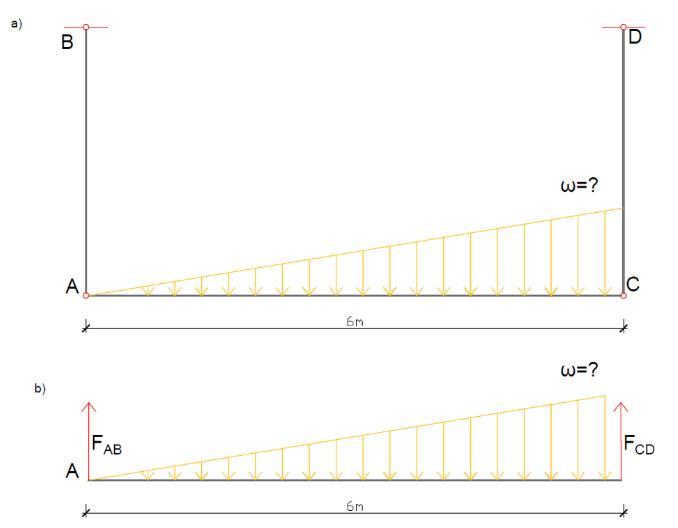
The uniform beam is supported by two rods AB and CD that have crosssectional areas of 10 mm2 and 15 mm2 , respectively. Determin
ddd [48]

Answer:

w=2.25

Explanation:

It is necessary to determine the maximum w so that the normal stress in the AB and CD rods does not exceed the permitted normal stress.  

The surface of the cross-section of the stapes was determined:  

A_ab= 10 mm^2

A-cd=  15 mm^2

The maximum load is determined from the condition that the normal stresses is not higher than the permitted normal stress σ_allow.

σ_ab = F_ab/A_ab\leqσ_allow

σ_cd =  F_cd/A_cd\leqσ_allow

In the next step we will determine the static size: Picture b).  

We apply the conditions of equilibrium:  

∑F_x=0

∑F_y=0

  ∑M=0

∑M_a=0 ==> -w*6*0.5*6*0.75*F_cd*6 =0

              ==> F_cd = 2*w*k*N

∑F_y=0 ==> F_cd+F_ab - 6*w*0.5 ==>2*w+F_ab -6*w*0.5 =0

              ==> F_ab = w*k*N

Now we determine the load w  

<u>Sector AB:  </u>

σ_ab = F_ab/A_ab\leq σ_allow=300 KPa

         = w/10*10^-6\leq σ_allow=300 KPa

w_ab = 3*10^-3 kN/m

<u>Sector CD:  </u>

σ_cd = F_cd/A_cd\leq σ_allow=300 KPa

         = 2*w/15*10^-6\leq σ_allow=300 KPa

w_cd = 2.25*10^-3 kN/m

w=min{w_ab;w_cd} ==> w=min{3*10^-3;2.25*10^-3}

                                ==> w=2.25 * 10^-3 kN/m

<u>The solution is:  </u>

                                w=2.25 N/m

note:

find the attached graph

6 0
2 years ago
Other questions:
  • Oil with a density of 800 kg/m3 is pumped from a pressure of 0.6 bar to a pressure of 1.4 bar, and the outlet is 3 m above the i
    9·1 answer
  • Tin atoms are introduced into a FCC copper crystal, producing an alloy with a lattice pa- rameter of 3.7589 x 10⁻⁸ cm and a dens
    8·1 answer
  • The wall of drying oven is constructed by sandwiching insulation material of thermal conductivity k = 0.05 W/m°K between thin me
    8·1 answer
  • The top 3 most popular male names of 2017 are Oliver, Declan, and Henry according to babynames. Write a program that modifies th
    6·1 answer
  • At a certain college, 30% of the students major in engineering, 20% play club sports, and 10% both major in engineering and play
    14·1 answer
  • One mole of iron (6 1023 atoms) has a mass of 56 grams, and its density is 7.87 grams per cubic centimeter, so thecenter-to-cent
    15·1 answer
  • The in situ moist unit weight of a soil is 17.3 kN/m3 and the moisture content is 16%. The specific gravity of soil solids is 2.
    12·1 answer
  • a. (24 points) Describe the microstructure present in a 10110 steel after each step in each of the following heat treatments (no
    10·1 answer
  • In which of the following branches of engineering is the practice not restricted?
    7·2 answers
  • what is the advantage of decreasing the field current of a separately excited dc motor below its nominal value
    7·1 answer
Add answer
Login
Not registered? Fast signup
Signup
Login Signup
Ask question!