answer.
Ask question
Login Signup
Ask question
All categories
  • English
  • Mathematics
  • Social Studies
  • Business
  • History
  • Health
  • Geography
  • Biology
  • Physics
  • Chemistry
  • Computers and Technology
  • Arts
  • World Languages
  • Spanish
  • French
  • German
  • Advanced Placement (AP)
  • SAT
  • Medicine
  • Law
  • Engineering
sleet_krkn [62]
2 years ago
9

A triangular roadside channel is poorly lined with riprap. The channel has side slopes of 2:1 (H:V) and longitudinal slope of 2.

5 percent. Determine the flow rate (cubic meters per second) in the channel if flow is uniform and the top width of the flowing channel is 5 meters.
Engineering
1 answer:
Oliga [24]2 years ago
8 0

Answer:

Q = 14.578 m³/s

Explanation:

Given

We use the Manning Equation as follows

Q = (1/n)*A*(∛R²)*(√S)

where

  • Q = volumetric water flow rate passing through the stretch of channel (m³/s for S.I.)
  • A = cross-sectional area of flow perpendicular to the flow direction, (m² for S.I.)
  • S = bottom slope of channel, m/m (dimensionless) = 2.5% = 0.025
  • n = Manning roughness coefficient (empirical constant), dimensionless = 0.023
  • R = hydraulic radius = A/P (m for S.I.) where :
  • A = cross-sectional area of flow as defined above,
  • P = wetted perimeter of cross-sectional flow area (m for S.I.)

we get A as follows

A = (B*h)/2

where

B = 5 m (the top width of the flowing channel)

h = (B/2)*(m) = (5 m/2)*(1/2) = 1.25 m   (the deep)

A = (5 m*1.25 m/2) = 3.125 m²

then we find P

P = 2*√((B/2)²+h²)   ⇒  P = 2*√((2.5 m)²+(1.25 m)²) = 5.59 m

⇒ R = A/P ⇒ R = 3.125 m²/5.59 m = 0.559 m

Substituting values into the Manning equation gives:

Q = (1/0.023)*(3.125 m²)*(∛(0.559 m)²)*(√0.025)

⇒ Q = 14.578 m³/s

You might be interested in
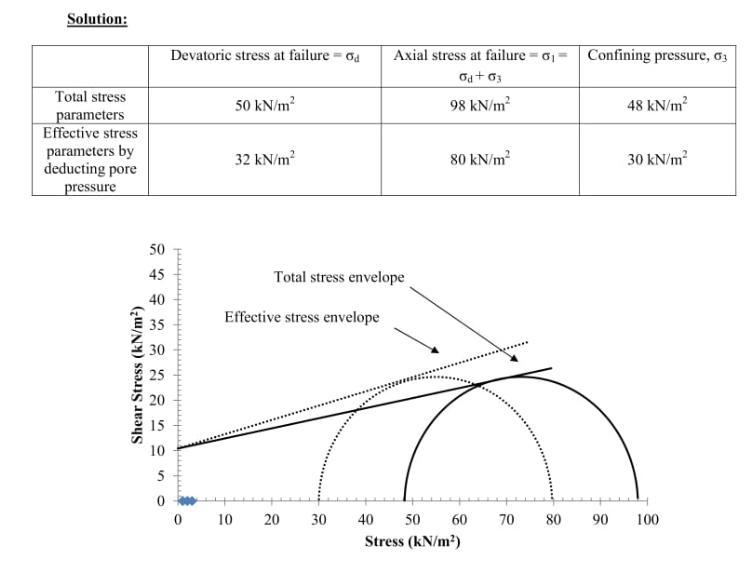
A sample of normally consolidated clay was subjected to a CU triaxial compression test that was carried out until the specimen f
QveST [7]

Answer:

Check the explanation

Explanation:

Given

1) CU traixial compression test

2) Devatoric stress at failure  = бd = 50 kN/m^2

3) Confining pressure at failure  = бd = 48 kN/m^2

4) Pore pressure at failure  = u = 18 kN/m^2

5) Unconfined compression stress  = q = 20 kN/m^2

6) Undrained cohesion  = q/2 = 20 kN/m^2

To find:

1) Effective and total stress strength failure envelope

Kindly check the attached image below .

7 0
2 years ago
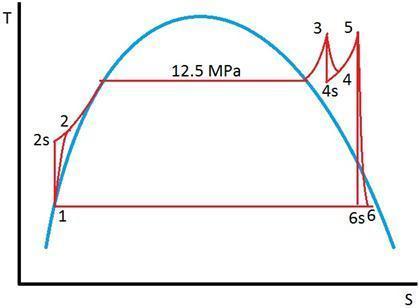
A steam power plant operates on the reheat Rankine cycle. Steam enters the highpressure turbine at 12.5 MPa and 550°C at a rate
gayaneshka [121]

Answer:

A) condenser pressure = 9.73 kPa,

B) 10242 kw

C) 36.9%

Explanation:

given data

entrance pressure of steam = 12.5 MPa

temperature of steam = 550⁰c

flow rate of steam = 7.7 kg/s

outer pressure = 2 MPa

reheated steam temperature = 450⁰c

isentropic efficiency of turbine( nt ) = 85% = 0.85

isentropic efficiency of pump = 90% = 0.90

From steam tables

at 12.5 MPa and 550⁰c ; h3 = 3476.5 kJ/kg,  S3 = 6.6317 kJ/kgK

also for an Isentropic expansion

S4s = S3 .

therefore when S4s = 6.6317 kJ/kg and P4 = 2 MPa

h4s = 2948.1 kJ/kg

nt = 0.85

nt (0.85) = \frac{h3-h4}{h3-h4s} = \frac{3476.5 - h4}{3476.5 - 2948.1}

making h4 subject of the equation

h4 = 3476.5 - 0.85 (3476.5 - 2948.1)

h4 = 3027.3 kj/kg

at P5 = 2 MPa and T5 = 450⁰c

h5 = 3358.2 kj/kg,  s5 = 7.2815 kj/kgk

at P6 , x6 = 0.95  and s5 = s6

using nt = 0.85 we can calculate for h6 and h6s

from the chart attached below we can see that

p6 = 9.73 kPa, h6 = 2463.3 kj/kg

B) the net power output

solution is attached below

c) thermal efficiency

thermal efficiency = 1 - \frac{qout}{qin} = 1 - ( 2273.7/ 3603.8) = 36.9% ≈ 37%

8 0
2 years ago
A 50-kg iron block and 20-kg copper block, both initially at 80 oC, are dropped into a large lake at 15 oC. Thermal equilibrium
bija089 [108]
I need this answer to please
5 0
2 years ago
Explain why the fundamental software engineering principles of process, dependability, requirements management, and reuse are re
Svet_ta [14]

Answer:

1. Costs and frequency of change.

2. The most important ‘non-functional’ requirements. Different systems have different priorities for non-functional requirements.

3. The software lifetime and delivery schedule.

Explanation:

The process of requirement gathering is required in both generic and customized software.

• A document to define the development process is required in all type of software application.

• Updating is required in each type of software. For doing so, new version of each type of software is released.

• Maintenance is an important part of software development. It is required in each type of application development.

• Software has some minimum requirements to execute. So, platform dependability is considered in all software development.

5 0
2 years ago
Read 2 more answers
To unload a bound stack of plywood from a truck, the driver first tilts the bed of the truck and then accelerates from rest. Kno
azamat

Answer:

a) The truck must have an acceleration of at least 3.92 * cos(θ)^2 for the stack to start sliding.

b) a = 2.94 * cos(θ)^2 + 0.32 * L * cos(θ)

Explanation:

The stack of plywood has a certain mass. The weight will depend on that mass.

w = m * g

There will be a normal reaction between the stack and the bed of the truck, this will be:

nr = -m * g * cos(θ)

Being θ the tilt angle of the bed.

The static friction force will be:

ffs = - m * g * cos(θ) * fJK

The dynamic friction force will be:

ffd = - m * g * cos(θ) * fik

These forces would produce accelerations

affs = -g * cos(θ) * fJK

affd = -g * cos(θ) * fik

affs = -9.81 * cos(θ) * 0.4 = -3.92 * cos(θ)

affd = -9.81 * cos(θ) * 0.3 = -2.94 * cos(θ)

These accelerations oppose to movement and must be overcome by another acceleration to move the stack.

The acceleration of the truck is horizontal, the horizontal component of these friction forces is:

affs = -3.92 * cos(θ)^2

affd = -2.94 * cos(θ)^2

The truck must have an acceleration of at least 3.92 * cos(θ)^2 for the stack to start sliding.

Assuming the bed has a lenght L.

The horizontal movement will be over a distance cos(θ) * L because L is tilted.

Movement under constant acceleration:

X(t) = X0 + V0 * t + 1/2 * a * t^2

In this case X0 = 0, V0 = 0, and a will be the sum of the friction force minus the acceleration of the truck.

If we set the frame of reference with the origin on the initial position of the stack and the positive X axis pointing backwards, the acceleration of the truck will now be negative and the dynamic friction acceleration positive.

L * cos(θ) = 1/2 * (2.94 * cos(θ)^2 - a) * 0.4^2

2.94 * cos(θ)^2 - a = 2 * 0.16 * L * cos(θ)

a = 2.94 * cos(θ)^2 + 0.32 * L * cos(θ)

6 0
2 years ago
Other questions:
  • a. Replacing standard incandescent lightbulbs with energy-efficient compact fluorescent lightbulbs can save a lot of energy. Cal
    9·1 answer
  • The top 3 most popular male names of 2017 are Oliver, Declan, and Henry according to babynames. Write a program that modifies th
    6·1 answer
  • The rigid bar CDE is attached to a pin support at E and rests on the 30 mm diameter brass cylinder BD. A 22 mm diameter steel ro
    8·1 answer
  • Two physical properties that have a major influence on the cracking of workpieces, tools, or dies during thermal cycling are the
    13·1 answer
  • The small 5-oz slider A moves without appreciable friction in the hollow tube, which rotates in a horizontal plane with a consta
    7·1 answer
  • Sea water with a density of 1025 kg/m3 flows steadily through a pump at 0.21 m3 /s. The pump inlet is 0.25 m in diameter. At the
    8·1 answer
  • Refrigerant-134a is compressed from 2 bar, saturated vapor, to 10 bar, 90o C in a compressor operating at steady state. The mass
    11·1 answer
  • Which requirement is an appropriate reason for a business to use information technology (IT) tools
    9·1 answer
  • Lydia is the CEO for a large pharmaceutical manufacturer. Her company is in the final stages of FDA
    12·1 answer
  • Mr. Ray deposited $200,000 in the Old and Third National Bank. If the bank pays 8% interest, how much will he have in the accoun
    10·2 answers
Add answer
Login
Not registered? Fast signup
Signup
Login Signup
Ask question!