answer.
Ask question
Login Signup
Ask question
All categories
  • English
  • Mathematics
  • Social Studies
  • Business
  • History
  • Health
  • Geography
  • Biology
  • Physics
  • Chemistry
  • Computers and Technology
  • Arts
  • World Languages
  • Spanish
  • French
  • German
  • Advanced Placement (AP)
  • SAT
  • Medicine
  • Law
  • Engineering
lyudmila [28]
2 years ago
4

A commercial enclosed gear drive consists of a 20° spur pinion having 16 teeth driving a 48-tooth gear. The pinion speed is 300

rev/min, the face width 2.25 in, and the diametral pitch 6 teeth/in. The gears are grade 1 steel, through-hardened at 200 Brinell, made to No. 6 quality standards, uncrowned, and are to be accurately and rigidly mounted. Assume a pinion life of 10^8 cycles and a reliability of 0.90. Determine the AGMA bending stresses of the gear and the corresponding factors of safety if 5 hp is to be transmitted. Assume Ko = KB = KT = Cf = 1
Engineering
1 answer:
viva [34]2 years ago
7 0

Answer:

S_h(new) = 1.29

yes new design S_h>S_h(old)

Explanation:

solution:

Change Np into change Dp, V, W^{t}, Y,K_{v}, K_{s}, I

Dp = Dp(old) = 2.667 ==> Dp(new) = 3.667

V = V(old) = 209.4 ==> V(new) = 288

W^{t} = W^{t}(old) = 787.8 ==> W^{t}(new) = 573

Y = Y(old) = 0.296 ==> Y(new) = 0.331

K_{v} = K_{v}(old) = 1.20 ==>K_{v}(new) = 1.23

K_{s} = K_{s}(old) = 1.088 ==> K_{s}(new) = 1.091

I = I(old) = 0.121 ==> I(new) = 0.110

S_h(new) = S_h(old)*(K_{v}(old)/K_{v}(new))*(W^{t}(old)/W^{t}(new))*(K_{s}(old)/K_{s}(new))*(I(new)/I(old))

S_h(new) = 1.29

yes new design S_h>S_h(old)

You might be interested in
A curve in a speed track has a radius of 1000 ft and a rated speed of 120 mi/h. (From Sample Prob. 12.7 is the definition of rat
forsale [732]

Answer:

tan \theta = \frac{(176ft/s)^2}{1000 ft 32.2 ft/s^2}= 0.962

\theta = tan^{-1} (0.962) = 43.89

Explanation:

If the question is: Determine the banking angle θ

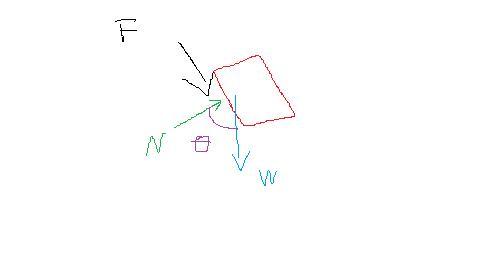
We have the forces involved on the figure attached.

For this case we know that the weight is given by:

W = mg

And for this case the centripetal acceleration would be given by:

a=\frac{v^2}{r}

If we analyze the sum of forces on x and y we have:

\sum F_x = m a_x

F + W sin \theta = ma cos theta

And if we solve for the force we got:

F = ma cos \theta - mg sin \theta = \frac{mv^2}{r} cos \theta - mg sin \theta

\sum F_y = m a_y

N - W cos \theta = ma sin \theta

If we solve for the normal force we got:

N =W cos \theta + ma sin \theta = \frac{mv^2}{r} sin \theta + mg cos \theta

In order to find the banking angle we use the fact that F =0

0 = \frac{mv^2}{r} cos \theta - mg sin \theta

tan \theta= \frac{v^2}{rg}

The velocity on this case is 120 mi/h if we convert this into ft/ s we got:

120 mi/h * \frac{5280 ft}{1mi} *\frac{1hr}{3600 s}= 176 ft/s

And then we have this:

tan \theta = \frac{(176ft/s)^2}{1000 ft 32.2 ft/s^2}= 0.962

\theta = tan^{-1} (0.962) = 43.89

5 0
2 years ago
A railcar with an overall mass of 78,000 kg traveling with a speed vi is approaching a barrier equipped with a bumper consisting
sergij07 [2.7K]

Answer:

v₀ = 2,562 m / s  = 9.2 km/h

Explanation:

To solve this problem let's use Newton's second law

              F = m a = m dv / dt = m dv / dx dx / dt = m dv / dx v

              F dx = m v dv

We replace and integrate

            -β ∫ x³ dx = m ∫ v dv

            β x⁴/ 4 = m v² / 2

We evaluate between the lower (initial) integration limits v = v₀, x = 0 and upper limit v = 0 x = x_max

        -β (0- x_max⁴) / 4 = ½ m (v₀²2 - 0)

         x_max⁴ = 2 m /β   v₀²


Let's look for the speed that the train can have for maximum compression

         x_max = 20 cm = 0.20 m


         v₀ =√(β/2m)   x_max²

Let's calculate

          v₀ = √(640 106/2 7.8 104)    0.20²

          v₀ = 64.05  0.04

          v₀ = 2,562 m / s

          v₀ = 2,562 m / s (1lm / 1000m) (3600s / 1h)

          v₀ = 9.2 km / h

5 0
2 years ago
Consider an infinitely thin flat plate of chord c at an angle of attack α in a supersonic flow. The pressure on the upper and lo
amm1812

Answer:

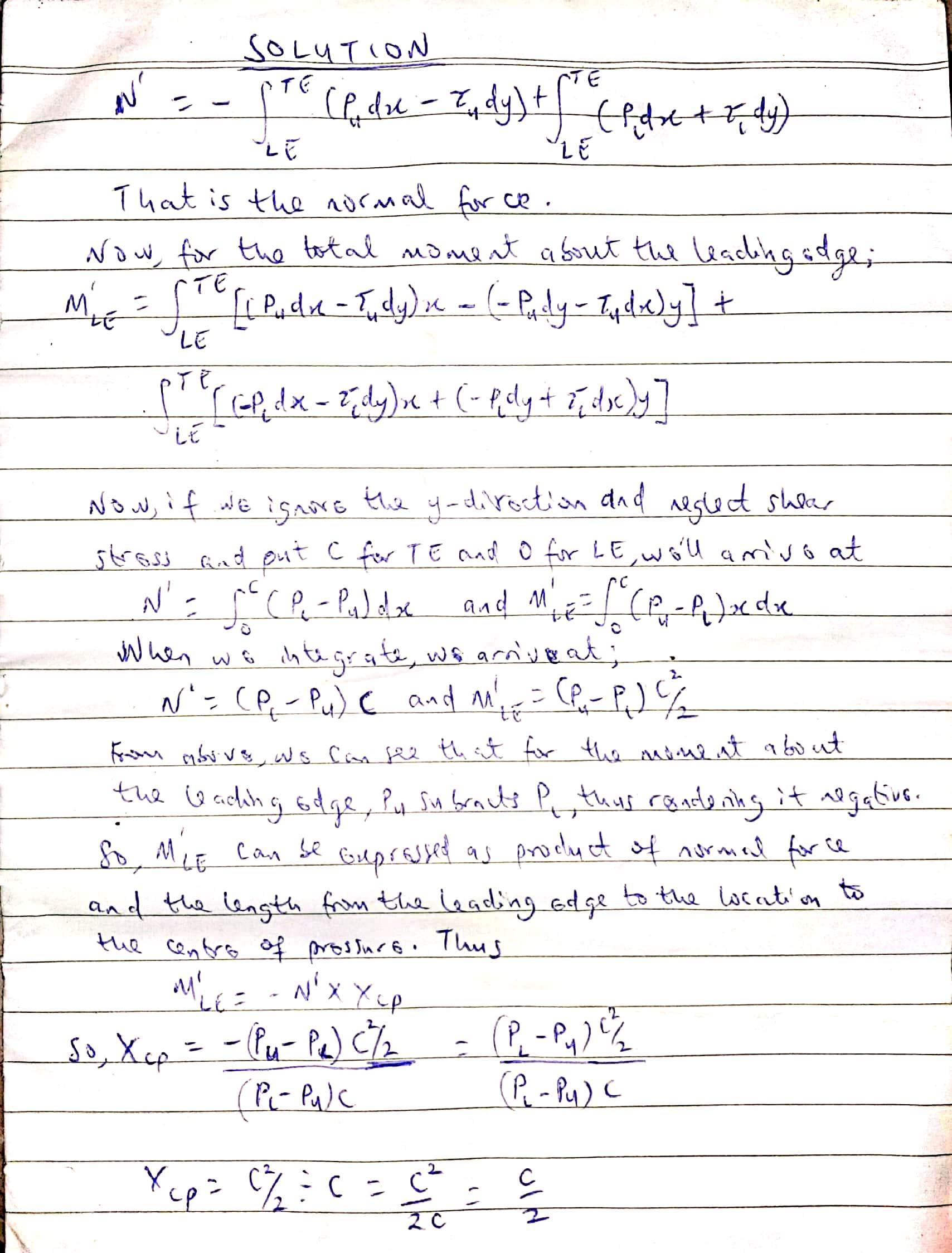
X_cp = c/2

Explanation:

We are given;

Chord = c

Angle of attack = α

p u (s) = c 1

​p1(s)=c2,

and c2 > c1

First of all, we need to find the resultant normal force on the plate and the total moment about leading edge.

I've attached the solution

4 0
2 years ago
The 30-kg gear is subjected to a force of P=(20t)N where t is in seconds. Determine the angular velocity of the gear at t=4s sta
tatyana61 [14]

Answer:

\omega =\frac{24}{1.14375}=20.983\frac{rad}{s}

Explanation:

Previous concepts

Angular momentum. If we consider a particle of mass m, with velocity v, moving under the influence of a force F. The angular  momentum about point O is defined as the “moment” of the particle’s linear momentum, L, about O. And the correct formula is:

H_o =r x mv=rxL

Applying Newton’s second law to the right hand side of the above equation, we have that r ×ma = r ×F =

MO, where MO is the moment of the force F about point O. The equation expressing the rate of change  of angular momentum is this one:

MO = H˙ O

Principle of Angular Impulse and Momentum

The equation MO = H˙ O gives us the instantaneous relation between the moment and the time rate of change of angular  momentum. Imagine now that the force considered acts on a particle between time t1 and time t2. The equation MO = H˙ O can then be integrated in time to obtain this:

\int_{t_1}^{t_2}M_O dt = \int_{t_1}^{t_2}H_O dt=H_0t2 -H_0t1

Solution to the problem

For this case we can use the principle of angular impulse and momentum that states "The mass moment of inertia of a gear about its mass center is I_o =mK^2_o =30kg(0.125m)^2 =0.46875 kgm^2".

If we analyze the staritning point we see that the initial velocity can be founded like this:

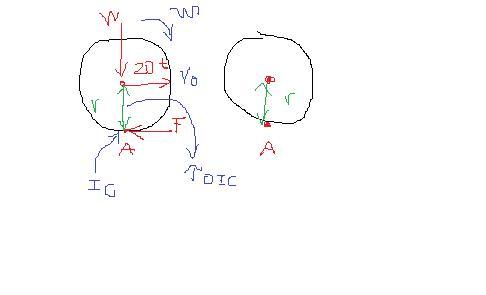
v_o =\omega r_{OIC}=\omega (0.15m)

And if we look the figure attached we can use the point A as a reference to calculate the angular impulse and momentum equation, like this:

H_Ai +\sum \int_{t_i}^{t_f} M_A dt =H_Af

0+\sum \int_{0}^{4} 20t (0.15m) dt =0.46875 \omega + 30kg[\omega(0.15m)](0.15m)

And if we integrate the left part and we simplify the right part we have

1.5(4^2)-1.5(0^2) = 0.46875\omega +0.675\omega=1.14375\omega

And if we solve for \omega we got:

\omega =\frac{24}{1.14375}=20.983\frac{rad}{s}

8 0
2 years ago
Instructions given by traffic police or construction flaggers _____. A. Are sometimes important to follow B. Are usually not imp
Anestetic [448]

Answer:

D. Overrule any other laws and traffic control devices.

Explanation:

Laws and traffic control devices are undoubtedly compulsory to be followed at every point in time to control traffic and other related situations. However, there are cases when certain instructions overrule these laws and traffic control devices. For example, when a traffic police is giving instructions, and though the traffic control devices too (such as traffic lights) are displaying their own preset lights to control some traffic, the instructions from the traffic police take more priority. This is because at that point in time, the instructions from the traffic control devices might not be just applicable or sufficient.

Also, in the case of instructions given by construction flaggers, these instructions have priority over those from controlling devices. This is because during construction traffic controls are redirected from the norms. Therefore, the flaggers such be given more importance.


6 0
2 years ago
Other questions:
  • Gina is about to use a fire extinguisher on a small fire. What factor determines the type of extinguisher she should use
    9·2 answers
  • On the reality television show "Survivor," two tribes compete for luxuries such as food and shelter. During such challenges, one
    12·1 answer
  • If a server takes precisely 15 seconds to serve a customer and customers arrive exactly every 20 seconds, what is the average wa
    7·1 answer
  • Current density is given in cylindrical coordinates as J = −106z1.5az A/m2 in the region 0 ≤ rho ≤ 20 µm; for rho ≥ 20 µm, J = 0
    13·1 answer
  • Hot combustion gases, modeled as air behaving as an ideal gas, enter a turbine at 10 bar, 1500 K and exit at 1.97 bar and 900 K.
    7·1 answer
  • A thin-walled tube with a diameter of 12 mm and length of 25 m is used to carry exhaust gas from a smoke stack to the laboratory
    7·1 answer
  • A thin, flat plate that is 0.2 m × 0.2 m on a side is oriented parallel to an atmospheric airstream having a velocity of 40 m/s.
    5·2 answers
  • A heat recovery device involves transferring energy from the hot flue gases passing through an annular region to pressurized wat
    6·1 answer
  • Determine the design angle ϕ (0∘≤ϕ≤90 ∘) between struts AB and AC so that the 400 lb horizontal force has a component of 600 lb
    10·1 answer
  • 2.24 Carbon dioxide (CO2) gas in a piston-cylinder assembly undergoes three processes in series that begin and end at the same s
    6·1 answer
Add answer
Login
Not registered? Fast signup
Signup
Login Signup
Ask question!