answer.
Ask question
Login Signup
Ask question
All categories
  • English
  • Mathematics
  • Social Studies
  • Business
  • History
  • Health
  • Geography
  • Biology
  • Physics
  • Chemistry
  • Computers and Technology
  • Arts
  • World Languages
  • Spanish
  • French
  • German
  • Advanced Placement (AP)
  • SAT
  • Medicine
  • Law
  • Engineering
kiruha [24]
2 years ago
6

Engine oil at T = 60 °C is forced to flow between two very large, stationary, parallel flat plates separated by a thin gap heigh

t h = 3.60 mm. The plate dimensions are L = 1.25 m and W = 0.550 m. The outlet pressure is atmospheric, and the inlet pressure is 1 atm gage pressure.
Estimate the volume flow rate of oil. Also calculate the Reynolds number of the oil flow, based on gap height h and average velocity V.
Is the flow laminar or turbulent?
Engineering
1 answer:
garik1379 [7]2 years ago
8 0

Answer:

(a) The volume flow rate is 5.43 × 10⁻³ m³/s

(b) The Reynolds's number is 251.1

The flow is laminar as the Reynolds's number is below the critical value of 2040

Explanation:

Here, we have  

The engine oil temperature = 60 °C

Plate gap = 3.60 m

Plate dimensions =

Length, L = 1.25 m

Width, W = 0.550 m

Inlet pressure = 1 atm

Viscosity of engine oil at  SAE 10W - 60

μ = 31.946 mPa.s = 0.031946 kg/m·s

(a) \frac{dP}{dx} = \frac{0\, atm -1 \, atm}{1.25 \, m}  = \frac{0\, bar-1.01325 \, bar}{1.25 \, m}  =   0.8106 \,  bar = 81060 \, Pa

u =\frac{1}{2\times \mu} \times\frac{dP}{dx} \times (y^2 - hy)\\dA = W \times dy

The rate of change of velocity is given by;

\frac{dv}{dt} =\int {u} \, dA

\frac{dv}{dt} =\int\limits^h_0 {\frac{1}{2\times \mu} \times\frac{dP}{dx} \times (y^2 - hy)} \, \times W \times dy

\frac{dv}{dt} =\frac{-1}{12\times \mu}  {\times\frac{dP}{dx} \times h^3} \, \times W

By substituting, we arrive at

\frac{dv}{dt} =\frac{-1}{12\times \mu}  {\times\frac{dP}{dx} \times h^3} \, \times W

\frac{dv}{dt} =\frac{-1}{12\times 0.031946}  {\times-81060 \times 0.0036^3} \, \times 0.55  = 5.43 \times 10^{-3}

The volume flow rate is

\frac{dv}{dt} =5.43 \times 10^{-3} \, m^3/s

(b) The velocity, V is given by

V = \frac{du}{dt}

V =\frac{\frac{dv}{dt } }{W \times h}, we plug in the values and we have;

V =\frac{5.43\times10^{-3} }{0.55 \times 0.0036} = 2.7 \, m/s

Reynolds's number is given by;

Re = \frac{\rho \times v \times h}{\mu}

Where, ρ for the engine oil is 0.8130 g/cm³ = 813 kg/m³

Re = \frac{813 \times 2.7 \times 0.0036}{0.031946 } = 251.1

As the Reynolds's number value is less than 2040, the flow is laminar flow.

You might be interested in
Water at 70 kPa and 1008C is compressed isentropically in a closed system to 4 MPa. Determine the final temperature of the water
Nikitich [7]

Answer:

The answer is "909.3928  KJ".

Explanation:

70 \ kPa  \ \ and \ \ 100^{\circ}C \\\\s_i= 7.56162\ \frac{kJ}{kgK}\\\\u_i= 2509.39 \ \frac{kJ}{kg}\\\\

The method is isentropic since the cylinders are shielded.

Calculating the work:

w= u_2-u_i \\\\

   = 3418.7728-2509.38 \\\\=909.3928 \ KJ

3 0
2 years ago
Steam enters a turbine operating at steady state at 1 MPa, 200 °C and exits at 40 °C with a quality of 83%. Stray heat transfer
Andrei [34K]

Answer:

(a) Work out put=692.83\frac{KJ}{Kg}

(b) Change in specific entropy=0.0044\frac{KJ}{Kg-K}

Explanation:

Properties of steam at 1 MPa and 200°C

        h_1=2827.4\frac{KJ}{Kg},s_1=6.69\frac{KJ}{Kg-K}

We know that if we know only one property in side the dome then we will find the other property by using steam property table.

Given that dryness or quality of steam at the exit of turbine is 0.83 and temperature T=40°C.So from steam table we can find pressure corresponding to saturation temperature 40°C.

Properties of saturated steam at 40°C

      h_f= 167.5\frac{KJ}{Kg} ,h_g= 2537.4\frac{KJ}{Kg}

 s_f= 0.57\frac{KJ}{Kg-K} ,s_g= 8.25\frac{KJ}{Kg-K}

So the enthalpy of steam at the exit of turbine  

h_2=h_f+x(h_g-h_f)\frac{KJ}{Kg}

h_2=167.5+0.83(2537.4-167.5)\frac{KJ}{Kg}

h_2=2134.57\frac{KJ}{Kg}

s_2=s_f+x(s_g-s_f)\frac{KJ}{Kg-K}

s_2=0.57+0.83(8.25-0.57)\frac{KJ}{Kg-K}

s_2=6.6944\frac{KJ}{Kg-K}

(a)

Work out put =h_1-h_2

                      =2827.4-2134.57 \frac{KJ}{Kg}

Work out put =692.83 \frac{KJ}{Kg}

(b) Change in specific entropy

     s_2-s_1=6.6944-6.69\frac{KJ}{Kg-K}

Change in specific entropy =0.0044\frac{KJ}{Kg-K}

3 0
2 years ago
Toeboards are usually ___ inches high and used on landings and balconies.
Ksju [112]

Answer:4 inches

Explanation:

Google told me

6 0
2 years ago
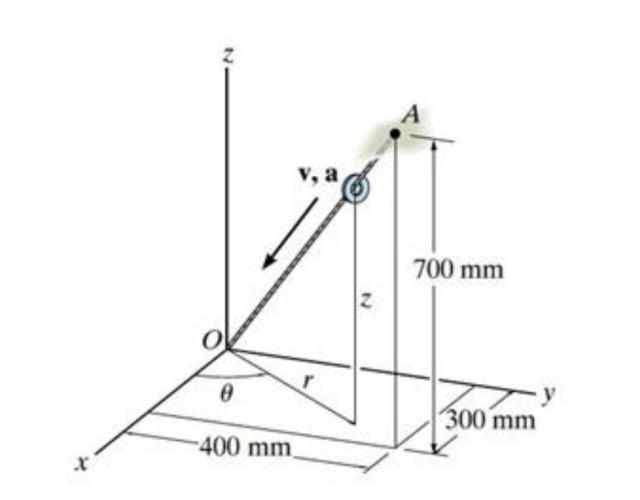
The small washer is sliding down the cord OA. When it is at the midpoint, its speed is 28 m/s and its acceleration is 7 m/s 2 .
Neporo4naja [7]

Answer:

Velocity components

V_r = -16.28 m/s

V_z = -22.8 m/s

V_q = 0 m/s

For Acceleration components;

a_r = -4.07m/s^2

a_z = -5.70m/s^2

a_q = 0m/s^2

Explanation:

We are given:

Speed v_o = 28 m/s

Acceleration a_o= 7 m/s^2

We first need to find the radial position r of washer in x-y plane.

Therefore

r = \sqrt{300^2 + 400^2}

r = 500 mm

To find length along direction OA we have:

L = \sqrt{500^2 + 700^2}L = 860 mm

Therefore, the radial and vertical components of velocity will be given as:

V_r = V_o*cos(Q)

V_z = V_o*sin(Q)

Where Q is the angle between OA and vector r.

Therefore,

V_r = 28 * \frac{r}{L} = > 28 * \frac{500}{860}

V_r = -16.28 m/s

• V_z = 28 * \frac{700}{860} = -22.8

• V_q = 0 m/s

The radial and vertical components of acceleration will be:

a_r = a_o*cos(Q)

a_z = a_o*sin(Q)

Therefore we have:

• a_r = 7* \frac{500}{860} = -4.07m/s^2

• a_z = 7 * \frac{700}{860} = -5.70 m/s^2

• a_q = 0 m/s^2

Note : image is missing, so I attached it

3 0
2 years ago
Let Deterministic Quicksort be the non-randomized Quicksort which takes the first element as a pivot, using the partition routin
juin [17]

Answer:

Answer for the question:

Let Deterministic Quicksort be the non-randomized Quicksort which takes the first element as a pivot, using the partition routine that we covered in class on the quicksort slides. Consider another almost-best case for quicksort, in which the pivot always splits the arrays 1/3: 2/3, i.e., one third is on the left, and two thirds are on the right, for all recursive calls of Deterministic Quicksort. (a) Give the runtime recurrence for this almost-best case. (b) Use the recursion tree to argue why the runtime recurrence solves to Theta (n log n). You do not need to do big-Oh induction. (c) Give a sequence of 4 distinct numbers and a sequence of 13 distinct numbers that cause this almost-best case behavior. (Assume that for 4 numbers the array is split into 1 element on the left side, the pivot, and two elements on the right side. Similarly, for 13 numbers it is split with 4 elements on the left, the pivot, and 8 elements on the right side.)

is given in the attachment.

Explanation:

Download pdf
3 0
2 years ago
Other questions:
  • A_____ transducer is a device that can convert an electronic controller output signal into a standard pneumatic output. A. pneum
    13·1 answer
  • A closed system consisting of 4 lb of a gas undergoes a process during which the relation between pressure and volume is pVn 5 c
    7·1 answer
  • Water at 400 kPa with a quality of 75% has its pressure raised 200 kPa (to 600 kPa) in a constant volume process. What is the ne
    15·1 answer
  • 1. Create a class called Name that represents a person's name. The class should have fields named firstName representing the per
    8·2 answers
  • A joining process in which a filler metal is melted and distributed by capillary action between faying surfaces, the base metals
    12·1 answer
  • A driver traveling at 65 mi/h rounds a curve on a level grade to see a truck overturned across the roadway at a distance of 350
    13·1 answer
  • While at a concert you notice five people in the crowd headed in the same direction. Your tendency to group them is due to? *
    10·1 answer
  • Mr. Ray deposited $200,000 in the Old and Third National Bank. If the bank pays 8% interest, how much will he have in the accoun
    10·2 answers
  • Dalton needs to prepare a close-out report for his project. Which part of the close-out report would describe
    6·1 answer
  • What term describes a guardrail system
    13·2 answers
Add answer
Login
Not registered? Fast signup
Signup
Login Signup
Ask question!