answer.
Ask question
Login Signup
Ask question
All categories
  • English
  • Mathematics
  • Social Studies
  • Business
  • History
  • Health
  • Geography
  • Biology
  • Physics
  • Chemistry
  • Computers and Technology
  • Arts
  • World Languages
  • Spanish
  • French
  • German
  • Advanced Placement (AP)
  • SAT
  • Medicine
  • Law
  • Engineering
xeze [42]
2 years ago
11

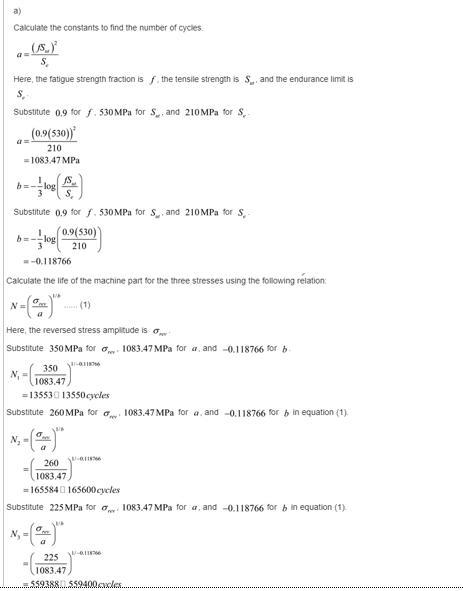
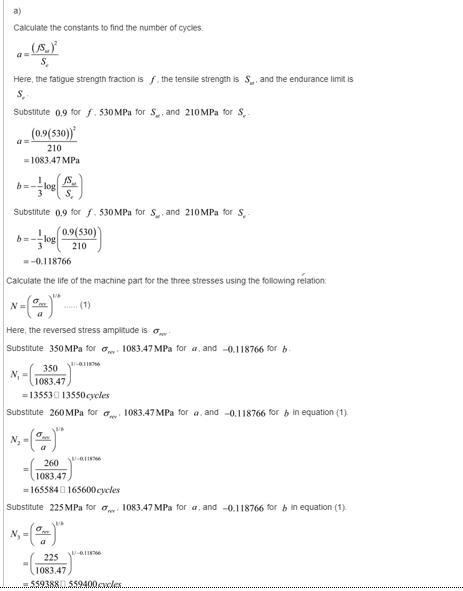
A machine part will be cycled at ±350 MPa for 5 (103) cycles. Then the loading will be changed to ±260 MPa for 5 (104) cycles. F

inally, the load will be changed to ±225 MPa. How many cycles of operation can be expected at this final stress level? For the part, S = 530 MPa, f = 0.9, and has a fully corrected endurance strength of Se = 210 MPa.

Engineering
1 answer:
dimulka [17.4K]2 years ago
6 0

Answer:

a) The number of cycles of operation at 225 MPa is 184,100 cycles

b) The number of cycles of operation at 225 MPa is 33,600 cycles

Explanation:

You might be interested in
Consider two different flows over geometrically similar airfoil shapes, one airfoil being twice the size of the other. The flow
yulyashka [42]

Answer

No;

The two flows are not dynamically similar

 Explanation:  Given

T∞,1 = 800k

V∞,1 = 200m/s

p∞,1 = 1.739kg/m³

T∞,2 = 200k

V∞,2 = 100m/s

p∞,2 = 1.23kg/m³

Size1 = 2 * Size2 (L1 = 2L2)  Assumptions Made

α ∝√T

μ∝√T  Two (2) conditions must be met if the two flows are to be considered similar.

Condition 1: Similar Parameters must be the same for both flows

Condition 2: The bodies and boundaries must be genetically true.  Condition 2 is true

Checking for the first condition...

Well need to calculate Reynold's Number for both flows

And Check if they have the same Reynold's Number  Using the following formula

Re = pVl/μ

Re1 = p1V1l1/μ1  Re2 = p2V2l2/μ2  Re1/Re2 = p1V1l1/μ1 ÷ p2V2l2/μ2

Re1/Re2 = p1V1l1/μ1 * μ2/p2V2l2

Re1/Re2 = p1V1l1μ2/p2V2l2μ1

Re1/Re2 = p1V1l1√T2 / p1V1l1√T1

Re1/Re2 = (1.739 * 200 * 2L2 * √200) / (1.23 * 100 * L2 * √800)

Re1/Re2 = 9837.2/3479

Re1/Re2 = 2,828/1

Re1:Re2 = 2.828:1

Re1 ≠ Re2,

So condition 1 is not satisfied  Since one of tbe conditions is not true, the two flows are not dynamically similar

5 0
2 years ago
Determine the angular acceleration of the uniform disk if (a) the rotational inertia of the disk is ignored and (b) the inertia
lukranit [14]

Answer:

α = 7.848 rad/s^2  ... Without disk inertia

α = 6.278 rad/s^2  .... With disk inertia

Explanation:

Given:-

- The mass of the disk, M = 5 kg

- The right hanging mass, mb = 4 kg

- The left hanging mass, ma = 6 kg

- The radius of the disk, r = 0.25 m

Find:-

Determine the angular acceleration of the uniform disk without and with considering the inertia of disk

Solution:-

- Assuming the inertia of the disk is negligible. The two masses ( A & B )  are hung over the disk in a pulley system. The disk is supported by a fixed support with hinge at the center of the disk.

- We will make a Free body diagram for each end of the rope/string ties to the masses A and B.

- The tension in the left and right string is considered to be ( T ).

- Apply newton's second law of motion for mass A and mass B.

                      ma*g - T = ma*a

                      T - mb*g = mb*a

Where,

* The tangential linear acceleration ( a ) with which the system of two masses assumed to be particles move with combined constant acceleration.

- g: The gravitational acceleration constant = 9.81 m/s^2

- Sum the two equations for both masses A and B:

                      g* ( ma - mb ) = ( ma + mb )*a

                      a =  g* ( ma - mb ) / ( ma + mb )

                      a = 9.81* ( 6 - 4 ) / ( 6 + 4 ) = 9.81 * ( 2 / 10 )

                      a = 1.962 m/s^2  

- The rope/string moves with linear acceleration of ( a ) which rotates the disk counter-clockwise in the direction of massive object A.

- The linear acceleration always acts tangent to the disk at a distance radius ( r ).

- For no slip conditions, the linear acceleration can be equated to tangential acceleration ( at ). The correlation between linear-rotational kinematics is given below :

                     a = at = 1.962 m/s^2

                     at = r*α      

Where,

           α: The angular acceleration of the object ( disk )

                    α = at / r

                    α = 1.962 / 0.25

                    α = 7.848 rad/s^2                                

- Take moments about the pivot O of the disk. Apply rotational dynamics conditions:


                Sum of moments ∑M = Iα

                 ( Ta - Tb )*r = Iα

- The moment about the pivots are due to masses A and B.


               Ta: The force in string due to mass A

               Tb: The force in string due to mass B

                I: The moment of inertia of disk = 0.5*M*r^2

                   ( ma*a - mb*a )*r = 0.5*M*r^2*α

                   α = ( ma*a - mb*a ) / ( 0.5*M*r )

                   α = ( 6*1.962 - 4*1.962 ) / ( 0.5*5*0.25 )

                   α = ( 3.924 ) / ( 0.625 )

                   α = 6.278 rad/s^2
6 0
2 years ago
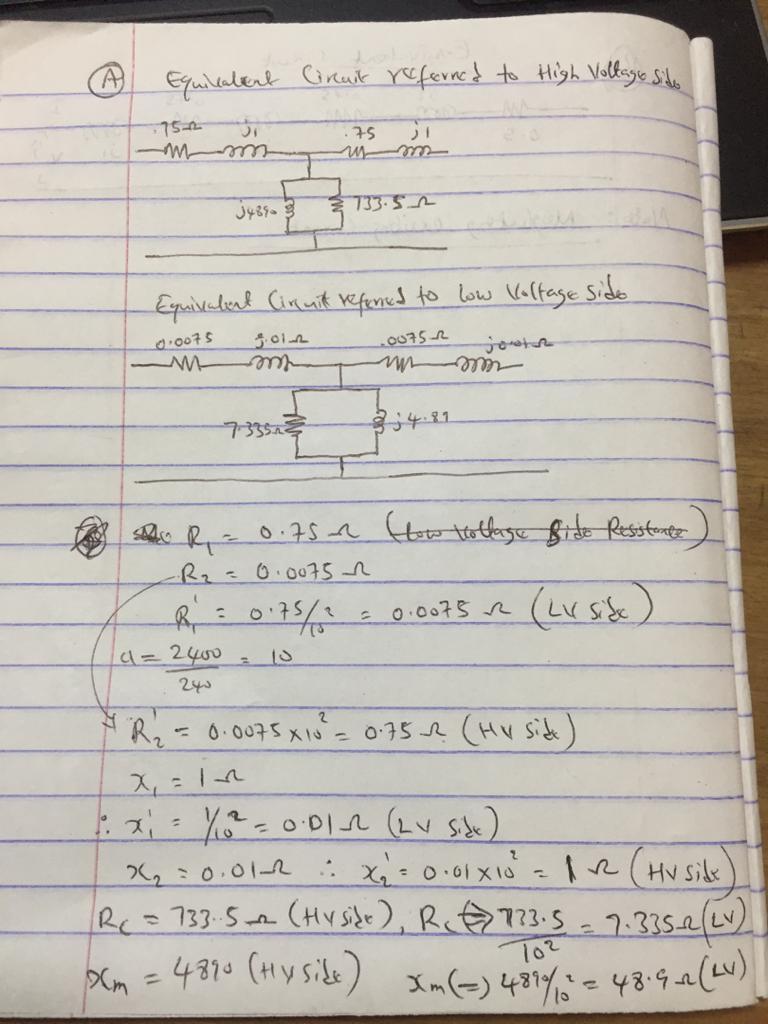
A single phase, 50-KVA, 2400-240-volt, 60 Hz distribution transformer has the following parameters: •
never [62]

Answer:

B) voltage at the sending end of the feeder = 2483.66 v

Explanation:

attached below is the the equivalent circuits and the remaining solution  for option A

B) voltage = 2400 v

   I  = \frac{50*10^3}{2400}  =  20.83 A

calculate voltage at sending end ( Vs )

Vs = 2400 +  20.83 ∠ -cos^-1 (0.8) ( 0.75*2 + 0.5 + j 2 + j2 )

hence Vs = 2483.66 ∠ 0.961

therefore voltage at the sending end = 2483.66 v

8 0
2 years ago
An adiabatic gas turbine expands air at 1300 kPa and 500◦C to 100 kPa and 127◦C. Air enters the turbine through a 0.2-m2 opening
Viktor [21]

Given:

Pressure, P_{1} = 1300 kPa

Temperature,  T_{1} = 500^{\circ}

P_{2} = 100 kPa

T_{2} = 127^{\circ}  

velocity, v = 40 m/s

A = 1m^{2}

Solution:

For air propertiess at

P_{1} = 1300 kPa

T_{1} = 500^{\circ}

h_{1} = 793kJ/K

v_{1} = 0.172\frac{m^{3}}{kg}

and also at

P_{2} = 100 kPa

T_{2} = 127^{\circ}  

h_{2} = 401 KJ/K

v_{2} =  1.15\frac{m^{3}}{kg}

a) Mass flow rate is given by:

m' = \frac{Av}{v_{1}}

Now,

m = \frac{0.2\times 40}{0.172} = 46.51 kg/s

b) for the power produced by turbine, P = m'(h_{1} - h_{2})

P = 46.51\times(793 - 401) = 18.231 MW

5 0
2 years ago
A pump with a 400 mm diameter suction pipe and 350 mm diameter discharge pipe is to deliver 20,000 litres per minute of 15.60C w
Svetach [21]

Answer:

pump head is 10.15 m

Explanation:

given data

diameter suction = 400 mm

diameter discharge = 350 mm

discharge = 20000 l/m

to find out

pump head in meters

solution

we know discharge is 20000 l/m

so discharge = \frac{1}{3} m³/min

and

we know suction head hs  is express as

hs = section gauge × specif gravity of Hg

hs = 0.127 × 13.6

hs = 1.7272 m of water

and

delivery head hd is express as

hd = \frac{delivery gauge}{density of water*g}

hd = \frac{75*10^3}{1000*9.81}

hd = 7.6453 m of water

and

we know distance between the gauge is here

Distance D = 0.075 + 0.45 = 0.525 m

so

discharge velocity vd is express as

Vd = \frac{discharge}{area}

Vd = \frac{1}{3*\frac{\pi }{4} * 0.35^2}

Vd = 3.465 m/s

and

suction velocity Vs is express as

Vs = \frac{discharge}{area}

Vs =  \frac{1}{3*\frac{\pi }{4} * 0.4^2}

Vs = 2.653 m/s

so

pump head will be here

pump head = hs + hd + D + \frac{Vd^2 - Vs^2}{2g}

pump head = 1.7272 + 7.6453 + 0.525 +  \frac{3.465^2 - 2.653^2}{2*9.81}

so pump head = 10.15 m

7 0
2 years ago
Other questions:
  • A 20 mm 3 20 mm silicon chip is mounted such thatthe edges are flush in a substrate. The substrate provides anunheated starting
    5·1 answer
  • Marble A is placed in a hollow tube, and the tube is swung in a horizontal plane causing the marble to be thrown out. As viewed
    11·1 answer
  • A fully braced structural member in a building is subjected to several different loads, including roof loads of D = 5 k and L_r
    7·1 answer
  • In a parallel one-dimensional flow in the positive x direction, the velocity varies linearly from zero at y = 0 to 32 m/s at y =
    8·1 answer
  • tech A says that a Hall-effect sensor can be used in an electronic ignition system. Tech B says that an optical-type sensor can
    6·1 answer
  • The velocity distribution for laminar flow between parallel plates is given by u umax = 1 − ( 2y h ) 2 Where h is the distance s
    15·1 answer
  • To find the reactance XLXLX_L of an inductor, imagine that a current I(t)=I0sin(ωt)I(t)=I0sin⁡(ωt) , is flowing through the indu
    9·1 answer
  • A cylinder with a 0.25 m inner diameter and a 0.43 m outer diameter is internally pressurized to 175 MPa. a) Determine the maxim
    15·1 answer
  • A completely reversible heat pump produces heat at a rate of 300 kW to warm a house maintained at 24°C. The exterior air, which
    7·1 answer
  • A vertical bar consists of three prismatic segments A1, A2, and A3 with cross-sectional areas of 6000 mm2, 5000 mm2, and 4000 mm
    9·1 answer
Add answer
Login
Not registered? Fast signup
Signup
Login Signup
Ask question!