answer.
Ask question
Login Signup
Ask question
All categories
  • English
  • Mathematics
  • Social Studies
  • Business
  • History
  • Health
  • Geography
  • Biology
  • Physics
  • Chemistry
  • Computers and Technology
  • Arts
  • World Languages
  • Spanish
  • French
  • German
  • Advanced Placement (AP)
  • SAT
  • Medicine
  • Law
  • Engineering
grigory [225]
2 years ago
9

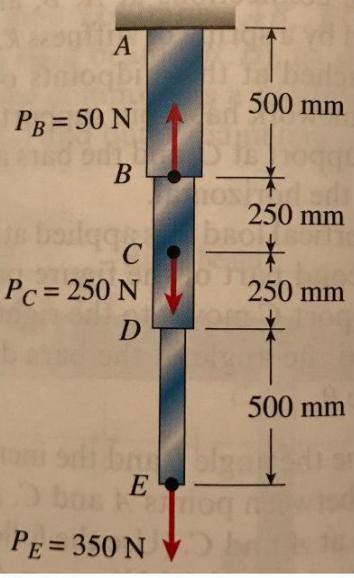
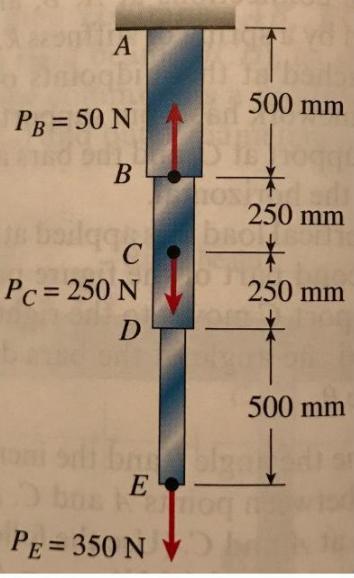
A vertical bar consists of three prismatic segments A1, A2, and A3 with cross-sectional areas of 6000 mm2, 5000 mm2, and 4000 mm

2, respectively. The bar is made of steel with E 5 200 GPa. Calculate the displacements at points B, D, and E. Ignore the weight of the bar. Goodno, Barry J.. Statics and Mechanics of Materials (p. 609). Cengage Learning. Kindle Edition.

Engineering
1 answer:
Lelechka [254]2 years ago
6 0

Answer + Explanation:

For computing the displacement at point B and D we need to determine the following calculations

Pnet = Pc + Pe + Pb

Pnet = 250 + 350 - 50

Pnet = 550 N

<u><em>Now the deflection for bar AB is</em></u>

           PLab

δab = -------------

            ae

     550 * 500

= -------------------------

     6,000 * 200 x 10³

= 2.292 x 10⁻⁴mm

<u><em>Now for bar BC it is</em></u>

           PLbc

δbc = ------------

             ae

  (550 + 50) * 250

=  ----------------------

   5,000 * 200 x 10³

= 1.5 x 10⁻⁴mm

<em><u>And for bar CD it is</u></em>

           PLcd

δcd = ------------

             ae

  (550 - 250 + 50) * 250

=  --------------------------------

   5,000 * 200 x 10³

= 0.875 x 10⁻⁴mm

Now the displacement is as follows

For B = 2.292 × 10⁻⁴ mm

For D = 4.667 × 10⁻⁴ mm

= 2.292 × 10⁻⁴ + 1.5 × 10⁻⁴ + 0.875 × 10⁻⁴

= 4.667 × 10⁻⁴ mm

We simply applied the above formulas for determining the  displacements at points B, D and the same is to be considered

You might be interested in
The rigid bar CDE is attached to a pin support at E and rests on the 30 mm diameter brass cylinder BD. A 22 mm diameter steel ro
Leno4ka [110]

Answer:

stress = 38.84 MPa

Explanation:

S_{D} = \alpha _{brass} * (delta T) *(L_{BD} )\\= (18.8 * 10^(-6) )*(30)*(0.3)\\= 0.0001692 m\\\\E_{BD} = stress / strain\\stress = E_{BD} * S_{D}\\stress = (200 *10^9) * (0.0001692)\\stress = 33.84 MPa

3 0
2 years ago
Q10. Select the correct option for the following questions – (10 points, 2 each) a. After an edge dislocation has passed through
Gnom [1K]

Answer:

a. True - Because the atomic arrangements of that region is disorderer because of the extra half plane atoms in between the line

b.Slip

C. Strength theoretical is greater than strength experimental

d. Shear stress

e. Highest linear density

4 0
2 years ago
(3) Calculate the heat flux through a sheet of brass 7.5 mm (0.30 in.) thick if the temperatures at the two faces are 150°Cand 5
bezimeni [28]

Answer:

a.) 1.453MW/m2,  b.)  2,477,933.33 BTU/hr  c.) 22,733.33 BTU/hr  d.) 1,238,966.67 BTU/hr

Explanation:

Heat flux is the rate at which thermal (heat) energy is transferred per unit surface area. It is measured in W/m2

Heat transfer(loss or gain) is unit of energy per unit time. It is measured in W or BTU/hr

1W = 3.41 BTU/hr

Given parameters:

thickness, t = 7.5mm = 7.5/1000 = 0.0075m

Temperatures 150 C = 150 + 273 = 423 K

                        50 C = 50 + 273 = 323 K

Temperature difference, T = 423 - 323 = 100 K

We are assuming steady heat flow;

a.) Heat flux, Q" = kT/t

K= thermal conductivity of the material

The thermal conductivity of brass, k = 109.0 W/m.K

Heat flux, Q" = \frac{109 * 100}{0.0075} = 1,453,333.33 W/m^{2} \\ Heat flux, Q" = 1.453MW/m^{2} \\

b.) Area of sheet, A = 0.5m2

Heat loss, Q = kAT/t

Heat loss, Q = \frac{109*0.5*100}{0.0075} = 726,666.667W

Heat loss, Q = 726,666.667 * 3.41 = 2,477,933.33 BTU/hr

c.) Material is now given as soda lime glass.

Thermal conductivity of soda lime glass, k is approximately 1W/m.K

Heat loss, Q=\frac{1*0.5*100}{0.0075} = 6,666.67W

Heat loss, Q = 6,666.67 * 3.41 = 22,733.33 BTU/hr

d.) Thickness, t is given as 15mm = 15/1000 = 0.015m

Heat loss, Q=\frac{109*0.5*100}{0.015} =363,333.33W

Heat loss, Q = 363,333.33 * 3.41 = 1,238,966.67 BTU/hr
5 0
2 years ago
6.28 A six-lane freeway (three lanes in each direction) in rolling terrain has 10-ft lanes and obstructions 4 ft from the right
dimulka [17.4K]

Answer:

Assume Base free flow speed (BFFS) = 70 mph

Lane width = 10 ft

Reduction in speed corresponding to lane width, fLW = 6.6 mph

Lateral Clearance = 4 ft

Reduction in speed corresponding to lateral clearance, fLC = 0.8 mph

Interchanges/Ramps = 9/ 6 miles = 1.5 /mile

Reduction in speed corresponding to Interchanges/ramps, fID = 5 mph

No. of lanes = 3

Reduction in speed corresponding to number of lanes, fN = 3 mph

Free Flow Speed (FFS) = BFFS – fLW – fLC – fN – fID = 70 – 6.6 – 0.8 – 3 – 5 = 54.6 mph

Peak Flow, V = 2000 veh/hr

Peak 15-min flow = 600 veh

Peak-hour factor = 2000/ (4*600) = 0.83

Trucks and Buses = 12 %

RVs = 6 %

Rolling Terrain

fHV = 1/ (1 + 0.12 (2.5-1) + 0.06 (2.0-1)) = 1/1.24 = 0.806

fP = 1.0

Peak Flow Rate, Vp = V / (PHV*n*fHV*fP) = 2000/ (0.83*3*0.806*1.0) = 996.54 ~ 997 veh/hr/ln

Vp < (3400 – 30 FFS)

S = FFS

S = 54.6 mph

Density = Vp/S = (997) / (54.6) = 18.26 veh/mi/ln

7 0
2 years ago
Oliver is designing a new children’s slide to increase the speed at which a child can descend. His first design involved steel b
AVprozaik [17]

Answer:

The correct option is;

A) Steel becomes too hot in the Sun and can burn the children

Explanation:

The properties of steel includes;

Low specific heat capacity, high thermal and electrical toughness, high hardness, high tensile strength, high yield strength, appreciable elongation, high fatigue strength, can easily corrode, high malleability and ability to creep

Therefore, due to the low specific heat capacity, which is 0.511 J/(g·°C) and high conductivity of steel which is about 32 W/(m·k), the temperature of the steel can rapidly rise and the hot steel surface can readily conduct the heat, (due to the temperature difference) to other bodies that come in contact

8 0
2 years ago
Other questions:
  • Define a) Principal Plane b) Principal Stress c) anelasticity d) yield point e) ultimate tensile stress f) hardness g) toughness
    5·1 answer
  • Oil in an engine is being cooled by air in a cross-flow heat exchanger, where both fluids are unmixed. Oil (cp = 2000 J/kg. K) f
    12·1 answer
  • A particle has an initial velocity of v0 = 14 ft/s to the right, at s0 = 0, and a = 2 ft/s2 to the left. determine its position
    5·1 answer
  • Air in a 10 ft3 cylinder is initially at a pressure of 10 atm and a temperature of 330 K. The cylinder is to be emptied by openi
    10·2 answers
  • A negative pressure respirator brings fresh air to you through a hose<br>A) True<br>B)False​
    15·2 answers
  • The velocity of a particle which moves along the s-axis is given by v = 2-4t+5t^(3/2), where t is in seconds and v is in meters
    11·2 answers
  • Two physical properties that have a major influence on the cracking of workpieces, tools, or dies during thermal cycling are the
    13·1 answer
  • A rectangular beam having b=300 mm and d=575 mm, spans 5.5 m face to face of simple supports. It is reinforced for flexure with
    14·1 answer
  • The BARO sensor informs the PCM about changes in weather and ____________________.
    14·1 answer
  • Alicia had to get over her fear of heights in order to become comfortable maintaining the generators in wind turbines. professio
    7·1 answer
Add answer
Login
Not registered? Fast signup
Signup
Login Signup
Ask question!