answer.
Ask question
Login Signup
Ask question
All categories
  • English
  • Mathematics
  • Social Studies
  • Business
  • History
  • Health
  • Geography
  • Biology
  • Physics
  • Chemistry
  • Computers and Technology
  • Arts
  • World Languages
  • Spanish
  • French
  • German
  • Advanced Placement (AP)
  • SAT
  • Medicine
  • Law
  • Engineering
GrogVix [38]
2 years ago
10

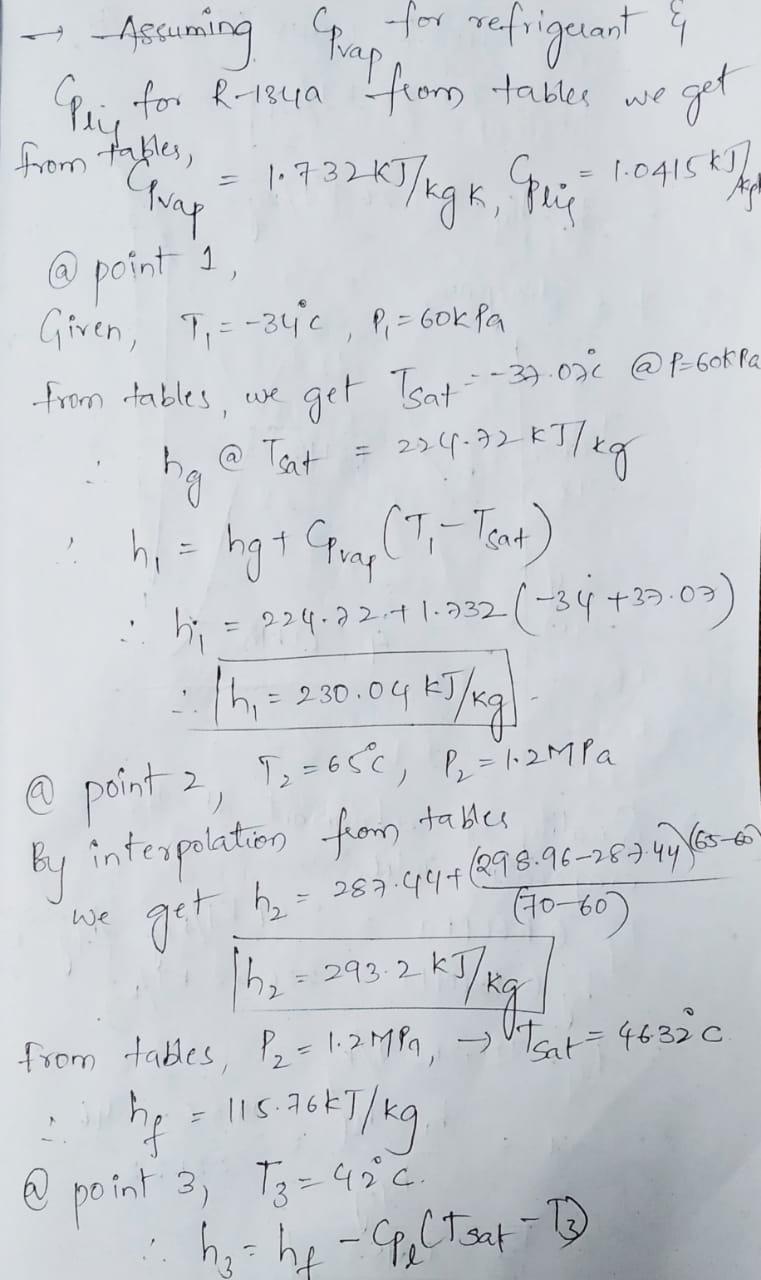
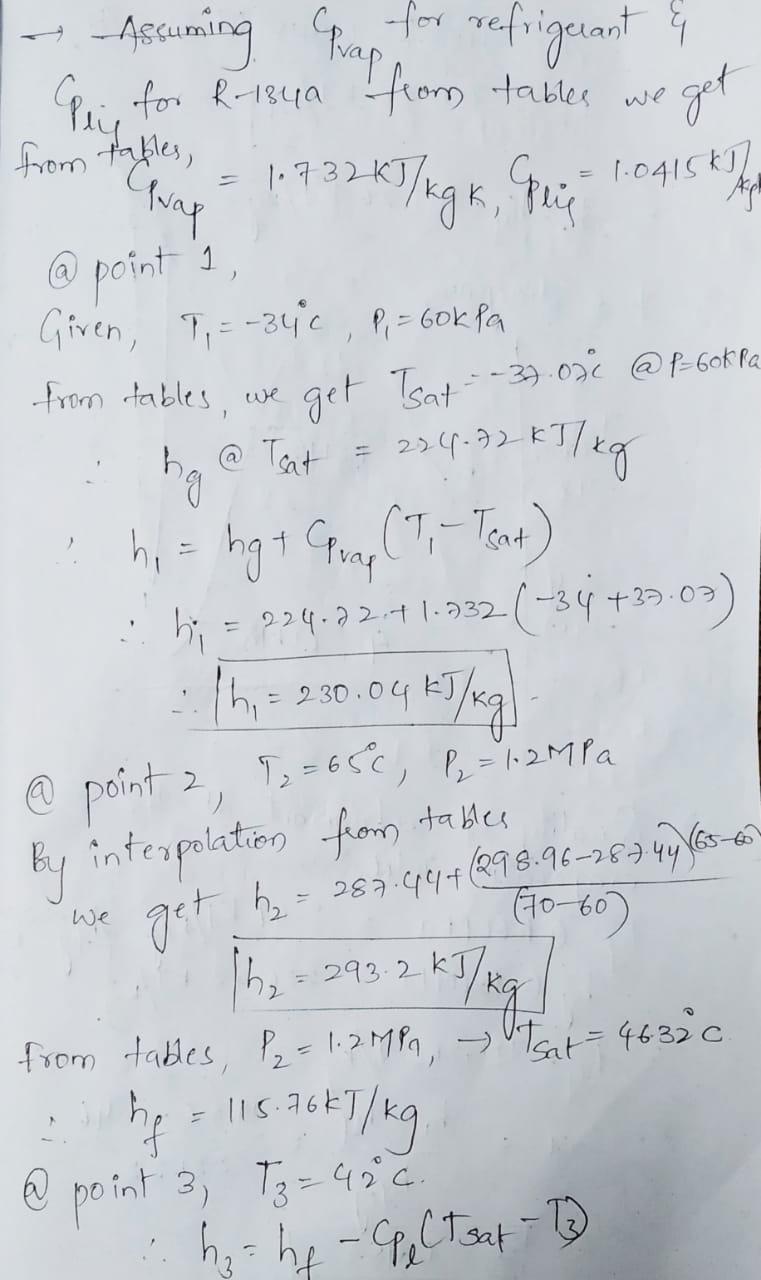
A commercial refrigerator with refrigerant -134a as the working fluid is used to keep the refrigerated space at -30C by rejectin

g its waste heat to cooling water that enters the condenser at 18C at a rate of 0.25 kg/s and leaves at 26C. The refrigerant enters the condenser at 1.2 MPa and 65C and leaves at 42C. The inlet state of the compressor is 60 kPa and -34C and the compressor is estimated to gain a net heat of 450 W from the surroundings. Determine
a. the quality of the refrigerant at the evaporator inlet,


b.the refrigeration load,


c. the COP of the refrigerator, and


d. the theoretical maximum refrigeration load for the same power input to the compressor.

Engineering
Guest
2 years ago
full answer plz
3 answers:
Leto [7]2 years ago
7 0

Answer:

a. the quality of the refrigerant at the evaporator inlet, x = 0.487

b.the refrigeration load, 5.46 kw

c. the COP of the refrigerator, 2.24

d. maximum refrigeration load 12.43 kw

Explanation:

Mariana [72]2 years ago
6 0

Answer:

a) 0.487

b) refrigeration load = 5.46w

c) cop = 2.24

d)ref load max = 12.43kw

Explanation:

Guest2 years ago
0 0

A commercial refrigerator with refrigerant-134a as the working fluid is used to
keep the refrigerated space at -30°C by rejecting its waste heat to cooling water
that enters the condenser at 18°C at a rate of 0.25 kg/s and leaves at 26°C. The
refrigerant enters the condenser at 1.2 MPa and 65°C and leaves at 42°C.
The inlet state of the compressor is 60 kPa and -34°C and the compressor is
estimated to gain a net heat of 450 W from the surroundings. Determine (a) the
quality of the refrigerant at the evaporator inlet, (b) the refrigeration load, (c) the
COP of the refrigerator, and (d) the theoretical maximum refrigeration load for the
same power input to the compressor.

You might be interested in
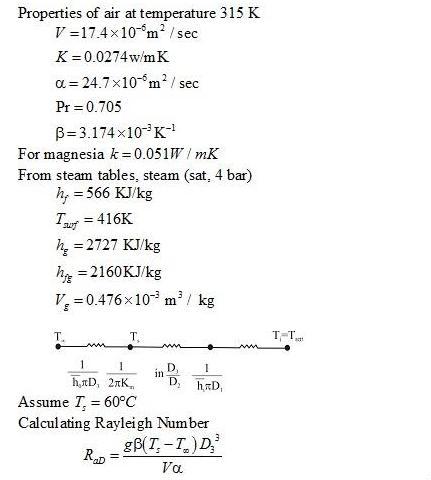
1. Saturated steam at 4 bars absolute pressure with a mean velocity of 3 m/s flows through a horizontal SS304 stainless-steel pi
saveliy_v [14]

Answer:

(a) Rate of heat transfer = 34.65 W/m

(b) quality of outlet of pipe  x = 0.967

(c) Temperature of outer surface of insulation, T₂ = U1.157°C

Yes it is safe to touch, (But gentle touch)

Explanation:

Detailed explanation is given in the attach document.

5 0
2 years ago
A thin-walled tube with a diameter of 12 mm and length of 25 m is used to carry exhaust gas from a smoke stack to the laboratory
nlexa [21]

Answer:

(a)  h₁   = 204.45 W/m²k

(b) h₀ = 46.80 W/m².k

(c) T = T = 15.50°C

Explanation:

Given Data;

Diameter = 12mm

Length = 25 m

Entry temperature = 200°C

Flow rate = 0.006 kg/s

velocity = 2.5 m/s.

Step 1: Calculating the mean temperature;

(200 + 15)/2

Mean temperature = 107.5°C = 380.5 K

The properties of air at mean temperature 380.5 K are given as:

v = 24.2689*10⁻⁶m²/s

a = 35.024*10⁻⁶m²/s

μ    = 221.6 *10⁻⁷Ns/m²

k = 0.0323 W/m.k

Cp = 1012 J/kg.k

Step 2: Calculating the prantl number using the formula;

Pr = v/a

   = 24.2689*10⁻⁶/ 35.024*10⁻⁶

   = 0.693

Step3: Calculating the reynolds number using the formula;

Re = 4m/πDμ

    = 4 *0.006/π*12*10⁻³ * 221.6 *10⁻⁷

    = 0.024/8.355*10⁻⁷

    = 28725

Since Re is greater than 2000, the flow is turbulent. Nu becomes;

Nu = 0.023Re^0.8 *Pr^0.3

Nu = 0.023 * 28725^0.8 * 0.693^0.3

     = 75.955

(a) calculating the heat transfer coefficient:

Nu = hD/k

h = Nu *k/D

  = (75.955 * 0.0323)/12*10^-3

h   = 204.45 W/m²k

(b)

Properties of air at 15°C

v = 14.82 *10⁻⁶m²/s

k = 0.0253 W/m.k

a = 20.873 *10⁻⁶m²/s

Pr(outside) = v/a

                  = 14.82 *10⁻⁶/20.873 *10⁻⁶

                 = 0.71

Re(outside) = VD/v

                   = 2.5 * 12*10⁻³/14.82*10⁻⁶

                    =2024.29

Using Zakauskus correlation,

Nu = 0.26Re^0.6 * Pr^0.37 * (Pr(outside)/Pr)^1/4

    = 0.26 * 2024.29^0.6 *  0.71^0.37 * (0.71/0.693)^1/4

    = 22.199

Nu = h₀D/k

h₀ = Nu*k/D

     = 22.199* 0.0253/12*10⁻³

h₀ = 46.80 W/m².k

 (c)

Calculating the overall heat transfer coefficient using the formula;

1/U =1/h₁ +1/h₀

1/U = 1/204.45 + 1/46.80

1/U = 0.026259

U = 1/0.026259

U = 38.08

Calculating the temperature of the exhaust using the formula;

T -T₀/T₁-T₀ = e^-[uπDL/Cpm]

T - 15/200-15 = e^-[38.08*π*12*10⁻³*25/1012*0.006]

T - 15/185 = e^-5.911

T -15 = 185 * 0.002709

T = 15+0.50

T = 15.50°C
6 0
2 years ago
Small droplets of carbon tetrachloride at 68 °F are formed with a spray nozzle. If the average diameter of the droplets is 200 u
Licemer1 [7]

Answer:

the difference in pressure between the inside and outside of the droplets is 538 Pa

Explanation:

given data

temperature = 68 °F

average diameter = 200 µm

to find out

what is the difference in pressure between the inside and outside of the droplets

solution

we know here surface tension of carbon tetra chloride at 68 °F is get from table 1.6 physical properties of liquid that is

σ = 2.69 × 10^{-2} N/m

so average radius = \frac{diameter}{2} =  100 µm = 100 ×10^{-6} m

now here we know relation between pressure difference and surface tension

so we can derive difference pressure as

2π×σ×r = Δp×π×r²    .....................1

here r is radius and  Δp pressure difference and σ surface tension

Δp = \frac{2 \sigma }{r}    

put here value

Δp = \frac{2*2.69*10^{-2}}{100*10^{-6}}  

Δp = 538

so the difference in pressure between the inside and outside of the droplets is 538 Pa

7 0
2 years ago
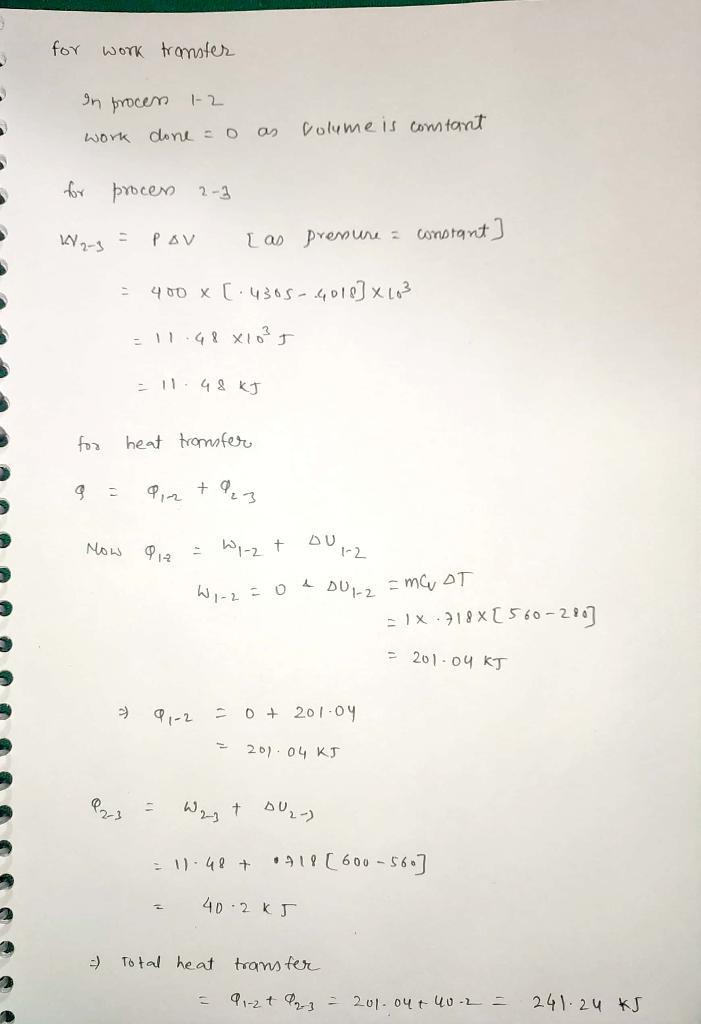
Air in tankBis at 200 kPa, 280 K and mass 1 kg. It is connected to an empty piston/cylinder with a float pressure of 400 kPa sim
Romashka [77]

Answer:

Explanation: see attachment

7 0
2 years ago
Why is it so dangerous to use a ground lift on a metal cased power tool
MaRussiya [10]
Answer:

Removal of the safety ground connection on equipment can expose users to an increased danger of electric shock and may contradict wiring regulations. ... If a fault develops in any line-operated equipment, cable shields and equipment enclosures may become energized, creating an electric shock hazard.
7 0
1 year ago
Other questions:
  • A particle has an initial velocity of v0 = 14 ft/s to the right, at s0 = 0, and a = 2 ft/s2 to the left. determine its position
    5·1 answer
  • 4.9 Given that I 4 amps when Vs 40 volts and Is 4 amps and I 1 amp when Vs 20 volts and Is 0, use superposition and linearity to
    5·1 answer
  • One mole of iron (6 1023 atoms) has a mass of 56 grams, and its density is 7.87 grams per cubic centimeter, so thecenter-to-cent
    15·1 answer
  • 2. A ¼ in. diameter rod must be machined on a lathe to a smaller diameter for use as a specimen in a tension test. The rod mater
    9·1 answer
  • The Hamming encoder/decoder in the lecture detected and corrected one error bit. By adding a thirteen bit which is the exclusive
    13·1 answer
  • Q5. A hypothetical metal alloy has a grain diameter of 2.4 x 10⁻² mm. After a heat treatment at 575°C for 500 min, the grain dia
    7·1 answer
  • A thin-walled tube with a diameter of 6 mm and length of 20 m is used to carry exhaust gas from a smoke stack to the laboratory
    7·1 answer
  • In this module you learned about searching, sorting and algorithms in C++ and how to implement these elements in your C++ progra
    6·1 answer
  • Water enters a circular tube whose walls are maintained at constant temperature at specified flow rate and temperature. For full
    8·1 answer
  • A spherical tank for storing gas under pressure is 25 m in diameter and is made of steel 15 mm thick. The yield point of the mat
    5·2 answers
Add answer
Login
Not registered? Fast signup
Signup
Login Signup
Ask question!