answer.
Ask question
Login Signup
Ask question
All categories
  • English
  • Mathematics
  • Social Studies
  • Business
  • History
  • Health
  • Geography
  • Biology
  • Physics
  • Chemistry
  • Computers and Technology
  • Arts
  • World Languages
  • Spanish
  • French
  • German
  • Advanced Placement (AP)
  • SAT
  • Medicine
  • Law
  • Engineering
otez555 [7]
2 years ago
12

A student placed 11.5 g of glucose (C6H12O6) in a volumetric flask, added enough water to dissolve the glucose by swirling, then

carefully added additional water until the 100. mL mark on the neck of the flask was reached. The flask was then shaken until the solution was uniform. A 40.0 mL sample of this glucose solution was diluted to 0.500 L. How many grams of glucose are in 100. mL of the final solution

Chemistry
2 answers:
Alik [6]2 years ago
5 0

Answer:

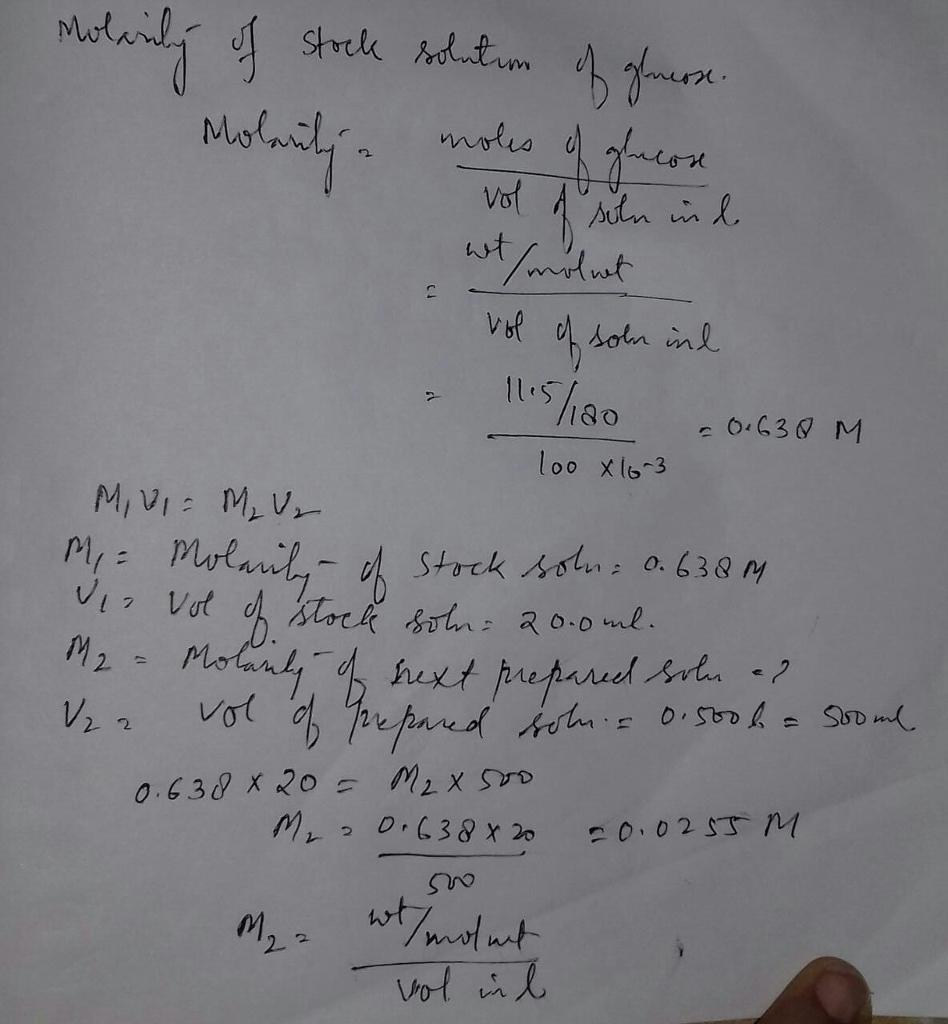
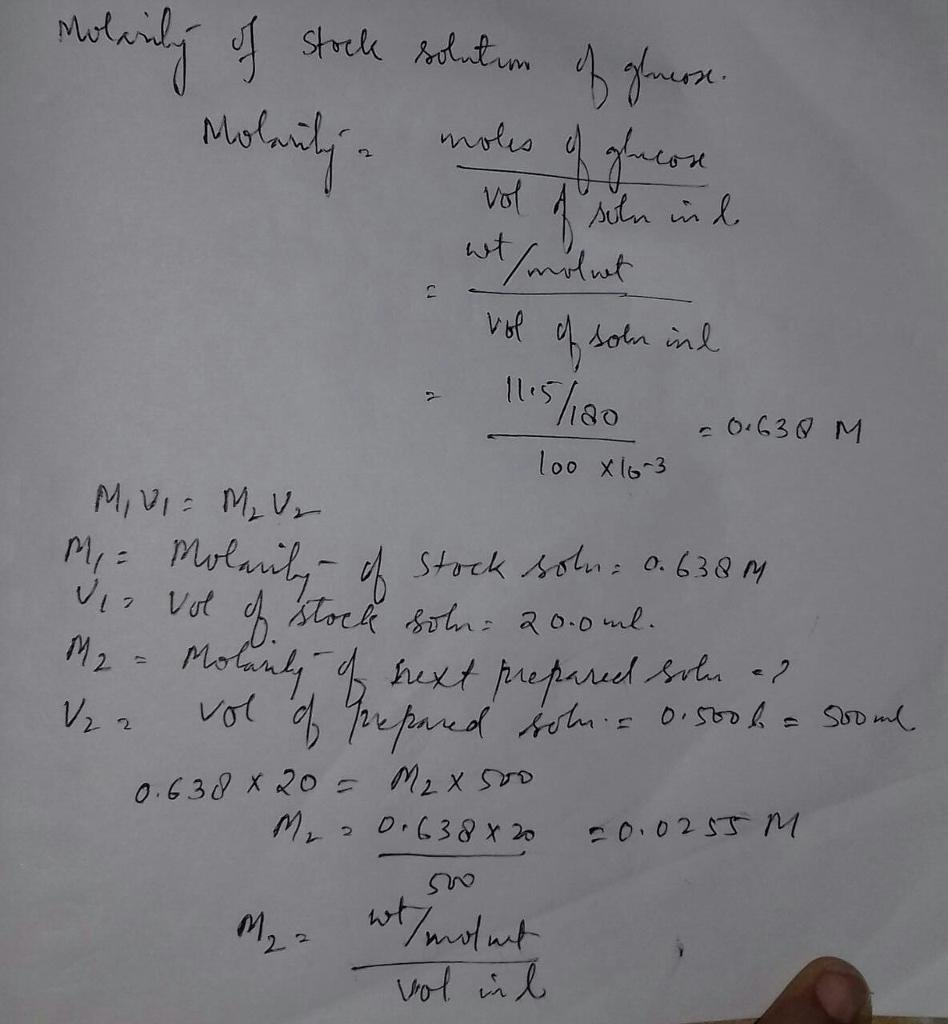
0.459 gram

Explanation:

Find the attachment

Andreas93 [3]2 years ago
3 0

Answer:

There is 0.92 g of glucose in 100 mL of the final solution.

Explanation:

Initially, 11.5 g of glucose is added to the volumetric flask

Water is then added to 100 mL Mark,

The flask was then shaken until the solution was uniform.

The shaking of the mixture makes the concentration of glucose to become uniform all through the solution.

At this point, the concentration of this solution in g/mL is (11.5/100) = 0.115 g/mL

A 40.0 mL sample of this glucose solution was diluted to 0.500 L.

40.0 mL of the already mixed solution is then diluted to 0.500 L.

The mass of glucose in 40.0 mL of the mixed solution with concentration 0.115 g/mL is then given as

Mass = (conc in g/mL) × (volume) = 0.115 × 40 = 4.6 g

So, this mass is then diluted to 0.500 L mark.

New concentration = (mass)/(conc In mL) = (4.6/500) = 0.0092 g/mL

How many grams of glucose are in 100. mL of the final solution

Mass = (conc in g/mL) × (Volume in mL) = 0.0092 × 100 = 0.92 g

Hope this Helps!!!
You might be interested in
mixture or pure substance: 1.blood 2.dyes 3.self-raising flour 4.muesli 5.copper wire 6.distilled water 7.table salt 8.milk 9.br
jenyasd209 [6]

Answer: Mixture: Blood , Self raising flour,muesli ,dyes, milk, tea, air, bronze

Pure substance: Copper wire, distilled water, table salt, oxygen.

Explanation:

Mixture is a substance which is made up two or more number of compounds which chemically inactive and retain their distinct chemical properties.

Blood , Self raising flour,muesli ,dyes, milk, tea, air, bronze

Pure substance is defined as anything with uniform and unchanging composition is known s pure substance.

Copper wire, distilled water, table salt, oxygen.

5 0
2 years ago
How does the arrangement of atoms in a mineral relate to its properties?
MakcuM [25]
The arrangement of atoms in a mineral can change its physical and chemical properties. 
Diamonds and coal are both made of carbon, however, their chemical and physical properties are very different. 

6 0
2 years ago
Read 2 more answers
A copper rod that has a mass of 200.0 g has an initial temperature of 20.0°C and is heated to 40.0°C. If 1,540 J of heat are nee
Romashka [77]

Heat gained in a system can be calculated by multiplying the given mass to the specific heat capacity of the substance and the temperature difference. It is expressed as follows:<span>

Heat = mC(T2-T1)</span>

1540 = 200.0 (C)(40 - 20)

<span> <span>C = 0.385 J / g C</span></span>

<span><span>
</span></span>

<span><span>Hope this answers the question. Have a nice day.</span></span>

8 0
2 years ago
Read 2 more answers
A certain electrochemical cell has for its cell reaction: zn + hgo → zno + hg which is the half-reaction occurring at the anode?
Leya [2.2K]
It is b because I'm just going around the house with me to the mall to get u at the moment I don't have any plans tonight or naw
3 0
2 years ago
When the reaction CO2(g) + H2(g) ⇄ H2O(g) + CO(g) is at equilibrium at 1800◦C, the equilibrium concentrations are found to be [C
UNO [17]

Answer:

The new molar concentration of CO at equilibrium will be  :[CO]=1.16 M.

Explanation:

Equilibrium concentration of all reactant and product:

[CO_2] = 0.24 M, [H_2] = 0.24 M, [H_2O] = 0.48 M, [CO] = 0.48 M

Equilibrium constant of the reaction :

K=\frac{[H_2O][CO]}{[CO_2][H_2]}=\frac{0.48 M\times 0.48 M}{0.24 M\times 0.24 M}

K = 4

CO_2(g) + H_2(g) \rightleftharpoons H_2O(g) + CO(g)

Concentration at eq'm:

0.24 M          0.24 M                 0.48 M            0.48 M

After addition of 0.34 moles per liter of CO_2 and H_2 are added.

(0.24+0.34) M    (0.24+0.34) M  (0.48+x)M         (0.48+x)M

Equilibrium constant of the reaction after addition of more carbon dioxide and water:

K=4=\frac{(0.48+x)M\times (0.48+x)M}{(0.24+0.34)\times (0.24+0.34) M}

4=\frac{(0.48+x)^2}{(0.24+0.34)^2}

Solving for x: x = 0.68

The new molar concentration of CO at equilibrium will be:

[CO]= (0.48+x)M = (0.48+0.68 )M = 1.16 M

3 0
2 years ago
Other questions:
  • Which statement describes a chemical reaction?
    9·2 answers
  • Complete combustion of a 0.600-g sample of a compound in a bomb calorimeter releases 24.0 kJ of heat. The bomb calorimeter has a
    10·2 answers
  • What is the mass of a solution that has a density of 0.775 g/ml and a volume of 50.0ml?
    8·1 answer
  • A person is pushing a box across a table. The measured forces on the box are 10N, 14N, 7N, 10N. Which force is represented by 7N
    11·2 answers
  • The ph of a solution that contains 0.818 m acetic acid (ka = 1.76 x 10⁻⁵) and 0.172 m sodium acetate is __________.
    11·1 answer
  • Determine the empirical formula for compounds that have the following analyses: a. 66.0% barium and 34.0% chlorine b. 80.38% bis
    6·1 answer
  • Catherine has some seawater. She wants to separate pure water from the seawater.
    8·2 answers
  • 1. Given the image below, which calculation will NOT give you the correct average atomic mass?
    10·1 answer
  • Question 6 of 15
    8·1 answer
  • A 5-ounce cup of raspberry yogurt contains 5.0 g of protein, 3.0 g of fat, and 13.3 g of carbohydrate. The fuel values for prote
    14·1 answer
Add answer
Login
Not registered? Fast signup
Signup
Login Signup
Ask question!