answer.
Ask question
Login Signup
Ask question
All categories
  • English
  • Mathematics
  • Social Studies
  • Business
  • History
  • Health
  • Geography
  • Biology
  • Physics
  • Chemistry
  • Computers and Technology
  • Arts
  • World Languages
  • Spanish
  • French
  • German
  • Advanced Placement (AP)
  • SAT
  • Medicine
  • Law
  • Engineering
elixir [45]
2 years ago
7

Chauncey Corporation began business on June 30, 2016. At that time, it issued 20,000 shares of $50 par value, six percent, cumul

ative preferred stock and 90,000 shares of $10 par value common stock. Through the end of 2018, there had been no change in the number of preferred and common shares outstanding. Required a. Assume that Chauncey declared dividends of $69,000 in 2016, $0 in 2017, and $354,000 in 2018. Calculate the total dividends and the dividends per share paid to each class of stock in 2016, 2017, and 2018. Round to two decimal places. Year Preferred Stock Common Stock Preferred per share Common per share 2016 Answer Answer Answer Answer 2017 Answer Answer Answer Answer 2018 Answer Answer Answer Answer b. Assume that Chauncey declared dividends of $0 in 2016, $120,000 in 2017, and $186,000 in 2018. Calculate the total dividends and the dividends per share paid to each class of stock in 2016, 2017, and 2018. Round to two decimal places.
Business
1 answer:
Crazy boy [7]2 years ago
6 0

Answer:

See the explanation below

Explanation:

a. Assume that Chauncey declared dividends of $69,000 in 2016, $0 in 2017, and $354,000 in 2018. Calculate the total dividends and the dividends per share paid to each class of stock in 2016, 2017, and 2018. Round to two decimal places.

a1. Dividend payment of $69,000 in 2016

Total cumulative preferred dividend = 20,000 * $50 * 6% = $60,000

Cumulative preferred dividend per share = $50 * 6% = $3.00 per share

Total common stock dividend = $69,000 - $60,000 = $9,000

Common stock dividend per share = $9,000/90,000 = $0.10 per share

a2. Dividend payment of $0 in 2017

Since $0 dividend is declared, it means no dividend is paid to each class of stock in 2017.

However, cumulative preferred dividend to be carried forward to when next the dividend is paid are as follows:

Total cumulative preferred dividend = 20,000 * $50 * 6% = $60,000

Cumulative preferred dividend per share = $50 * 6% = $3.00 per share

a3. Dividend payment of $354,000 in 2018

Note that the last year cumulative preferred stock dividend will be paid together with their this year's dividend before the common stock dividends are paid as follows:

Total cumulative preferred dividend for two years (2017 and 2018) = (20,000 * $50 * 6%) × 2 = $120,000

Cumulative preferred dividend per share for 2018 alone = $50 * 6% = $3.00 per share

Cumulative preferred dividend per share for 2017 and 2018 = ($50 * 6%) × 2 = $6.00 per share

Total common stock dividend = $354,000 - $120,000 = $234,000

Common stock dividend per share = $234,000/90,000 = $2.60 per share

b. Assume that Chauncey declared dividends of $0 in 2016, $120,000 in 2017, and $186,000 in 2018. Calculate the total dividends and the dividends per share paid to each class of stock in 2016, 2017, and 2018. Round to two decimal places.

b1. Dividend payment of $0 in 2016

Since $0 dividend is declared, it means no dividend is paid to each class of stock in 2016.

However, cumulative preferred dividend to be carried forward to when next the dividend is paid are as follows:

Total cumulative preferred dividend = 20,000 * $50 * 6% = $60,000

Cumulative preferred dividend per share = $50 * 6% = $3.00 per share

b2. Dividend payment of $120 in 2017

Note that the last year cumulative preferred stock dividend will be paid together with their this year's dividend before the common stock dividends are paid as follows:

Total cumulative preferred dividend for two years (2017 and 2018) = (20,000 * $50 * 6%) × 2 = $120,000

Cumulative preferred dividend per share for 2018 alone = $50 * 6% = $3.00 per share

Cumulative preferred dividend per share for 2017 and 2018 = ($50 * 6%) × 2 = $6.00 per share

Since proffered stock has exhausted the dividend paid, no or $0 dividend will be paid to the common stock holder.

b3. Dividend payment of $186,000 in 2018

Total cumulative preferred dividend = 20,000 * $50 * 6% = $60,000

Cumulative preferred dividend per share = $50 * 6% = $3.00 per share

Total common stock dividend = $186,000 - $60,000 = $96,000

Common stock dividend per share = $96,000/90,000 = $1.07 per share.

You might be interested in
At a decision point in a decision tree, which machine would you select when trying to maximize payoff when the anticipated benef
Marat540 [252]

Answer:

Machine C

Explanation:

The computation of the expected benefit is shown below:

For Machine A

= $45,000 × 90%

= $40,500

For Machine B

= $80,000 × 50%

= $40,000

For Machine C

= $60,000 × 75%

= $45,000

If we see the expected benefit of each machine so we can say that the Machine C has the highest benefit generated from the available ones

8 0
2 years ago
You have savings of $157,000. After talking it over with your spouse, you agree to risk no more than 30% on your new business id
Marina86 [1]

Answer:

$47,100

Explanation:

The amount to be invested is not more than 30 % of $157,000

=30% x $157,000

=30/100 x $157,000

=0.3 x $157,000

=$47,100

6 0
1 year ago
A ________ is a digital media file produced and distributed via real simple syndication (rss) for playback on a variety of fixed
EastWind [94]
The answer to this question is the podcast. A podcast is a list of digital audio files that a person can download by the means of subscription. The podcast can be accessed through the internet and can be streamed and downloaded in the user's device. The series of podcast can be downloaded automatically when the list is updated.
6 0
2 years ago
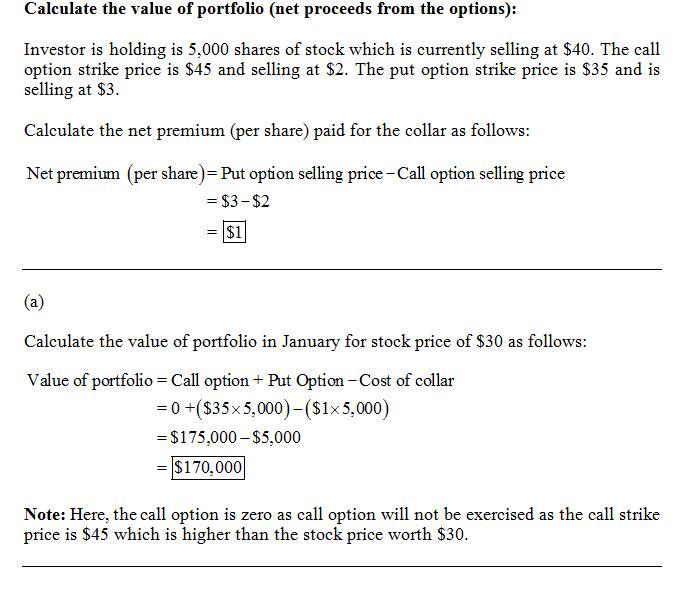
Imagine that you are holding 5,000 shares of stock, currently selling at $40 per share. You are ready to sell the shares but wou
Bess [88]

Answer

The answer and procedures of the exercise are attached in the following archives.

Step-by-step explanation:

You will find the procedures, formulas or necessary explanations in the archive attached below. If you have any question ask and I will aclare your doubts kindly.  

5 0
2 years ago
The following December 31, 2021, fiscal year-end account balance information is available for the Stonebridge Corporation: Cash
aalyn [17]

Answer and Explanation:

1. Total current assets

As we know that

Current ratio = Current assets ÷ current liabilities

Current liabilities  is

= Accounts payable + Accrued interest + Salaries payable

= $50,000 + $1,000 + $22,000

= $73,000

And,

Current ratio = 1.5:1

So,

Total current assets is

= 1.5 × $73,000

= $109,500

b.  Short term investment is

Short term investment = Total current assets - Cash and cash equivalents - Accounts receivables - Inventories

= $109,500 - ($6,100 + $31,000 + $71,000)

= $1,400

c. Now retained earning is

Total assets

= Total current assets + Property, plant and equipment

= $109,500 + $175,000

= $284,500

Total liabilities is

= Current liabilities + Notes payable

= $73,000 + $41,000

= $114,000

Retained earnings is

= Total assets - Total liabilities  - Paid in capital

= $284,500 - $114,000 - $155,000

= $15,500

6 0
2 years ago
Other questions:
  • _______ allows you to convert text to a graphic element.
    14·2 answers
  • Which business risk is avoidable with proper precautions? A. Machine breakdown B. obsolescence of fixed machinery. C. natural ca
    6·2 answers
  • Shawn went to a restaurant where the beer was mediocre and the place was run-down. The restaurant was out of many of its more po
    15·1 answer
  • On July 8, Jones Inc. issued an $80,000, 6%, 120-day note payable to Miller Company. Assume that the fiscal year of Jones ends J
    9·1 answer
  • he Steel Mill is currently operating at 84 percent of capacity. Annual sales are $28,400 and net income is $2,250. The firm has
    8·1 answer
  • Sonia opened a yoga studio where she teaches classes and sells yoga clothing. Variable costs for Sonia's yoga studio include the
    7·2 answers
  • A company has two departments, Y and Z that incur delivery expenses. An analysis of the total delivery expense of $12,000 indica
    15·1 answer
  • The creation of business enterprises where a head office managed geographically separate operational units was facilitated by: G
    10·1 answer
  • A strategy to be a low-cost provider of branded footwear is unlikely to result in the company being one of the best-performers i
    7·1 answer
  • Seven months ago, you purchased 400 shares of stock on margin. The initial margin requirement on your account is 60 percent and
    15·1 answer
Add answer
Login
Not registered? Fast signup
Signup
Login Signup
Ask question!