answer.
Ask question
Login Signup
Ask question
All categories
  • English
  • Mathematics
  • Social Studies
  • Business
  • History
  • Health
  • Geography
  • Biology
  • Physics
  • Chemistry
  • Computers and Technology
  • Arts
  • World Languages
  • Spanish
  • French
  • German
  • Advanced Placement (AP)
  • SAT
  • Medicine
  • Law
  • Engineering
seraphim [82]
2 years ago
9

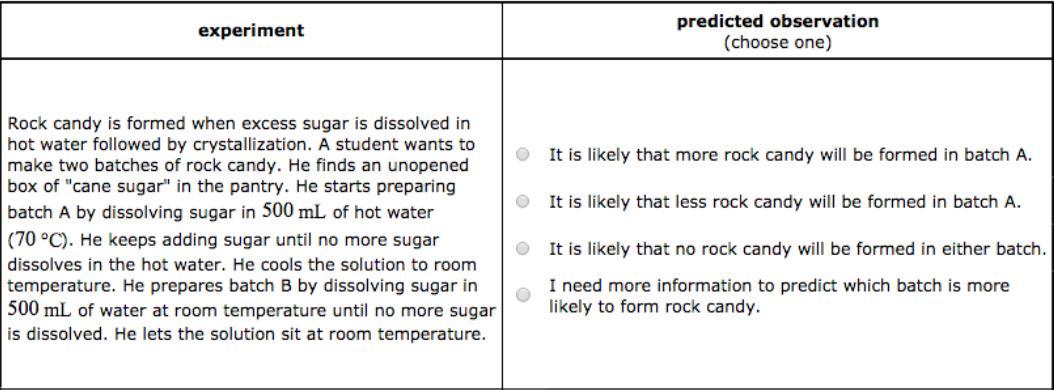
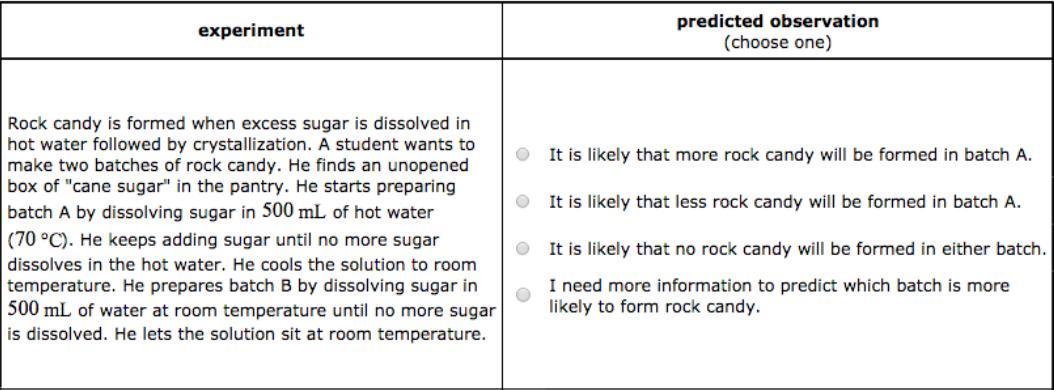
Rock candy is formed when excess sugar is dissolved in hot water followed by crystallization. A student wants to make two batche

s of rock candy. He finds an unopened box of "cane sugar" in the pantry. He starts preparing batch A by dissolving sugar in of hot water (). He keeps adding sugar until no more sugar dissolves in the hot water. He cools the solution to room temperature. He prepares batch B by dissolving sugar in of water at room temperature until no more sugar is dissolved. He lets the solution sit at room temperature.It is likely that less rock candy will be formed in batch A. It is likely that no rock candy will be formed in either batch. I need more information to predict which batch is more likely to form rock candy.

Chemistry
1 answer:
GenaCL600 [577]2 years ago
6 0

Complete Question

The complete question is shown on the first uploaded image  

Answer:

It is  likely that more candy will be  formed  in batched A

Explanation:

From the question we are told in experiment procedure that  rock candy will be formed when excess sugar is  dissolved in hot water followed by a crystallization so this makes understand that there in need for the water to be hot. and looking at the procedure in making the two batches of rock candy we see that the water used for batch A is hotter than than that used for   batch B hence more rocky candy would be formed in batch A.

You might be interested in
A collection of coins contains 14 pennies, 16 dimes, and 7 quarters. What is the percentage of pennies in the collection?A colle
marin [14]

Answer:

=37.83783784

Explanation:

Find the total sum of all coins,

which is 37, take the number of pennies and the total of all coins put in parenthesis( 14/37) like so and than * times them by 100

you equation should look like this

(14/37)* 100= and than the answer shown above should be the one you received. I have checked this with multiple calculators, it should be accurate.  

8 0
2 years ago
Read 2 more answers
Which of the following compounds has polar covalent bonds: NaBr, Br2, HBr, and CBr4?
svetlana [45]

Answer: Option (e) is the correct answer.

Explanation:

A bond that is formed when an electron is transferred from one atom to another results in the formation of an ionic bond.

For example, NaBr will be an ionic compound as there is transfer of electron from Na to Br.

Whereas a bond that is formed by sharing of electrons is known as a covalent bond.

For example, CBr_{4} will be a covalent compound as there is sharing of electron between carbon and bromine atom.

Also, when electrons are shared between the combining atoms and there is large difference in electronegativity of these atoms then partial charges develop on these atoms. As a result, it forms a polar covalent bond.

For example, in a HBr compound there is sharing of electrons between H and Br. Also, due to difference in electronegativity there will be partial positive charge on H and partial negative charge on Br.  

Thus, we can conclude that out of the given options HBr is the only compound that has polar covalent bonds.

8 0
2 years ago
A gas occupies 72.1 at stp. At what temperature would the gas occupy 85.9 L at a pressure of 93.6 kPa?
Alika [10]

Answer:

328.1 K.

Explanation:

  • To calculate the no. of moles of a gas, we can use the general law of ideal gas: <em>PV = nRT</em>.

where, P is the pressure of the gas in atm.

V is the volume of the gas in L.

n is the no. of moles of the gas in mol.

R is the general gas constant,

T is the temperature of the gas in.

  • If n is constant, and have two different values of (P, V and T):

<em>P₁V₁T₂ = P₂V₂T₁</em>

<em></em>

P₁ = 1.0 atm (standard P), V₁ = 72.1 L, T₁ = 25°C + 273 = 298 K (standard T).

P₂ = 93.6 kPa = 0.924 atm, V₂ = 85.9 L, T₂ = ??? K.

<em>T₂ = P₂V₂T₁/P₁V₁ = </em>(0.924 atm)(85.9 L)(298 K)/(1.0 atm)(72.1 L) <em>= 328.1 K.</em>

<em></em>

4 0
2 years ago
in sample of elemental bromine, 55% or the atoms are Br-79, and the remainder are Br-81. if this sample is typical of naturally
Gwar [14]

Answer:

The average atomic mass of bromine is 79.9 amu.

Explanation:

Given data:

Percentage of Br⁷⁹ = 55%

Percentage of Br⁸¹ = 45%

Average atomic mass of bromine = ?

Formula:

Average atomic mass = [mass of isotope× its abundance] + [mass of isotope× its abundance] +...[ ] / 100

Now we will put the values in formula.

Average atomic mass = [55 × 79] + [81 ×45] / 100

Average atomic mass = 4345 + 3645 / 100

Average atomic mass = 7990 / 100

Average atomic mass = 79.9 amu

The average atomic mass of bromine is 79.9 amu.

3 0
2 years ago
Sulfurous acid is a diprotic acid with the following acid-ionization constants: Ka1 = 1.4x10⁻², Ka2 = 6.5x10⁻⁸ If you have a 1.0
REY [17]

Answer:

pH = 7.1581

Explanation:

The equilibrium of NaHSO₃ with Na₂SO₃ is:

HSO₃⁻ ⇄ SO₃²⁻ + H⁺

<em>Where K of equilibrium is the Ka2: 6.5x10⁻⁸</em>

HSO₃⁺ reacts with NaOH, thus:

HSO₃⁻ + NaOH → SO₃²⁻ + H₂O + Na⁺

As the buffer is of 1.0L, initial moles of HSO₃⁻ and SO₃²⁻ are:

HSO₃⁻: 0.252 moles

SO₃²⁻: 0.139 moles

Based on the reaction of NaOH, moles added of NaOH are subtracting moles of HSO₃⁻ and producing SO₃²⁻. The moles added are:

0.0500L ₓ (1mol /L): 0.050 moles of NaOH.

Thus, final moles of both compounds are:

HSO₃⁻: 0.252 moles - 0.050 moles = 0.202 moles

SO₃²⁻: 0.139 moles + 0.050 moles = 0.189 moles

Using H-H equation for the HSO₃⁻ // SO₃²⁻ buffer:

pH = pka + log [SO₃²⁻] / [HSO₃⁻]

Where pKa is - log Ka = 7.187

Replacing:

pH = 7.187 + log [0.189] / [0.202]

<h3>pH = 7.1581</h3>
4 0
2 years ago
Other questions:
  • 28 ml of 0.10 m hcl is added to 60 ml of 0.10 m sr(oh)2. determine the concentration of oh− in the resulting solution.
    6·2 answers
  • What is the mole fraction of potassium dichromate, K2Cr2O7, in a solution prepared from 24.42 g of potassium dichromate and 240.
    12·1 answer
  • ethylene glycol used in automobile antifreeze and in the production of polyester. The name glycol stems from the sweet taste of
    10·1 answer
  • The acid HOCl (hypochlorous acid) is produced by bubbling chlorine gas through a suspension of solid mercury(II) oxide particles
    15·1 answer
  • Stu Dent has finished his titration, and he comes to you for help with the calculations. He tells you that 20.00 mL of unknown c
    11·1 answer
  • What is the best example of a cyclic event?
    7·1 answer
  • In a hexagonal-close-pack (hcp) unit cell, the ratio of lattice points to octahedral holes to tetrahedral holes is 1:1:2. What i
    12·1 answer
  • How long will it take 10.0 mL of Ne gas to effuse through a porous barrier if it has been observed that 125 minutes are required
    13·1 answer
  • A magnesium ion, Mg2+, with a charge of 3.2×10⁻¹⁹C and an oxide ion, O2−, with a charge of −3.2×10⁻¹⁹C, are separated by a dista
    6·1 answer
  • 1. For HF and HBr, the partial positive charge on H atom is 0.29 and 0.09, respectively. Use electronegativities (EN) to explain
    15·1 answer
Add answer
Login
Not registered? Fast signup
Signup
Login Signup
Ask question!