answer.
Ask question
Login Signup
Ask question
All categories
  • English
  • Mathematics
  • Social Studies
  • Business
  • History
  • Health
  • Geography
  • Biology
  • Physics
  • Chemistry
  • Computers and Technology
  • Arts
  • World Languages
  • Spanish
  • French
  • German
  • Advanced Placement (AP)
  • SAT
  • Medicine
  • Law
  • Engineering
maria [59]
2 years ago
11

Air enters a compressor steadily at the ambient conditions of 100 kPa and 22°C and leaves at 800 kPa. Heat is lost from the comp

ressor in the amount of 120 kJ/kg, and the air experiences an entropy decrease of 0.40 kJ/kg·K. Using constant specific heats, determine
(a) the exit temperature of the air,
(b) the work input to the compressor, and
(c) the entropy generation during this process.
Engineering
1 answer:
telo118 [61]2 years ago
3 0

Answer:

a) 358.8K

b) 181.1 kJ/kg.K

c) 0.0068 kJ/kg.K

Explanation:

Given:

P1 = 100kPa

P2= 800kPa

T1 = 22°C = 22+273 = 295K

q_out = 120 kJ/kg

∆S_air = 0.40 kJ/kg.k

T2 =??

a) Using the formula for change in entropy of air, we have:

∆S_air = c_p In \frac{T_2}{T_1} - Rln \frac{P_2}{P_1}

Let's take gas constant, Cp= 1.005 kJ/kg.K and R = 0.287 kJ/kg.K

Solving, we have:

[/tex] -0.40= (1.005)ln\frac{T_2}{295} ln\frac{800}{100}[/tex]

-0.40= 1.005(ln T_2 - 5.68697)- 0.5968

Solving for T2 we have:

T_2 = 5.8828

Taking the exponential on the equation (both sides), we have:

[/tex] T_2 = e^5^.^8^8^2^8 = 358.8K[/tex]

b) Work input to compressor:

w_in = c_p(T_2 - T_1)+q_out

w_in = 1.005(358.8 - 295)+120

= 184.1 kJ/kg

c) Entropy genered during this process, we use the expression;

Egen = ∆Eair + ∆Es

Where; Egen = generated entropy

∆Eair = Entropy change of air in compressor

∆Es = Entropy change in surrounding.

We need to first find ∆Es, since it is unknown.

Therefore ∆Es = \frac{q_out}{T_1}

\frac{120kJ/kg.k}{295K}

∆Es = 0.4068kJ/kg.k

Hence, entropy generated, Egen will be calculated as:

= -0.40 kJ/kg.K + 0.40608kJ/kg.K

= 0.0068kJ/kg.k

You might be interested in
) A shaft encoder is to be used with a 50 mm radius tracking wheel to monitor linear displacement. If the encoder produces 256 p
andrey2020 [161]

Answer:

number of pulses produced =  162 pulses

Explanation:

give data

radius = 50 mm

encoder produces = 256 pulses per revolution

linear displacement = 200 mm

solution

first we consider here roll shaft encoder on the flat surface without any slipping

we get here now circumference that is

circumference = 2 π r .........1

circumference = 2 × π × 50

circumference = 314.16 mm

so now we get number of pulses produced

number of pulses produced = \frac{linear\ displacement}{circumference} × No of pulses per revolution .................2

number of pulses produced = \frac{200}{314.16} × 256

number of pulses produced =  162 pulses

5 0
2 years ago
What is the linear distance traveled in one revolution of a 36-inch wheel
Afina-wow [57]

Answer:

  36π inches ≈ 113.0973 inches

Explanation:

The circumference of the wheel is pi times its diameter.

  C = πd

  C = π(36 in) = 36π in ≈ 113.0973 in

The distance around the wheel is 36π inches, about 113.0973 inches.

7 0
2 years ago
Find the largest number. The process of finding the maximum value (i.e., the largest of a group of values) is used frequently in
salantis [7]

Answer:

See Explanation

Explanation:

Required

- Pseudocode to determine the largest of 10 numbers

- C# program to determine the largest of 10 numbers

The pseudocode and program makes use of a 1 dimensional array to accept input for the 10 numbers;

The largest of the 10 numbers is then saved in variable Largest and printed afterwards.

Pseudocode (Number lines are used for indentation to illustrate the program flow)

1. Start:

2. Declare Number as 1 dimensional array of 10 integers

3. Initialize: counter = 0

4. Do:

4.1 Display “Enter Number ”+(counter + 1)

4.2 Accept input for Number[counter]

4.3 While counter < 10

5. Initialize: Largest = Number[0]

6. Loop: i = 0 to 10

6.1 if Largest < Number[i] Then

6.2 Largest = Number[i]

6.3 End Loop:

7. Display “The largest input is “+Largest

8. Stop

C# Program (Console)

Comments are used for explanatory purpose

using System;

namespace ConsoleApplication1

{

   class Program

   {

       static void Main(string[] args)

       {

           int[] Number = new int[10];  // Declare array of 10 elements

           //Accept Input

           int counter = 0;

           while(counter<10)

           {

               Console.WriteLine("Enter Number " + (counter + 1)+": ");

               string var = Console.ReadLine();

               Number[counter] = Convert.ToInt32(var);

               counter++;                  

           }

           //Initialize largest to first element of the array

           int Largest = Number[0];

           //Determine Largest

           for(int i=0;i<10;i++)

           {

               if(Largest < Number[i])

               {

                   Largest = Number[i];

               }

           }

           //Print Largest

           Console.WriteLine("The largest input is "+ Largest);

           Console.ReadLine();

       }

   }

}

8 0
2 years ago
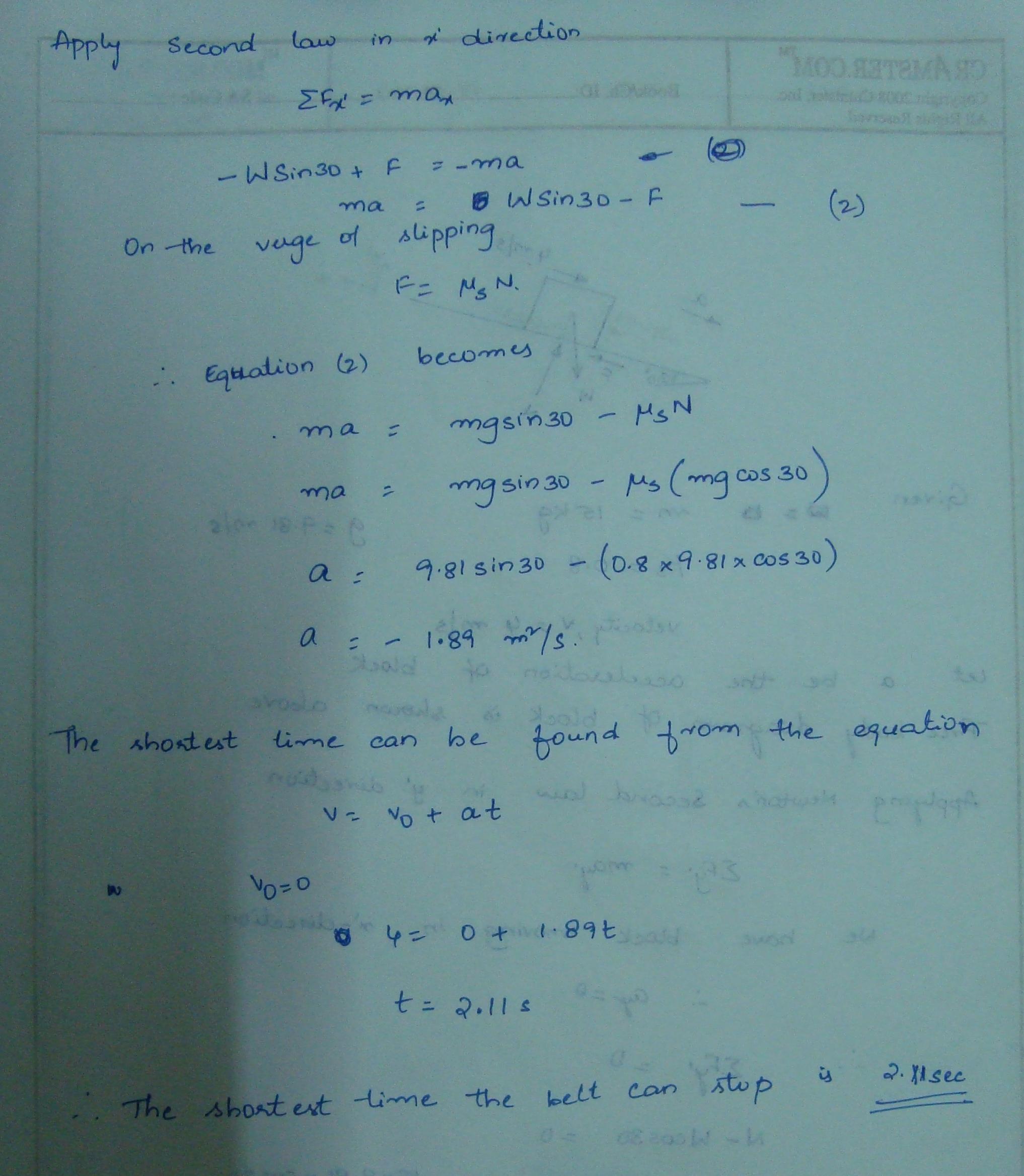
13–27. The conveyor belt is moving downward at 4 m&gt;s. If the coefficient of static friction between the conveyor and the 15-k
Feliz [49]

Answer:

See explanation for step by step procedure to get answer.

Explanation:

Given that:

The conveyor belt is moving downward at 4 m>s. If the coefficient of static friction between the conveyor and the 15-kg package B is ms = 0.8, determine the shortest time the belt can stop so that the package does not slide on the belt.

See the attachments for complete steps to get answer.

4 0
2 years ago
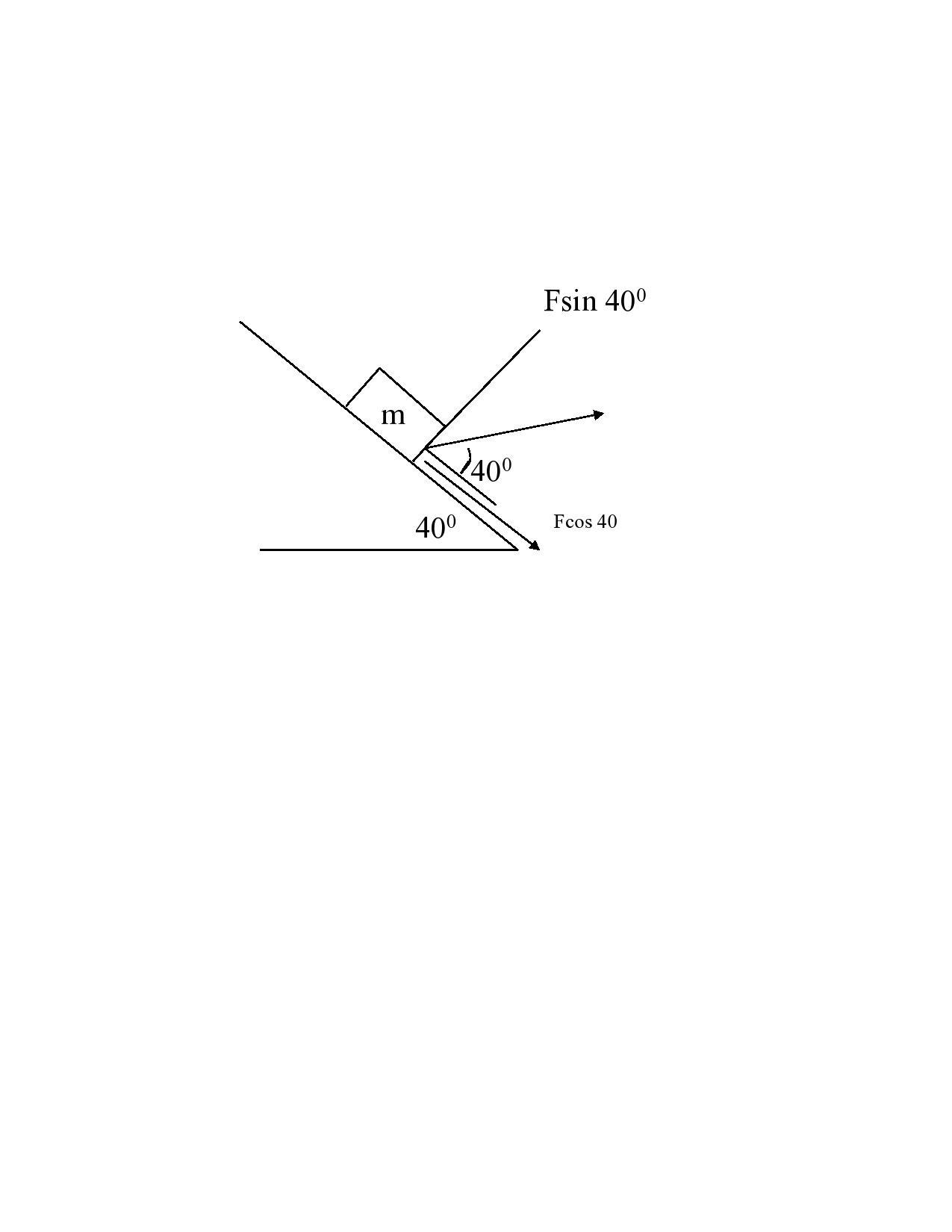
The 10-kg block slides down 2 m on the rough surface with kinetic friction coefficient μk = 0.2. What is the work done by the fr
Rashid [163]

Answer:

153.2 J

Explanation:

Let's first list our given parameters;

mass (m) of the block = 10 kg

which slides down ( i.e displacement) = 2 m

kinetic coefficient of friction (μk) = 0.2

In the diagram shown below;  if we take an integral look at the component of force in the direction of the displacement; we have

F_x= Fcos 40°

F_x= 100 (cos 40°)

F_x= 76.60 N

Workdone by the friction force can now be determined as:

W = F_x × displacement

W = 76.60 × 2

W = 153.2 J

∴  the work done by the friction force = 153.2 J

7 0
2 years ago
Other questions:
  • Theorems of Pappus and Guldinus are used to find: a. The surface area and volume of a body of rotation b. The surface area and v
    14·1 answer
  • Determine the amount of gamma and alpha phases in a 10-kg, 1060 steel casting as it is being cooled to the following temperature
    6·1 answer
  • The four-wheel-drive all-terrain vehicle has a mass of 320 kg with center of mass G2. The driver has a mass of 82 kg with center
    15·1 answer
  • A mass of 12 kg saturated refrigerant-134a vapor is contained in a piston-cylinder device at 240 kPa. Now 300 kJ of heat is tran
    8·1 answer
  • The purification of hydrogen gas is possible by diffusion through a thin palladium sheet. Calculate the number of kilograms of h
    8·1 answer
  • A dc shunt generator rated at 85 kW produces a voltage of 280 V. The brush voltage drop is 2.5 V, and the armature and field res
    6·1 answer
  • A commercial refrigerator with refrigerant-134a as the working fluid is used to keep the refrigerated space at -30C by rejecting
    13·1 answer
  • A spherical tank for storing gas under pressure is 25 m in diameter and is made of steel 15 mm thick. The yield point of the mat
    5·2 answers
  • Consider a steady developing laminar flow of water in a constant-diameter horizontal discharge pipe attached to a tank. The flui
    14·1 answer
  • Use the drop -down menus to select the appropriate question type. Picking between two possible alternatives: Showing an understa
    7·1 answer
Add answer
Login
Not registered? Fast signup
Signup
Login Signup
Ask question!