answer.
Ask question
Login Signup
Ask question
All categories
  • English
  • Mathematics
  • Social Studies
  • Business
  • History
  • Health
  • Geography
  • Biology
  • Physics
  • Chemistry
  • Computers and Technology
  • Arts
  • World Languages
  • Spanish
  • French
  • German
  • Advanced Placement (AP)
  • SAT
  • Medicine
  • Law
  • Engineering
svp [43]
2 years ago
8

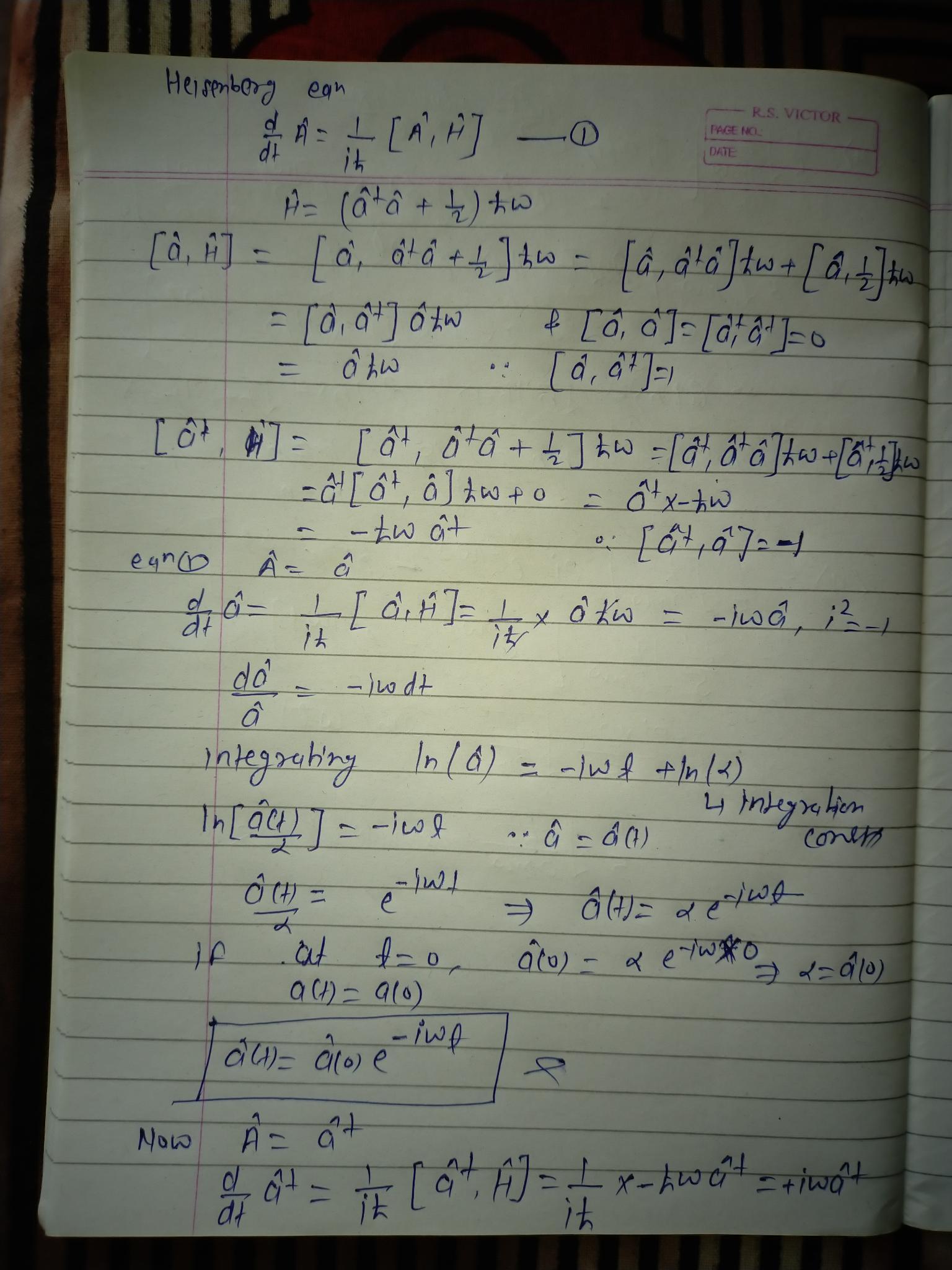
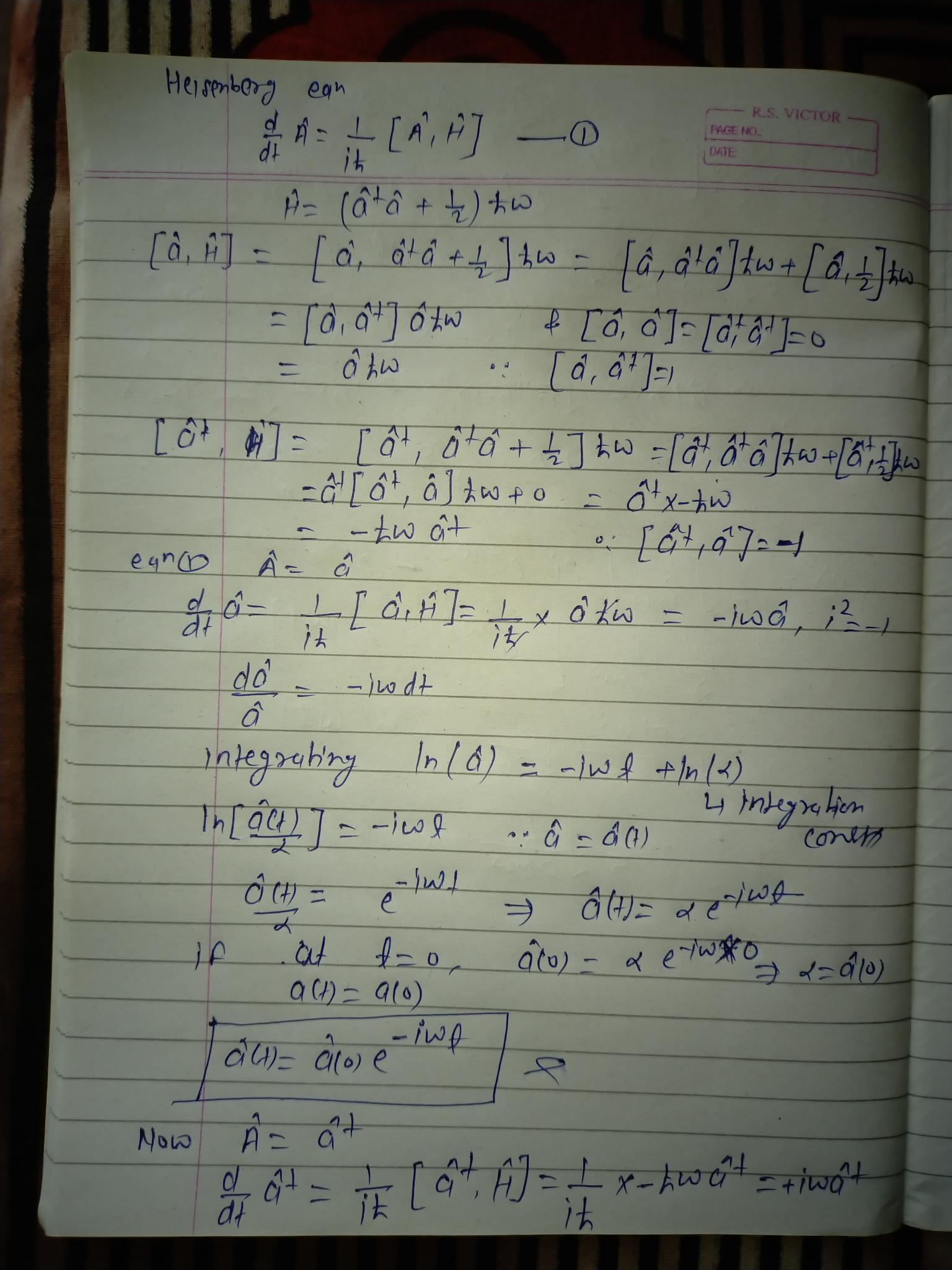
Explicitly solve the Heisenberg equations of motion to find the time–dependent raising and lowering (creation and annihilation)

operators for a one-dimensional oscillator in the Heisenberg picture. Show these operators are consistent with the time–dependent position and momentum operators previously derived in Lecture

Physics
1 answer:
Sedaia [141]2 years ago
3 0

Answer:

see detailed solution attached.

Explanation:

You might be interested in
A car travels 30 miles in 1 hour on a winding mountain road. Which of the following is a true statement?
siniylev [52]

Answer:

The true statement is:

"(C) The magnitude of the average velocity is equal to 30 m.p.h."

Explanation:

Given that a car travels 30 miles in 1 hour on a winding mountain road.

Let' check all the statements one by one:

(A) The magnitude of the total displacement is larger than the distance traveled.

Since the entire motion of the car is not exactly given in the question, so it is not possible to tell whether the magnitude of the total displacement is larger than the distance traveled or not.

Thus, this statement is not true.

(B) The magnitude of the average velocity is greater than 30 m.p.h.

The average velocity of an object is defined as the total displacement covered by the particle divided by the total time taken in covering that displacement.

Total distance covered by the car = 30 miles.

Total time taken by the car to cover this distance = 1 hour.

Therefore, the average velocity of the car for this time interval = \rm \dfrac{30\ miles}{1\ hour }= 30\ m.p.h.

Thus, this statement is also not true.

(C) The magnitude of the average velocity is equal to 30 m.p.h.

As is cleared in part (B) section above, the average velocity of the car in the given time interval is 30 m.p.h.

Thus, this statement is true.

(D)The magnitude of the average velocity is less than to 30 m.p.h.

Since. the average velocity of the car is 30 m.p.h.

Thus, this statement is not true.

(E)The car traveled with a constant speed of 30 m.p.h.

The motion of the car on the mountain road is not thoroughly given in the question, so again it is not possible to tell whether the car traveled with a constant speed of 30 m.p.h. or not.

Thus, this statement is also not true.
4 0
2 years ago
Read 2 more answers
Use the momentum equation for photons found in this week's notes, the wavelength you found in #3, and Plank’s constant (6.63E-34
Nostrana [21]
To help you I need to assume a wavelength and then calculate the momentum.

The momentum equation for photons is:

p = h / λ , this is the division of Plank's constant by the wavelength.

Assuming λ = 656 nm = 656 * 10 ^ - 9 m, which is the wavelength calcuated in a previous problem, you get:

p = (6.63 * 10 ^-34 ) / (656 * 10 ^ -9) kg * m/s

p = 1.01067 * 10^ - 27 kg*m/s which  must be rounded to three significant figures.

With that, p = 1.01 * 10 ^ -27 kg*m/s

The answers are rounded to only 2 significan figures, so our number rounded to 2 significan figures is 1.0 * 10 ^ - 27 kg*m/s

So, assuming the wavelength λ = 656 nm, the answer is the first option: 1.0*10^-27 kg*m/s.
7 0
2 years ago
Read 2 more answers
A pair of glasses is dropped from the top of a 32.0m stadium. A pen is dropped 2.Os later. How high above the ground is the pen
Svetllana [295]

Answer:

h_p = 30.46\ m

Explanation:

<u>Free Fall Motion</u>

A free-falling object refers to an object that is falling under the sole influence of gravity. If the object is dropped from a certain height h, it moves downwards until it reaches ground level.

The speed vf of the object when a time t has passed is given by:

v_f=g\cdot t

Where g = 9.8 m/s^2

Similarly, the distance y the object has traveled is calculated as follows:

\displaystyle y=\frac{g\cdot t^2}{2}

If we know the height h from which the object was dropped, we can solve the above equation for t:

\displaystyle t=\sqrt{\frac{2\cdot y}{g}}

The stadium is h=32 m high. A pair of glasses is dropped from the top and reaches the ground at a time:

\displaystyle t_1=\sqrt{\frac{2\cdot 32}{9.8}}=2.56\ sec

The pen is dropped 2 seconds after the glasses. When the glasses hit the ground, the pen has been falling for:

t_2=2.56 - 2 = 0.56\ sec

Therefore, it has traveled down a distance:

\displaystyle y=\frac{9.8\cdot 0.56^2}{2} = 1.54\ m

Thus, the height of the pen is:

h_p = 32 - 1.54\Rightarrow h_p=30.46\ m

8 0
2 years ago
A 2 000-kg sailboat experiences an eastward force of 3 000 N by the ocean tide and a wind force against its sails with a magnitu
Vesnalui [34]

Answer:

The magnitude of the resultant acceleration is 2.2 m/s^2

Explanation:

Mass (m) of the sailboat =  2000 kg

Force acting on the sailboat due to ocean  tide is F_1 = 3000N

Eastwards means takes place along the positive x direction

ThenF_{1x} = 3000N and F_{1y}= 0

Wind Force acting on the Sailboat isF_2  = 6000N directed towards the northwest that means at an angle  45 degree above the negative x axis

Then  

F_{2x} = -(6000N) cos 45 degree = -4242.6 N

F_{2y}  = (6000N) cos 45 degree = 4242.6 N

Hence  , the net force acting on the sailboat in x direction is  

F_x = F_{1x}+ F_{2x}

=  - 3000 N + 4242.6 N

=  - 3000 N +4242.6 N

= 1242.6N

Net Force acting on the sailboat in y direction is  

F_y = F_{1y}+ F_{2y}

= 0+ 4242.6N

= 4242.6N

The magnitude of the resultant force =

Using pythagorean theorm of 1243 N and 4243 N

\sqrt{(1242.6)^2 + (4242.6)^2

\sqrt{(1544054.76) + (17999654.8)}

\sqrt{(19543709.5)^2}

4420.8 N

F = ma

a = \frac{F}{m}

a =\frac{4420.8}{ 2000}

=2.2 m/s^2

4 0
2 years ago
A box slides down a frictionless plane inclined at an angle θ ¸ above the horizontal. The gravitational force on the box is dire
DedPeter [7]
<h2>Answer: at an angle \theta below the inclined plane. </h2>

If we draw the <u>Free Body Diagram</u> for this situation (figure attached), taking into account only the gravity force in this case, we will see the weight W of the block, which is directly proportional to the gravity acceleration g:  

W=m.g

This force is directed vertically at an angle \theta below the inclined plane, this means it has an X-component and a Y-component:

W=W_{X}+W_{Y}

W_{X}=m.g.cos(\theta)

W_{Y}=m.g.sin(\theta)

Therefore the correct option is c

6 0
2 years ago
Read 2 more answers
Other questions:
  • Complete combustion of 1.0 metric ton of coal (assuming pure carbon) to gaseous carbon dioxide releases 3.3 x 10¹⁰ j of heat. co
    10·1 answer
  • A 0.180-kilogram cart traveling at 0.80 meter per second to the right collides with a 0.100-kilogram cart initially at rest. The
    13·1 answer
  • Part F - Example: Finding Two Forces (Part I)
    5·1 answer
  • Charlie is playing with his daughter Torrey in the snow. She sits on a sled and asks him to slide her across a flat, horizontal
    10·2 answers
  • The furnace keeps houseAat 25◦C, while thefurnace in houseBkeeps it at 20◦C. Which house requires heat to be supplied by its fur
    7·1 answer
  • On average, both arms and hands together account for 13% of a person's mass, while the head is 7.0% and the trunk and legs accou
    8·1 answer
  • A child tugs on a rope attached to a 0.62-kg toy with a horizontal force
    7·1 answer
  • Tech A says that some electric actuators are positioned by an A/C ECU which checks the air flow with sensors. Tech B says that e
    12·1 answer
  • A construction worker accidentally drops a brick from a high scaffold. a. What is the brick's velocity after 4.0 s? b. How far d
    15·1 answer
  • In the year 2090, and Burt is still alive! Well, he’s really just a brain connected to a “life machine.” Since Burt has no body,
    7·1 answer
Add answer
Login
Not registered? Fast signup
Signup
Login Signup
Ask question!