answer.
Ask question
Login Signup
Ask question
All categories
  • English
  • Mathematics
  • Social Studies
  • Business
  • History
  • Health
  • Geography
  • Biology
  • Physics
  • Chemistry
  • Computers and Technology
  • Arts
  • World Languages
  • Spanish
  • French
  • German
  • Advanced Placement (AP)
  • SAT
  • Medicine
  • Law
  • Engineering
Tems11 [23]
2 years ago
4

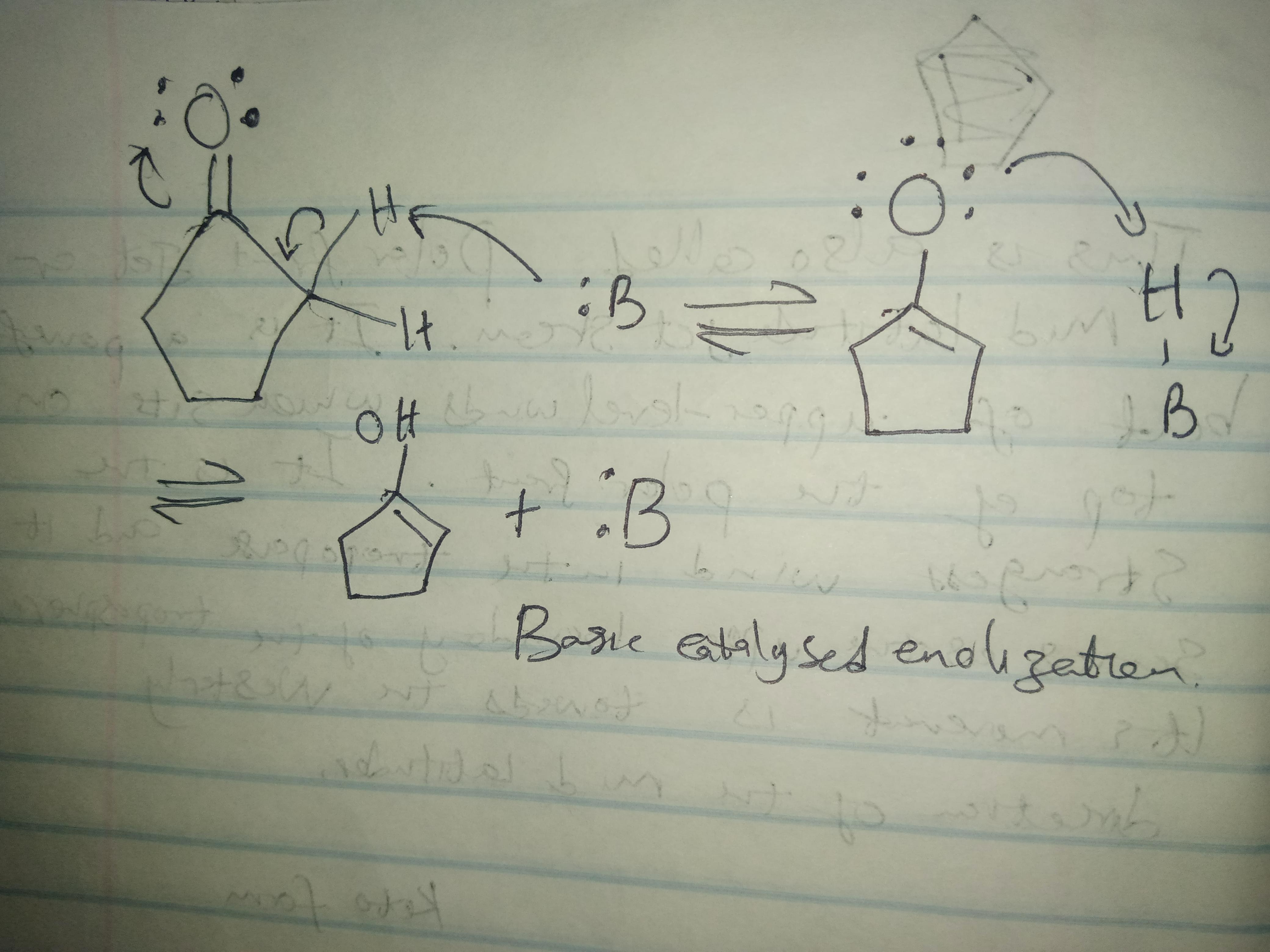
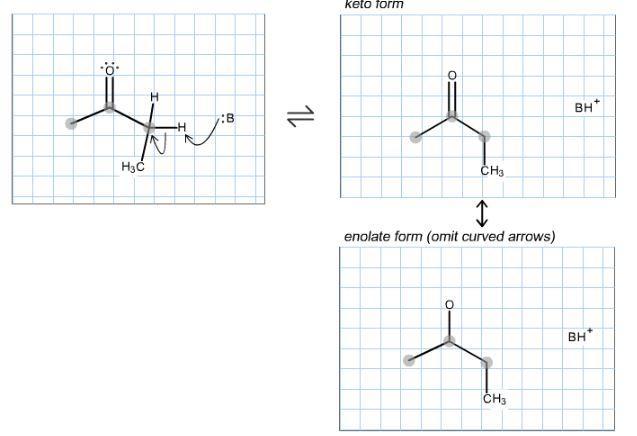
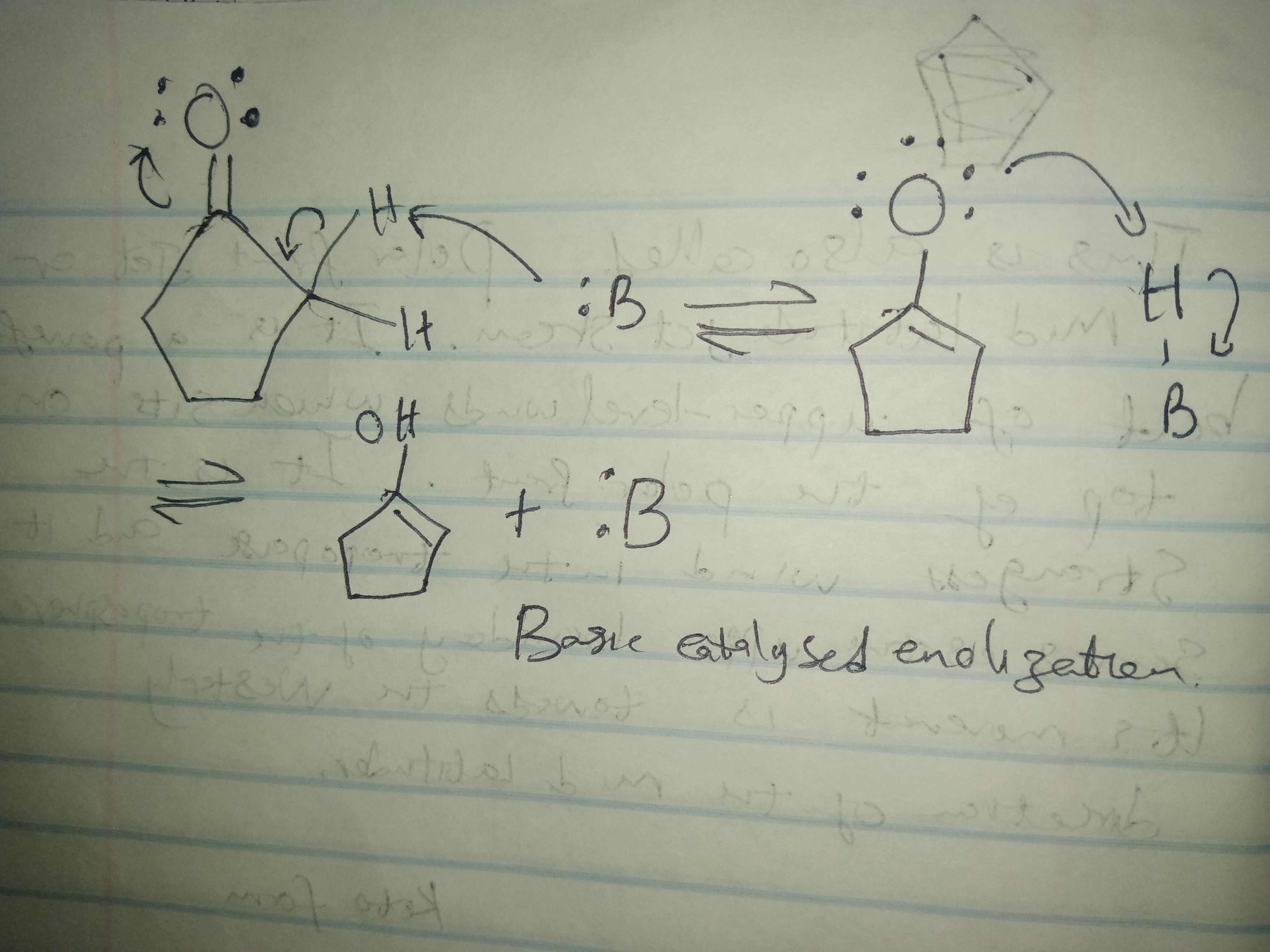
Draw the curved arrow(s) to depict the formation of the keto form of an enolate ion via a strong base, B. Complete the resonance

structures of the enolate anion\'s keto and enolate forms with bonds, charges, and nonbonding electron pairs. Use curved arrows to show how the keto form resonates to the enolate form.

Chemistry
2 answers:
nikitadnepr [17]2 years ago
6 0

Answer:

The answer is on the attached document

Explanation:

zaharov [31]2 years ago
3 0

Answer:

The question is not complete. Find attached of the remaining question and the answer.

Explanation:

See the attached file for the answer.

You might be interested in
A mixture of gases containing 0.20 mol of SO2 and 0.20 mol of O2 in a 4.0 L flask reacts to form SO3. If the temperature is 25ºC
diamong [38]

Answer : The pressure in the flask after reaction complete is, 2.4 atm

Explanation :

To calculate the pressure in the flask after reaction is complete we are using ideal gas equation.

PV=n_TRT\\\\P=(n_1+n_2)\times \frac{RT}{V}

where,

P = final pressure in the flask = ?

R = gas constant = 0.0821 L.atm/mol.K

T = temperature = 25^oC=273+25=298K

V = volume = 4.0 L

n_1 = moles of SO_2 = 0.20 mol

n_2 = moles of O_2 = 0.20 mol

Now put all the given values in the above expression, we get:

P=(0.20+0.20)mol\times \frac{(0.0821L.atm/mol.K)\times (298K)}{4.0L}

P=2.4atm

Thus, the pressure in the flask after reaction complete is, 2.4 atm

5 0
2 years ago
During an investigation, students dropped a tarnished penny into a solution of acetic acid and sodium chloride. Tiny bubbles for
pogonyaev
A. The penny experienced a color change, and a gas was produced.
The penny was less tarnished (color change), and tiny bubbles formed around the penny (due to a gas being produced).
6 0
2 years ago
The unit cell for cr2o3 has hexagonal symmetry with lattice parameters a = 0.4961 nm and c = 1.360 nm. If the density of this ma
IRINA_888 [86]

To calculate the packing factor, first calculate the area and volume of unit cell.

Area is calculated as:

A=6R^{2}\sqrt{3}

Here, R is radius and is related to a as follows:

R=\frac{a}{2}

Putting the value in expression for area,

A=6(\frac{a}{2})^{2}\sqrt{3}=1.5a^{2}\sqrt{3}

The value of a is 0.4961 nm

Since, 1 nm=10^{-7}cm

Thus, 0.4961 nm=4.961\times 10^{-8} cm

Putting the value,

Area=1.5(4.961\times 10^{-8}cm)^{2}\sqrt{3}=6.39\times 10^{-15}cm^{2}

Now, volume can be calculated as follows:

V=Area\times c

The value of c is 1.360 nm or 1.360\times 10^{-7} cm

Putting the value,

V=(6.39\times 10^{-15}cm^{2})\times (1.360\times 10^{-7} cm)=8.7\times 10^{-22}cm^{3}

now, number of atom in unit cell can be calculated by using the following formula:

n=\frac{\rho N_{A}V_{c}}{A}

Here, A is atomic mass of Cr_{2}O_{3} is 151.99 g/mol.

Putting all the values,

n=\frac{(5.22 g/cm^{3})(6.023\times 10^{23} mol^{-1})(8.7\times 10^{-22}cm^{3})}{(151.99 g/mol)}\approx 18

Thus, there will be 18 Cr_{2}O_{3} units in 1 unit cell.

Since, there are 2 Cr atoms and 3 oxygen atoms thus, units of chromium and oxygen will be 2×18=36 and 3×18=54 respectively.

The atomic radii of Cr^{3+} and O^{2-} is 62 pm and 140 pm respectively.

Converting them into cm:

1 pm=10^{-10}cm

Thus,

r_{Cr^{3+}}=6.2\times 10^{-9}cm

and,

r_{O^{2-}}=1.4\times 10^{-8}cm

Volume of sphere will be sum of volume of total number of cations and anions thus,

V_{S}=V_{Cr^{3+}}+V_{O^{2-}}

Since, volume of sphere is V=\frac{4}{3}\pi r^{3},

V_{S}=36\left ( \frac{4}{3}\pi (r_{Cr^{3+})^{3}} \right )+54\left ( \frac{4}{3}\pi (r_{O^{2-})^{3}} \right )

Putting the values,

V_{S}=36\left ( \frac{4}{3}(3.14) (6.2\times 10^{-9} cm)^{3}} \right )+54\left ( \frac{4}{3}(3.14) (1.4\times 10^{-8} cm)^{3}} \right )=6.6\times 10^{-22}\times 10^{-8}cm^{3}

The atomic packing factor is ratio of volume of sphere and volume of crystal, thus,

packing factor=\frac{V_{S}}{V_{C}}=\frac{6.6\times 10^{-22}cm^{3}}{8.7\times 10^{-22}cm^{3}}=0.758

Thus, atomic packing factor is 0.758.
6 0
2 years ago
Read 2 more answers
A sample of an ideal gas occupies 2.78 x 10^3 mL at 25°C and 760 mm Hg.
iris [78.8K]

Answer: It will occupy 4.45\times 10^3ml at the same temperature and 475 mm Hg.

Explanation:

Boyle's Law: This law states that pressure is inversely proportional to the volume of the gas at constant temperature and number of moles.

P\propto \frac{1}{V}     (At constant temperature and number of moles)

P_1V_1=P_2V_2    (At constant temperature and number of moles)

where,

P_1 = initial pressure of gas = 760 mm Hg

P_2 = final pressure of gas = 475 mm Hg

V_1 = initial volume of gas = 2.78\times 10^3ml

V_2  = final volume of gas = ?

Putting in the values:

760mm Hg\times 2.78\times 10^3ml=475 mm Hg\times V_2

V_2=4.45\times 10^3ml

Thus it will occupy 4.45\times 10^3ml at the same temperature and 475 mm Hg

5 0
2 years ago
Read 2 more answers
Some hydrogen gas is enclosed within a chamber being held at 200∘C∘C with a volume of 0.0250 m3m3. The chamber is fitted with a
Semenov [28]

Answer:

The final volume is 39.5 L = 0.0395 m³

Explanation:

Step 1: Data given

Initial temperature = 200 °C = 473 K

Volume = 0.0250 m³ = 25 L

Pressure = 1.50 *10^6 Pa

The pressure reduce to 0.950 *10^6 Pa

The temperature stays constant at 200 °C

Step 2: Calculate the volume

P1*V1 = P2*V2

⇒with P1 = the initial pressure = 1.50 * 10^6 Pa

⇒with V1 = the initial volume = 25 L

⇒with P2 = the final pressure = 0.950 * 10^6 Pa

⇒with V2 = the final volume = TO BE DETERMINED

1.50 *10^6 Pa * 25 L = 0.950 *10^6 Pa * V2

V2 = (1.50*10^6 Pa * 25 L) / 0.950 *10^6 Pa)

V2 = 39.5 L = 0.0395 m³

The final volume is 39.5 L = 0.0395 m³

3 0
2 years ago
Other questions:
  • The ionization energy for a hydrogen atom is 1.31×10⁶ J/mol. What is the ionization energy for He+?
    5·2 answers
  • ASAP PLEASE HELP:
    11·2 answers
  • A compound is 2.00% H by mass, 32.7% S by mass, and 65.3% O by mass. What is its empirical formula? The second step is to calcul
    5·2 answers
  • What type of bond holds amino acids together?
    14·2 answers
  • NiO is to be reduced to nickel metal in an industrial process by use of the reaction:NiO(s) + CO(g) <-----> Ni(s) + CO2(g)
    8·1 answer
  • For this question, the "entropy term" refers to "-TΔS". Addition reactions are generally favorable at low temperatures because _
    6·1 answer
  • A 0.050 M solution of AlCl3 had an observed osmotic pressure of 3.85 atm at 20 ∘C . Calculate the van't Hoff factor i for AlCl3.
    10·1 answer
  • Please help me please
    14·2 answers
  • Nickel-63 has a half life of 92 hours. If a
    14·1 answer
  • How do acids and bases affect molecules such Proteins? ​
    15·1 answer
Add answer
Login
Not registered? Fast signup
Signup
Login Signup
Ask question!