answer.
Ask question
Login Signup
Ask question
All categories
  • English
  • Mathematics
  • Social Studies
  • Business
  • History
  • Health
  • Geography
  • Biology
  • Physics
  • Chemistry
  • Computers and Technology
  • Arts
  • World Languages
  • Spanish
  • French
  • German
  • Advanced Placement (AP)
  • SAT
  • Medicine
  • Law
  • Engineering
jok3333 [9.3K]
2 years ago
6

For this question, the "entropy term" refers to "-TΔS". Addition reactions are generally favorable at low temperatures because _

_______.
Chemistry
1 answer:
nata0808 [166]2 years ago
8 0

Answer:

Lowering the temperature typically reduces the significance of the decrease in entropy. That makes the Gibbs Free energy of the reaction more negative. As a result, the reaction becomes more favorable overall.  

Explanation:

In an addition reaction there's a decrease in the number of particles. Consider the hydrogenation of ethene as an example.

\rm H_2C\text{=}CH_2\; (g) + H_2\; (g) \stackrel{\text{Ni}^\ast}{\to} H_3C\text{-}CH_3\; (g).

When \rm H_2 is added to \rm H_2C\text{=}CH_2 (ethene) under heat and with the presence of a catalyst, \rm H_3C\text{-}CH3 (ethane) would be produced.

Note that on the left-hand side of the equation, there are two gaseous molecules. However, on the right-hand side there's only one gaseous molecule. That's a significant decrease in entropy. In other words, \Delta S < 0.

The equation for the change in Gibbs Free Energy for a particular reaction is:

\Delta G = \Delta H + (\underbrace{- T \, \Delta S}_{\text{entropy}\atop \text{term}}).

For a particular reaction, the more negative \Delta G is, the more spontaneous ("favorable") the reaction would be.

Since typically \Delta S < 0 for addition reactions, the "entropy term" of it would be positive. That's not very helpful if the reaction needs to be favorable.

T (absolute temperature) is always nonnegative. However, lowering the temperature could help bring the value of


You might be interested in
Arsenic produces a blue flame when heated. Calcium produces an orange-red flame. Which of these best explains why this differenc
MrMuchimi

Flame colors are produced from the movement of the electrons in the metal ions present in the compounds. When you heat it, the electrons gain energy and can jump into any of the empty orbitals at higher levels Each of these jumps involves a specific amount of energy being released as light energy, and each corresponds to a particular color. As a result of all these jumps, a spectrum of colored lines will be produced. The color you see will be a combination of all these individual colors.

6 0
2 years ago
Which is stronger, the strong force (SF) or the electromagnetic force (EMF)? Describe how they battle each other in the nucleus.
Roman55 [17]

Answer:uclear Force that holds together the nucleus of an atom. electromagnetic force. ... They are unstable because the Strong Force that would hold them together if the protons and neutrons were closer is weakened because the protons and neutrons get too far apart.

Explanation:

6 0
2 years ago
Phosphorus has the molecular formula p4, and sulfur has the molecular formula s8. how many grams of phosphorus contain the same
Alinara [238K]
1) Find the number of molecules in 7.88 g of sulfur

molar mass of S8 = 8*atomic mass of S = 8 * 32.0 g / mol = 256.0 g/mol

Number of moles  = mass in grams / atomic mass = 7.88 g / 256.0 g / mol = 0.0308 moles

2) Find the mass of 0.0308 moles of P4

mass = number of moles * molar mass

molar mass of P4 = 4 * atomic mass of P = 4 * 31 g/mol = 124 g/mol

mass of P4 = 0.0308 moles * 124 g/mol = 3.8192g ≈ 3.82 g.

Answer: 3.82 grams of P4 will have the same number of molecules as 7.88 g of S8 (that is 0.0308 moles of molecules)
6 0
2 years ago
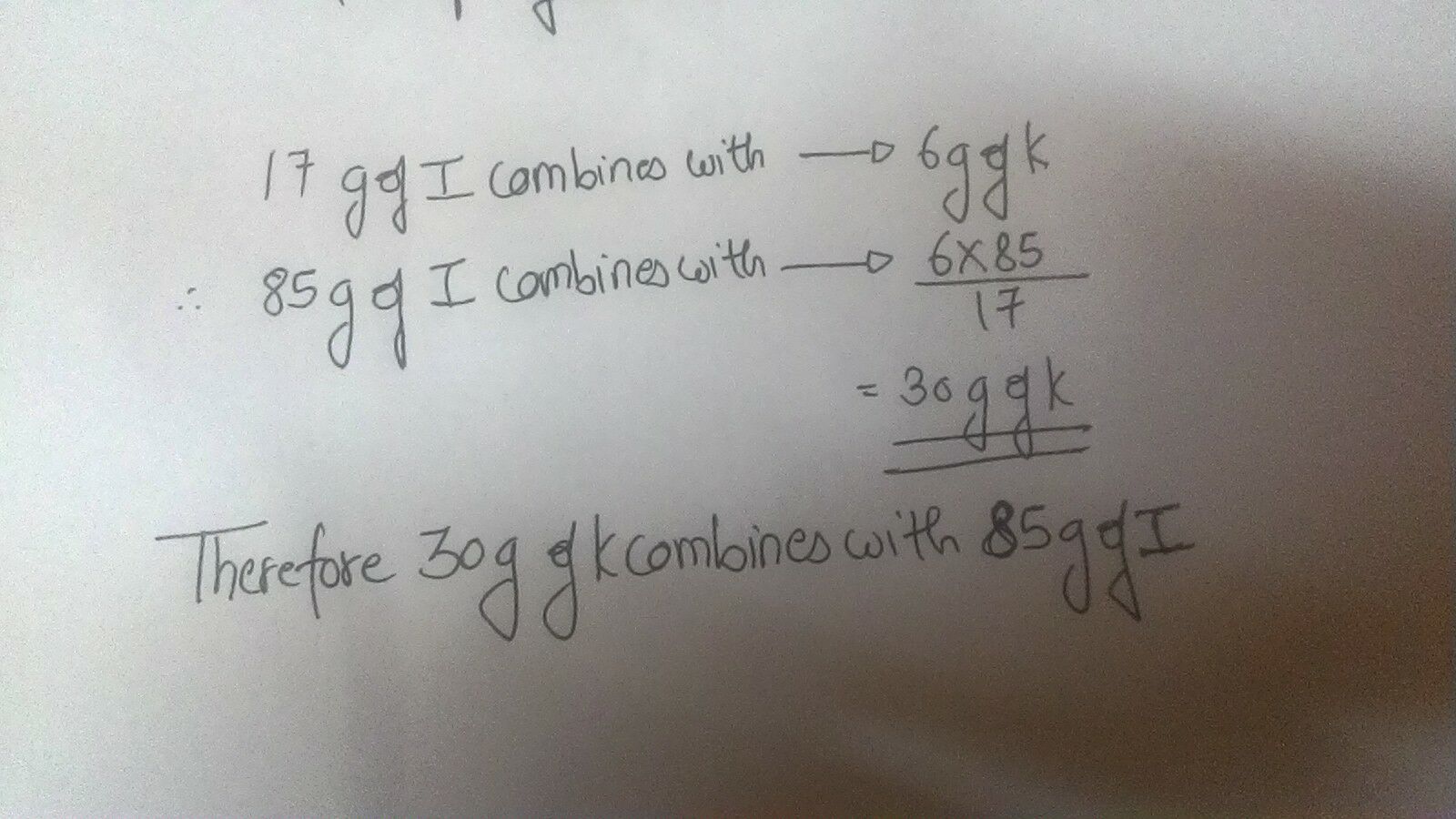
If 6 g of element k combine with 17 g of element l, how many grams of element k combine with 85 g of element l?
Ede4ka [16]
Hope this helps you.

5 0
2 years ago
Exactly 500 grams of ice are melted at a temperature of 32°f. (lice = 333 j/g.) calculate the change in entropy (in j/k). (give
denpristay [2]
Entropy Change is calculated  by (Energy transferred) / (Temperature in kelvin) 
deltaS = Q / T 

Q = (mass)(latent heat of fusion) 
Q = m(hfusion) 
Q = (500g)(333J/g) = 166,500J 

T(K) = 32 + 273.15 = 305.15K 
deltaS = 166,500J / 305.15K 
deltaS = 545.63 J/K
3 0
2 years ago
Other questions:
  • If the coefficient 2 is placed in front of the product tetraiodine nonaoxide (I4O9), then, how many atoms of each element must b
    14·1 answer
  • The density of a gaseous compound is 1.623 g/l at stp determine the molar mass of the compound
    6·1 answer
  • Consider the reaction below. 2H2O 2H2 + O2 How many moles of hydrogen are produced when 6.28 mol of oxygen form?
    7·1 answer
  • You are holding four identical balloons each containing 10.0g of a different gas. The balloon containing which gas is the larges
    15·1 answer
  • If a dozen clementine oranges have a mass of 744g, what will be the mass of 15 Clementines?
    5·2 answers
  • For a reaction with ΔH° = −9 kJ/mol, decide if the following statement is true. If it is false, choose the statement that makes
    11·1 answer
  • Calculate the cell potential E at 25°C for the reaction 2 Al(s) + 3 Fe2+(aq) → 2 Al3+(aq) + 3 Fe(s) given that [Fe 2+] = 0.020 M
    10·1 answer
  • Explain the observed pattern of how the sizes and charges of atoms change with the addition and subtraction of electrons. ( NEED
    10·1 answer
  • A student in a chemistry laboratory has access to two acid solutions. The first one is 20% acid and the second solution is 45% a
    12·1 answer
  • Joelle is a manager at a construction company, and she is interested in the chemistry behind the materials they use. She has beg
    6·2 answers
Add answer
Login
Not registered? Fast signup
Signup
Login Signup
Ask question!