answer.
Ask question
Login Signup
Ask question
All categories
  • English
  • Mathematics
  • Social Studies
  • Business
  • History
  • Health
  • Geography
  • Biology
  • Physics
  • Chemistry
  • Computers and Technology
  • Arts
  • World Languages
  • Spanish
  • French
  • German
  • Advanced Placement (AP)
  • SAT
  • Medicine
  • Law
  • Engineering
cestrela7 [59]
2 years ago
13

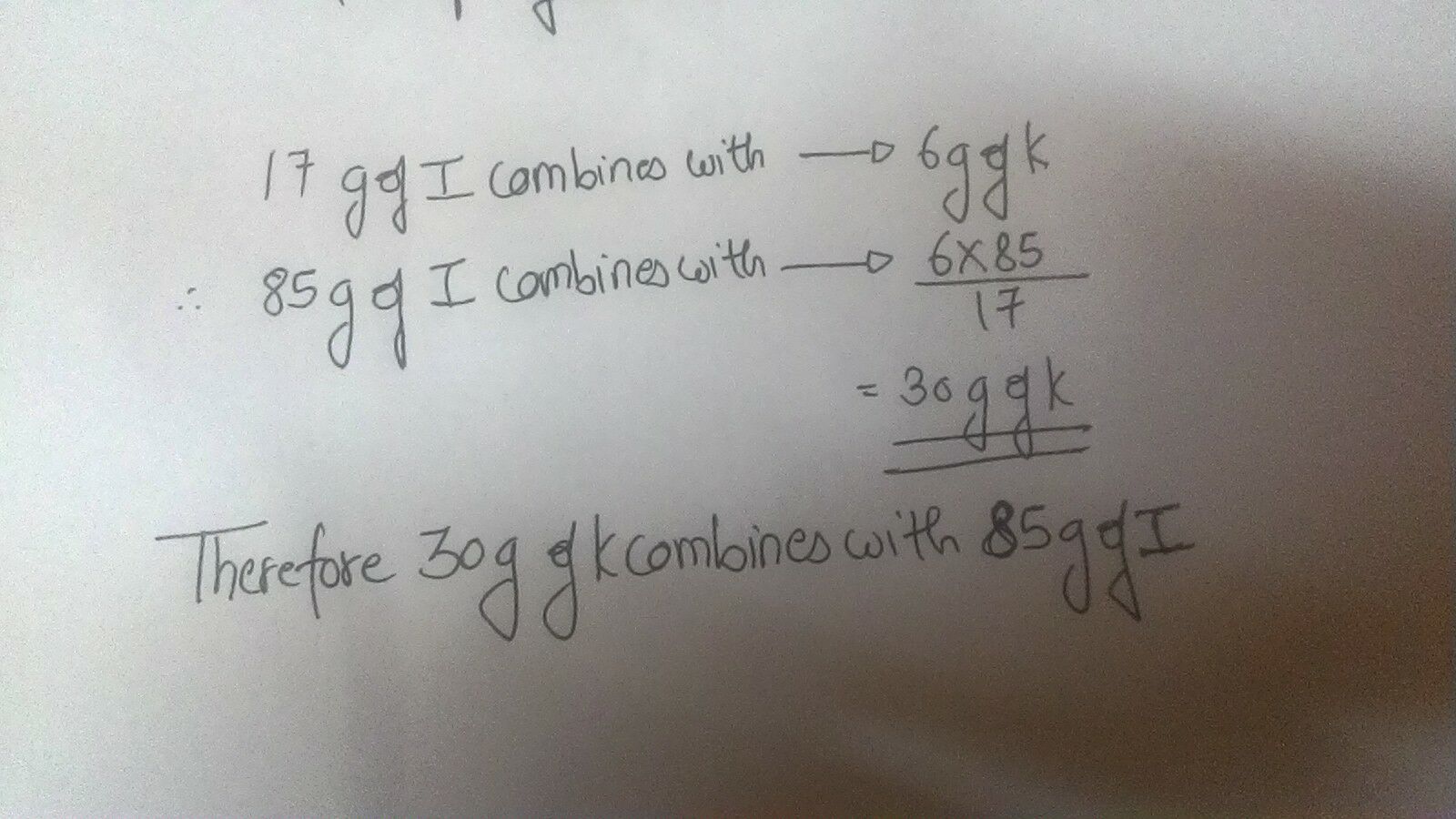
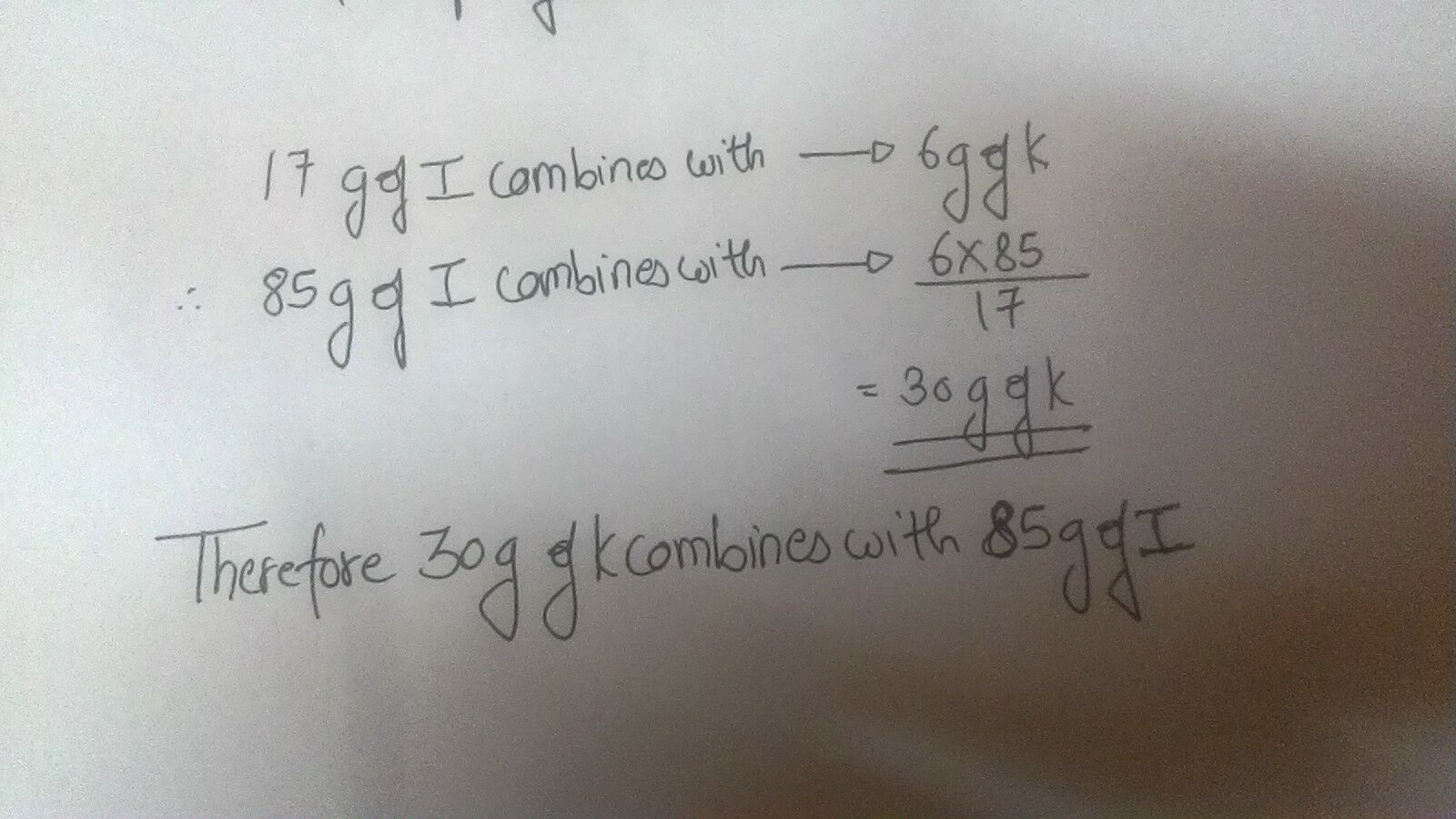
If 6 g of element k combine with 17 g of element l, how many grams of element k combine with 85 g of element l?

Chemistry
1 answer:
Ede4ka [16]2 years ago
5 0
Hope this helps you.

You might be interested in
Will is learning about a new kind of plastic used to make models. He learns that infrared light is absorbed by the plastic, X-ra
tamaranim1 [39]

Answer:

no it dosen't matter

Explanation:

because it absorbed the light so it had to damage it.

8 0
2 years ago
Read 2 more answers
A 0.1064 g sample of a pesticide was decomposed by the action of sodium biphenyl. The liberated Cl- was extracted with water and
Ilya [14]

Answer:

Percentage of an aldrin in the sample is 44.41%.

Explanation:

Cl^-+AgNO_3\rightarrow AgCl+NO_{3}^-

Molarity of the silver nitrate solution = 0.03337 M

Volume of the silver nitrate = 23.28 mL = 0.02328 L

Moles of silver nitrate = n

0.03337 M=\frac{n}{0.02328 L}

n = 0.03337 M\times 0.02328 L=0.0007768 mol

According to reaction 1 mole of silver nitrate recats with 1 moles of chloride ions.

Then 0.0007768 moles of silver nitrate will react with:

\frac{1}{1}\times 0.0007768 mol=0.0007768 mol chloride ions.

In one mole of aldrin there are 6  moles of chloride ions.

Then moles of aldrin containing 0.0007768 moles chloride ions are:

\frac{0.0007768 mol}{6}=0.0001295 mol

Moles of aldrin present in the sample = 0.0001295 mol

Mass of 0.0001295 moles of aldrin present in the sample :

0.0001295 mol × 364.92 g/mol =0.04726 g

Percentage of an aldrin in the sample:

\frac{0.04726 g}{0.1064 g}\times 100=44.41\%

8 0
2 years ago
A transition in the balmer series for hydrogen has an observed wavelength of 434 nm. Use the Rydberg equation below to find the
DanielleElmas [232]

Answer:

i. n = 5

ii. ΔE = 7.61 × 10^{-46} KJ/mole

Explanation:

1. ΔE = (1/λ) = -2.178 × 10^{-18}(\frac{1}{n^{2}_{final} } - \frac{1}{n^{2}_{initial}  })

    (1/434 × 10^{-9}) = -2.178 × 10^{-18} (\frac{n^{2}_{initial} - n^{2}_{final}  }{n^{2}_{final} n^{2}_{initial}   })

⇒ 434 × 10^{-9} = (1/-2.178 × 10^{-18})\frac{n^{2}_{final} *n^{2}_{initial}   }{n^{2}_{initial} - n^{2}_{final}    }

But, n_{final} = 2

434 × 10^{-9} = (1/2.178 × 10^{-18})\frac{2^{2} n^{2}_{initial}  }{n^{2}_{initial} - 2^{2}  }

434 × 10^{-9}  × 2.178 × 10^{-18} = (\frac{4n^{2}_{initial}  }{n^{2}_{initial} - 4 })

⇒ n_{initial} = 5

Therefore, the initial energy level where transition occurred is from 5.

2. ΔE = hf

     = (hc) ÷ λ

    = (6.626 × 10−34 × 3.0 × 10^{8} ) ÷ (434 × 10^{-9})

    = (1.9878 × 10^{-25}) ÷ (434 × 10^{-9})

    = 4.58 × 10^{-19} J

    = 4.58 × 10^{-22} KJ

But 1 mole = 6.02×10^{23}, then;

energy in KJ/mole = (4.58 × 10^{-22} KJ) ÷ (6.02×10^{23})

         = 7.61 × 10^{-46} KJ/mole

7 0
2 years ago
Why are the concentrations of [H3O+] and [OH−] equal in pure water?
kotegsom [21]

Answer : The correct option is, (A) [H_3O^+]=[OH^-] because one of each is produced every time an [H^+] transfers from one water molecule to another.

Explanation :

As we know that, when the two water molecule combine to produced hydronium ion and hydroxide ion.

The balanced reaction will be:

HOH+HOH\rightarrow H_3O^++OH^-

Acid : It is a substance that donates hydrogen ion when dissolved in water.

Base : It is a substance that accepts hydrogen ion when dissolved in water.

From this we conclude that, the hydrogen ion are transferred from one water molecule to the another water molecule to form hydronium ion and hydroxide ion. In this reaction, one water molecule will act as a base and another water molecule will act as an acid.

Hence, the correct option is, (A)

3 0
2 years ago
Which best describes the process of convection?
Goryan [66]

Answer:

Convection is the primary way heat travels through appliances. Convection is the primary way heat travels through liquids and gasses. Convection is the primary way heat travels through rays.

Explanation:
8 0
1 year ago
Read 2 more answers
Other questions:
  • imagine you or your family member experienced a medical emergency. explain two reasons when and why confidentiality would be imp
    6·1 answer
  • A sample of gas has a volume of 215 cm3 at 23.5 degrees Celsius and 84.6kPa what volume will the gas occupy at stp
    13·2 answers
  • The formation of large molecules from small repeating units is known as what kind of reaction? Oxidation reduction condensation
    7·1 answer
  • Calculate the number of grams of Mg needed for this reaction to release enough energy to increase the temperature of 78 mL of wa
    10·1 answer
  • Suppose the price of gasoline increases 10% and quantity of gasoline demanded in Orlando drops 5% per day. Demand for gasoline i
    11·1 answer
  • Ammonia gas occupies a volume of 2,725ml at a pressure of 701 kPa. What volume would it occupy at 101 kPa?
    9·1 answer
  • Consider the following intermediate chemical equations.
    5·1 answer
  • Use the words protons neutrons and I suppose in the same sentence ​
    5·1 answer
  • What is the change in enthalpy in joules when 5.44 x 10- mol of AgCl dissolves in water according to the following chemical equa
    14·1 answer
  • A white powder is known to be a mixture of magnesium oxide and aluminum oxide. 100cm3 of 2moldm-3 NaOH(aq) is just sufficient to
    7·1 answer
Add answer
Login
Not registered? Fast signup
Signup
Login Signup
Ask question!