answer.
Ask question
Login Signup
Ask question
All categories
  • English
  • Mathematics
  • Social Studies
  • Business
  • History
  • Health
  • Geography
  • Biology
  • Physics
  • Chemistry
  • Computers and Technology
  • Arts
  • World Languages
  • Spanish
  • French
  • German
  • Advanced Placement (AP)
  • SAT
  • Medicine
  • Law
  • Engineering
expeople1 [14]
2 years ago
3

Refrigerant 134a enters an insulated compressor operating at steady state as saturated vapor at -12oC with a volumetric flow rat

e of 0.18 m3/s. Refrigerant exits at 7 bar, 70oC. Changes in kinetic and potential energy from inlet to exit can be ignored. Determine the volumetric flow rate at the exit, in m3/s, and the compressor power, in kW.
Engineering
1 answer:
Svetllana [295]2 years ago
8 0

Answer:

\dot V_{out} = 0.061\,\frac{m^{3}}{s}, \dot W = 108.875\,kW

Explanation:

The process in the compressor is modelled after the First Law of Thermodynamics:

\dot W + \dot m \cdot (h_{1}-h_{2}) = 0

The specific enthalpies of the refrigerant at inlet and outlet are, respectively:

Inlet (Saturated vapor)

\nu = 0.10744\,\frac{m^{3}}{kg}

h = 243.34\,\frac{kJ}{kg}

Outlet (Superheated Vapor)

\nu = 0.036373\,\frac{m^{3}}{kg}

h = 308.34\,\frac{kJ}{kg}

The mass flow is:

\dot m = \frac{\left(0.18\,\frac{m^{3}}{s} \right)}{0.10744\,\frac{m^{3}}{kg} } \co

\dot m = 1.675\,\frac{kg}{s}

The volumetric flow rate at the exit is:

\dot V_{out} = \left(1.675\,\frac{kg}{s} \right)\cdot \left(0.036373\,\frac{m^{3}}{kg} \right)

\dot V_{out} = 0.061\,\frac{m^{3}}{s}

The power needed to make the compressor work is:

\dot W = \dot m \cdot (h_{2}-h_{1})

\dot W = \left(1.675\,\frac{kg}{s} \right)\cdot \left(308.34\,\frac{kJ}{kg}-243.34\,\frac{kJ}{kg} \right)

\dot W = 108.875\,kW

You might be interested in
When should you exercise extreme caution around power lines?
Elis [28]

<em>You should take note and exercise extreme precautions when you are near power lines and consider the following: </em>

<em> </em>

<em>1. Make sure that you have a good distance away from the lines. The minimum distance you can get is 10 feet away from the lines. Be cautious as well when you see broken lines as they could still harm you and electrified you. </em>

<em>2. Do not make ladders, equipments and things around you touch the power lines as it may harm you as well. </em>

<em>3. Clear everything and ensure that no things are near you before you lift your hands and other tools.</em>

6 0
2 years ago
The legend that Benjamin Franklin flew a kite as a storm approached is only a legend—he was neither stupid nor suicidal. Suppose
Delicious77 [7]

Answer: 0.93 mA

Explanation:

In order to calculate the current passing through the water layer, as we have the potential difference between the ends of the string as a given, assuming that we can apply Ohm’s law, we need to calculate the resistance of the water layer.

We can express the resistance as follows:

R = ρ.L/A

In order to calculate the area A, we can assume that the string is a cylinder with a circular cross-section, so the Area of the water layer can be written as follows:

A= π(r22 – r12) = π( (0.0025)2-(0.002)2 ) m2 = 7.07 . 10-6 m2

Replacing by the values, we get R as follows:

R = 1.4 1010 Ω

Applying Ohm’s Law, and solving for the current I:

I = V/R = 130 106 V / 1.4 1010 Ω = 0.93 mA

7 0
2 years ago
The 8-mm-thick bottom of a 220-mm-diameter pan may be made from aluminum (k = 240 W/m ⋅ K) or copper (k = 390 W/m ⋅ K). When use
Artemon [7]

Answer:

For aluminum 110.53 C

For copper 110.32 C

Explanation:

Heat transmission through a plate (considering it as an infinite plate, as in omitting the effects at the borders) follows this equation:

q = \frac{k * A * (th - tc)}{d}

Where

q: heat transferred

k: conduction coeficient

A: surface area

th: hot temperature

tc: cold temperature

d: thickness of the plate

Rearranging the terms:

d * q = k * A * (th - tc)

\frac{d * q}{k * A} = th - tc

th = \frac{d * q}{k * A} + tc

The surface area is:

A = \frac{\pi * d^2}{4}

A = \frac{\pi * 0.22^2}{4} = 0.038 m^2

If the pan is aluminum:

th = \frac{0.008 * 600}{240 * 0.038} + 110 = 110.53 C

If the pan is copper:

th = \frac{0.008 * 600}{390 * 0.038} + 110 = 110.32 C

7 0
2 years ago
Derive the probability that a receptor is occupied by a ligand using a model that treats the L ligands in solution as distinguis
love history [14]

that is the same thing as you are not going through this week or something

7 0
2 years ago
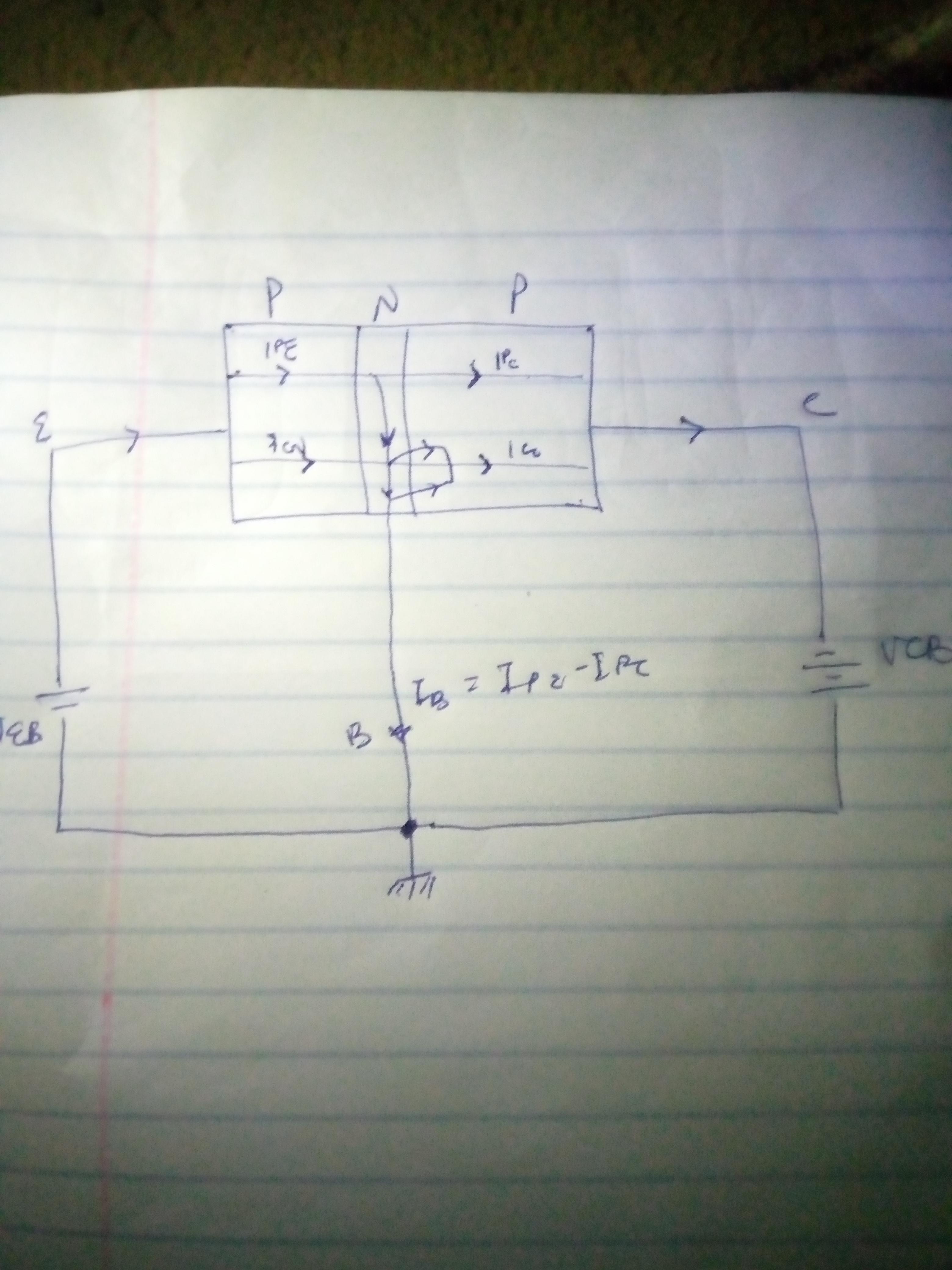
For a p-n-p BJT with NE 7 NB 7 NC, show the dominant current components, with proper arrows, for directions in the normal active
Sonja [21]

Answer:

=> base transport factor = 0.98.

=> emitter injection efficiency = 0.99.

=> common-base current gain = 0.97.

=> common-emitter current gain = 32.34.

=> ICBO = 1 × 10^-6 A.

=> base transit time = 0.325.

=> lifetime = 1.875.

Explanation:

(Kindly check the attachment for the diagram showing the dominant current components, with proper arrows, for directions in the normal active mode).

The following parameters or data are given for a p-n-p BJT with NE 7 NB 7 NC and they are: IEp = 10 mA, IEn = 100 mA, ICp = 9.8 mA, and ICn = 1 mA.

(1). The base transport factor = ICp/IEp=9.8/10 =  0.98.

(2). emitter injection efficiency =IEp/ IEp + ICn = 10/10 + 0.1 =  0.99.

(3).common-base current gain = 0.98 × 0.99 = 0.9702.

(4).common-emitter current gain =0.97 / 1- 0.97  = 32.34.

(5). Icbo = Ico = 1 × 10^-6 A.

(6). base transit time = 1248 × 10^-2 × (1.38× 10^-23/1.603 × 10^-19). = 0.325.

(7).lifetime;

= > 2 = √0.325 + √ lifetime.

= Lifetime = 2.875.

6 0
2 years ago
Other questions:
  • Tin atoms are introduced into a FCC copper crystal, producing an alloy with a lattice pa- rameter of 3.7589 x 10⁻⁸ cm and a dens
    8·1 answer
  • An electrical utility delivers 6.25E10 kWh of power to its customers in a year. What is the average power required during the ye
    15·1 answer
  • Air in a 10 ft3 cylinder is initially at a pressure of 10 atm and a temperature of 330 K. The cylinder is to be emptied by openi
    10·2 answers
  • An aircraft component is fabricated from an aluminum alloy that has a plane-strain fracture toughness of 40 MPa1m (36.4 ksi1in.)
    15·1 answer
  • Air whose density is 0.082 lbm/ft3 enters the duct of an air-conditioning system at a volume flow rate of 450 ft3/min. If the di
    8·2 answers
  • 13–27. The conveyor belt is moving downward at 4 m&gt;s. If the coefficient of static friction between the conveyor and the 15-k
    11·1 answer
  • Reconsider Couette flow between two parallel plates as derived in class, but with the top plate moving with a known velocity +i
    13·1 answer
  • A thin-walled tube with a diameter of 12 mm and length of 25 m is used to carry exhaust gas from a smoke stack to the laboratory
    7·1 answer
  • Water enters a circular tube whose walls are maintained at constant temperature at specified flow rate and temperature. For full
    8·1 answer
  • What is the component called that usually has a dual-voltage selector switch and has cables that connect to the motherboard and
    15·1 answer
Add answer
Login
Not registered? Fast signup
Signup
Login Signup
Ask question!