answer.
Ask question
Login Signup
Ask question
All categories
  • English
  • Mathematics
  • Social Studies
  • Business
  • History
  • Health
  • Geography
  • Biology
  • Physics
  • Chemistry
  • Computers and Technology
  • Arts
  • World Languages
  • Spanish
  • French
  • German
  • Advanced Placement (AP)
  • SAT
  • Medicine
  • Law
  • Engineering
Readme [11.4K]
2 years ago
5

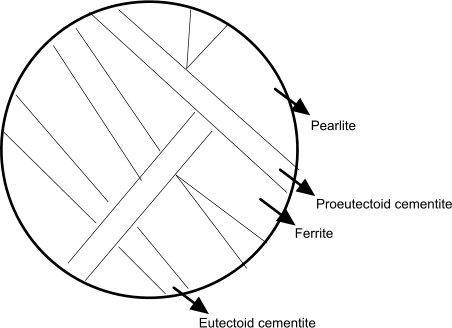
Consider 1.0 kg of austenite containing 1.15 wt% C, cooled to below 727C (1341F). (a) What is the proeutectoid phase? (b) How

many kilograms each of total ferrite and cementite form? (c) How many kilograms each of pearlite and the proeutectoid phase form? (d) Schematically sketch and label the resulting microstructure

Engineering
1 answer:
sergejj [24]2 years ago
6 0

Answer:

a) The proeutectoid phase is known like cementite and its chemical formula is Fe₃C

b) The kilograms of total ferrite and is 0.8311 kg

The kilograms of total cementite is 0.1689 kg

c) The kilograms of total cementite is 0.9343 kg

Explanation:

Given:

1 kg of austenite

1.15 wt% C

Cooled to below 727°C

Questions:

a) What is the proeutectoid phase?

b) How many kilograms each of total ferrite and cementite form, Wf = ?, Wc = ?

c) How many kilograms each of pearlite and the proeutectoid phase form, Wp = ?

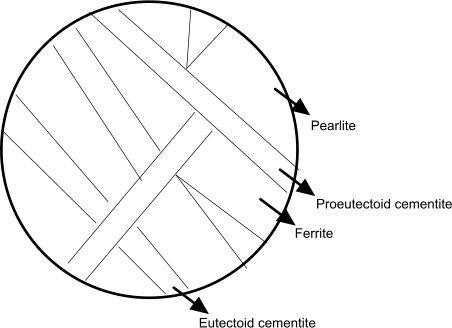
d) Schematically sketch and label the resulting microstructure

a) The proeutectoid phase is known like cementite and its chemical formula is Fe₃C

b) To get the mass of the total ferrite form:

W_{f} =\frac{C_{cementite}-C_{2}  }{C_{cementite}-C_{1}  }

Here,

Ccementite = composition of cementite = 6.7 wt%

C₁ = composition of phase 1 = 0.022 wt%

C₂ = composition of alloy = 1.15 wt%

Substituting values:

W_{f} =\frac{6.7-1.15}{6.7-0.022} =0.8311kg

To get the mass of the total cementite:

W_{c} =\frac{C_{2}-C_{1}}{C_{cementite}-C_{1} } =\frac{1.15-0.022}{6.7-0.022} =0.1689kg

c) The mass of pearlite:

W_{p} =\frac{6.7-1.15}{5.94} =0.9343kg

d) In the diagram you can see the different compositions (pearlite, proeutectoid cementite, ferrite, eutectoid cementite)

You might be interested in
The wall of drying oven is constructed by sandwiching insulation material of thermal conductivity k = 0.05 W/m°K between thin me
masha68 [24]

Answer:

86 mm

Explanation:

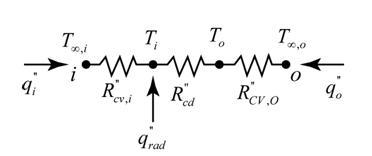
From the attached thermal circuit diagram, equation for i-nodes will be

\frac {T_ \infty, i-T_{i}}{ R^{"}_{cv, i}} + \frac {T_{o}-T_{i}}{ R^{"}_{cd}} + q_{rad} = 0 Equation 1

Similarly, the equation for outer node “o” will be

\frac {T_{ i}-T_{o}}{ R^{"}_{cd}} + \frac {T_{\infty, o} -T_{o}}{ R^{"}_{cv, o}} = 0 Equation 2

The conventive thermal resistance in i-node will be

R^{"}_{cv, i}= \frac {1}{h_{i}}= \frac {1}{30}= 0.033 m^{2}K/w Equation 3

The conventive hermal resistance per unit area is

R^{"}_{cv, o}= \frac {1}{h_{o}}= \frac {1}{10}= 0.100 m^{2}K/w Equation 4

The conductive thermal resistance per unit area is

R^{"}_{cd}= \frac {L}{K}= \frac {L}{0.05} m^{2}K/w Equation 5

Since q_{rad}  is given as 100, T_{o}  is 40 T_ \infty  is 300 T_{\infty, o}  is 25  

Substituting the values in equations 3,4 and 5 into equations 1 and 2 we obtain

\frac {300-T_{i}}{0.033} +\frac {40-T_{i}}{L/0.05} +100=0  Equation 6

\frac {T_{ i}-40}{L/0.05}+ \frac {25-40}{0.100}=0

T_{i}-40= \frac {L}{0.05}*150

T_{i}-40=3000L

T_{i}=3000L+40 Equation 7

From equation 6 we can substitute wherever there’s T_{i} with 3000L+40 as seen in equation 7 hence we obtain

\frac {300- (3000L+40)}{0.033} + \frac {40- (3000L+40)}{L/0.05}+100=0

The above can be simplified to be

\frac {260-3000L}{0.033}+ \frac {(-3000L)}{L/0.05}+100=0

\frac {260-3000L}{0.033}=50

-3000L=1.665-260

L= \frac {-258.33}{-3000}=0.086*10^{-3}m= 86mm

Therefore, insulation thickness is 86mm

8 0
2 years ago
An ideal Diesel cycle has a compression ratio of 18 and a cutoff ratio of 1.5. Determine the maximum air temperature and the rat
defon

Answer:

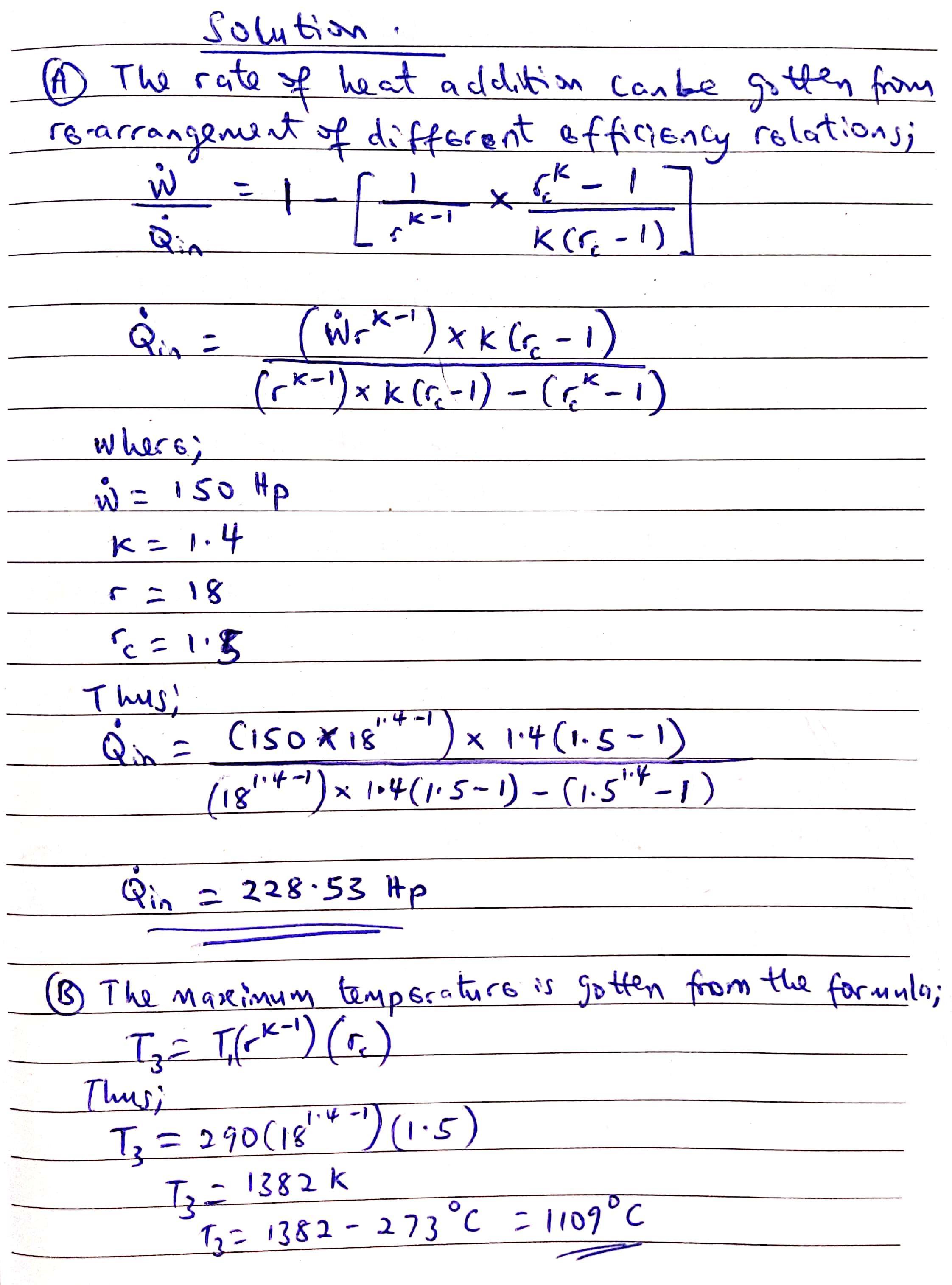
A) Rate of heat addition = 228.53 Hp

B) Maximum Air temperature = 1109 °C

Explanation:

We are given;

Cut off ratio; r_c = 1.5

Compression ratio; r = 18

Power produced; W` = 150 Hp

cp = 1.005 kJ/kg·K

cv = 0.718 kJ/kg·K

R = 0.287 kJ/kg·K

k = 1.4

Temperature;T1 = 17°C = 17 + 273 K = 290K

I've attached the rest of the explanation below.

8 0
2 years ago
Chapter 19: Diesel Engine Operation and Diagnosis -Chapter Quiz
Llana [10]

Answer: See explanation

Explanation:

1. How is diesel fuel ignited in a warm diesel engine?

B. Heat compression

2. Which type of diesel injection produces less noise?

A. Indirect injection (IDI)

3. Which diesel injection system requires the use of a glow plug?

A. Indirect injection (IDI)

4. The three phases of diesel ignition include:

C. Ignition delay, repaid combustion, controlled combustion.

5. What fuel system component is used in a vehicle equipped with a diesel engine that is seldom used on the same vehicle when it is equipped with a gasoline engine?

D. Water-fuel separator

6. The diesel injection pump is usually driven by a _________________.

A. Gear off the camshaft

7. Which diesel system supplies high-pressure diesel fuel to all the injectors all of the time?

C. High-pressure common rail

8. Glow plugs should have high resistance when _____________and lower resistance when __________________.

B. Warm/cold

9. Technician A says that glow plugs are used to help start a diesel engine and are shut off as soon as the engine starts. Technician B says that the glow plugs are turned off as soon as a flame is detected in the combustion chamber. Which Technician is correct?

D. Neither Technicians A NOR B

10. What part should be removed to test cylinder compression on a diesel engine?

D. A glow plug

6 0
2 years ago
A converging-diverging nozzle is designed to operate with an exit Mach number of 1.75 . The nozzle is supplied from an air reser
Flura [38]

Answer:

a. 4.279 MPa

b. 3.198 MPa to 4.279 MPa

c. 0.939 MPa

d. Below 3.198 MPa

Explanation:

From the given parameters

M_{exit} = 1.75 MPa  

M at 1.6 MPa gives A_{exit}/A* = 1.2502

M at 1.8 MPa gives  A_{exit}/A* = 1.4390

Therefore, by interpolation, we have M_{exit} = 1.75 MPa  gives A

However, we shall use M_{exit} = 1.75 MPa and A

Similarly,

P_{exit}/P₀ = 0.1878

a) Where the nozzle is choked at the throat there is subsonic flow in the following diverging part of the nozzle. From tables, we have

A_{exit}/A* = 1.387. by interpolation M

Therefore P_{exit} = P₀ × P

Which shows that the nozzle is choked for back pressures lower than 4.279 MPa

b) Where there is a normal shock at the exit of the nozzle, we have;

M₁ = 1.75 MPa, P₁ = 0.1878 × 5 = 0.939 MPa

Where the normal shock is at M₁ = 1.75 MPa, P₂/P₁ = 3.406

Where the normal shock occurs at the nozzle exit, we have

P_b = 3.406\times 0.939 = 3.198 MPa

Where the shock occurs t the section prior to the nozzle exit from the throat, the back pressure was derived as P_b = 4.279 MPa

Therefore the back pressure value ranges from 3.198 MPa to 4.279 MPa

c) At M_{exit} = 1.75 MPa  and P

d) Where the back pressure is less than 3.198 MPa according to isentropic flow relations supersonic flow will exist at the exit plane    
8 0
2 years ago
Water (cp = 4180 J/kg·°C) enters the 2.5 cm internal diameter tube of a double-pipe counter-flow heat exchanger at 17°C at a rat
aksik [14]

Answer:

Length = 129.55m, 129.55m

Explanation:

Given:

cp of water = 4180 J/kg·°C

Diameter, D = 2.5 cm

Temperature of water in =  17°C

Temperature of water out = 80°C

mass rate of water =1.8 kg/s.

Steam condensing at 120°C

Temperature at saturation = 120°C

hfg of steam at 120°C = 2203 kJ/kg

overall heat transfer coefficient of the heat exchanger = 700 W/m2 ·°C

U = 700 W/m2 ·°C

Since Temperature of steam is at saturation,

temperature of steam going in = temperature of steam out = 120°C

Energy balance:

Heat gained by water = Heat loss by steam

Let specific capacity of steam = 2010kJ/Kg .°C

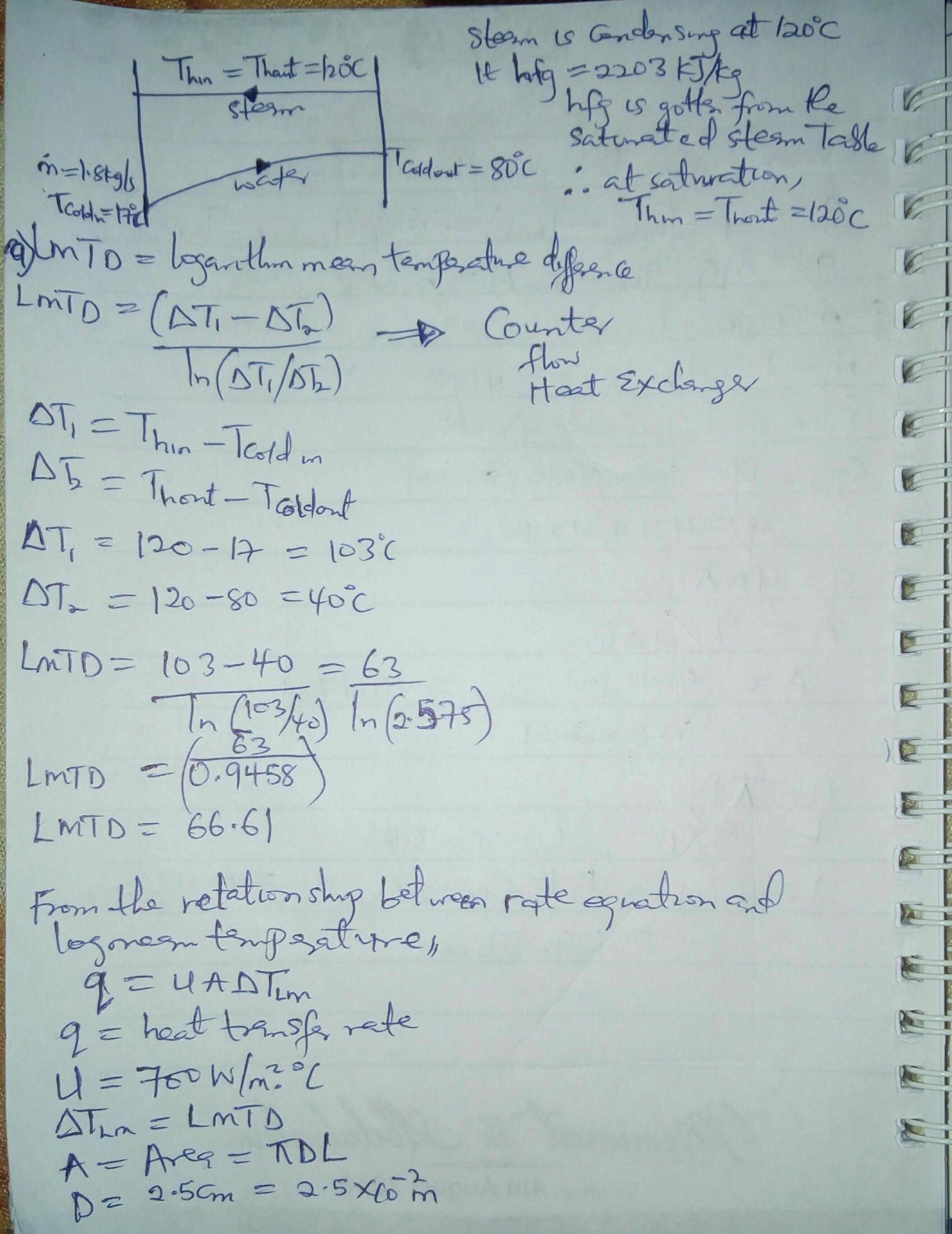
Find attached the full solution to the question.

3 0
2 years ago
Other questions:
  • A circular ceramic plate that can be modeled as a blackbody is being heated by an electrical heater. The plate is 30 cm in diame
    15·1 answer
  • Consider a very long rectangular fin attached to a flat surface such that the temperature at the end of the fin is essentially t
    9·1 answer
  • The critical resolved shear stress for iron is 27 MPa (4000 psi). Determine the maximum possible yield strength for a single cry
    12·1 answer
  • One mole of iron (6 1023 atoms) has a mass of 56 grams, and its density is 7.87 grams per cubic centimeter, so thecenter-to-cent
    15·1 answer
  • Check the answer that best describes the relationship between f(x) and x. (For example if f(x) is Θ(x) check that as your answer
    12·1 answer
  • Hot combustion gases, modeled as air behaving as an ideal gas, enter a turbine at 10 bar, 1500 K and exit at 1.97 bar and 900 K.
    7·1 answer
  • Why is it that dislocations play an important role in controlling the mechanical properties of metallic materials, however, they
    10·1 answer
  • Consider water at 27°C in parallel flow over an isothermal, 1‐m‐long flat plate with a velocity of 2 m/s. a) Plot the variation
    15·1 answer
  • What should always be done before beginning any diagnosis?
    9·1 answer
  • A surface grinding operation is used to finish a flat plate that is 5.50 in wide and 12.500 in long. The starting thickness is 1
    9·1 answer
Add answer
Login
Not registered? Fast signup
Signup
Login Signup
Ask question!