answer.
Ask question
Login Signup
Ask question
All categories
  • English
  • Mathematics
  • Social Studies
  • Business
  • History
  • Health
  • Geography
  • Biology
  • Physics
  • Chemistry
  • Computers and Technology
  • Arts
  • World Languages
  • Spanish
  • French
  • German
  • Advanced Placement (AP)
  • SAT
  • Medicine
  • Law
  • Engineering
Nikitich [7]
2 years ago
6

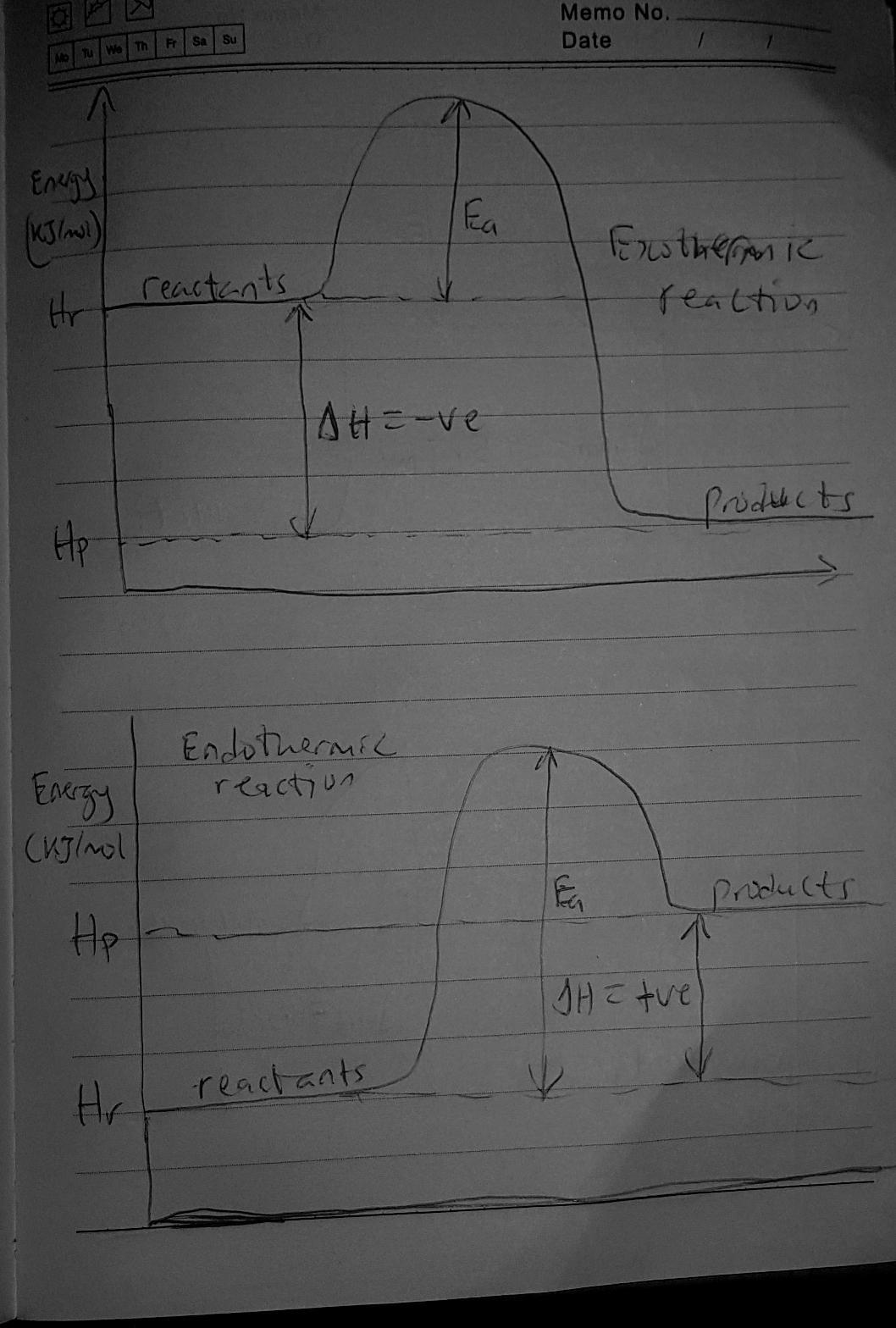
) The energy of the reactants is shown on the following energy diagram. On the right side of the energy diagram, draw a horizont

al line segment to indicate the energy of the products. Draw a vertical double-headed arrow ( ↕ ) on the graph that corresponds to the value of ΔH for the reaction.

Chemistry
1 answer:
Kryger [21]2 years ago
7 0

Answer:

Check Explanation

Explanation:

The question isn't complete, hence, I'll exhaustively draw the two energy diagram possible for the two types of reactions; exothermic and endothermic reaction.

The energy diagrams for both reaction types are presented in the attached image.

On the plot,

Hp represents the heat content/heat of formation/enthalpies of the products.

Hr represents the heat content/heat of formation/enthalpies of the reactants.

Ea = Activation energy for the respective reactions

ΔH = Heat of reaction, negative for the exothermic reaction and positive for the endothermic reaction.

Hope this Helps!!!

You might be interested in
Robyn has been working on developing a new task to test the reaction time of athletes. As she begins to test athletes using her
umka2103 [35]

Answer:

Ceiling effect

Explanation:

A ceiling effect takes place when the test items are not challenging enough for a group of individuals. Thus, the test score will not increase for a subsample of people who may have improved because they have already attained the highest score that can be achieved on that test.

6 0
2 years ago
Find the number of moles of water that can be formed if you have 170 mol of hydrogen gas and 80 mol of oxygen gas. Express your
Sav [38]

<u>Answer:</u> The amount of water that can be formed is 160 moles

<u>Explanation:</u>

We are given:

Moles of hydrogen gas = 170 moles

Moles of oxygen gas = 80 moles

The chemical equation for the reaction of hydrogen gas and oxygen gas follows:

2H_2+O_2\rightarrow 2H_2O

By Stoichiometry of the reaction:

1 mole of oxygen gas reacts with 2 moles of hydrogen gas

So, 80 moles of oxygen gas will react with = \frac{2}{1}\times 80=160mol of hydrogen gas

As, given amount of hydrogen gas is more than the required amount. So, it is considered as an excess reagent.

Thus, oxygen gas is considered as a limiting reagent because it limits the formation of product.

By Stoichiometry of the reaction:

1 mole of oxygen gas produces 2 moles of water

So, 80 moles of oxygen gas will produce = \frac{2}{1}\times 80=160moles of water

Hence, the amount of water that can be formed is 160 moles
3 0
2 years ago
Write the equations that represent the first and second ionization steps for hydroselenic acid (H2Se) in water. (Use H3O+ instea
Otrada [13]

Answer:

The equations are

1) H_{2}Se+H_{2}O--> H_{3}O^{+}+HSe^{-}

2) HSe^{-} +H_{2}O--> H_{3}O^{+}+Se^{-2}

Explanation:

There are two ionization steps in the dissociation of hydroselenic acid.

In first dissociation the H₂Se loses one proton and forms hydrogen selenide ion as shown below:

H_{2}Se+H_{2}O--> H_{3}O^{+}+HSe^{-}

The next step is again removal of a proton from the base formed above.

HSe^{-} +H_{2}O--> H_{3}O^{+}+Se^{-2}

4 0
2 years ago
Explain why you hear a “whoosh” sound when you open a can containing a carbonated drink. Which gas law applies?
Lana71 [14]

Carbonated drinks have the air under pressure so that carbon bubbles are forced into the drink, keeping it carbonated. So when you open a can, the air under pressure in the can comes out of the can at a high speed, making a "whooshing" sound. The gas law that applies to this concept is the Boyle's Law (PV=k or P1V1=P2V2).

6 0
2 years ago
Read 2 more answers
Identify the sets of quantum numbers that describe all the electrons in the ground state of a neutral beryllium atom, be. each s
Mkey [24]
<span>A beryllium atom has 4 electrons. 1, 0, 0, +1/2 1, 0, 0, -1/2 2, 0, 0, +1/2 2, 0, 0, -1/2</span>
8 0
2 years ago
Other questions:
  • The recommended daily allowance (rda of calcium is 1.2 g. calcium carbonate contains 12.0% calcium by mass. how many grams of ca
    12·2 answers
  • A 5.00 mL sample of H3PO4 solution of unknown concentration is titrated with a 0.1090 M NaOH solution. A volume of 7.12 mL of th
    5·1 answer
  • The acid-dissociation constant, ka, for gallic acid is 4.57 ⋅ 10-3. what is the base-dissociation constant, kb, for the gallate
    8·2 answers
  • When the pressure that a gas exerts on a sealed container changes from 22.5 psi to psi the temperature changes from 110 c to 65.
    14·1 answer
  • A chemist mixes two liquids A and B to form a homogeneous mixture. The densities of the liquids are 2.0514 g/mL for A and 2.6678
    8·1 answer
  • Phosphoric acid, which is commonly used as rust inhibitor, food additive and etching agent for dental and orthopedic use, can be
    9·1 answer
  • When 0.270 mol of a nondissociating solute is dissolved in 410.0 mL of CS2, the solution boils at 47.52 ∘C. What is the molal bo
    14·1 answer
  • The following reaction is exothermic. C6H12O6(s)+6O2(g)⇌6CO2(g)+6H2O(g)C6H12O6(s)+6O2(g)⇌6CO2(g)+6H2O(g) Predict the effect (shi
    13·1 answer
  • How many milliliters of a 0.8 M solution of citric acid would be needed to react with 15 grams of baking soda? Show your work.
    6·1 answer
  • What is produced on the top of a pool of water by the mutual attraction between water molecules?
    5·1 answer
Add answer
Login
Not registered? Fast signup
Signup
Login Signup
Ask question!