answer.
Ask question
Login Signup
Ask question
All categories
  • English
  • Mathematics
  • Social Studies
  • Business
  • History
  • Health
  • Geography
  • Biology
  • Physics
  • Chemistry
  • Computers and Technology
  • Arts
  • World Languages
  • Spanish
  • French
  • German
  • Advanced Placement (AP)
  • SAT
  • Medicine
  • Law
  • Engineering
kiruha [24]
2 years ago
10

methane Express your answer as a condensed structural formula omitting all bonds (e.g CH3CH2CH3). nothing Request Answer Part B

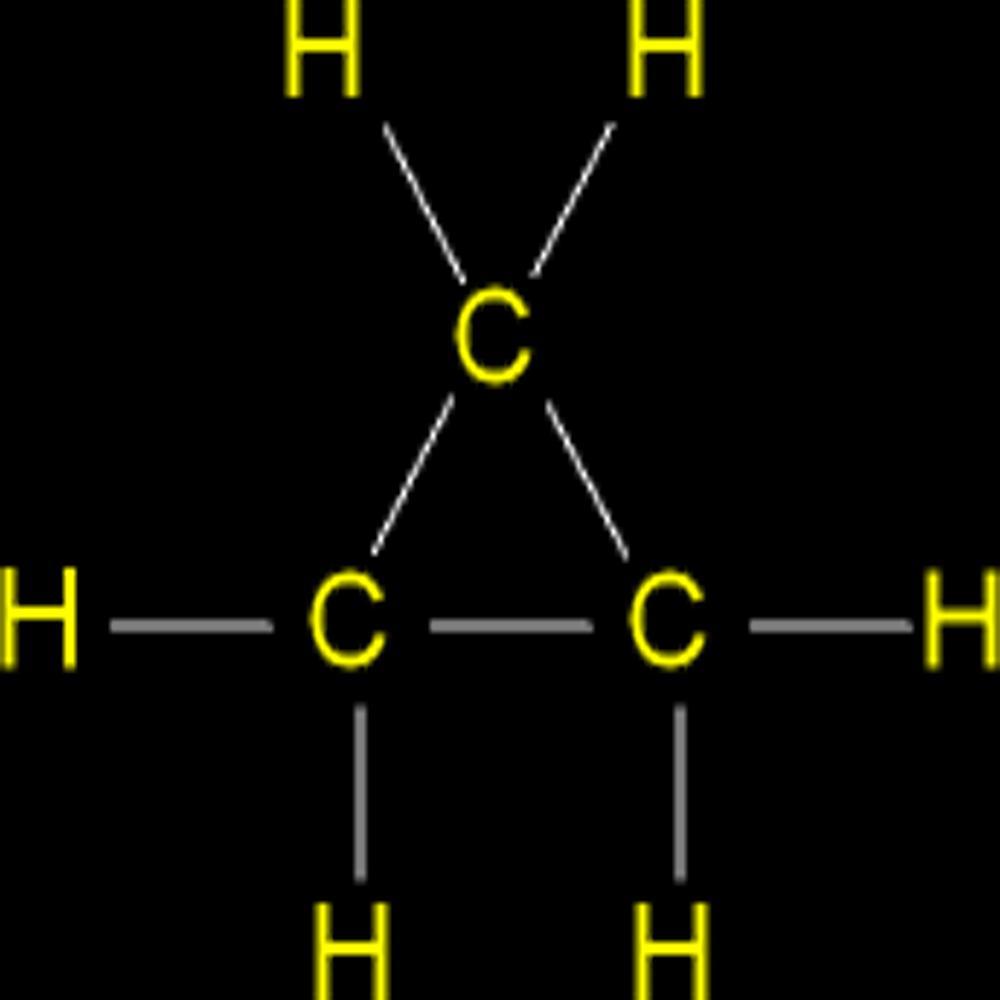
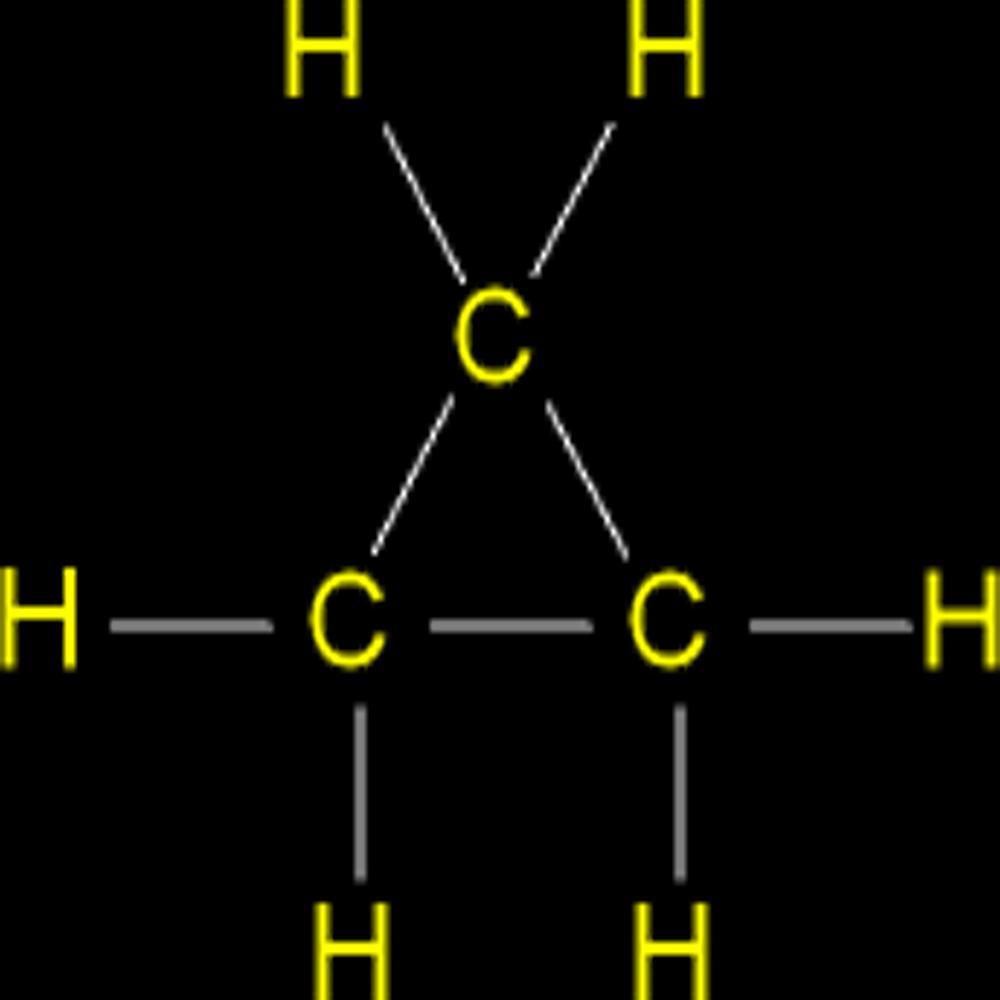
ethane Express your answer as a condensed structural formula omitting all bonds (e.g CH3CH2CH3). nothing Request Answer Part C pentane Express your answer as a condensed structural formula omitting all bonds (e.g CH3CH2CH3). nothing Request Answer Part D cyclopropane Draw the molecule on the canvas by choosing buttons from the Tools (for bonds), Atoms, and Advanced Template toolbars. Include all hydrogen atoms.

Chemistry
1 answer:
bonufazy [111]2 years ago
3 0

Answer:

a

 The condensed structural formula for methane is

            CH_4

b

 The condensed structural formula for ethane is

           CH_3 CH_3

c

  The condensed structural formula for pentane is  

            CH_2(CH_2)_3CH_3

d

   The diagram for the structural formula for cyclopropane is shown on the first uploaded image

Explanation:

You might be interested in
Describe how you could determine the specific heat of a sample of a solid substance. You may assume that the substance does not
lesya692 [45]
<span>I would measure the mass of the solid substance. I would prepare a known mass of room temperature water large enough to submerge the solid substance in question. I would place the water in an insulated container. Then I would heat the solid substance to a known temperature. I would measure the temperature of the heated sample and the water. Then I would submerge the sample in the water and allow the sample and the water to reach the same temperature. I would measure this equilibrium temperature. I would interpret the difference in temperature between the heated sample and the equilibrium temperature as the change in temperature in the sample. Given the known mass, the beginning temperature of the water, and the equilibrium temperature I can determine how much energy was transferred from the heated sample to the water. Now the mass of the sample, a change in temperature in the solid substance, and the amount of energy transferred to create the temperature is known. This is sufficient to determine the specific heat of the solid substance</span>
6 0
2 years ago
Read 2 more answers
What is net ionic equation borax hydrolysis?
deff fn [24]
The net ionic equation of borax hydrolysis would be:

 <span>Na2B4O7 + 7H2O-----------------> 2 NaOH + 4 H3BO3
</span>
Wherein 2 moles of sodium hydroxide and 4 moles of boric acid are produced by the hydrolysis.
I hope my answer has come to your help. Thank you for posting your question here in Brainly. We hope to answer more of your questions and inquiries soon. Have a nice day ahead!
7 0
2 years ago
In a voltaic cell made of a Ag strip and an Al strip immersed in 1.0 M aqueous AgNO_3 and Al(NO_3)_3 solutions, respectively, wi
Tema [17]

Answer:

When the operation of the voltaic cell, which is formed of an aluminum and silver strip takes place, the atom of aluminum loses three of its electrons and the Al3+ formed moves within the solution. The Al3+ ion gets dissolved within the solution and the electrons lost in the process moves through the wire and get acquired by the ions of silver, which then get reduced to solid Ag resulting in the mass gain of silver strip.

7 0
2 years ago
If you perform the experiment described in investigation #15 by mixing 10 g of glue with 13 g of water and 8 g of sodium borate
Phantasy [73]

10 g of glue with 13 g of water ,

Mass ratio of the material can be calculated as:    

\frac{Mass of glue}{Mass of glue + Mass of water}  

\frac{10 g}{10 g + 13 g }  

\frac{10 g}{23 g }

8 g of sodium borate suspended in 11 g of water, mass ratio can be calculated as:

\frac{Mass of sodium borate}{Mass of sodium borate + Mass of water}  

\frac{ 8 g}{ 8 g + 11 g }  

\frac{8 g}{19 g }

3 0
2 years ago
A 0.050 M solution of AlCl3 had an observed osmotic pressure of 3.85 atmatm at 20°C.Calculate the van't Hoff factor iii for AlCl
Alja [10]

Answer:

The actual Van't Hoff factor for AlCl3 is 3.20

Explanation:

Step 1: Data given

Molarity of AlCl3 = 0.050 M

osmotic pressure = 3.85 atm

Temperature = 20 °C

Step 2: Calculate the Van't Hoff factor

AlCl3(aq) → Al^3+(aq) + 3Cl^-(aq)

The theoretical value is 4 ( because 1 Al^3+ ion + 3 Cl- ions) BUT due to the interionic atractions the actual value will be less

Osmotic pressure depends on the molar concentration of the solute but not on its identity., and is calculated by:

π = i.M.R.T

 ⇒ with π = the osmotic pressure = 3.85 atm

⇒ with i = the van't Hoff factor

⇒ with M = the molar concentration of the solution = 0.050 M

⇒ with R = the gas constant = 0.08206 L*atm/K*mol

⇒ with T = the temperature = 20 °C = 293.15 Kelvin

i = π /(M*R*T )

i = (3.85) / (0.050*0.08206*293.15)

i = 3.20

The actual Van't Hoff factor is 3.20
6 0
2 years ago
Other questions:
  • The rapid movement of gases molecules can be explained because gases have ___ size particles and exert _____ attraction for othe
    7·2 answers
  • If 35.50 cm3 of a NaOH solution are required for the complete neutralization of a 25.00cm3 sample of 0.200mol dm-3 H2SO4, what i
    5·1 answer
  • Which expression represents the equilibrium constant expression for sulphurous acid (H2SO3)?
    8·1 answer
  • A sample of 508.4 grams of copper completely reacted with oxygen to form 572.4 grams of a copper oxide product. how many grams o
    10·1 answer
  • Can one atom in this type of reaction win the "tug of war"? What might happen if it did?
    10·2 answers
  • What is the value of all conversion factors that are used in dimensional analysis?
    10·2 answers
  • It is often necessary to prepare a dilute solution from a more concentrated solution rather than starting from a solid and just
    13·1 answer
  • The molecules that make up soap have a region that contains polar covalent bonds and a region that contains nonpolar covalent bo
    11·1 answer
  • Calculate the molar mass of a 2.89 g gas at 346 ml, a temperature of 28.3 degrees Celsius, and a pressure of 760 mmHg.
    14·1 answer
  • The melting point of gallium metal is 29.76⁰C. If a piece of gallium is sliced into three parts, the melting point of each part
    7·1 answer
Add answer
Login
Not registered? Fast signup
Signup
Login Signup
Ask question!