answer.
Ask question
Login Signup
Ask question
All categories
  • English
  • Mathematics
  • Social Studies
  • Business
  • History
  • Health
  • Geography
  • Biology
  • Physics
  • Chemistry
  • Computers and Technology
  • Arts
  • World Languages
  • Spanish
  • French
  • German
  • Advanced Placement (AP)
  • SAT
  • Medicine
  • Law
  • Engineering
Mazyrski [523]
2 years ago
15

The temperature distribution across a wall 0.3 m thick at a certain instant of time is T(x) a bx cx2 , where T is in degrees Cel

sius and x is in meters, a 200 C, b 200 C/m, and c 30 C/m2 . The wall has a thermal conductivity of 1 W/mK. (a) On a unit surface area basis, determine the rate of heat transfer into and out of the wall and the rate of change of energy stored by the wall. (b) If the cold surface is exposed to a fluid at 100 C, what is the convection coefficient
Engineering
1 answer:
Oksi-84 [34.3K]2 years ago
6 0

Answer:

the rate of heat transfer into the wall is \mathbf{q__{in}} \mathbf{  = 200 W/m^2}

the rate of heat output is \mathbf{q_{out} =182 \ W/m^2}

the rate of change of energy stored by the wall is \mathbf{ \Delta E_{stored} = 18  \ W/m^2 }

the convection coefficient is h = 4.26 W/m².K

Explanation:

From the question:

The temperature distribution across the wall is given by :

T(x) = ax+bx+cx^2

where;

T = temperature in ° C

and a, b, & c are constants.

replacing 200° C for a, - 200° C/m for b and  30° C/m² for c ; we have :

T(x) = 200x-200x+30x^2

According to the application of Fourier's Law of heat conduction.

q_x = -k \dfrac{dT}{dx}

where the rate of heat input q_{in} = q_k ; Then x= 0

So:

q_{in}= -k (\dfrac{d( 200x-200x+30x^2)}{dx})_{x=0}

q_{in}= -1 (-200+60x)_{x=0}

\mathbf{q__{in}} \mathbf{  = 200 W/m^2}

Thus , the rate of heat transfer into the wall is \mathbf{q__{in}} \mathbf{  = 200 W/m^2}

The rate of heat output is:

q_{out} = q_{x=L}; where x = 0.3

q_{out} = -k (\dfrac{dT}{dx})_{x=0.3}

replacing T with 200x-200x+30x^2 and k with 1 W/m.K

q_{out} = -1 (\dfrac{d(200x-200x+30x^2)}{dx})_{x=0.3}

q_{out} = -1 (-200+60x)_{x=0.3}

q_{out} = 200-60*0.3

\mathbf{q_{out} =182 \ W/m^2}

Therefore , the rate of heat output is \mathbf{q_{out} =182 \ W/m^2}

Using energy balance to determine the change of energy(internal energy) stored by the wall.

\Delta E_{stored} = E_{in}-E_{out}  \\ \\ \Delta E_{stored} = q_{in}- q_{out} \\ \\ \Delta E_{stored} = (200 - 182 ) W/m^2 \\ \\

\mathbf{ \Delta E_{stored} = 18  \ W/m^2 }

Thus; the rate of change of energy stored by the wall is \mathbf{ \Delta E_{stored} = 18  \ W/m^2 }

We all know that for a steady state, the heat conducted to the end of the plate must be convected to the surrounding fluid.

So:

q_{x=L} = q_{convected}

q_{x=L} = h(T(L) - T _ \infty)

where;

h is the convective heat transfer coefficient.

Then:

Replacing  \  182 W/m^2  \ for  \  q_{x=L}  , (200-200x +30x \  for  \ T(x)  \ , 0.3 m   \ for  \  x \ and  \ 100^0 C for \   T We have:

182 = h(200-200×0.3 + 30 ×0.3² - 100 )

182 = h (42.7)

h = 4.26 W/m².K

Thus, the convection coefficient is h = 4.26 W/m².K

You might be interested in
A digital-to-analog converter uses a reference voltage of 120 V dc and has eight binary digit precision. In one of the sampling
Pavel [41]

Answer: Vo= 39.84 volts

Explanation:

Let Vo to be the voltage level of the signal,

Therefore,

Vo = 120{0.5(0) + 0.25(1) + 0.125(0) + 0.0625 (1) + 0.03125(0)

+ 0.015625(1) + 0.007812(0) +0.003906(1)}

Vo= 39.84 volts

8 0
2 years ago
Read 2 more answers
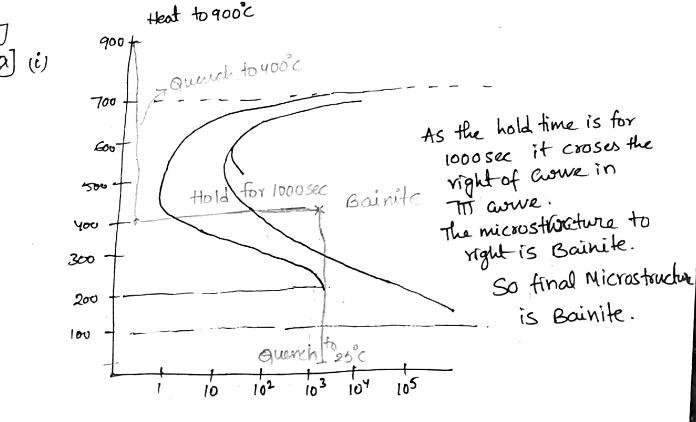
a. (24 points) Describe the microstructure present in a 10110 steel after each step in each of the following heat treatments (no
Mrac [35]

Answer:

Explanation:

Please check the below file for the attached file

6 0
2 years ago
As the porosity of a refractory ceramic brick increases:
ivolga24 [154]

Answer:

A) strength decreases, chemical resistance decreases, and thermal insulation increases

Explanation:

Strength always decreases, chemical resistence decreases, and thermal condictivity must be reduced therefore themal insulation must increase.

7 0
2 years ago
A double-acting duplex pump with 6.5-in. liners, 2.5-in. rods, and 18-in. strokes was operated at 3,000 psig and 20 cycles/min.
Stella [2.4K]

Answer:

Pump factor = Fp =  7.854 gal/cycle

Ev = 82.00 %

P_H = 183.29 hp

Explanation:

Given data:

Dimension of duplex pump

6.5 inch liner  

2.5 inch rod

18 inch strokes

Pressure 3000 psig

Pit dimension

7 ft wide

20 ft long

Ls = 18 inch

Velocity = (18)/10

volumetric efficiency is given as E_v = (Actual flow rate)/(Theortical flow rate) * 100

we know that flow rate is given as = Area * velocity

Theoritical flow rate = \frac{\pi}{2}\times Ls(2d_l^2 - d_r^2)\times N

Ev = \frac{7\times 12 \times 20\times 12\times 12 \times \frac{18}{10} inch^3/min}{\frac{\pi}{2} \times 18 (2\times 6.5^2 -2.5^2) \times 20}

Ev = 82.00 %

Pump factor Fp = = \frac{\pi}{2}\times Ls(2d_l^2 - d_r^2)\times Ev

Fp =\frac{\pi}{2} \times 18 (2\times 6.5^2 -2.5^2) \times 0.82

Fp = 1814.22 in^3/cyl

Fp =  7.854 gal/cycle

Flow rate q = NFp = 20 \times 7.854 = 157.08 gal/min

Power Ph = \frac{\DeltaP q}{1714} = \frac{3000 \times 157.08}{1714} = 274.93 hp

6 0
2 years ago
Write a method printShampooInstructions(), with int parameter numCycles, and void return type. If numCycles is less than 1, prin
kirill [66]

Answer:

// The method is defined with a void return type

// It takes a parameter of integer called numCycles

// It is declared static so that it can be called from a static method

public static void printShampooInstructions(int numCycles){

// if numCycles is less than 1, it display "Too few"

   if (numCycles < 1){

       System.out.println("Too few.");

   }

// else if numCycles is less than 1, it display "Too many"

    else if (numCycles > 4){

       System.out.println("Too many.");

   }

// else it uses for loop to print the number of times to display

// Lather and rinse

  else {

       for(int i = 1; i <= numCycles; i++){

           System.out.println(i + ": Lather and rinse.");

       }

       System.out.println("Done");


   }

}

Explanation:

The code snippet is written in Java. The method is declared static so that it can be called from another static method. It has a return type of void. It takes an integer as parameter.

It display "Too few" if the passed integer is less than 1. Or it display "Too much" if the passed integer is more than 4. Else it uses for loop to display "Lather and rinse" based on the passed integer.

8 0
2 years ago
Other questions:
  • Compute the mass fractions of α ferrite and cementite in pearlite. Assume T=726⁢ C∘.
    15·1 answer
  • Water has a density of 1.94 slug/ft^3. What is the density expressed in SI units? Express the answer to three significant figure
    8·1 answer
  • An excavation is at risk for cave-in and water accumulation because of the excess soil that has accumulated. What type of excava
    12·1 answer
  • A driver traveling at 65 mi/h rounds a curve on a level grade to see a truck overturned across the roadway at a distance of 350
    13·1 answer
  • What is the PW (at i 5%) of SuperTool's new test equipment? The development cost is $1.2M. Net revenues will begin at $300,000 f
    9·1 answer
  • Suggest how any sorting algorithm can be augmented in a way to make the best-case count of its key comparisons equal to just n−1
    6·1 answer
  • Two airstreams are mixed steadily and adiabatically. The first stream enters at 35°C and 30 percent relative humidity at a rate
    6·1 answer
  • Which of the following describes boundaries?
    10·1 answer
  • What are some goals of NYFEA? Select three options.
    9·2 answers
  • George is replacing a burned out resistor in a circuit board. The board has a 10, a 20, and a 40 on resistor, all in parallel. W
    5·1 answer
Add answer
Login
Not registered? Fast signup
Signup
Login Signup
Ask question!