answer.
Ask question
Login Signup
Ask question
All categories
  • English
  • Mathematics
  • Social Studies
  • Business
  • History
  • Health
  • Geography
  • Biology
  • Physics
  • Chemistry
  • Computers and Technology
  • Arts
  • World Languages
  • Spanish
  • French
  • German
  • Advanced Placement (AP)
  • SAT
  • Medicine
  • Law
  • Engineering
sladkih [1.3K]
2 years ago
7

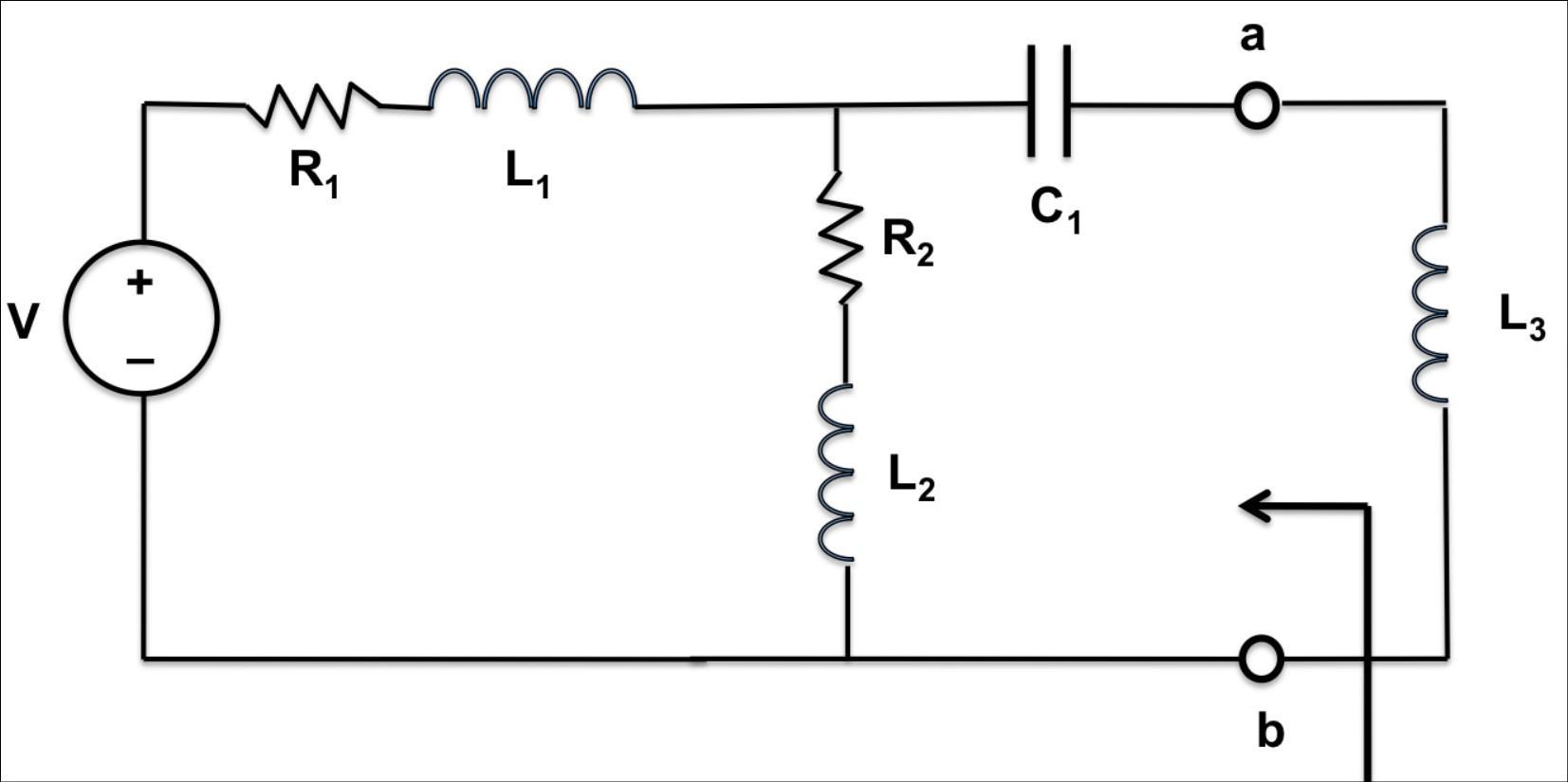
In the given circuit, V(t)=12cos(2000t+45)V, R1=R2=2Ω, L1=L2=L3=3mH and C1=250μF. You are required to find the Thevenin equivale

nt of this circuit using phasors. If you write the Thevenin voltage, Vth, in phasor form, what is the magnitude of this phasor? Put your answer in the box below without units.

Engineering
1 answer:
sashaice [31]2 years ago
8 0

The question is incomplete! Complete question along with answer and step by step explanation is provided below.

Question:

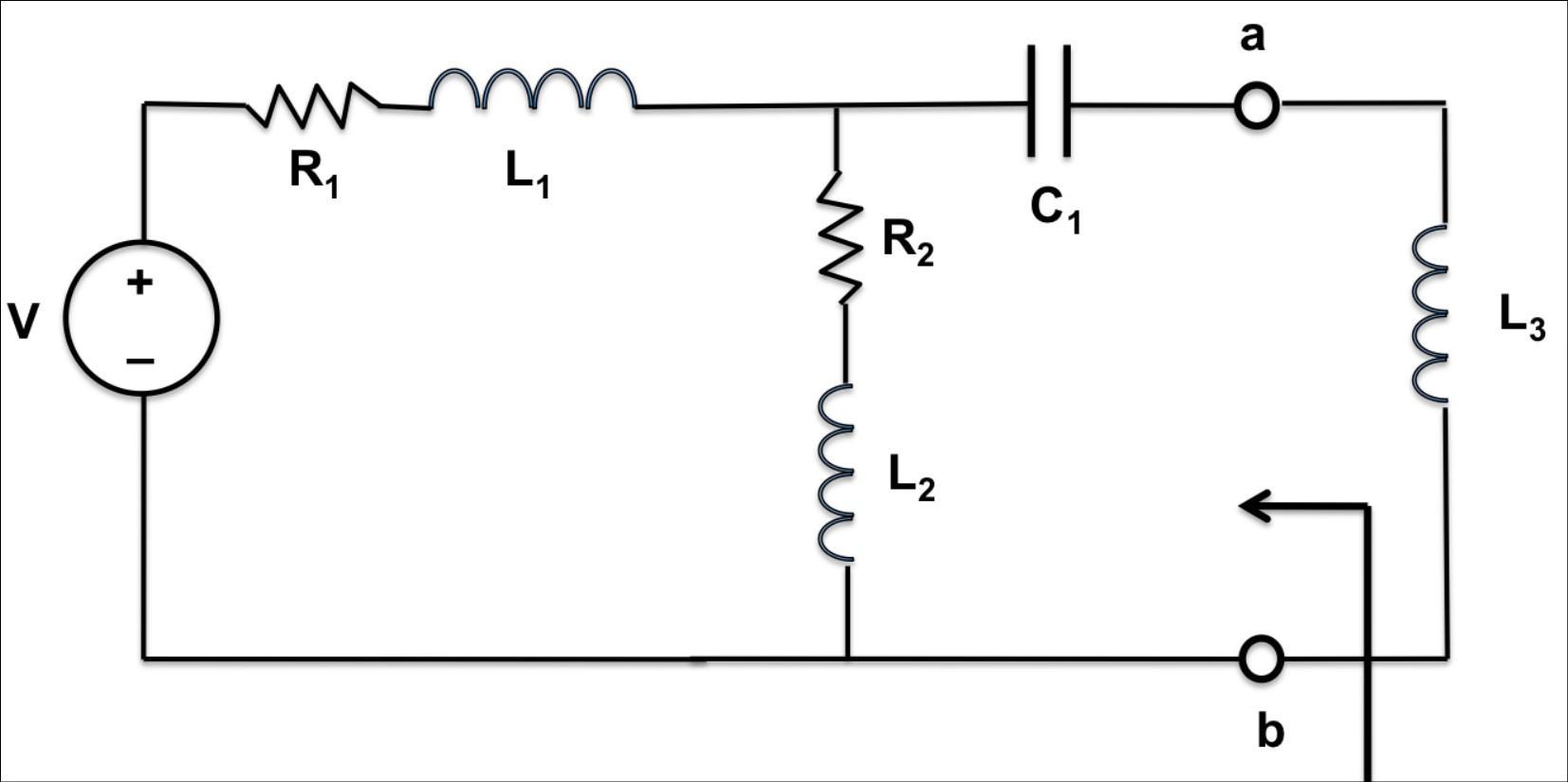
In the given circuit, V(t)=12cos(2000t+45)V, R1=R2=2Ω, L1=L2=L3=3mH and C1=250μF. You are required to find the Thevenin equivalent of this circuit using phasors.

a. If you write the Thevenin voltage, Vth, in phasor form, what is the magnitude of this phasor? Put your answer in the box below without units.

b. What is the value of the angle associated with the phasor Vth, in degrees?

c. Now, calculate the Thevenin impedance, Zth. What is the magnitude of this phasor?

d. What is the angle associated with the phasor Zth, in degrees?

Answer:

Vth = 6 < 45° V

Zth = 1.414 < 45°

a. The magnitude of the Thevenin voltage is 6 V

b. The phase angle of the Thevenin voltage is 45°

c. The magnitude of the Thevenin impedance is 1.414 V

d. The phase angle of the Thevenin impedance is 45°
Explanation:

The given voltage is

V(t)=12cos(2000t+45)

In phasor form,

V(t) = 12 < 45° V

So the magnitude of voltage is 12 V and the phase angle is 45°

Also the frequency ω = 2000

then the inductance is

L₁ = L₂ = L₃ = jωL = j×2000×0.003 = j6 Ω

and the capacitance is

C₁ = 1/jωC = 1/(j×2000×250x10⁻⁶) = -j2 Ω

and the resistance is

R₁ = R₂ = 2 Ω

Thevenin voltage:

The Thevenin voltage is the voltage that appears across the open-circuited terminals a-b (after removing L₃)

The Thevenin voltage is given by

Vth = V(t) × [ (R₂ + L₂) / (R₁ + L₁) + (R₂ + L₂) ]

Please note that there is no current flow in the capacitor due to open-circuited terminal a-b

Vth = 12 < 45°  × [ (2 + j6) / (2 + j6) + (2 + j6) ]

Vth = 12 < 45°  × [ (2 + j6) / (4 + j12) ]

Vth = 4.24264 + j4.24264 V

In phasor form,

Vth = 6 < 45° V

a. The magnitude of the Thevenin voltage is 6 V

b. The phase angle of the Thevenin voltage is 45°

Thevenin Impedance:

The Thevenin Impedance is the impedance of the circuit calculated when looking from the terminal a-b

Zth = [ (R₁ + L₁) × (R₂ + L₂) / (R₁ + L₁) + (R₂ + L₂) ] + (-j2)

Zth = [ (2 + j6) × (2 + j6) / (2 + j6) + (2 + j6) ] - j2

Zth = [ (2 + j6) × (2 + j6) / (2 + j6) + (2 + j6) ] - j2

Zth = [ (-32 + j24) / (4 + j12) ] -j2

Zth = [ (1 +j3) ] - j2

Zth = 1 + j Ω

In phasor form,

Zth = 1.414 < 45°

c. The magnitude of the Thevenin impedance is 1.414 V

d. The phase angle of the Thevenin impedance is 45°
You might be interested in
The wall of drying oven is constructed by sandwiching insulation material of thermal conductivity k = 0.05 W/m°K between thin me
masha68 [24]

Answer:

86 mm

Explanation:

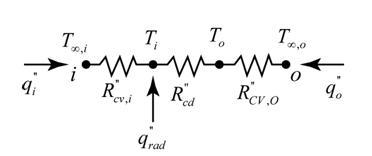
From the attached thermal circuit diagram, equation for i-nodes will be

\frac {T_ \infty, i-T_{i}}{ R^{"}_{cv, i}} + \frac {T_{o}-T_{i}}{ R^{"}_{cd}} + q_{rad} = 0 Equation 1

Similarly, the equation for outer node “o” will be

\frac {T_{ i}-T_{o}}{ R^{"}_{cd}} + \frac {T_{\infty, o} -T_{o}}{ R^{"}_{cv, o}} = 0 Equation 2

The conventive thermal resistance in i-node will be

R^{"}_{cv, i}= \frac {1}{h_{i}}= \frac {1}{30}= 0.033 m^{2}K/w Equation 3

The conventive hermal resistance per unit area is

R^{"}_{cv, o}= \frac {1}{h_{o}}= \frac {1}{10}= 0.100 m^{2}K/w Equation 4

The conductive thermal resistance per unit area is

R^{"}_{cd}= \frac {L}{K}= \frac {L}{0.05} m^{2}K/w Equation 5

Since q_{rad}  is given as 100, T_{o}  is 40 T_ \infty  is 300 T_{\infty, o}  is 25  

Substituting the values in equations 3,4 and 5 into equations 1 and 2 we obtain

\frac {300-T_{i}}{0.033} +\frac {40-T_{i}}{L/0.05} +100=0  Equation 6

\frac {T_{ i}-40}{L/0.05}+ \frac {25-40}{0.100}=0

T_{i}-40= \frac {L}{0.05}*150

T_{i}-40=3000L

T_{i}=3000L+40 Equation 7

From equation 6 we can substitute wherever there’s T_{i} with 3000L+40 as seen in equation 7 hence we obtain

\frac {300- (3000L+40)}{0.033} + \frac {40- (3000L+40)}{L/0.05}+100=0

The above can be simplified to be

\frac {260-3000L}{0.033}+ \frac {(-3000L)}{L/0.05}+100=0

\frac {260-3000L}{0.033}=50

-3000L=1.665-260

L= \frac {-258.33}{-3000}=0.086*10^{-3}m= 86mm

Therefore, insulation thickness is 86mm

8 0
2 years ago
CHALLENGE ACTIVITY 2.8.1: Using constants in expressions. The cost to ship a package is a flat fee of 75 cents plus 25 cents per
mihalych1998 [28]

Answer:

Weight(lb): 10

Flat fee(cents): 75

Cents per pound: 25

Shipping cost(cents): 325

Explanation:

we run this as a jave programming language

import java.util.Scanner;

public class Shipping Calculator {

   public static void main (String [] args) {

       int shipWeightPounds = 10;

       int shipCostCents = 0;

       final int FLAT_FEE_CENTS = 75;


        final int CENTS_PER_POUND = 25;

       shipCostCents = FLAT_FEE_CENTS + CENTS_PER_POUND * shipWeightPound

       /* look up the solutioin above */

       System.out.println("Weight(lb): " + shipWeightPounds);

       System.out.println("Flat fee(cents): " + FLAT_FEE_CENTS);

       System.out.println("Cents per pound: " + CENTS_PER_POUND);

       System.out.println("Shipping cost(cents): " + shipCostCents);

   }

}

7 0
2 years ago
An optical mouse originally cost $31.85. Before it was removed from the store, it underwent the following changes in price. 27%
saul85 [17]

Answer:

b.

$43.21

Explanation:

8 0
2 years ago
Read 2 more answers
Steam enters a turbine operating at steady state at 1 MPa, 200 °C and exits at 40 °C with a quality of 83%. Stray heat transfer
Andrei [34K]

Answer:

(a) Work out put=692.83\frac{KJ}{Kg}

(b) Change in specific entropy=0.0044\frac{KJ}{Kg-K}

Explanation:

Properties of steam at 1 MPa and 200°C

        h_1=2827.4\frac{KJ}{Kg},s_1=6.69\frac{KJ}{Kg-K}

We know that if we know only one property in side the dome then we will find the other property by using steam property table.

Given that dryness or quality of steam at the exit of turbine is 0.83 and temperature T=40°C.So from steam table we can find pressure corresponding to saturation temperature 40°C.

Properties of saturated steam at 40°C

      h_f= 167.5\frac{KJ}{Kg} ,h_g= 2537.4\frac{KJ}{Kg}

 s_f= 0.57\frac{KJ}{Kg-K} ,s_g= 8.25\frac{KJ}{Kg-K}

So the enthalpy of steam at the exit of turbine  

h_2=h_f+x(h_g-h_f)\frac{KJ}{Kg}

h_2=167.5+0.83(2537.4-167.5)\frac{KJ}{Kg}

h_2=2134.57\frac{KJ}{Kg}

s_2=s_f+x(s_g-s_f)\frac{KJ}{Kg-K}

s_2=0.57+0.83(8.25-0.57)\frac{KJ}{Kg-K}

s_2=6.6944\frac{KJ}{Kg-K}

(a)

Work out put =h_1-h_2

                      =2827.4-2134.57 \frac{KJ}{Kg}

Work out put =692.83 \frac{KJ}{Kg}

(b) Change in specific entropy

     s_2-s_1=6.6944-6.69\frac{KJ}{Kg-K}

Change in specific entropy =0.0044\frac{KJ}{Kg-K}

3 0
2 years ago
Consider insulation on a circular pipe For the same thickness and type of insulation, the thermal resistance of the insulation i
leonid [27]

Answer:

b). The same for all pipes independent of the diameter

Explanation:

We know,

R_{conduction}=\frac{ln(\frac{r_{2}}{r_{1}})}{2\pi LK}

R_{convection}=\frac{1}{h(2\pi r_{2}L)}

From the above formulas we can conclude that the thermal resistance of a substance mainly depends upon heat transfer coefficient,whereas radius has negligible effects on heat transfer coefficient.

We also know,

Factors on which thermal resistance of insulation depends are :

1. Thickness of the insulation

2. Thermal conductivity of the insulating material.

Therefore from above observation we can conclude that the thermal resistance of the insulation is same for all pipes independent of diameter.

5 0
2 years ago
Other questions:
  • A hydrogen-filled balloon to be used in high altitude atmosphere studies will eventually be 100 ft in diameter. At 150,000 ft, t
    7·1 answer
  • A gas metal arc welder is also known as a _____ welder.
    5·1 answer
  • Choose the correct sequence of the following events leading to the sensory processing of a stimulus. 1. transmission 2. transduc
    13·1 answer
  • The components of an electronic system dissipating 90 W are located in a 1-m-long circular horizontal duct of 15-cm diameter. Th
    11·1 answer
  • Why is it that dislocations play an important role in controlling the mechanical properties of metallic materials, however, they
    10·1 answer
  • Complete the following sentence.
    5·1 answer
  • Who can work on a fixed ladder that extends more than 24 feet?
    11·1 answer
  • What should always be done before beginning any diagnosis?
    9·1 answer
  • Most fatal collisions in Florida happen during
    8·2 answers
  • Dalton needs to prepare a close-out report for his project. Which part of the close-out report would describe
    6·1 answer
Add answer
Login
Not registered? Fast signup
Signup
Login Signup
Ask question!