answer.
Ask question
Login Signup
Ask question
All categories
  • English
  • Mathematics
  • Social Studies
  • Business
  • History
  • Health
  • Geography
  • Biology
  • Physics
  • Chemistry
  • Computers and Technology
  • Arts
  • World Languages
  • Spanish
  • French
  • German
  • Advanced Placement (AP)
  • SAT
  • Medicine
  • Law
  • Engineering
stira [4]
2 years ago
9

An unknown compound, B, has the molecular formula C7H12. On catalytic hydrogenation 1 mol of B absorbs 2 mol of hydrogen and yie

lds 2-methylhexane. B has significant IR absorption band at about 3300 and 2200 cm-1. Which compound best represents B?
a. 5-methyl-1,3-hexadiene
b. 5-methyl-1-hexyne
c. 3-methyl-1-hexyne
d. 5-methyl-2-hexyne
e. 2-methyl-1,5-hexadiene

Chemistry
1 answer:
kobusy [5.1K]2 years ago
5 0

Answer:

B and D

Explanation:

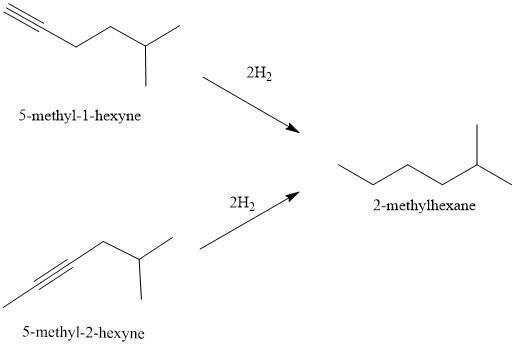
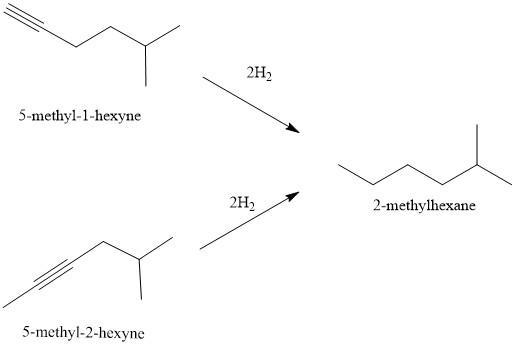
If we use the info given we have a band a 3300 cm-1 and 2200 cm-1 this indicates that we have an <u>alkyne functional group</u>. Additionally, the hydrogenation of the unknown molecule will consume two moles of hydrogens this fits with the <u>2 pi bonds</u> in the alkyne functional group. So, we can <u>discard "a" and "e"</u>. The product of this hydrogenation is 2-methylhexane therefore we can <u>discard c</u> because the methyl group is placed on carbon 3. Structures b and d can work.

See figure 1

I hope it helps!

You might be interested in
The mass of a container is determined to be 1.2 g. A sample of a compound is transferred to this container, and the mass of the
Nikitich [7]

Answer:

Sorry I don't know what you

3 0
1 year ago
If 25.0 g of NH₃ and 45.0g of O₂ react in the following reaction, what is the mass in grams of NO that will be formed? 4 NH₃ (g)
Allisa [31]

Answer:

The correct answer would be : 33.8 g

Explanation:

Molar mass of ammonia,

Molar Mass = 1* Molar Mass(N) + 3* Molar Mass (H)

= 1*14.01 + 3*1.008  = 17.034 g/mol

mass(NH3)= 25.0 g  (given)

number of mol of NH3,

n = mass of NH3/molar mass of NH3

=(25.0 g)/(17.034 g/mol)

= 1.468 mol

Now,

Molar mass of O2

= 32 g/mol

mass(O2)= 45.0 g

similar as ammonia

n (O2)=(45.0 g)/(32 g/mol)

= 1.406 mol

Balanced chemical equation is:

4 NH3 + 5 O2 ---> 4 NO + 6 H2O

1.83456 mol of O2 is required  for 1.46765 mol of NH3

by the calculation we have only 1.40625 mol of O2

Thus, the limiting agent will be - O2

now the Molar mass of NO,

= 1*14.01 + 1*16.0

= 30.01 g/mol  (similar formula used for NH3)

Balanced equation :

mol of NO formed = (4/5)* moles of O2

= (4/5)×1.40625  (from above calculation)

= 1.125 mol

mass of NO = number of moles × molar mass

= 1.125*30.01

= 33.8 g

Thus, the correct answer would be : 33.8 g
5 0
2 years ago
Before landing, the brakes and the tires of an airliner have a temperature of 15.0∘C. Upon landing, the 90.7 kg carbon fiber bra
Goryan [66]

Answer:

0.921 J/g degrees C

Explanation:

Recall that the First Law of Thermodynamics demands that the total internal energy of an isolated system must remain constant. Any amount of energy lost by the brakes must be gained by the tires (in the form of heat in this situation).  Therefore, heat given off by the brakes = −heat taken in by tires, or:

−qbrakes=qtires

The equation used to calculate the quantity of heat energy exchanged in this process is:

−qbrakes=−cbrakes mbrakes ΔTbrakes=ctires mtires ΔTtires=qtires

First we must convert the mass of the tires and the brakes from  kg to  g.

massbrakes=90.7 kg×1,000. g1 kg=9.07×10⁴ g

masstires=123 kg×1,000. g1 kg=1.23×10⁵ g

Next, substitute in known values and rearrange to solve for ctires. Note that the final temperature for both the tires and the brakes is 172∘C, the initial temperature of the brakes is 312∘C and the initial temperature of the tires is 15∘C.

−(1.400Jg∘C)(9.07×10⁴ g)(172∘C−312∘C)=(ctires)(1.23×10⁵ g)(172∘C−15∘C)

ctires=−(1.400 Jg∘C)(9.07×10⁴ g)(−140∘C)(1.23×10⁵ g)(157∘C)=17,777,200 J19311000 g∘C=0.9206Jg∘C

The answer should have three significant figures, so round to 0.921Jg∘C.

6 0
2 years ago
A scuba tank contains a mixture of oxygen (O2) and nitrogen (N2) gas. The oxygen has a partial pressure of PO2=5.62MPa. The tota
dmitriy555 [2]

Answer:

21.16 MPa

Explanation:

Partial pressure of oxygen = 5.62 MPa

Total gas pressure = 26.78 MPa

But

Total pressure of the gas= sum of partial pressures of all the constituent gases in the system.

This implies that;

Total pressure of the system = partial pressure of nitrogen + partial pressure of oxygen

Hence partial pressure of nitrogen=

Total pressure of the system - partial pressure of oxygen

Therefore;

Partial pressure of nitrogen= 26.78 - 5.62

Partial pressure of nitrogen = 21.16 MPa

7 0
2 years ago
Read 2 more answers
What mass of solid lead would displace exactly 234.6 liters of water?
eimsori [14]
Thank you for posting your question here at brainly. I hope the answer will help you. Feel free to ask more questions.

The mass of solid lead would displace exactly 234.6 liters of water should be <span>2,674,440</span>
6 0
2 years ago
Read 2 more answers
Other questions:
  • The ionization energy for a hydrogen atom is 1.31×10⁶ J/mol. What is the ionization energy for He+?
    5·2 answers
  • You are writing a safety contract for your class. List 10 things you would include in the contract.
    8·2 answers
  • What name is used to describe the H-N-H group?
    14·1 answer
  • The mineral rhodochrosite [manganese(II) carbonate, MnCO3] is a commercially important source of manganese. Write a half-reactio
    7·1 answer
  • A sample of copper with a mass of 63.5g contains 6.02 x10^23 atoms calculate the mass of an average copper atom
    14·1 answer
  • Robyn has been working on developing a new task to test the reaction time of athletes. As she begins to test athletes using her
    8·1 answer
  • a carbon-12 atom has a mass defect of 0.9564 amu. what is its nuclear binding energy? round to 3 significant figures.
    9·2 answers
  • Which option describes energy being released as heat?
    11·2 answers
  • In one compound of lead and sulfur, there are 6.46 g of lead
    13·1 answer
  • Please help like now please
    7·1 answer
Add answer
Login
Not registered? Fast signup
Signup
Login Signup
Ask question!