answer.
Ask question
Login Signup
Ask question
All categories
  • English
  • Mathematics
  • Social Studies
  • Business
  • History
  • Health
  • Geography
  • Biology
  • Physics
  • Chemistry
  • Computers and Technology
  • Arts
  • World Languages
  • Spanish
  • French
  • German
  • Advanced Placement (AP)
  • SAT
  • Medicine
  • Law
  • Engineering
Whitepunk [10]
2 years ago
15

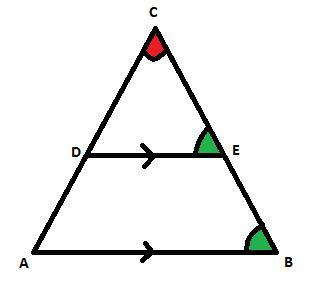
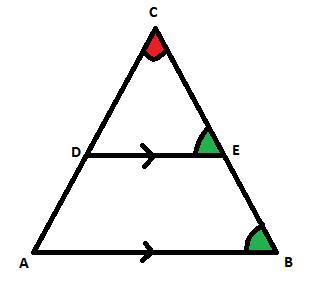
Read the proof. Given: AB ∥ DE Prove: △ACB ~ △DCE Triangle A B C is shown. Line D E is drawn inside of the triangle and is paral

lel to side A B. The line forms triangle D C E. We are given AB ∥ DE. Because the lines are parallel and segment CB crosses both lines, we can consider segment CB a transversal of the parallel lines. Angles CED and CBA are corresponding angles of transversal CB and are therefore congruent, so ∠CED ≅ ∠CBA. We can state ∠C ≅ ∠C using the reflexive property. Therefore, △ACB ~ △DCE by the AA similarity theorem. SSS similarity theorem. AAS similarity theorem. ASA similarity theorem.

Mathematics
1 answer:
NikAS [45]2 years ago
7 0

Answer:

(A) AA Similarity Theorem

Step-by-step explanation:

Given: AB ∥ DE

To Prove: \triangle ACB \sim \triangle DCE

Given Triangle ABC with Line DE drawn inside of the triangle and parallel to side AB. The line DE forms a new triangle DCE.

Because AB∥DE and segment CB crosses both lines, we can consider segment CB a transversal of the parallel lines.

Angles CED and CBA are corresponding angles of transversal CB and are therefore congruent, so ∠CED ≅ ∠CBA.

We can state ∠C ≅ ∠C using the reflexive property.

Therefore, \triangle ACB \sim \triangle DCE by the AA similarity theorem.

Remark: In the diagram, we can see that the two triangles share Angle C and have two equal angles at E and B. Therefore, they are similar by the Angle-Angle Similarity Theorem.

You might be interested in
PROBLEM SOLVING You are participating in an orienteering competition. The diagram shows the position of a river that cuts throug
Wewaii [24]

Answer:

The shortest distance is 2.2 miles      

Step-by-step explanation:

we know that

The shortest distance you must travel to reach the river is the perpendicular distance to the river

step 1

Find the slope of the line perpendicular to the river

we have

y=3x+2

The slope of the river  is m=3

Remember that if two lines are perpendicular, then their slopes are opposite reciprocal (the product of their slopes is -1)

therefore

The slope of the line perpendicular to the river is

m=-1/3

step 2

Find the equation of the line into point slope form

y-y1=m(x-x1)

we have

m=-1/3

point(2,1)

substitute

y-1=-(1/3)(x-2)

step 3

Find the intersection point of the river and the line perpendicular to the river

we have

y=3x+2 ------> equation A

y-1=-(1/3)(x-2) -----> equation B

Solve the system by graphing

The intersection point is (-0.1,1,7)

see the attached figure

step 3

Find the distance between the points (2,1) and (-0,1,1.7)

the formula to calculate the distance between two points is equal to

d=\sqrt{(y2-y1)^{2}+(x2-x1)^{2}}

substitute

d=\sqrt{(1.7-1)^{2}+(-0.1-2)^{2}}

d=\sqrt{(0.7)^{2}+(-2.1)^{2}}

d=2.2\ miles

6 0
2 years ago
A 400 gallon tank initially contains 100 gal of brine containing 50 pounds of salt. Brine containing 1 pound of salt per gallon
posledela

Answer:

The amount of salt in the tank when it is full of brine is 393.75 pounds.

Step-by-step explanation:

This is a mixing problem. In these problems we will start with a substance that is dissolved in a liquid. Liquid will be entering and leaving a holding tank. The liquid entering the tank may or may not contain more of the substance dissolved in it. Liquid leaving the tank will of course contain the substance dissolved in it. If Q(t) gives the amount of the substance dissolved in the liquid in the tank at any time t we want to develop a differential equation that, when solved, will give us an expression for Q(t).

The main equation that we’ll be using to model this situation is:

Rate of change of <em>Q(t)</em> = Rate at which <em>Q(t)</em> enters the tank – Rate at which <em>Q(t)</em> exits the tank

where,

Rate at which Q(t) enters the tank = (flow rate of liquid entering) x

(concentration of substance in liquid entering)

Rate at which Q(t) exits the tank = (flow rate of liquid exiting) x

(concentration of substance in liquid exiting)

Let y<em>(t)</em> be the amount of salt (in pounds) in the tank at time <em>t</em> (in seconds). Then we can represent the situation with the below picture.

Then the differential equation we’re after is

\frac{dy}{dt} = (Rate \:in)- (Rate \:out)\\\\\frac{dy}{dt} = 5 \:\frac{gal}{s} \cdot 1 \:\frac{pound}{gal}-3 \:\frac{gal}{s}\cdot \frac{y(t)}{V(t)}  \:\frac{pound}{gal}\\\\\frac{dy}{dt} =5\:\frac{pound}{s}-3 \frac{y(t)}{V(t)}  \:\frac{pound}{s}

V(t) is the volume of brine in the tank at time <em>t. </em>To find it we know that at time 0 there were 100 gallons, 5 gallons are added and 3 are drained, and the net increase is 2 gallons per second. So,

V(t)=100 + 2t

We can then write the initial value problem:

\frac{dy}{dt} =5-\frac{3y}{100+2t} , \quad y(0)=50

We have a linear differential equation. A first-order linear differential equation is one that can be put into the form

\frac{dy}{dx}+P(x)y =Q(x)

where <em>P</em> and <em>Q</em> are continuous functions on a given interval.

In our case, we have that

\frac{dy}{dt}+\frac{3y}{100+2t} =5 , \quad y(0)=50

The solution process for a first order linear differential equation is as follows.

Step 1: Find the integrating factor, \mu \left( x \right), using \mu \left( x \right) = \,{{\bf{e}}^{\int{{P\left( x \right)\,dx}}}

\mu \left( t \right) = \,{{e}}^{\int{{\frac{3}{100+2t}\,dt}}}\\\int \frac{3}{100+2t}dt=\frac{3}{2}\ln \left|100+2t\right|\\\\\mu \left( t \right) =e^{\frac{3}{2}\ln \left|100+2t\right|}\\\\\mu \left( t \right) =(100+2t)^{\frac{3}{2}

Step 2: Multiply everything in the differential equation by \mu \left( x \right) and verify that the left side becomes the product rule \left( {\mu \left( t \right)y\left( t \right)} \right)' and write it as such.

\frac{dy}{dt}\cdot \left(100+2t\right)^{\frac{3}{2}}+\frac{3y}{100+2t}\cdot \left(100+2t\right)^{\frac{3}{2}}=5 \left(100+2t\right)^{\frac{3}{2}}\\\\\frac{dy}{dt}\cdot \left(100+2t\right)^{\frac{3}{2}}+3y\cdot \left(100+2t\right)^{\frac{1}{2}}=5 \left(100+2t\right)^{\frac{3}{2}}\\\\\frac{dy}{dt}(y \left(100+2t\right)^{\frac{3}{2}})=5\left(100+2t\right)^{\frac{3}{2}}

Step 3: Integrate both sides.

\int \frac{dy}{dt}(y \left(100+2t\right)^{\frac{3}{2}})dt=\int 5\left(100+2t\right)^{\frac{3}{2}}dt\\\\y \left(100+2t\right)^{\frac{3}{2}}=(100+2t)^{\frac{5}{2} }+ C

Step 4: Find the value of the constant and solve for the solution y(t).

50 \left(100+2(0)\right)^{\frac{3}{2}}=(100+2(0))^{\frac{5}{2} }+ C\\\\100000+C=50000\\\\C=-50000

y \left(100+2t\right)^{\frac{3}{2}}=(100+2t)^{\frac{5}{2} }-50000\\\\y(t)=100+2t-\frac{50000}{\left(100+2t\right)^{\frac{3}{2}}}

Now, the tank is full of brine when:

V(t) = 400\\100+2t=400\\t=150

The amount of salt in the tank when it is full of brine is

y(150)=100+2(150)-\frac{50000}{\left(100+2(150)\right)^{\frac{3}{2}}}\\\\y(150)=393.75

6 0
2 years ago
Using the chart above, find the state withholding tax for the following unmarried person. Mary Smith, salary $342, 2 exemptions
dmitriy555 [2]

Answer: 6.76


Ufc7cutcutct7c7tctucitxitxitxitxit


3 0
2 years ago
For ΔABC, ∠A = 4x - 10, ∠B = 5x + 10, and ∠C = 7x + 20. If ΔABC undergoes a dilation by a scale factor of 1 3 to create ΔA'B'C'
VLD [36.1K]
We know that the angles of a triangle sum to 180°.  For ΔABC, this means we have:
(4x-10)+(5x+10)+(7x+20)=180

Combining like terms,
16x+20=180

Subtracting 20 from both sides:
16x=160

Dividing both sides by 16:
x=10
This means ∠A=4*10-10=40-10=30°; ∠B=5*10+10=50+10=60°; and ∠C=7*10+20=70+20=90.

For ΔA'B'C', we have
(2x+10)+(8x-20)+(10x-10)=180

Combining like terms, 
20x-20=180

Adding 20 to both sides:
20x=200

Dividing both sides by 20:
x=10

This gives us ∠A'=2*10+10=20+10=30°; ∠B'=8*10-20=80-20=60°; and ∠C'=10*10-10=100-10=90°.

Since the angle are all congruent, ΔABC~ΔA'B'C' by AAA.
5 0
2 years ago
Read 2 more answers
The flower shop has 40 times as many flowers in one cooler as Julia has in her bouquet. The cooler has 120 flowers. How many flo
kiruha [24]
The answer is 4,800 if u multiply 120x40

8 0
2 years ago
Read 2 more answers
Other questions:
  • The Gordon family plans to buy a TV. One TV has a purchase price of $330 and an estimated yearly operating cost of $14. The othe
    13·2 answers
  • If m abf=7b-24 and m Abe = 2b what is m EBF
    13·1 answer
  • The graphs below have the same shape. The equation of the blue graph is f(x) = 2x. Which of these is the equation of the red gra
    9·1 answer
  • Which equation has an a-value of –2, a b-value of 1, and a c-value of 3? 0 = –2x2 + x + 3 0 = 2x2 + x + 3 0 = –2x2 + 3 0 = 2x2 –
    10·1 answer
  • Ben baked brownies in the brownie pan shown below. Each day, he is going to eat 303030 square centimeters of brownie from the pa
    8·2 answers
  • Given a data set consisting of 33 unique whole number observations, its five-number summary is:
    6·1 answer
  • If Serena selects 4 samples from the table, which row
    9·2 answers
  • HELP PLZ!
    13·1 answer
  • Given: ∠XWU ≅ ∠ZVT; ∠ZTV ≅ ∠XUW; TU ≅ VW Triangles Z V T and X W U overlap and intersect at point Y. Angles Z T U and W U W are
    14·2 answers
  • The quadratic function y = -10x2 + 160x - 430 models a store's daily profit (y), in dollars, for selling T-shirts priced at x do
    7·1 answer
Add answer
Login
Not registered? Fast signup
Signup
Login Signup
Ask question!