answer.
Ask question
Login Signup
Ask question
All categories
  • English
  • Mathematics
  • Social Studies
  • Business
  • History
  • Health
  • Geography
  • Biology
  • Physics
  • Chemistry
  • Computers and Technology
  • Arts
  • World Languages
  • Spanish
  • French
  • German
  • Advanced Placement (AP)
  • SAT
  • Medicine
  • Law
  • Engineering
Galina-37 [17]
2 years ago
11

2. In the same tournament, a player is positioned 35 m (40° W of S] of the net. He shoots the puck

Physics
1 answer:
andrezito [222]2 years ago
5 0

Answer:

The displacement of the net from player 2 in component form = (-47.498î - 26.812j)

The displacement of the net from player 2 in statement form is 54.54 m and 29.44° (S of W) or 60.56° (W of S)

Explanation:

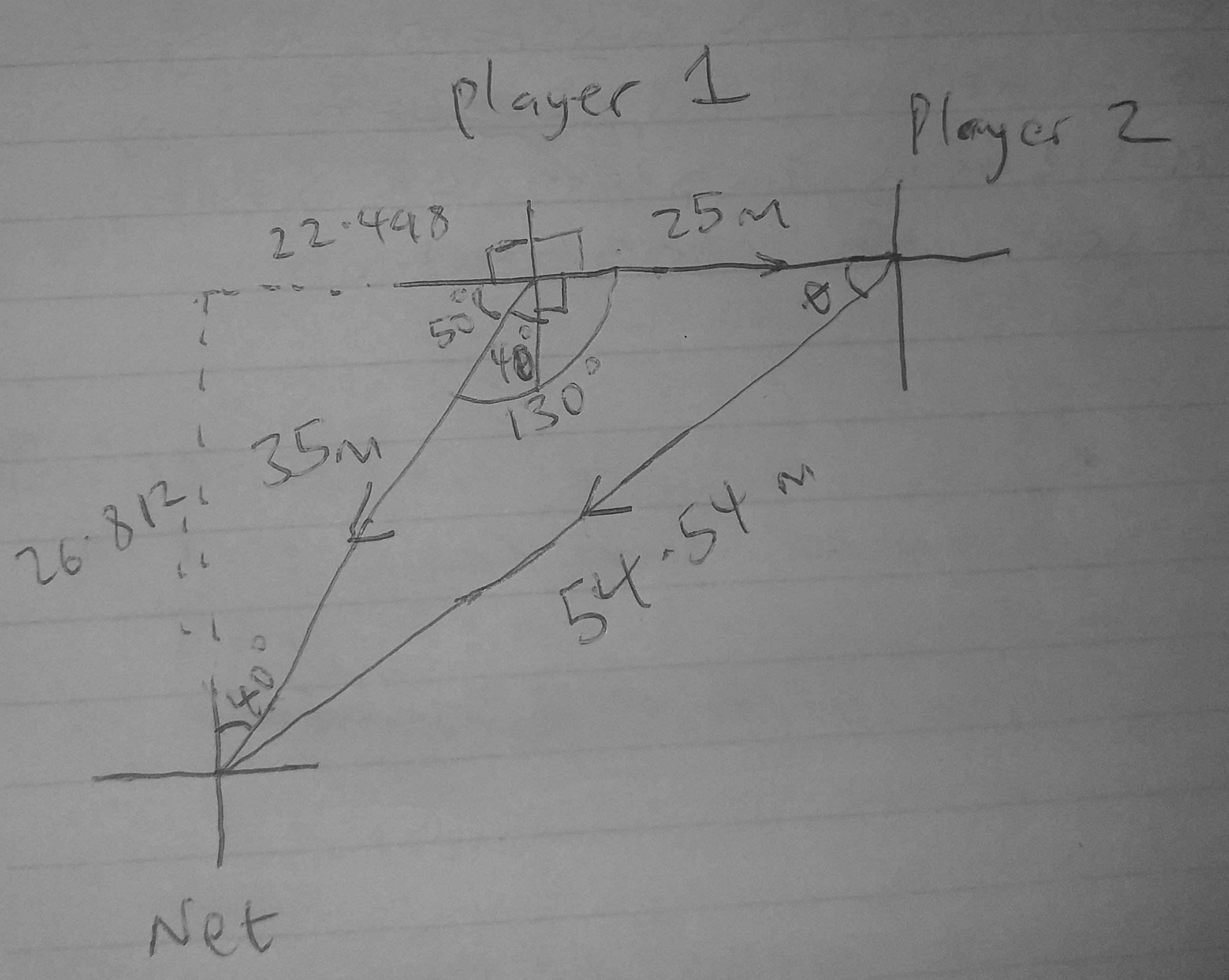
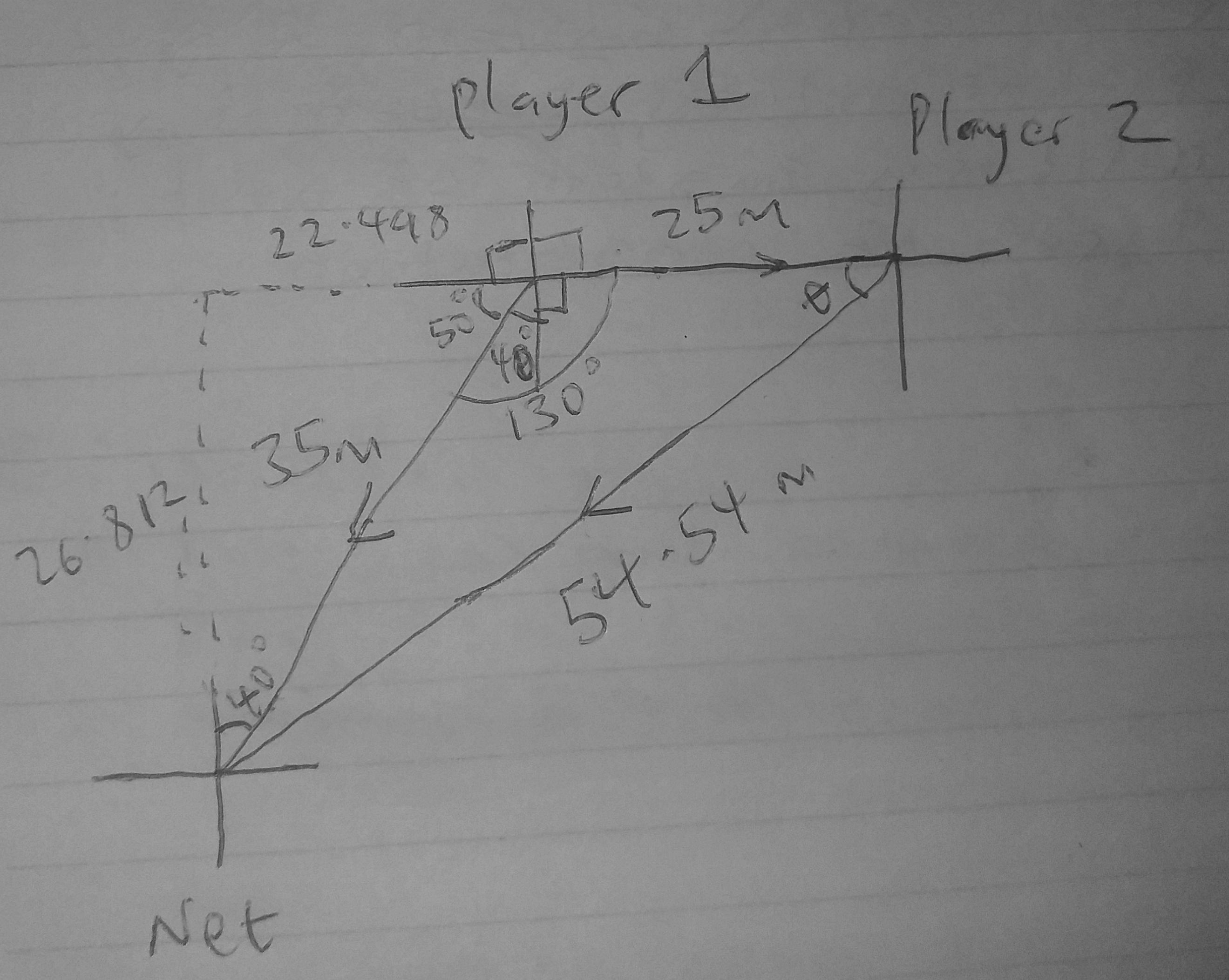
The sketch of the bearings described in the question is presented in the attached image to this solution.

Method 1

Using component method

Taking the player 1's position as the origin,

The displacement of the player 2 from the origin is (25î) m

The displacement of the net from the origin is 35[(sin θ)î + (cos θ)j]

But θ is the angle of the net's displacement reading from the positive x-axis in the anticlockwise direction. θ = 230°

Displacement of the net from the origin = 35[(cos 230°) + (cos 230°)]

= 35[-0.6428î - 0.7660j]

= (-22.498î - 26.812j) m

In component form, taking note of the directions of the respective displacements calculated (check the attached image)

(The displacement of the net from player 1) = (The displacement of player 2 from player 1) + (The displacement of the net from player 2)

Since we have agreed that player 1 is the origin

(The displacement of the net from origin) = (The displacement of player 2 from origin) + (The displacement of the net from player 2)

(-22.498î - 26.812j) = (25î) + (The displacement of the net from player 2)

The displacement of the net from player 2 = (-22.498î - 26.812j) - (25î) = (-47.498î - 26.812j)

The magnitude of this displacement = √[(-47.498)² + (-26.812)²]

= √(2,256.060004 + 718.883344) = 54.54 m

Direction = tan⁻¹ (-26.812/-47.498) = 209.44° (the signs on the components show that the direction is the third quadrant from the positive x-axis in the anti-clockwise direction)

Hence, the displacement of the net from player 2 is 54.54 m and 29.44° (S of W)

Method 2

Using trignometry,

We will use cosine and sine rule to obtain the required magnitude and direction of the displacement of the net from player 2

Cosine rule

Magnitude = √[35² + 25² - (2×25×35×cos 130°)] = √2,974.8783169514 = 54.54 m

Sine rule

(Sin θ)/35 = (Sin 130°)/54.54

Sin θ = (35 × Sin 130°)/54.54 = 0.4916

θ = Sin⁻¹ (0.4916) = 29.44°

This answer matches the answers from method 1.

Hope this Helps!!!
You might be interested in
Lorenzo is making a prediction. “I learned that nonmetals increase in reactivity when moving from left to right. So I predict th
nadezda [96]
That prediction is not correct because Xenon is extremely stable; column 18 of the periodic table contains the noble gasses, which are stable because their outer-most energy levels are completely filled. Having the octet (8) of valence electrons means that the element no longer needs to lose or gain electrons to gain stability.

The column 17 elements are unstable because they only have one valence electron short of the stable octet configuration of the noble gasses.
6 0
2 years ago
Read 2 more answers
An individual white LED (light-emitting diode) has an efficiency of 20% and uses 1.0 W of electric power. a. How many LEDs must
Neporo4naja [7]

Answer:

8, 8 W

Explanation:

The useful power of 1 Light Emitting Diode is

0.2\times 1=0.2\ W

Total power required is 1.6 W

Number of Light Emitting Diodes would be

n=\dfrac{1.6}{0.2}\\\Rightarrow n=8

The number of Light Emitting Diodes is 8.

Power would be

P=8\times 1=8\ W

The power that is required to run the Light Emitting Diodes is 8 W

7 0
2 years ago
A tank contains 100 gal of water and 50 oz of salt.water containing a salt concentration of 1 4 (1 1 2 sin t) oz/gal flows into
Alchen [17]

Answer:

Explanation:

Heres the possible full question and solution:

A tank contains 100 gal of water and 50 oz of salt. Water containing a salt concentration of ¼ (1 + ½ sin t) oz/gal flows ito the tank at a rate of 2 gal/min, and the mixture in the tank flows out at the same rate.

a. Find the amount of salt in the tank at any time.

b. Plot the solution for a time period long enough so that you see the ultimate behavior of the graph.

c. The long-time behavior of the solution is an oscillation about a certain constant level. What is this level? What is the amplitude of the oscillation?

solution

a)

Consider the tank contains 100gal of water and 50 oz of salt

Assume that the amount of salt in the tank at time t is Q(t).

Then, the rate of change of salt in the tank is given by \frac{dQ}{dt}.

Here, \frac{dQ}{dt}=rate of liquid flowing in the tank - rate of liquid flowing out.

Therefore,

Rate_{in} =2gal/min \times \frac{1}{4} (1+ \frac{1}{2}sin t)oz/gal\\\\\\ \frac{1}{2} (1+ \frac{1}{2}sin t)oz/min\\\\\\Rate_{out}=2gal/min \times\frac{Q}{100}oz/gal\\\\\frac{Q}{50}oz/min

Therefore,

\frac{dQ}{dt} can be evaluated as shown below:

\frac{dQ}{dt}=\frac{1}{2}(1+\frac{1}{2}\sin t)-\frac{Q}{50}\\\\\\\frac{dQ}{dt}+\frac{1}{50}Q=\frac{1}{2}+\frac{1}{4}\sin t

The above differential equation is in standard form:

\frac{dy}{dt}+Py=G

Here, P=\frac{1}{50},G=\frac{1}{2}+\frac{1}{4}\sin t

The integrating factor is as follows:

\mu(t)=e^{\int {P}dt}\\\mu(t)=e^{\int {\frac{1}{50}}dt}\\\mu(t)=e^{\frac{t}{50}}

Thus, the integrating factor is  \mu(t)=e^{\frac{t}{50}}

Therefore, the general solution is as follows:

y\mu(t)=\int {\mu (t)G}dt\\\\Qe^{\frac{t}{50}}=\int {e^{\frac{t}{50}}(\frac{1}{2}+\frac{1}{4}\sin t) dt}\\\\Qe^{\frac{t}{50}}=\frac{1}{2}\int {e^{\frac{t}{50}}dt + \frac{1}{4}\int {\sin t {e^{\frac{t}{50}}} dt}\\\\\Qe^{\frac{t}{50}}=25 {e^{\frac{t}{50}} + \frac{1}{4}\int {\sin t {e^{\frac{t}{50}}} dt}+C...(1)

Here, C is arbitrary constant of integration.

Solve \int {\sin te^{\frac{t}{50}}} dt}

Here u = e^{\frac{t}{50}} and v =\sin t.

Substitute u , v in the below formula:

\int{u,v}dt=u\int{v}dt-\int\frac{du}{dt}\int{v}dt\dot dt\\\\\int {e^{\frac{t}{50}}\sin t}dt=-e^{\frac{t}{50}}\cos t + \frac{1}{50}\int{e^{\frac{t}{50}}\cos t}dt...(2)

Now, take u = e^{\frac{t}{50}}, v =\sin t

Therefore, \int{e^{\frac{t}{50}}\cos t} dt=\int {e^{\frac{t}{50}}\sin t}dt - \frac{1}{50}\int{e^{\frac{t}{50}}\sin t}dt...(3)

Use (3) in equation(2)

\int {e^{\frac{t}{50}}\sin t}dt=-e^{\frac{t}{50}}\cos t + \frac{e^{\frac{t}{50}}}{50}\sin t - \frac{1}{2500}\int{e^{\frac{t}{50}}\sin t}dt\\\\\frac{2501}{2500}\int{e^{\frac{t}{50}}\sin t}dt={e^{\frac{t}{50}}\cos t}+\frac{e^{\frac{t}{50}}}{50}\sin t\\\\\int{e^{\frac{t}{50}}\sin t}dt=\frac{2500}{2501}{e^{\frac{t}{50}}\cos t}+\frac{50}{2501}e^{\frac{t}{50}}\sin t...(4)

Use (4) in equation(l) .

Qe^{\frac{t}{50}}=25 e^{\frac{t}{50}} - \frac{625}{2501}e^{\frac{t}{50}}\cos t +\frac{25}{5002}e^{\frac{t}{50}}\sin t+C

Apply the initial conditions t =0, Q = 50.

50=25-\frac{625}{2501}+c\\\\c=\frac{63150}{2501}

So, Qe^{\frac{t}{50}}=25 e^{\frac{t}{50}} - \frac{625}{2501}e^{\frac{t}{50}}\cos t +\frac{25}{5002}e^{\frac{t}{50}}\sin t+\frac{63150}{2501}

Therefore, the amount of salt in the tank at any time is as follows:

Qe^{\frac{t}{50}}=25 e^{\frac{t}{50}} - \frac{625}{2501}e^{\frac{t}{50}}\cos t +\frac{25}{5002}e^{\frac{t}{50}}\sin t+\frac{63150}{2501}e^{\frac{-t}{50}}

b)

sketch the solution curve as shown in attachment as graph 1:

CHECK COMMENT FOR C

3 0
2 years ago
A football player kicks a football downfield. The height of the football increases until it reaches a maximum height of 15 yards
Trava [24]

Answer:

kick 1 has travelled 15 + 15 = 30 yards before hitting the ground

so kick 2 travels 25 + 25 = 50 yards before hitting the ground

first kick reached 8 yards and 2nd kick reached 20 yards  

Explanation:

1st kick travelled 15 yards to reach maximum height of 8 yards

so, it has travelled 15 + 15 = 30 yards before hitting the ground

2nd kick is given by the equation

y (x) = -0.032x(x - 50)

Y = 1.6 X - 0.032x^2

we know that maximum height occurs is given as

x = -\frac{b}{2a}

y =- \frac{1.6}{2(-0.032)} = 25

and maximum height is

y = 1.6\times 25 - 0.032\times 25^2

y = 20

so kick 2 travels 25 + 25 = 50 yards before hitting the ground

first kick reached 8 yards and 2nd kick reached 20 yards

8 0
2 years ago
Read 2 more answers
(a) Aircraft sometimes acquire small static charges. Suppose a supersonic jet has a 0.500 - μC charge and flies due west at a sp
12345 [234]

(a) 2.64\cdot 10^{-8} N north

We can treat the aircraft as a single point charge moving in a magnetic field. In this case, the magnetic force exerted on the plane is

F=qvB sin \theta

where

q=0.500 \mu C = 0.500\cdot 10^{-6} C is the charge on the plane

v = 660 m/s is the velocity

B=8.00\cdot 10^{-5} T is the magnitude of the magnetic field

\theta=90^{\circ} is the angle between the direction of motion of the jet and of the magnetic field

Substituting,

F=(0.5\cdot 10^{-6})(660)(8.0\cdot 10^{-5})=2.64\cdot 10^{-8} N

The direction can be found by using Fleming's left hand rule. We have:

- index finger: magnetic field direction (straight up)

- middle finger: velocity of the plane (due west)

- force: thumb --> north

(b) Not negligible

As we can see from part (a), the magnitude of the force is not really big, so the effects are negligible.

For instance, we can compare this force with the weight of a plane. If we take a Boeing 737, its mass is about 80,000 kg, so its weight is

W=mg=(80000)(9.8)=784,000 N

As we can see, this is several orders of magnitude bigger than the magnetic force calculated at point (a), so the effects of the magnetic force are negligible.

8 0
2 years ago
Other questions:
  • What differentiates baseline activities from health-enhancing activities?
    15·2 answers
  • A 100.0 mL sample of 1.020 M HCl is mixed with a 50.0 mL sample of 2.040 M NaOH in a Styrofoam cup. If both solutions were initi
    7·1 answer
  • An arrow is launched upward with an initial speed of 100 meters per second (m/s). The equations above describe the constant-acce
    13·1 answer
  • A bowling ball of mass m=1.7kg is launched from a spring compressed by a distance d=0.31m at an angle of theta=37 measured from
    12·1 answer
  • Mantles for gas lanterns contain thorium, because it forms an oxide that can survive being heated to incandescence for long peri
    8·1 answer
  • Feng and Isaac are riding on a merry-ground. Feng rides on a horse at the outer rim of the circular platform, twice as far from
    10·1 answer
  • A small rock is thrown straight up with initial speed v0 from the edge of the roof of a building with height H. The rock travels
    11·1 answer
  • A concrete highway curve of radius 60.0 m is banked at a 19.0 ∘ angle. what is the maximum speed with which a 1400 kg rubber-tir
    10·1 answer
  • A child is playing with a spring toy, first stretching and then compressing it.
    10·1 answer
  • Irrigation channels that require regular flow monitoring are often equipped with electromagnetic flowmeters in which the magneti
    13·1 answer
Add answer
Login
Not registered? Fast signup
Signup
Login Signup
Ask question!