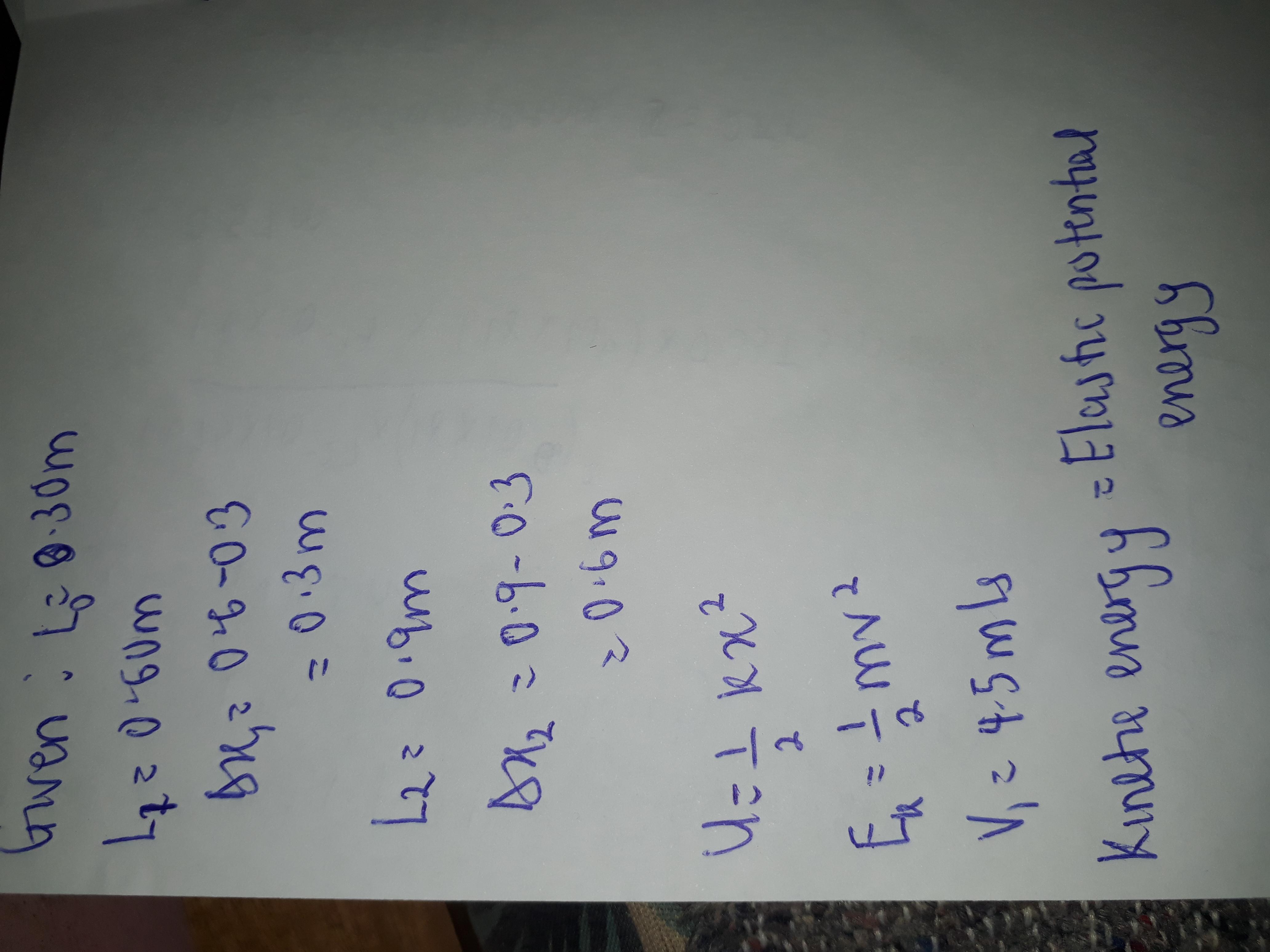
answer.
Ask question
Login Signup
Ask question
All categories
  • English
  • Mathematics
  • Social Studies
  • Business
  • History
  • Health
  • Geography
  • Biology
  • Physics
  • Chemistry
  • Computers and Technology
  • Arts
  • World Languages
  • Spanish
  • French
  • German
  • Advanced Placement (AP)
  • SAT
  • Medicine
  • Law
  • Engineering
stiks02 [169]
2 years ago
7

A tank contains 100 gal of water and 50 oz of salt.water containing a salt concentration of 1 4 (1 1 2 sin t) oz/gal flows into

the tank at a rate of 2 gal/min, and the mixture in the tank flows out at the same rate. (a) find the amount of salt in the ta

Physics
1 answer:
Alchen [17]2 years ago
3 0

Answer:

Explanation:

Heres the possible full question and solution:

A tank contains 100 gal of water and 50 oz of salt. Water containing a salt concentration of ¼ (1 + ½ sin t) oz/gal flows ito the tank at a rate of 2 gal/min, and the mixture in the tank flows out at the same rate.

a. Find the amount of salt in the tank at any time.

b. Plot the solution for a time period long enough so that you see the ultimate behavior of the graph.

c. The long-time behavior of the solution is an oscillation about a certain constant level. What is this level? What is the amplitude of the oscillation?

solution

a)

Consider the tank contains 100gal of water and 50 oz of salt

Assume that the amount of salt in the tank at time t is Q(t).

Then, the rate of change of salt in the tank is given by \frac{dQ}{dt}.

Here, \frac{dQ}{dt}=rate of liquid flowing in the tank - rate of liquid flowing out.

Therefore,

Rate_{in} =2gal/min \times \frac{1}{4} (1+ \frac{1}{2}sin t)oz/gal\\\\\\ \frac{1}{2} (1+ \frac{1}{2}sin t)oz/min\\\\\\Rate_{out}=2gal/min \times\frac{Q}{100}oz/gal\\\\\frac{Q}{50}oz/min

Therefore,

\frac{dQ}{dt} can be evaluated as shown below:

\frac{dQ}{dt}=\frac{1}{2}(1+\frac{1}{2}\sin t)-\frac{Q}{50}\\\\\\\frac{dQ}{dt}+\frac{1}{50}Q=\frac{1}{2}+\frac{1}{4}\sin t

The above differential equation is in standard form:

\frac{dy}{dt}+Py=G

Here, P=\frac{1}{50},G=\frac{1}{2}+\frac{1}{4}\sin t

The integrating factor is as follows:

\mu(t)=e^{\int {P}dt}\\\mu(t)=e^{\int {\frac{1}{50}}dt}\\\mu(t)=e^{\frac{t}{50}}

Thus, the integrating factor is  \mu(t)=e^{\frac{t}{50}}

Therefore, the general solution is as follows:

y\mu(t)=\int {\mu (t)G}dt\\\\Qe^{\frac{t}{50}}=\int {e^{\frac{t}{50}}(\frac{1}{2}+\frac{1}{4}\sin t) dt}\\\\Qe^{\frac{t}{50}}=\frac{1}{2}\int {e^{\frac{t}{50}}dt + \frac{1}{4}\int {\sin t {e^{\frac{t}{50}}} dt}\\\\\Qe^{\frac{t}{50}}=25 {e^{\frac{t}{50}} + \frac{1}{4}\int {\sin t {e^{\frac{t}{50}}} dt}+C...(1)

Here, C is arbitrary constant of integration.

Solve \int {\sin te^{\frac{t}{50}}} dt}

Here u = e^{\frac{t}{50}} and v =\sin t.

Substitute u , v in the below formula:

\int{u,v}dt=u\int{v}dt-\int\frac{du}{dt}\int{v}dt\dot dt\\\\\int {e^{\frac{t}{50}}\sin t}dt=-e^{\frac{t}{50}}\cos t + \frac{1}{50}\int{e^{\frac{t}{50}}\cos t}dt...(2)

Now, take u = e^{\frac{t}{50}}, v =\sin t

Therefore, \int{e^{\frac{t}{50}}\cos t} dt=\int {e^{\frac{t}{50}}\sin t}dt - \frac{1}{50}\int{e^{\frac{t}{50}}\sin t}dt...(3)

Use (3) in equation(2)

\int {e^{\frac{t}{50}}\sin t}dt=-e^{\frac{t}{50}}\cos t + \frac{e^{\frac{t}{50}}}{50}\sin t - \frac{1}{2500}\int{e^{\frac{t}{50}}\sin t}dt\\\\\frac{2501}{2500}\int{e^{\frac{t}{50}}\sin t}dt={e^{\frac{t}{50}}\cos t}+\frac{e^{\frac{t}{50}}}{50}\sin t\\\\\int{e^{\frac{t}{50}}\sin t}dt=\frac{2500}{2501}{e^{\frac{t}{50}}\cos t}+\frac{50}{2501}e^{\frac{t}{50}}\sin t...(4)

Use (4) in equation(l) .

Qe^{\frac{t}{50}}=25 e^{\frac{t}{50}} - \frac{625}{2501}e^{\frac{t}{50}}\cos t +\frac{25}{5002}e^{\frac{t}{50}}\sin t+C

Apply the initial conditions t =0, Q = 50.

50=25-\frac{625}{2501}+c\\\\c=\frac{63150}{2501}

So, Qe^{\frac{t}{50}}=25 e^{\frac{t}{50}} - \frac{625}{2501}e^{\frac{t}{50}}\cos t +\frac{25}{5002}e^{\frac{t}{50}}\sin t+\frac{63150}{2501}

Therefore, the amount of salt in the tank at any time is as follows:

Qe^{\frac{t}{50}}=25 e^{\frac{t}{50}} - \frac{625}{2501}e^{\frac{t}{50}}\cos t +\frac{25}{5002}e^{\frac{t}{50}}\sin t+\frac{63150}{2501}e^{\frac{-t}{50}}

b)

sketch the solution curve as shown in attachment as graph 1:

CHECK COMMENT FOR C

You might be interested in
John is going to use a rope to pull his sister Laura across the ground in a sled through the snow. He is pulling horizontally wi
bulgar [2K]

Answer:

The mass of Laura and the sled combined is 887.5 kg

Explanation:

The total force due to weight of Laura and friction on the sled can be calculated as follows;

F_T = F_L+F_S

     = (400 + 310) N

     = 710 N

From Newton's second law of motion, "the rate of change of momentum is directly proportional to the applied force.

F_T = \frac{(M_L+M_S)V}{t}

where;

M_L is mass of Laura and

M_S is mass of sled

Mass of Laura and the sled combined is calculated as follows;

(M_L+M_S) = \frac{F_T*t}{V}

given

V = Δv = 4-0 = 4m/s

t = 5 s

(M_L+M_S) = \frac{710*5}{4}\\\\(M_L+M_S) =  887.5 kg

Therefore, the mass of Laura and the sled combined is 887.5 kg

4 0
2 years ago
Compare the maximum rate of heat transfer to the basal metabolic rate by converting a bmr of 88 kcal/hr into watts. what is the
elena-14-01-66 [18.8K]

Explanation :

It is given that,

BMR i.e basal metabolic rate is 88 kcal/hr. So, BMR in watts is converted by the following :

We know that, 1 kilocalorie = 4184 joules

So, 1\ kcal/h=\dfrac{1\times 4184\ J}{3600\ sec}

1\ kcal/h=1.16\ J/sec

J/sec is nothing but watts.

So, 1\ kcal/h=1.16\ watts

and 88\ kcal/h=88\times 1.16\ watts = 102.08\ watts

So, it can be seen that the body can accommodate a modes amount of activity in hot weather but strenuous activity would increase the metabolic rate above the body's ability to remove heat.

8 0
2 years ago
An unstretched spring has a length of 0.30 m. When the spring is stretched to a total length of 0.60 m, it supports traveling wa
IceJOKER [234]

Explanation:

Below is an attachment containing the solution

7 0
2 years ago
If the current flowing through a circuit of constant resistance is doubled, the power dissipated by that circuit willa) decrease
slega [8]

Answer:

c) quadruple in magnitude

Explanation:

The power dissipated in the circuit is given by:

P=I^2 R

where

I is the current in the circuit

R is the total resistance of the circuit

In this problem:

- The current is doubled: I' = 2 I

- The resistance is kept constant: R' = R

So, the power dissipated is

P' = (I')^2 R' = (2I)^2 R=4 I^2 R=4 P

so, the power dissipated increase by a factor 4 (quadruples).

5 0
2 years ago
Three particles are moving perpendicular to a uniform magnetic field and travel on circular paths (see the drawing). They have t
Vaselesa [24]

Explanation:

Radius of a charged particle is given by

r=mv / Bq

= k/ q

where   k   =   m v / B         is a constant.

i.e.   more is the magnitude of  charge, less is the radius. (inversely proportional)

From the diagram  r_3   >   r_2   >   r_1  (more the curvature, less is the radius)

( although drawing is not given i am assuming the above order, however, one can change the order as per the diagram. The concept used remains the same)

therefore,    q_1   >   q_2   >   q_3 .

7 0
2 years ago
Other questions:
  • A hockey puck with a mass of 0.16 kg is sitting at rest on a frozen pond. Suddenly, the wind begins to blow, accelerating the pu
    6·2 answers
  • A kayaker needs to paddle north across a 100-m-wide harbor. the tide is going out, creating a tidal current that flows to the ea
    14·2 answers
  • For an object starting from rest and accelerating with constant acceleration, distance traveled is proportional to the square of
    8·1 answer
  • What can happen to an electron when sunlight hits it? select all that apply. select all that apply. it can drop down to a lower
    5·2 answers
  • You and your friend throw balloons filled with water from the roof of a several story apartment house. You simply drop a balloon
    6·1 answer
  • Two objects, X and Y, move toward one another and eventually collide. Object X has a mass of 2M and is moving at a speed of 2v0
    7·1 answer
  • Two ropes in a vertical plane exert equal-magnitude forces on a hanging weight but pull with an angle of 72.0° between them. Wha
    6·1 answer
  • A uniform magnetic field makes an angle of 30o with the z axis. If the magnetic flux through a 1.0 m2 portion of the xy plane is
    15·1 answer
  • An astronaut working with many tools some distance away from a spacecraft is stranded when the "maneuvering unit" malfunctions.
    11·1 answer
  • Two identical metal balls are rolling without slipping along a horizontal surface with speed V. Each ball encounters a hill ('tw
    6·1 answer
Add answer
Login
Not registered? Fast signup
Signup
Login Signup
Ask question!