answer.
Ask question
Login Signup
Ask question
All categories
  • English
  • Mathematics
  • Social Studies
  • Business
  • History
  • Health
  • Geography
  • Biology
  • Physics
  • Chemistry
  • Computers and Technology
  • Arts
  • World Languages
  • Spanish
  • French
  • German
  • Advanced Placement (AP)
  • SAT
  • Medicine
  • Law
  • Engineering
ivann1987 [24]
2 years ago
6

A hockey puck with a mass of 0.16 kg is sitting at rest on a frozen pond. Suddenly, the wind begins to blow, accelerating the pu

ck across the ice at 625 m/s2. If friction is ignored, the force of the wind can be calculated to be _______.
A. 625.16 N
B. 100 N
C. 3,906 N
D. 0.000256 N
Physics
2 answers:
lions [1.4K]2 years ago
5 0

YES THE ANSWER IS B 100 N THX TO U I GOT IT RIGHT


cricket20 [7]2 years ago
3 0
The answer is B 100n
You might be interested in
You are provided with three polarizers with filters making angles of (A) 90 ​∘ ​​ , (B) 180 ​∘ ​​ and (C) −45 ​∘ ​​ with respect
irinina [24]

Answer:

Order of maximum transmission of the polarizer is A, C and B.

Solution:

As per the question:

For the first polarizer, the angle is quite insignificant:

(A) 90^{\circ}:

The light intensity after passing through the first polarizer is I_{o} and this intensity does not depend on the angle of the polarizer.

Consider 90^{\circ} with the vertical, the intensity is given by:

I = I_{o}cos^{2}90^{\circ}

I = I_{o}cos(2(45^{\circ})) = I_{o}(\frac{1+cos90^{\circ})}{2} = \frac{I_{o}}{2}

(B) 180^{\circ}:

Suppose the second polarizer is  45^{\circ} with the vertical.

Now, intensity through the second polarizer:

I' = Icos^{2}(\theta_{2} - \theta_{1}) = \frac{I_{o}}{2}cos^{2}(- 45 - 90)

I' =  \frac{I_{o}}{2}cos^{2}135^{\circ} = \frac{I_{o}}{4}

Now, if we consider the second polarizer to be 180^{\circ},

I' = \frac{I_{o}}{2}cos^{2}180^{\circ} = \frac{I_{o}}{2}cos^{2}(180^{\circ} - 90^{\circ}) = 0

(C) - 45^{\circ}:

Now,

Intensity through the third polarizer, if it is 180^{\circ} with the vertical:

I' = Icos^{2}(\theta_{2} - \theta_{1}) = \frac{I_{o}}{2}cos^{2}(180 - (- 45))

I' = \frac{I_{o}}{8}

5 0
2 years ago
Your friend says, “chemical changes are caused by an input in energy. In physical changes, there is no transfer of energy” is yo
nalin [4]

Answer:

Ok, let's suppose the simplest of the physical changes:

We have an object that is not moving (so it is not accelerated)

and there is change, now the object moves.

Because there was a change, means that there was an acceleration, and by the second Newton's law.

Force equals mass times acceleration:

F = m*a

There must be a force.

So suppose that you pushed the object, then some energy that you had, you transferred it to the object, that now is moving and now has kinetic energy.

Now, is kinda true that in a closed system the total energy is always constant, but it depends on what is our system.

So if we think in our system as you and the object, then in the whole system the energy does not change because the energy that you lost is now on the object, but again, there was a transfer of energy.

So no, your friend is not correct.

3 0
2 years ago
A 90° elbow in a horizontal pipe is used to direct water flow upward at a rate of 40 kg/s. The diameter of the entire elbow is 1
tekilochka [14]

Answer:

(a) The gauge pressure is 4,885.3 Pa

(b) The anchoring force needed to hold the elbow in place is approximately 296.5 N

The direction of the anchoring force is approximately ≈ 134.8

Explanation:

The given parameters in the fluid dynamics question are;

Pipe elbow angle, θ = 90°

The mass flowrate of the water, \dot m = 40 kg/s

The diameter of the elbow, D = 10 cm

The pressure at the point of discharge of the fluid = Atmospheric pressure

The elevation between the inlet and exit of the elbow, z = 50 cm

The weight of the elbow and the water = Negligible

(a) The velocity of the fluid, v₁ = v₂ = v is given as follows;

ρ·v·A = \dot m

v = \dot m/(ρ·A)

Where;

ρ = The density of the fluid (water) = 997 kg/m³

A = The cross-sectional area of the of the elbow = π·D²/4 = π×0.1²/4 ≈ 0.00785398163

A = 0.00785398163 m²

v = 40 kg/s/(0.00785398163 m² × 997 kg/m³) ≈ 5.1083 m/s

Bernoulli's equation for the flow of fluid is presented as follows;

\dfrac{P_1}{\rho \cdot g} +\dfrac{v_1}{2 \cdot g} + z_1 = \dfrac{P_2}{\rho \cdot g} +\dfrac{v_2}{2 \cdot g} + z_2

v₁ = v₂ for the elbow of uniform cross section

P₁ - P₂ = ρ·g·(z₂ - z₁)

P₁ - P₂ = The gauge pressure = P_{gauge}

z₂ - z₁ = z = 50 cm = 0.5 m

∴ P_{gauge} = 997 kg/m³ × 9.8 m/s² × 0.5 m = 4,885.3 Pa

The gauge pressure, P_{gauge} = 4,885.3 Pa

(b) The forces acting on the elbow are;

F_{Rx} + P_{gauge}·A = -β·\dot m·v

F_{Ry}  = β·\dot m·v

∴ F_{Rx}  = -β·\dot m·v -  P_{gauge}·A

F_{Rx}  = -1.03 × 40 kg/s × 5.1083 m/s -  4,885.3 Pa × 0.00785398163 m² ≈ -208.83 N

F_{Ry}  = 1.03 × 40 kg/s × 5.1083 m/s = 210.46196 N

The resultant force, F_R, is given as follows;

F_R = √(F_{Rx}² + F_{Rz}²)

∴ F_R = √((-208.83)² + (210.46196)²) ≈ 296.486433934

Therefore;

The anchoring force needed to hold the elbow in place, F_R ≈ 296.5 N

The direction of the anchoring force, θ

\theta = tan^{-1}\left( \dfrac{F_{Ry}}{F_{Rx}} \right)

∴ θ = arctan(210.46196/(-208.83)) = -45..2230044°

θ = 180° + -45.2230044° = 134.7769956°

∴ The direction of the anchoring force is approximately, θ ≈ 134.8°

7 0
2 years ago
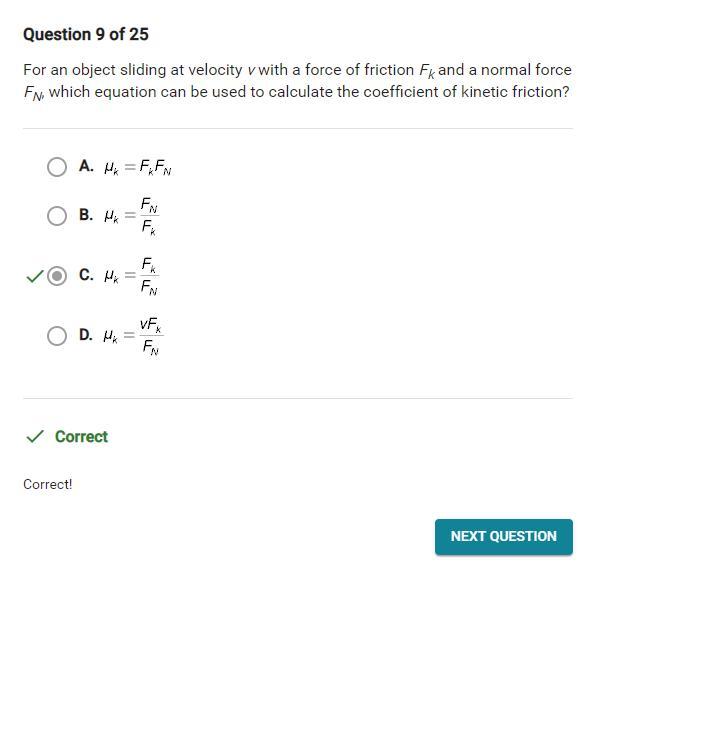
For an object sliding at velocity v with a force of friction Fk and a normal force FNs which equation can be usedto calculate th
musickatia [10]

Answer:

C.

Explanation:

Apex says so

7 0
2 years ago
Your heart pumps 80 g of blood with each beat. The blood starts from rest and reaches a speed of 0.60 m/s in the aorta. If each
Gala2k [10]

Answer:

d. 0.3 N

Explanation:

Force: This is defined as the product of mass of a body and its acceleration.

The S.I unit of Force is Newton (N).

Mathematically Force can be represented as,

F = ma .................. Equation 1

Where F = force, m = mass, a = acceleration.

also

a = (v-u)/t............... Equation 2

Where v = final velocity, u = initial velocity, t = time.

Given: v = 0.60 m/s, u = 0 m/s ( From rest), t= 0.16 s.

Substitute into equation 2

a = (0.60-0)/0.16

a = 3.75 m/s²

Also given: m = 80 g = 0.08 kg.

Substitute into equation 1,

F = 0.08(3.75)

F = 0.3 N.

Hence he average force = 0.3 N

The right option is d. 0.3 N

6 0
2 years ago
Other questions:
  • What do wind turbines, hydroelectric dams, and ethanol plants have in common?
    7·2 answers
  • Which best explains why infrared waves are ineffective for treating cancer ?
    14·2 answers
  • A proton travels at right angles through a magnetic field of 0.025 teslas. If the magnitude of the magnetic force on the proton
    12·1 answer
  • When boiling water, a hot plate takes an average of 8 minutes and 55 seconds to boil 100 milliliters of water. Assume the temper
    10·1 answer
  • Find an expression for the torsional constant k in terms of the moment of inertia I of the disk and the angular frequency ω of s
    10·1 answer
  • Finally, you are ready to answer the main question. Cheetahs, the fastest of the great cats, can reach 50.0 miles/hourmiles/hour
    8·1 answer
  • Floor lamps usually have a base with large inertia, while the long body and top have much less inertia. Part A If you want to sh
    6·1 answer
  • A square loop of wire has a perimeter of 4.00 mm and is oriented such that two of its parallel sides form a 13.0 ∘∘ angle with t
    5·1 answer
  • A wire of 5.8m long, 2mm diameter carries 750ma current when 22mv potential difference is applied at its ends. if drift speed of
    10·2 answers
  • A balky cow is leaving the barn as you try harder and harder to push her back in. In coordinates with the origin at the barn doo
    10·1 answer
Add answer
Login
Not registered? Fast signup
Signup
Login Signup
Ask question!