answer.
Ask question
Login Signup
Ask question
All categories
  • English
  • Mathematics
  • Social Studies
  • Business
  • History
  • Health
  • Geography
  • Biology
  • Physics
  • Chemistry
  • Computers and Technology
  • Arts
  • World Languages
  • Spanish
  • French
  • German
  • Advanced Placement (AP)
  • SAT
  • Medicine
  • Law
  • Engineering
pychu [463]
2 years ago
10

Air enters a compressor operating at steady state at 176.4 lbf/in.^2, 260°F with a volumetric flow rate of 424 ft^3/min and exit

s at 15.4 lbf/in.^2, 80°F. Heat transfer occurs at a rate of 6800 Btu/h from the compressor to its surroundings. Assuming the ideal gas model for air and neglecting kinetic and potential energy effects, determine the power input, in hp
Engineering
1 answer:
Lera25 [3.4K]2 years ago
6 0

Answer:

W_s  = 283.181 hp

Explanation:

Given that:

Air enters a compressor operating at steady state at a pressure P_1 =  176.4 lbf/in.^2  and Temperature T_1 at 260°F

Volumetric flow rate V = 424 ft^3/min

Air exits at a pressure P_2  = 15.4 lbf/in.^2 and Temperature T_2 at 80°F.

Heat transfer occurs at a rate of 6800 Btu/h from the compressor to its surroundings; since heat is released to the surrounding; then:

Q_{cv} = -6800 Btu/h  = - 1.9924 kW

Using the steady  state  energy in the process;

h_2 - h_1 + g(z_2-z_1)+ \dfrac{1}{2}(v^2_2-v_1^2) = \dfrac{Q_{cv}}{m}- \dfrac{W_s}{m}

where;

g(z_2-z_1) =0  and  \dfrac{1}{2}(v^2_2-v_1^2) = 0

Then; we have :

h_2 - h_1 = \dfrac{Q_{cv}}{m}- \dfrac{W_s}{m}

h_2 - h_1 = \dfrac{Q_{cv} - W_s}{m}

{m}(h_2 - h_1) ={Q_{cv} - W_s}

W_s  ={Q_{cv} + {m}(h_2 - h_1) ----- (1)

Using the relation of Ideal gas equation;

P₁V₁ = mRT₁

Pressure P_1 =  176.4 lbf/in.^2   = ( 176.4 ×  6894.76 ) N/m² = 1216235.664 N/m²

Volumetric flow rate V = 424 ft^3/min = (424 ×  0.0004719) m³  /sec

= 0.2000856 m³  /sec

Temperature = 260°F = (260°F − 32) × 5/9 + 273.15 = 399.817 K

Gas constant R=287 J/kg K

Then;

1216235.664 N/m² × 0.2000856 m³  /sec = m × 287 J/kg K × 399.817 K

m = \dfrac { 1216235.664 N/m^2 \times 0.2000856 m^3  /sec  } {287 J/kg K \times 399.817 K  }

m = 2.121 kg/sec

The change in enthalpy:

m(h_1-h_2) =  m * C_p * \Delta T= m* C_p * ( T_1 -T_2)

= 2.121* 1.005* ( 399.817 -299.817)

= 213.1605 kW

From (1)

W_s  ={Q_{cv} + {m}(h_2 - h_1)

W_s  =  - 1.9924 kW + 213.1605 kW

W_s  = 211.1681  kW

W_s  = 283.181 hp

The power input is W_s  = 283.181 hp

You might be interested in
Effects of biological hazards are widespread. Select the answer options which describe potential effects of coming into contact
s2008m [1.1K]

Answer:

- Allergic Reactions

- Life Threatinging Events

Explanation:

Sources of biological hazards may include bacteria, viruses, insects, plants, birds, animals, and humans. These sources can cause a variety of health effects ranging from skin irritation and allergies to infections (e.g., tuberculosis, AIDS), cancer and so on.

7 0
2 years ago
A four-cylinder, four-stroke internal combustion engine has a bore of 3.7 in. and a stroke of 3.4 in. The clearance volume is 16
abruzzese [7]

Answer:

1) The three possible assumptions are

a) All processes are reversible internally

b) Air, which is the working fluid circulates continuously in a closed loop

cycle

c) The process of combustion is depicted as a heat addition process

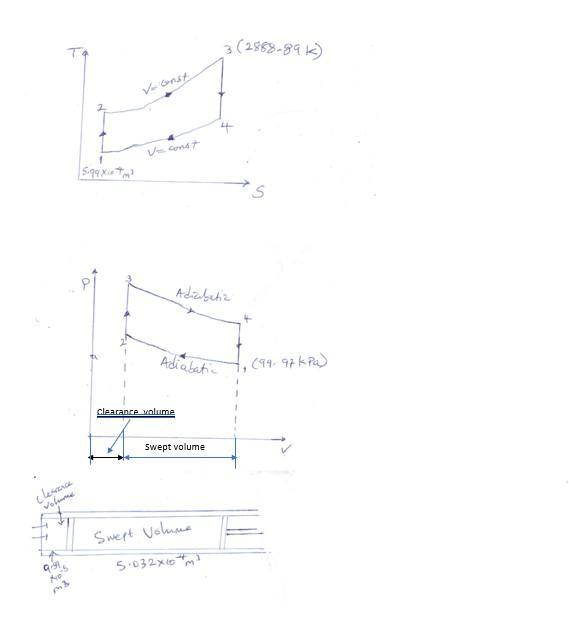
2) The diagrams are attached

5) The net work per cycle is 845.88 kJ/kg

The power developed in horsepower ≈ 45374 hP

Explanation:

1) The three possible assumptions are

a) All processes are reversible internally

b) Air, which is the working fluid circulates continuously in a closed loop

cycle

c) The process of combustion is depicted as a heat addition process

2) The diagrams are attached

5) The dimension of the cylinder bore diameter = 3.7 in. = 0.09398 m

Stroke length = 3.4 in. = 0.08636 m.

The volume of the cylinder v₁= 0.08636 ×(0.09398²)/4 = 5.99×10⁻⁴ m³

The clearance volume = 16% of cylinder volume = 0.16×5.99×10⁻⁴ m³

The clearance volume, v₂  = 9.59 × 10⁻⁵ m³

p₁ = 14.5 lbf/in.² = 99973.981 Pa

T₁ = 60 F = 288.706 K

\dfrac{T_{2}}{T_{1}} = \left (\dfrac{v_{1}}{v_{2}}  \right )^{K-1}

Otto cycle T-S diagram

T₂ = 288.706*6.25^{0.393} = 592.984 K

The maximum temperature = T₃ = 5200 R = 2888.89 K

\dfrac{T_{3}}{T_{4}} = \left (\dfrac{v_{4}}{v_{3}}  \right )^{K-1}

T₄ = 2888.89 / 6.25^{0.393} = 1406.5 K

Work done, W = c_v×(T₃ - T₂) - c_v×(T₄ - T₁)

0.718×(2888.89  - 592.984) - 0.718×(1406.5 - 288.706) = 845.88 kJ/kg

The power developed in an Otto cycle = W×Cycle per second

= 845.88 × 2400 / 60  = 33,835.377 kW = 45373.99 ≈ 45374 hP.

8 0
2 years ago
A woman approaches a room attendant with a letter. She requests that the attendant leave the letter in Room 1201. Which is the m
MrRa [10]
Attendant politely refused
8 0
2 years ago
A joining process in which a filler metal is melted and distributed by capillary action between faying surfaces, the base metals
PolarNik [594]

Answer:

A soldering process

Explanation:

Given that ,The filler metal's melting point temperature is less than 450 ° C.

Usually, the brazing material has the liquid temperature of the melting point, the full melting point of the filler material approaching 450 degrees centigrade, while the filler material is less than 450 degrees centigrade in the case of soldering.

Therefore the answer is "A soldering process".

4 0
2 years ago
Water (cp = 4180 J/kg·°C) enters the 2.5 cm internal diameter tube of a double-pipe counter-flow heat exchanger at 17°C at a rat
aksik [14]

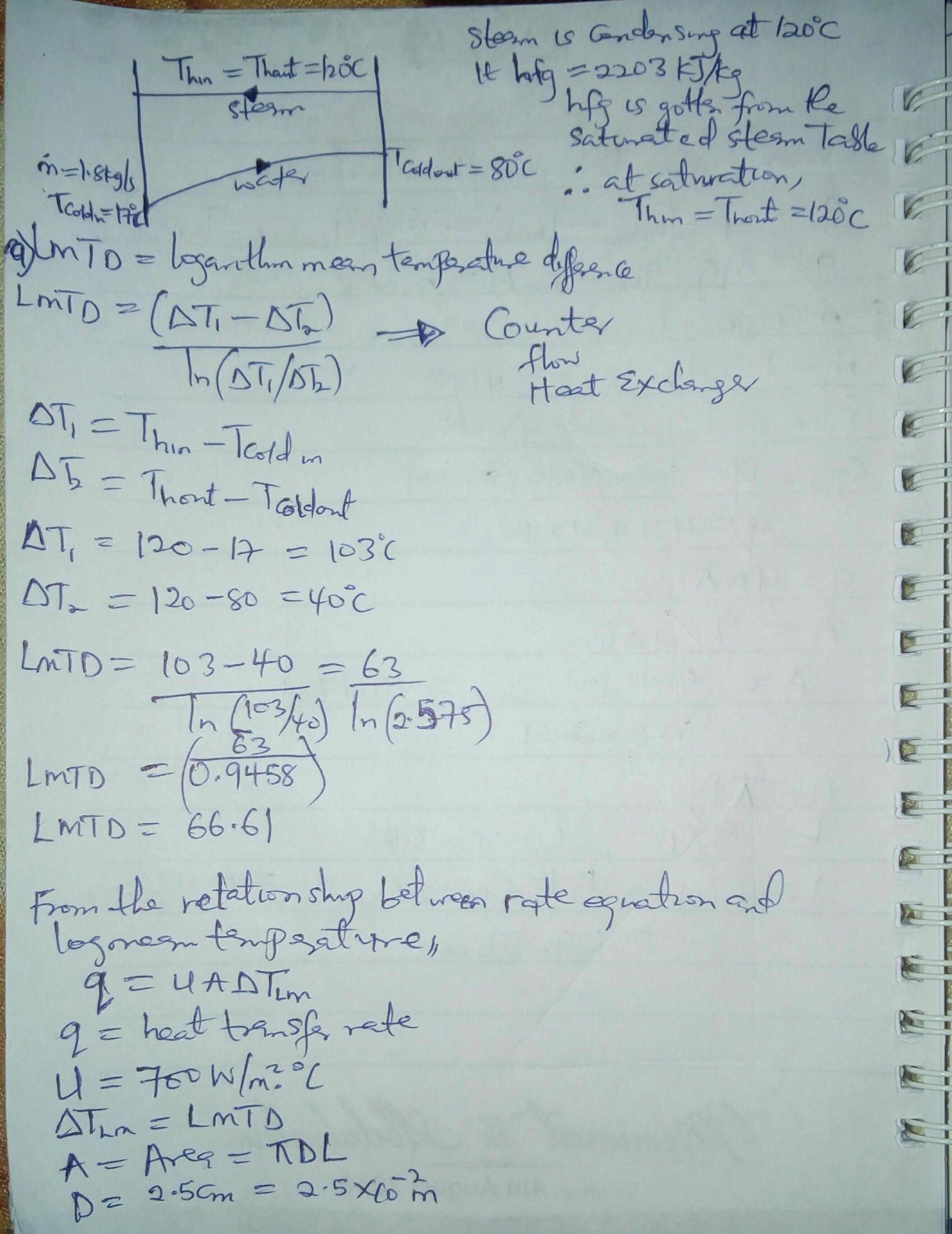
Answer:

Length = 129.55m, 129.55m

Explanation:

Given:

cp of water = 4180 J/kg·°C

Diameter, D = 2.5 cm

Temperature of water in =  17°C

Temperature of water out = 80°C

mass rate of water =1.8 kg/s.

Steam condensing at 120°C

Temperature at saturation = 120°C

hfg of steam at 120°C = 2203 kJ/kg

overall heat transfer coefficient of the heat exchanger = 700 W/m2 ·°C

U = 700 W/m2 ·°C

Since Temperature of steam is at saturation,

temperature of steam going in = temperature of steam out = 120°C

Energy balance:

Heat gained by water = Heat loss by steam

Let specific capacity of steam = 2010kJ/Kg .°C

Find attached the full solution to the question.

3 0
2 years ago
Other questions:
  • Define a named tuple Player that describes an athlete on a sports team. Include the fields name, number, position, and team.
    15·1 answer
  • Write multiple if statements
    5·1 answer
  • 3. A 4-m × 5-m × 7-m room is heated by the radiator of a steam-heating system. The steam radiator transfers heat at a rate of 10
    9·1 answer
  • What does the following program segment do? Declare Count As Integer Declare Sum As Integer Set Sum = 0 For (Count = 1; Count &l
    15·1 answer
  • Show that a chirped Gaussian pulse is compressed initially inside a single-mode fiber when ftC < 0. Derive expressions for th
    12·1 answer
  • A gas stream flowing at 1000 cfm with a particulate loading of 400 gr/ft3 discharges from a certain industrial plant through an
    8·1 answer
  • Block D of the mechanism is confined to move within the slot of member CB. Link AD is rotating at a constant rate of ωAD = 6 rad
    11·1 answer
  • A 35-pound force is applied to a 3-inch cylinder with a 6-inch stroke. What is the power produced by the cylinder that moves its
    7·1 answer
  • A shaft consisting of a steel tube of 50-mm outer diameter is to transmit 100 kW of power while rotating at a frequency of 34 Hz
    7·1 answer
  • Technician A says that the carpet padding is designed to help reduce noise and vibrations.
    5·1 answer
Add answer
Login
Not registered? Fast signup
Signup
Login Signup
Ask question!