answer.
Ask question
Login Signup
Ask question
All categories
  • English
  • Mathematics
  • Social Studies
  • Business
  • History
  • Health
  • Geography
  • Biology
  • Physics
  • Chemistry
  • Computers and Technology
  • Arts
  • World Languages
  • Spanish
  • French
  • German
  • Advanced Placement (AP)
  • SAT
  • Medicine
  • Law
  • Engineering
Delvig [45]
2 years ago
11

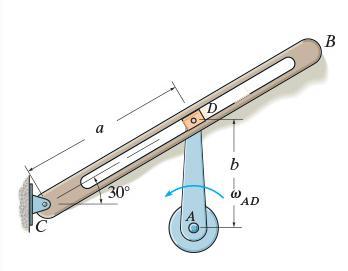
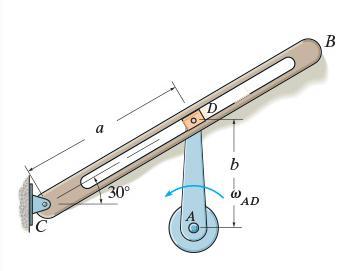
Block D of the mechanism is confined to move within the slot of member CB. Link AD is rotating at a constant rate of ωAD = 6 rad

/s measured counterclockwise. Suppose that a = 350 mm , b = 2001)Determine the angular velocity of member CB at the instant shown measured counterclockwise.
2)Determine the angular acceleration of member CB at the instant shown measured counterclockwise.

Engineering
1 answer:
svet-max [94.6K]2 years ago
4 0

Answer:

1) 1.71 rad/s

2) -6.22 rad/s²

Explanation:

Choose point C to be the origin.

Using geometry, we can show that the coordinates of point A are:

(a cos 30°, a sin 30° − b)

Therefore, the coordinates of point D at time t are:

(a cos 30° − b sin(ωt), a sin 30° − b + b cos(ωt))

The angle formed by CB with the x-axis is therefore:

tan θ = (a sin 30° − b + b cos(ωt)) / (a cos 30° − b sin(ωt))

1) Taking the derivative with respect to time, we can find the angular velocity:

sec² θ dθ/dt = [(a cos 30° − b sin(ωt)) (-bω sin(ωt)) − (a sin 30° − b + b cos(ωt)) (-bω cos(ωt))] / (a cos 30° − b sin(ωt))²

sec² θ dθ/dt = -bω [(a cos 30° − b sin(ωt)) sin(ωt) − (a sin 30° − b + b cos(ωt)) cos(ωt)] / (a cos 30° − b sin(ωt))²

sec² θ dθ/dt = -bω [(a cos 30° sin(ωt) − b sin²(ωt)) − (a sin 30° cos(ωt) − b + b cos²(ωt))] / (a cos 30° − b sin(ωt))²

sec² θ dθ/dt = -bω (a cos 30° sin(ωt) − b sin²(ωt) − a sin 30° cos(ωt) + b − b cos²(ωt)) / (a cos 30° − b sin(ωt))²

sec² θ dθ/dt = -bω (a cos 30° sin(ωt) − a sin 30° cos(ωt)) / (a cos 30° − b sin(ωt))²

sec² θ dθ/dt = -abω (cos 30° sin(ωt) − sin 30° cos(ωt)) / (a cos 30° − b sin(ωt))²

We know at the moment shown, a = 350 mm, b = 200 mm, θ = 30°, ω = 6 rad/s, and t = 0 s.

sec² 30° dθ/dt = -(350) (200) (6) (cos 30° sin(0) − sin 30° cos(0)) / (350 cos 30° − 200 sin(0))²

sec² 30° dθ/dt = -(350) (200) (6) (-sin 30°) / (350 cos 30°)²

dθ/dt = (200) (6) (1/2) / 350

dθ/dt = 600 / 350

dθ/dt = 1.71 rad/s

2) Taking the second derivative of θ with respect to time, we can find the angular acceleration.

sec² θ d²θ/dt² + 2 sec² θ tan θ dθ/dt = -abω [(a cos 30° − b sin(ωt))² (ω cos 30° cos(ωt) + ω sin 30° sin(ωt)) − (cos 30° sin(ωt) − sin 30° cos(ωt)) (2 (a cos 30° − b sin(ωt)) (-bω cos(ωt)))] / (a cos 30° − b sin(ωt))⁴

At t = 0:

sec² θ d²θ/dt² + 2 sec² θ tan θ dθ/dt = -abω [(a cos 30°)² (ω cos 30°) − (0 − sin 30°) (2 (a cos 30°) (-bω))] / (a cos 30°)⁴

sec² θ d²θ/dt² + 2 sec² θ tan θ dθ/dt = -abω (a²ω cos³ 30° − 2abω sin 30° cos 30°) / (a⁴ cos⁴ 30°)

sec² θ d²θ/dt² + 2 sec² θ tan θ dθ/dt = -bω (aω cos² 30° − 2bω sin 30°) / (a² cos³ 30°)

d²θ/dt² + 2 tan θ dθ/dt = -bω² (a cos² 30° − b) / (a² cos 30°)

Plugging in values:

d²θ/dt² + 2 tan 30° dθ/dt = -(200) (6)² (350 cos² 30° − 200) / (350² cos 30°)

d²θ/dt² + 2 tan 30° dθ/dt = -7200 (262.5 − 200) / (350² cos 30°)

d²θ/dt² + 2 tan 30° (1.71) = -4.24

d²θ/dt² = -6.22 rad/s²
You might be interested in
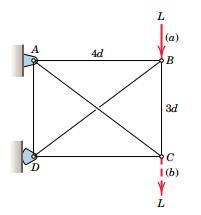
The rectangular frame is composed of four perimeter two-force members and two cables AC and BD which are incapable of supporting
Rama09 [41]

Answer:

Your question is lacking some information attached is the missing part and the solution

A) AB = AD = BD = 0, BC = LC

    AC = \frac{5L}{3}T, CD = \frac{4L}{3} C

B) AB = AD = BC = BD = 0

   AC = \frac{5L}{3} T, CD = \frac{4L}{3} C

Explanation:

A) Forces in all members due to the load L in position A

assuming that BD goes slack from an inspection of Joint B

AB = 0 and BC = LC from Joint D, AD = 0 and CD = 4L/3 C

B) steps to arrive to the answer is attached below

AB = AD = BC = BD = 0

AC = \frac{5L}{3} T,  CD = \frac{4L}{3}C

7 0
2 years ago
When leveraging Artificial Intelligence (AI) in today's business landscape, which statement represents the data leveraged for so
adoni [48]

Answer:

Some AI could end up taking the jobs of many humans.

Explanation:

Their intelligence exponentially grows and human intelligence grows gradually, causing more ideas and better work efficiency from AI.

8 0
2 years ago
An automobile having a mass of 900 kg initially moves along a level highway at 100 km/h relative to the highway. It then climbs
creativ13 [48]

Answer:

ΔKE=-347.278 kJ

ΔPE= 441.45 kJ

Explanation:

given:

mass m=900 kg

the gravitational acceleration g=9.81 m/s^2

the initial velocity V_{1}=100 km/h-->100*10^3/3600=27.78 m/s

height above the highway h=50 m

h1=0m

the final velocity V_{F}=0 m/s

<u>To find:</u>

the change in kinetic energy ΔKE

the change in potential energy ΔPE

<u>assumption:</u>

We take the highway as a datum

<u>solution:</u>

ΔKE=5*m*(V_{F}^2-V_{1}^2)

      =-347.278 kJ

ΔPE=m*g*(h-h1)

      = 441.45 kJ

5 0
2 years ago
The legend that Benjamin Franklin flew a kite as a storm approached is only a legend—he was neither stupid nor suicidal. Suppose
Delicious77 [7]

Answer: 0.93 mA

Explanation:

In order to calculate the current passing through the water layer, as we have the potential difference between the ends of the string as a given, assuming that we can apply Ohm’s law, we need to calculate the resistance of the water layer.

We can express the resistance as follows:

R = ρ.L/A

In order to calculate the area A, we can assume that the string is a cylinder with a circular cross-section, so the Area of the water layer can be written as follows:

A= π(r22 – r12) = π( (0.0025)2-(0.002)2 ) m2 = 7.07 . 10-6 m2

Replacing by the values, we get R as follows:

R = 1.4 1010 Ω

Applying Ohm’s Law, and solving for the current I:

I = V/R = 130 106 V / 1.4 1010 Ω = 0.93 mA

7 0
2 years ago
6.28 A six-lane freeway (three lanes in each direction) in rolling terrain has 10-ft lanes and obstructions 4 ft from the right
dimulka [17.4K]

Answer:

Assume Base free flow speed (BFFS) = 70 mph

Lane width = 10 ft

Reduction in speed corresponding to lane width, fLW = 6.6 mph

Lateral Clearance = 4 ft

Reduction in speed corresponding to lateral clearance, fLC = 0.8 mph

Interchanges/Ramps = 9/ 6 miles = 1.5 /mile

Reduction in speed corresponding to Interchanges/ramps, fID = 5 mph

No. of lanes = 3

Reduction in speed corresponding to number of lanes, fN = 3 mph

Free Flow Speed (FFS) = BFFS – fLW – fLC – fN – fID = 70 – 6.6 – 0.8 – 3 – 5 = 54.6 mph

Peak Flow, V = 2000 veh/hr

Peak 15-min flow = 600 veh

Peak-hour factor = 2000/ (4*600) = 0.83

Trucks and Buses = 12 %

RVs = 6 %

Rolling Terrain

fHV = 1/ (1 + 0.12 (2.5-1) + 0.06 (2.0-1)) = 1/1.24 = 0.806

fP = 1.0

Peak Flow Rate, Vp = V / (PHV*n*fHV*fP) = 2000/ (0.83*3*0.806*1.0) = 996.54 ~ 997 veh/hr/ln

Vp < (3400 – 30 FFS)

S = FFS

S = 54.6 mph

Density = Vp/S = (997) / (54.6) = 18.26 veh/mi/ln

7 0
2 years ago
Other questions:
  • Show that a chirped Gaussian pulse is compressed initially inside a single-mode fiber when ftC &lt; 0. Derive expressions for th
    12·1 answer
  • Air whose density is 0.082 lbm/ft3 enters the duct of an air-conditioning system at a volume flow rate of 450 ft3/min. If the di
    8·2 answers
  • 6.8.1: Function pass by pointer: Transforming coordinates. Define a function CoordTransform() that transforms its first two inpu
    9·1 answer
  • 15. A cold-chamber die-casting machine operates automatically, supported by two industrial robots.The machine produces two zinc
    9·2 answers
  • The molecular weight of a 10g rubber band
    12·1 answer
  • A pair of spur gears with 20 degree pressure angle, full-depth, involute teeth transmits 65 hp. The pinion is mounted on a shaft
    5·1 answer
  • A three-phase line has an impedance of 0.4 j2.7 ohms per phase. The line feeds two balanced three-phase loads that are connected
    9·1 answer
  • A spring-loaded toy gun is used to shoot a ball of mass m = 1.50 kg straight up in the air. The spring has spring constant k = 6
    13·1 answer
  • What are practical considerations you might encounter when you increase the moment of inertia (I) while keeping the cross-sectio
    13·1 answer
  • 1. A _____ is applied to a wall or roof rafters to add strength and keep the building straight and plumb.
    9·1 answer
Add answer
Login
Not registered? Fast signup
Signup
Login Signup
Ask question!